How to Outsource SEO Without Losing Your Rankings
How to Outsource SEO Without Losing Your Rankings Rankings don’t...
Read More →
A page can rank well and still be skipped by the answer sitting above it. AI SEO is the work of making sure your business is part of that answer, and still worth the click when someone follows the link.

AI SEO is the practice of improving how your website, content, and brand can be discovered, understood, represented, and potentially cited across AI-powered search and answer experiences, while keeping the fundamentals classic search depends on. For Google specifically, the documented eligibility rules are ordinary Search fundamentals, not a separate AI-specific ranking system.
For businesses, optimizing content for AI searches comes down to five habits:
The term “AI SEO” is also used for using AI tools to do SEO work. This guide focuses on the first meaning and covers the second briefly near the end.
Methodology:This guide draws on Google Search Central’s documentation on AI features and your website, Google’s Search Console Help page for the Generative AI performance report, Google Analytics Help’s default channel group definitions, Pew Research Center’s July 2025 browsing study, and Forrester’s January 2026 buyer-insights research, alongside recurring AI-search patterns Growzify observes in client work. Pew’s data reflects U.S. browsing in March 2025, so treat it as directional.
Search behavior changes when an answer appears before the links.Pew Research Center’s July 2025 studytracked the browsing of 900 U.S. adults in March 2025. It found that users clicked a traditional result link in 8% of visits when an AI summary appeared, compared with 15% of visits when it didn’t. Users clicked a link inside the AI summary itself in just 1% of visits to pages that had one.
That’s one study, one country, and one month, and Google’s AI features have kept changing since. It’s best read as a signal, not a forecast.
Buying behavior is moving too. Forrester’s January 2026 research, based on its 2025 Buyers’ Journey Survey of nearly 18,000 global business buyers, says generative AI searches are a starting point for B2B buyers. It also warns that AI search tools often return incomplete or unreliable information, which creates mistrust.
Taken together, the picture is practical rather than dramatic:
In Growzify’s experience, that makes two jobs matter. Your content has to be easy to find, understand, and verify, and it has to hold up as the page a buyer trusts once they land.
You’ll see several overlapping terms. None has an official definition, and practitioners use it differently. Growzify uses AI SEO service as the umbrella.
| Term | Common meaning | Main focus |
| AI SEO | Optimizing for AI-powered search while keeping classic SEO strong | The whole program |
| AEO (answer engine optimization) | Structuring content so a direct answer can be extracted from the page | Clear questions and short, direct answers |
| GEO (generative engine optimization) | Making content usable in generated answers | Source usefulness and brand representation |
| LLM optimization | Improving how a brand or topic is represented across LLM-based experiences | Entity clarity, source coverage, factual consistency, and third-party representation |
aThese are common practitioner definitions, not standards.
AI SEO also has two meanings that are easy to mix up:
The two can overlap, but they answer different questions. One asks how you appear in AI answers. The other asks how you work faster.

Google’s documentation is more modest than much of the industry commentary.Google’s guide to AI features and your websitesays a page must be indexed and eligible to appear in Search with a snippet to be shown as a supporting link. It also states there are no additional requirements to appear in AI Overviews or AI Mode, and no other special optimizations are necessary.
The same page lists foundational practices:
It also says these features may use “query fan-out,” issuing multiple related searches across subtopics and data sources. And it explains that site owners can limit what’s shown with controls such as nosnippet, data-nosnippet, max-snippet, and noindex.
Here’s Growzify’s reading, and it’s an interpretation, not a Google claim. For Google’s features, AI SEO is mostly strong fundamentals plus content that’s clear and easy to verify. There’s no secret markup to add.
That documentation covers Google only. Other AI platforms use their own retrieval and source systems, so don’t assume one playbook works the same everywhere.
For Google, start with ordinary Search eligibility and people-first SEO fundamentals. Then improve the clarity, factual consistency, evidence, and self-contained usefulness of your important content.
For broader AI platforms, measure brand mentions, citations, and referral traffic separately, because their retrieval and selection systems aren’t identical.
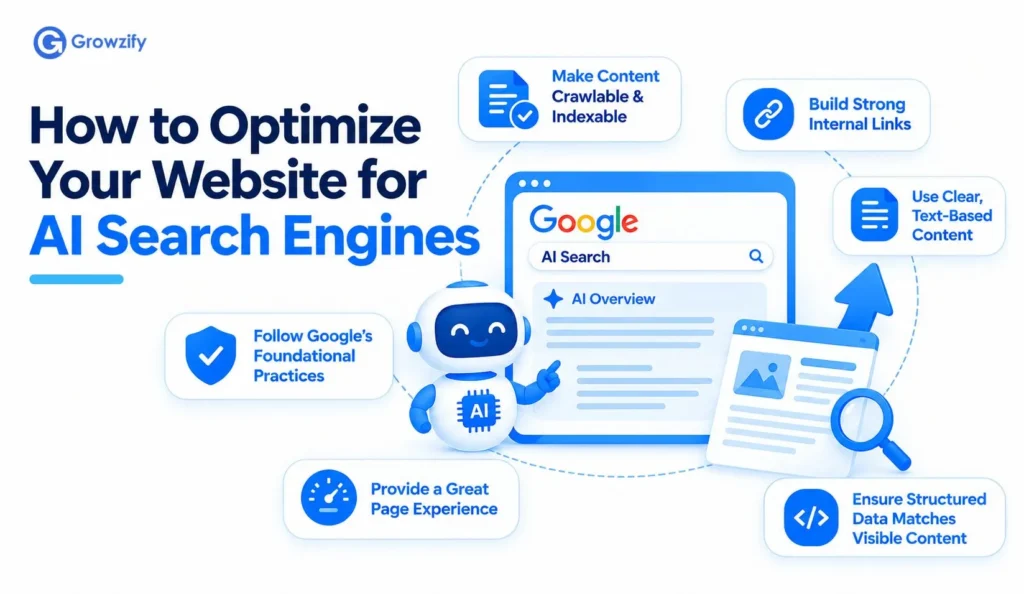
Work through these in order. Each step makes the next one more useful.
Before changing any wording, check that your important pages meet the documented requirements for Google’s AI features.
| Check | What to confirm |
| Crawling | robots.txt doesn’t block pages you want discovered |
| Indexing | Priority pages are indexed and not set to noindex by accident |
| Snippets | No nosnippet or restrictive max-snippet setting on pages you want quoted |
| Text availability | Key answers appear as text, not only inside images, video, or scripts |
| Internal links | Important pages are linked from relevant pages on your site |
If you’ve chosen to restrict snippets on some pages, that’s a legitimate decision. Just make it deliberately, since the same controls that limit snippets also limit what Google’s AI features can show from those pages.
Other AI platforms have their own retrieval and source systems, so these checks are a sensible baseline, not a guarantee of eligibility everywhere.
Start from the questions your buyers actually ask, not from a keyword list. Pull them from sales calls, support tickets, on-site search, and Search Console queries.
Group them by topic. Because Google’s AI features may fan out into related searches, check whether your site covers the nearby subtopics a buyer would naturally ask next.
Query fan-out supports broader information retrieval. It doesn’t prove that creating more URLs increases AI visibility, so treat it as a reason to assess coverage, not to multiply pages.
As a Growzify content-structure recommendation, put a concise, self-contained answer near the beginning of sections that address important buyer questions. This improves clarity and extractability for readers and answer systems, but it shouldn’t be treated as a confirmed Google AI-selection factor.
Keep each answer short enough to stand on its own if someone quotes only that passage.
Here’s an illustrative before-and-after for a fictional finance-software company. It isn’t a real client example.
Before:
Our platform leverages cutting-edge automation to revolutionize how finance teams approach month-end close, delivering unparalleled efficiency.
After:
Month-end close automation is software that handles repeatable close tasks, such as reconciliations and journal-entry matching, so finance teams spend less time on manual checks. It’s most useful for teams closing several entities or high transaction volumes. It doesn’t remove the need for review, since a controller still approves adjustments.
The second version defines the term, says who it’s for, and states a limit. The passage can stand on its own when quoted, summarized, or extracted, without depending on several paragraphs of surrounding context.
Growzify’s guide onmatching search intent to rank in Google AI Overviewsgoes deeper on page structure, so this guide doesn’t repeat it.
AI systems may encounter information about a business across first-party and third-party sources. When important public facts conflict, the resulting representation can become inconsistent or outdated, depending on the platform and the sources it uses.
Audit these basics across your site and your main third-party profiles:
Where you maintain structured data, make sure it matches the visible page text, as Google’s documentation advises.
Keeping important business facts consistent reduces ambiguity for users and systems that encounter those sources. That’s useful for brand representation, but it shouldn’t be presented as a confirmed cross-platform ranking or citation factor.
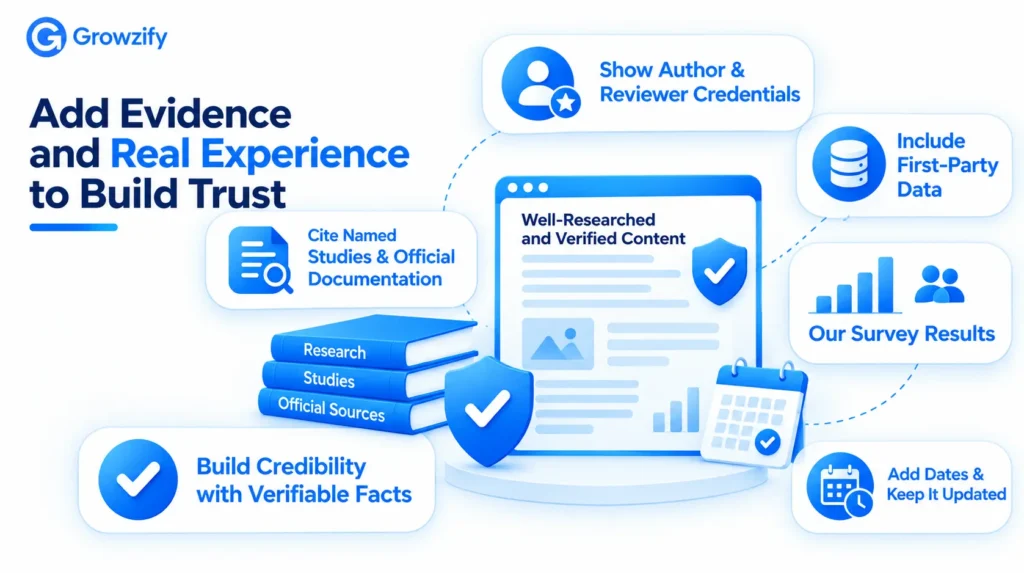
Generic claims are easy to replace and hard to trust. To make AI-assisted content more useful, focus on humanizing AI content with relevant context, original insights, and meaningful editorial review. Named sources, transparent authorship, first-party evidence, and current factual claims make content easier for readers to verify and increase its informational value.
They’re strong editorial quality controls. They aren’t guaranteed to earn an AI citation or selection.
Practical ways to add that:
This lines up with Google’s own people-first content principles as an editorial and trust standard. It’s also the part of AI SEO that’s hardest for competitors to copy quickly.
AI-search performance doesn’t currently reduce to one universal visibility score. Separate at least three types of evidence.
The report doesn’t include clicks, click-through rate, or query data. It also isolates a slice of activity for analysis. Google’s AI features documentation says sites appearing in these features are included in the overall search traffic reported under Web in the Performance report.
Some assistants may still appear under other channels, and visits that pass no referrer can land in Direct. Treat the AI Assistant numbers as a minimum.
For a Growzify planning example, start with 30 to 50 buyer questions, run them monthly, and keep the method consistent. That range is a practitioner suggestion, not an industry benchmark. For each prompt, log:
Repeat the same prompt set under comparable conditions where practical, since answers vary by platform, date, and user context.
These measurements answer different questions. Don’t collapse Google generative-search impressions, external AI-assistant referral traffic, and prompt-set visibility into one “AI visibility” number.
If you run a large site, the same principles apply at scale, with more governance. Growzify’s guide onhow enterprise brands can improve visibility in AI Overviewscovers that side.
You don’t need to rebuild your site to begin. As a practitioner suggestion, not a fixed rule, here’s a manageable first month.
Pick the pages by business value, not by how easy they are to edit. A product comparison page that influences deals matters more than an old blog post that happens to be simple to refresh.
After the first month, review what was implemented, what new measurement is now available, and whether any early directional signals have changed. Don’t treat one month as a universal window for proving AI-search or business impact.
A simple progression helps you decide how much to commit:
Some fundamentals stay exactly where they were:
AI SEO works best as an extension of a sound SEO program, not a replacement for one.
The second meaning of AI SEO is about process. AI tools can help cluster queries, draft outlines, summarize competitor coverage, and speed up audits.
The limit is accuracy and judgment. In Growzify’s experience, AI-assisted drafts need a subject-matter editor to remove generic claims, verify facts, and add real examples. Without that, you publish faster but add little that’s worth citing.
Growzify’s roundup ofAI SEO tools for content teamscompares options, so this guide doesn’t rank tools.
AI SEO is improving how your website, content, and brand can be discovered, understood, represented, and potentially cited across AI-powered search and answer experiences, while keeping your classic search visibility strong. The term is also sometimes used for using AI tools to do SEO work.
They overlap, but usage varies. AEO usually refers to structuring content so a direct answer can be extracted from a page. GEO usually refers to making content usable in generated answers. Growzify treats AI SEO as the umbrella that includes both.
No. Google’s documentation says pages must meet the usual Search eligibility requirements to appear in its AI features. Strong fundamentals remain the base, and AI SEO adds extractable answers, consistent facts, and new measurement on top.
Confirm your pages are crawlable and indexable, answer real buyer questions directly, keep facts consistent across your site and profiles, add named evidence and real experience, and measure Google AI impressions, assistant referral traffic, and prompt-set visibility separately.
AI can support SEO tasks such as research, clustering, outlines, and audits. It can’t replace strategic judgment, fact-checking, or accountability, so human review is still needed.
Use three separate measurements. Search Console’s Generative AI performance report covers impressions in Google’s AI Overviews and AI Mode, the GA4 AI Assistant channel covers recognized assistant referral traffic, and a recurring prompt sample covers mentions, citations, and accuracy in the assistants you choose. Treat the results as directional evidence, not exact rankings.
It can be, where your buyers use AI search to research. The sensible approach is to start with eligibility, answer quality, and brand consistency, which also benefit classic SEO, then expand based on what your measurement shows.
If you’d like help auditing your content for AI search and building a measurement baseline, Growzify’sAI SEO servicesteam can walk through where to start.

Chitranshu SharmaA growth strategist, digital marketing consultant, and the founder of Growzify, a performance-driven agency helping brands dominate search, shape perception, and build sustainable online visibility. With 8+ years of hands-on experience in Enterprise SEO, Online Reputation Management (ORM), and AI-led traffic generation, Chitranshu has helped startups, public figures, SaaS companies, and cannabis brands outrank competitors — ethically and at scale.

At Growzify, we are dedicated to helping your business achieve its goals. Are you Ready to take the next step?
How to Outsource SEO Without Losing Your Rankings Rankings don’t vanish because someone else is...
AI SEO vs Traditional SEO: The Comparison Guide Most “versus” articles frame two rival camps....

How to Rank Ecommerce Sites: Strategies That Actually Work Home Blog SEO How to Rank...

7 White Label SEO Practices That Support Client Retention and Agency Growth White-label SEO helps...
Content Gap Analysis For Large Enterprise Business Websites Content gap analysis for large enterprise business...
Content Mapping for Conversions: A Guide for Large Enterprise Websites Most enterprise sites don’t have...
Top 10 AI SEO Strategies to Get Ranked on AI Searches AI answers compress the...
How to Manage SEO Outsourcing Across Multiple Teams A single-owner outsourcing model works fine until...
Call Now





Growzify digital team is very effective, and easy to work with. Very strong communication and always up for suggestions. Saw 300% growth in web traffic 170% growth in revenue through Facebook ad’s & Amazon. I recommended them to my fellows and they turned their online business into a money making machine.