7 White Label SEO Practices That Support Client Retention and Agency Growth
7 White Label SEO Practices That Support Client Retention and...
Read More →
AI answers compress the discovery process. If your business isn’t cited, linked, or mentioned in the response, people may have fewer chances to find you through that interaction.

AI SEO strategies are the repeatable, prioritized actions a business uses to improve its visibility in AI-powered search answers, such as Google’s AI Overviews and AI Mode, ChatGPT search, Perplexity, and Microsoft Copilot. “Getting ranked on AI searches” here means being cited, linked, or mentioned inside the generated answer, not receiving one universal numbered ranking. No strategy guarantees a citation or mention.
The ten strategies below cover the main areas to prioritize. They’re numbered for navigation, and a recommended execution sequence appears later in the guide. In short:
Methodology:This guide draws on Google Search Central’s guide to optimizing for generative AI features (last updated July 2026), its documentation on AI features and on generative AI content, OpenAI’s documentation on its web crawlers, Google’s Search Console Help page for the Generative AI performance report, Google Analytics Help’s default channel group definitions, Google’s September 2026 announcement of multimodal reporting in Search Console, and Pew Research Center’s July 2025 browsing study, alongside recurring AI-search patterns Growzify observes in client work. Pew’s data reflects U.S. browsing in March 2025, so treat it as directional.
MostAI SEO services advice arrives as a pile of tactics: add this file, reformat that heading, install this markup. A list of tactics doesn’t tell you what to do first or what to skip.
The shift in behavior is real, though.Pew Research Center’s July 2025 studytracked 900 U.S. adults’ browsing in March 2025. Users clicked a traditional result link in 8% of visits when an AI summary appeared, versus 15% when it didn’t. They clicked a link inside the summary in 1% of visits to pages that had one.
That’s one study, one country, and one month, so read it as a signal, not a forecast. Still, it explains why a strategy built only on traffic from informational queries looks fragile.
This guide is the strategic layer. It assumes you already know what AI SEO is, and it spends more time on the decisions that set one business apart from another.
| S.no | Strategy | What it solves |
| 1 | Confirm Google generative-AI eligibility | Pages that aren’t eligible for Google’s generative Search features |
| 2 | Target buyer-choice questions | Visibility on queries that matter commercially |
| 3 | Publish non-commodity content | Content that adds nothing new |
| 4 | State who you serve and why you differ | Generic descriptions of your business |
| 5 | Earn genuine third-party corroboration | Weak external validation |
| 6 | Use Google’s business-data channels | Missing local and product information |
| 7 | Support text with images and video | Text-only pages in a visual search world |
| 8 | Set a crawler and preview policy | Accidental blocking or exposure |
| 9 | Keep facts consistent, current, and connected | Conflicting or stale information |
| 10 | Measure different signals separately | Guessing whether any of it works |
Start here for Google, because nothing else works if a page isn’t eligible.Google’s guide to optimizing for generative AI featuressays a page must be indexed and eligible to be shown in Google Search with a snippet. It also says a site must be included in Search generative AI features in Search Console to be eligible for display in those features.
Check four things on your priority pages:
Meeting these requirements doesn’t guarantee a page will be crawled, indexed, or served. Google says indexing and serving aren’t guaranteed.
Keep this step short and mechanical. It’s the entry ticket, not the strategy. Other platforms have their own access rules, which Strategy 8 covers.
Not every query is worth the same effort. Simple definition queries may often be satisfied directly in an AI response. Comparison and decision-stage questions can create more opportunities for supporting sources and deeper research.
Focus on queries like:
This is Growzify’s practitioner reasoning, not a documented rule. Prioritize these questions because they sit closer to evaluation and commercial decision-making, not because Google documents them as receiving preferential AI treatment.
Definition-only content still has a place, but it shouldn’t be the whole plan.
Build the list from sales calls, objections, and the questions prospects ask before they buy.
Google’s guide is blunt about what to avoid. It asks for “unique, compelling, and useful” content with a unique point of view, and contrasts non-commodity content, which offers expert or experienced takes that go beyond common knowledge, with generic “7 Tips” style articles.
For a business, non-commodity content usually means:
If you use AI tools to draft, edit carefully.Google’s guidance on generative AI contentsays, under “Focus on accuracy, quality, and relevance,” that it is critical to manually fact-check and review all AI-generated content before publishing.
It also warns that using generative AI to generate many pages without adding value for users may violate its spam policy on scaled content abuse.
Growzify’s guide onhumanizing AI contentcovers the editing workflow in detail.
AI-generated answers can draw on information from multiple accessible sources when describing a business. If your pages say nothing specific, there’s little accurate to repeat.
Here’s an illustrative before-and-after for a fictional scheduling software company. It isn’t a real client example.
| Wording | |
| Before | “ChairTime is the all-in-one solution for modern practice management.” |
| After | “ChairTime is appointment-scheduling software for independent dental clinics with two to ten chairs. It reduces no-shows with automated reminders and syncs with common practice-management systems. It’s not designed for hospital dental departments or large multi-state groups.” |
The second version names the audience, the problem, the method, and a limit. The clearer wording is easier for a reader, or a system summarizing the page, to interpret.
One caution. Writing clearly is a Growzify recommendation, not a Google requirement. Google’s guide says you don’t need to write in a specific way for generative AI search, and there’s no requirement to break content into tiny pieces. Clarity helps people, so write it for them.
Growzify’s guide onmatching search intent to rank in Google AI Overviewscovers page structure in depth.
Other sites that review, compare, or discuss your category also shape what readers and answer engines find. The question is how to earn that coverage honestly.
Google’s guide specifically advises against seeking inauthentic “mentions” across the web, noting this isn’t as helpful as it might seem. Growzify therefore treats genuine third-party coverage as a brand-discovery and corroboration strategy, not as a confirmed citation-ranking factor.
A workable approach:
Don’t assume that being included on one observed source will make your business appear in the AI answer. Source sets vary by prompt, user, platform, model, and time.
Focus on real editorial coverage, useful data, and relevant industry references, and don’t buy placements designed to manipulate rankings. The sources that appear will differ by question and platform, so check your own prompts rather than copying a generic list.
For some businesses, the most reliable way to supply accurate facts is through the channels Google already provides. Google’s guide recommends Google Business Profiles and Merchant Center feeds to make products and services visible in AI responses and Search results.
This applies where it fits your business:
If neither applies, skip this strategy. It’s a precision tool, not a requirement for everyone.
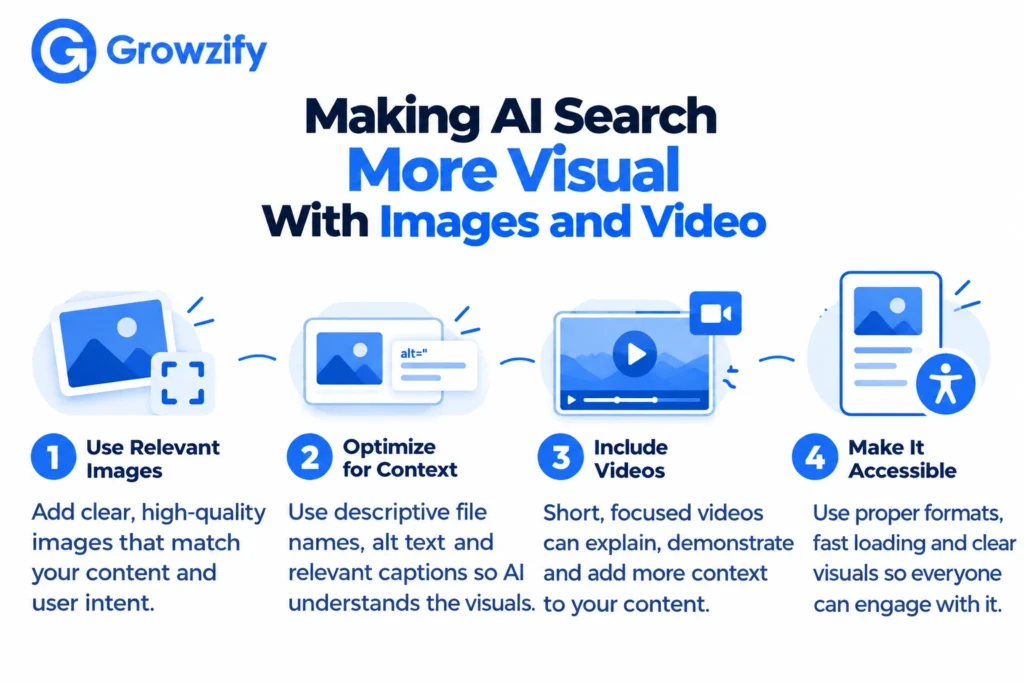
Google’s guide notes that many people appreciate finding images and videos as they search, and encourages supporting text with high-quality, relevant images and videos on your pages.
Practical steps:
Search itself is becoming more visual. Google announced web multimodal Search performance reporting in Search Console inSeptember 2026.
Use the multimodal search-type filter to analyze performance from searches where users search with images, including experiences such as Lens and Circle to Search.
Whether AI systems can reach and display your content is partly your decision. Make it on purpose.
OpenAI’s crawler documentationdescribes three agents:
| Agent | What OpenAI says it does | Robots.txt control |
| OAI-SearchBot | Surfaces websites in ChatGPT’s search features | Yes, managed independently |
| GPTBot | Crawls content that may be used in training generative AI foundation models | Yes, managed independently |
| ChatGPT-User | Handles certain user-initiated actions; not used to decide search appearance | Robots.txt rules may not apply |
OpenAI says a site can, for example, allow OAI-SearchBot to appear in search results while disallowing GPTBot. It recommends allowing OAI-SearchBot for visibility in ChatGPT’s search features, and says changes can take about 24 hours to be reflected in its search systems.
On Google’s side,its AI features documentationsays controls such as nosnippet, data-nosnippet, max-snippet, and noindex limit what’s shown from your pages in Search.
Two practical checks:
If your site, directory profiles, and press mentions disagree, it can be unclear which business details are current or accurate. Audit these across your site and main profiles:
Then keep your key pages current. Update real information instead of changing the date, and link related pages so readers and crawlers can follow them.
Treat this as factual governance and brand accuracy. It reduces ambiguity for readers and systems, but it isn’t a confirmed citation mechanism.
Growzify covers both in depth. See the guide onrefreshing old posts for AI Overviewsfor update workflows, and the guide onbuilding AI-ready topic clustersfor structuring related pages.
AI-search performance can’t currently be reduced to one reliable universal ranking. Separate four kinds of evidence.
It reports impressions only, with no clicks, click-through rate, or query data.
Some assistants may still appear under other channels, and visits that pass no referrer can land in Direct. Treat the AI Assistant numbers as a minimum.
For each prompt, record:
The result describes that sampled prompt set, not total visibility across the platform. Answers vary by user, platform, and over time.
These four signals answer different questions. A Google generative-AI impression, an AI citation, a brand mention, an assistant referral visit, and a conversion are different events. Don’t combine them into one “AI visibility” number.
A missing result in one prompt is a diagnostic signal, not proof that a new page is required. Here’s an illustrative log showing how to read it.
| Prompt | Assistant | Brand mentioned? | Page cited? | Description accurate? | Next step |
| Best scheduling software for small dental clinics | Assistant A | Yes | No | Mostly | Check whether an existing page covers the comparison, then decide if a new one is justified |
| ChairTime vs. competitor | Assistant A | Yes | Yes | Yes | None |
| Dental scheduling software pricing | Assistant B | No | No | n/a | Review whether pricing intent is adequately covered before publishing anything |
An illustrative sampling log. Answers vary by user and over time, so treat results as directional.
For a missed prompt, diagnose before you produce content:
Then choose the action the evidence supports: improve existing coverage, publish something new, or do nothing yet.
Attribution is messy. Look at the overall trend in visibility and conversions rather than crediting any single tactic.
Several popular AEO and GEO tactics are unnecessary for Google Search, according to Google’s guide:
That list matters because it frees budget. Spend it on eligibility, measurement, distinctive content, and commercially relevant questions before experimental hacks.
Google’s guide also notes that browser agents may access your website to gather data they need. It recommends reviewing agent-friendly website best practices where that’s relevant to your business.
For most sites, this is a watch item rather than an action item. If you sell products or take bookings online, check that key actions, such as forms and checkout steps, work cleanly and don’t depend on fragile scripts.
You don’t need to run all ten at once. As a practitioner suggestion, not a fixed rule, this is the recommended execution sequence:
Pick pages by business value, not by how easy they are to edit.
This grouping is Growzify practitioner judgment. It’s a simple way to decide where budget goes.
| Group | What belongs here |
| Invest | Platform eligibility, measurement, distinctive high-value content |
| Test | Prompt visibility, third-party editorial opportunities, multimodal opportunities |
| Apply when relevant | Business Profile and Merchant Center, video, browser-agent readiness |
| Skip | Special Google AI files, special AI schema, artificial mentions, mass query-variant pages |
AI SEO strategies are the repeatable, prioritized actions a business uses to improve its visibility in AI-powered search answers, meaning to be cited, linked, or mentioned inside generated responses. They build on classic SEO rather than replacing it.
Not in the usual sense. AI answers don’t generally present a numbered list of sources. Visibility means being cited, linked, or mentioned, and it can vary by user, query, and platform.
Eligibility is the first prerequisite. After that, establish measurement and your crawler policy, then prioritize commercially relevant buyer questions and non-commodity content. The exact order depends on the platform and the business.
First confirm platform eligibility and crawler access, then establish measurement. After that, prioritize commercially relevant buyer questions and non-commodity content before spending resources on experimental AEO and GEO tactics.
Not for Google. Its guide says you don’t need new machine-readable files, AI text files, or special schema.org markup to appear in Google Search.
That’s a business decision. OpenAI says OAI-SearchBot and GPTBot can be managed separately in robots.txt, while ChatGPT-User handles user-initiated actions where robots.txt rules may not apply. Decide on visibility and on training separately, and document the choice.
Use four separate signals: Search Console’s Generative AI performance report for impressions in Google’s AI features, the GA4 AI Assistant channel for recognized assistant referral traffic, monthly prompt sampling, and buyer-reported influence. Treat the combined picture as directional.
There’s no fixed timeline. Technical changes depend on when platforms recrawl and reprocess your pages, while content updates and third-party visibility depend on publication, discovery, and how individual AI systems refresh their sources. Establish a baseline and measure changes over time.
If you’d like help prioritizing these strategies for your business and setting up measurement, Growzify’sAI SEO servicesteam can walk through where to start.

At Growzify, we are dedicated to helping your business achieve its goals. Are you Ready to take the next step?

7 White Label SEO Practices That Support Client Retention and Agency Growth White-label SEO helps...
Content Gap Analysis For Large Enterprise Business Websites Content gap analysis for large enterprise business...
Content Mapping for Conversions: A Guide for Large Enterprise Websites Most enterprise sites don’t have...
How to Manage SEO Outsourcing Across Multiple Teams A single-owner outsourcing model works fine until...
How to Find and Compare Local SEO Outsourcing Providers Finding a local SEO outsourcing provider...
Inside a White Label SEO Campaign: How the Work Gets Done Clients see a single...

How to Vet an SEO Outsourcing Provider Before You Sign a Contract A polished proposal...
Multilingual SEO Best Practices: Optimize Your Multi-Language Website Translating a page and localizing it for...
Call Now





Growzify digital team is very effective, and easy to work with. Very strong communication and always up for suggestions. Saw 300% growth in web traffic 170% growth in revenue through Facebook ad’s & Amazon. I recommended them to my fellows and they turned their online business into a money making machine.