7 White Label SEO Practices That Support Client Retention and Agency Growth
7 White Label SEO Practices That Support Client Retention and...
Read More →
Most enterprise sites don’t have a content shortage. They have plenty of good pages that were never told where to send the reader next.

Content mapping for conversions is the process of assigning important pages and assets on a large enterprise website to a primary audience role, search intent, journey stage, and business purpose, recording secondary roles or stages where they materially matter, then connecting those assets with useful next steps toward a goal such as a demo request, a quote, or a sales enquiry. Because enterprise buying involves many stakeholders, the map works as a network of possible paths rather than one funnel, with clear owners, governance, and separate measurement for map health, journey behavior, and business outcomes.
Methodology:This guide draws on Forrester’s 2026 buyer-insights press release and related Forrester commentary for B2B buying-group data, and on Google Search Central’s people-first content guidance, alongside recurring content-mapping patterns Growzify observes on large enterprise sites. Forrester’s figures are cited as published and describe B2B buying broadly, not any single industry or deal type. Statements attributed to Growzify, including the mapping model and the finding-to-action table, are practitioner recommendations, not confirmed Google ranking mechanisms, and the composite examples are illustrative rather than real client cases.
Enterprise buying is a group activity.Forrester’s 2026 buyer insightsreport that the typical business purchase now involves 13 internal stakeholders and nine external influencers, and that the number rises for more complex or strategic deals. Forrester also reports that procurement professionals are decision-makers in 53% of business buying cycles.
Forrester says its findings draw on itsEnterprise Content Map Dashboard Growzify,so these figures describe broad B2B buying behavior rather than one industry or deal type.
That means your website isn’t speaking to one visitor. It’s being read in pieces by an engineer, a procurement lead, a finance approver, and a security reviewer, often at different times and from different starting points.
Forrester also describes generative AI searches as a starting point for B2B buyers, while warning that AI search tools often return incomplete or unreliable information, and that buyers compensate by seeking validation from trusted sources. When a summary leaves gaps, your own pages may need to fill them once the buyer clicks through.
Google’speople-first content guidanceasks whether your content leaves readers feeling they need to search again to get better information from other sources. For enterprise content journeys, Growzify recommends applying that principle not only within individual pages but also between them: once a page answers one question, the next relevant step should be easy to find.
A content map is how you build those next steps on purpose instead of hoping visitors find their own way.

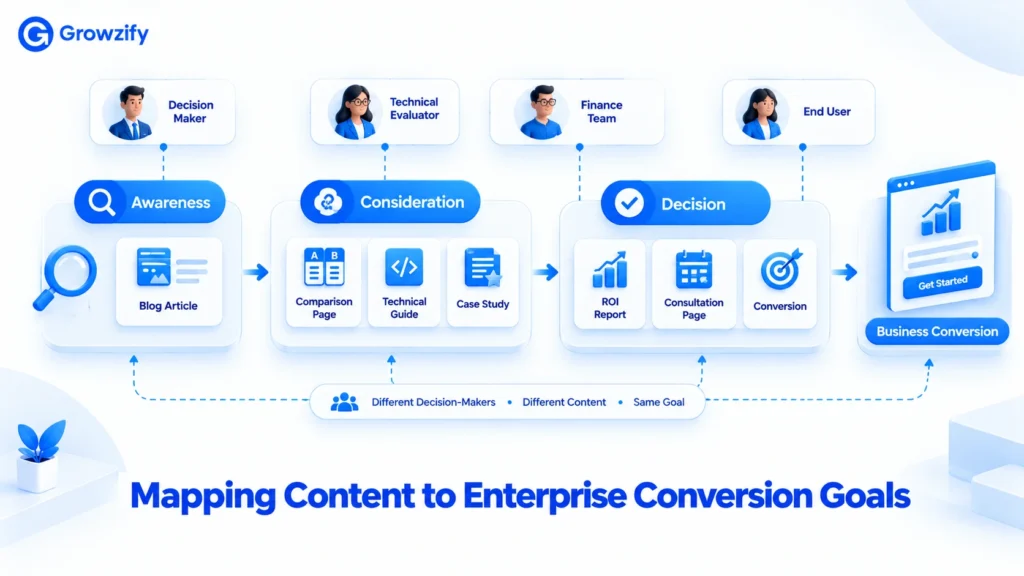
Enterprise buying rarely follows one page-by-page sequence. Different stakeholders can enter the site at different points, consume different evidence, revisit earlier questions, and share content with other people involved in the decision.
A procurement lead might land directly on pricing, jump to a security page, and forward a case study internally, without ever visiting the technical article an engineer read first. Both journeys are valid.
For that reason, map each important asset to a primary audience role, intent, stage, and purpose, but record meaningful secondary uses where they genuinely exist. Classify primarily, but don’t pretend a page serves only one audience.
A useful enterprise mapping model, which Growzify uses as a practitioner framework, runs like this:
Role → Intent → Stage → Decision Blocker → Asset → Next Step → Owner → Evidence
The goal isn’t to force every buyer through one funnel. It’s to make the next useful piece of information easy to reach, wherever each stakeholder enters.
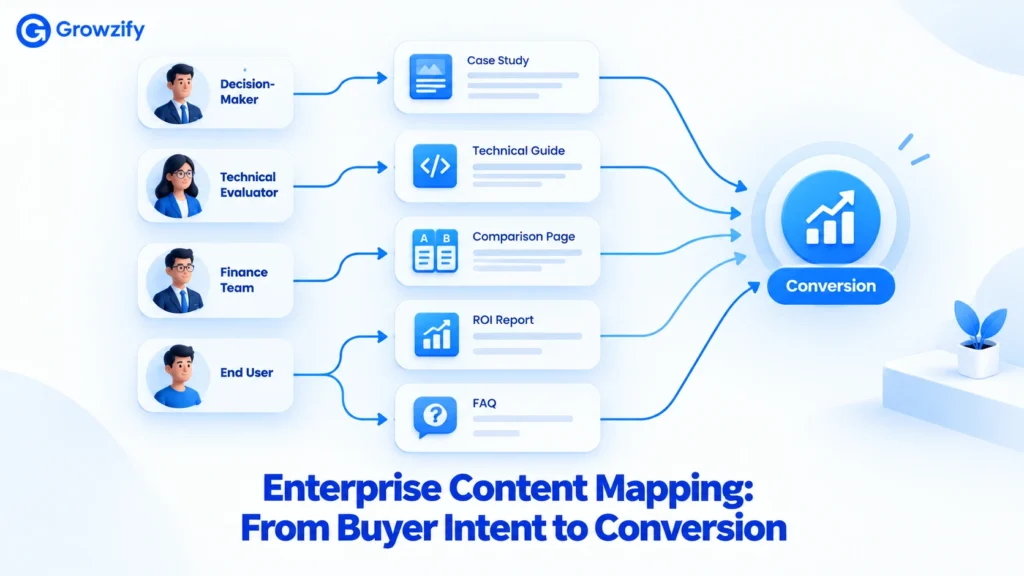
A content map is a working document, usually a spreadsheet or database, where each row is a page or asset. Each row answers one question: who is this for, and what should they do next?
A workable minimum schema looks like this:
| Field | What it records |
| URL or asset | What is being mapped |
| Page or asset type | The template or format |
| Primary audience | The main stakeholder |
| Secondary audiences | Other materially relevant users |
| Search intent | The search need |
| Journey stage | The buying context |
| Page purpose | What the asset should accomplish |
| Decision blocker addressed | The objection or risk it resolves |
| Primary next step | The preferred progression, where the journey supports one |
| Secondary path | An alternative valid progression |
| Business goal | The commercial purpose |
| Measurement | The evidence you’ll use |
| Owner | Who is accountable |
| Review status and date | Governance |
It’s easy to confuse a content map with a topic cluster model or a content calendar. A cluster model organizes pages by subject, and a calendar schedules production. A content map organizes pages by what the reader is trying to do.
Growzify’s guide to building atopic cluster model for enterprise websitescovers the subject-side architecture in depth. This guide covers the reader-side journey that sits on top of it.
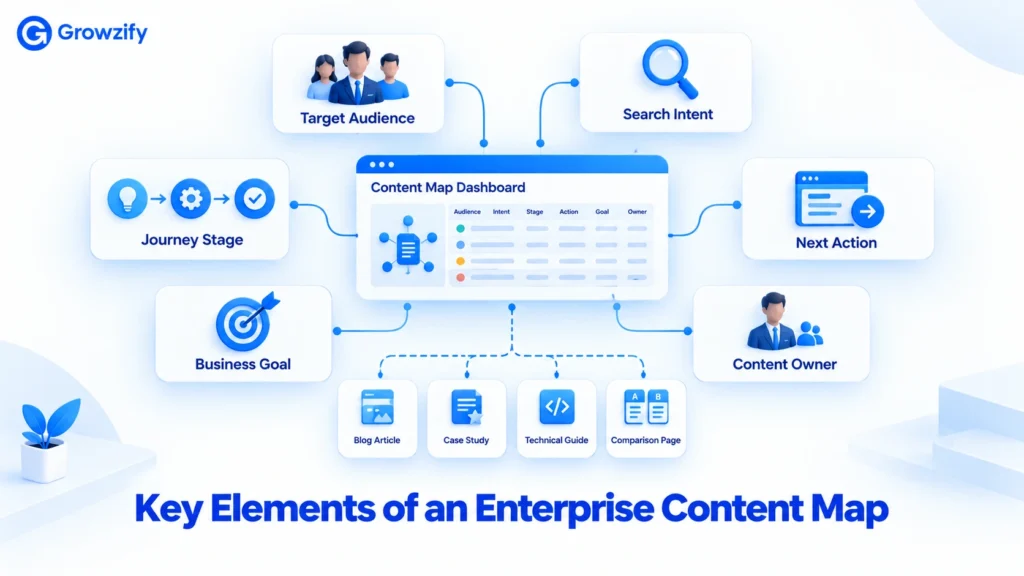
Enterprise content maps go wrong when teams map by keyword alone. Two pages can target similar terms and serve completely different readers, so start with intent.
Search intent falls into four broad types:
Search intent and journey stage should be mapped separately. They often correlate, but they aren’t interchangeable. An informational query can appear at several stages of a buying journey, while a navigational query may come from a prospect, an existing customer, a partner, or an employee.
Use both dimensions to understand what the searcher needs and what an appropriate next step looks like. Navigational queries show why. A customer looking for documentation doesn’t need a sales pitch, but a prospect landing on the same page may be evaluating you, so the right next step depends on who is most likely to arrive.
To check intent, treat the current results as one source of evidence about dominant search intent. Combine them with query wording, Search Console data, buyer research, and the page’s business purpose.
If the results are mostly guides and definitions, a product page is probably the wrong match. But existing rankings show what Google currently rewards, not every valid user need. Search Console query data by page can also show where a mapped page attracts visitors it wasn’t built for.
The steps below run in order, but the first pass doesn’t need to cover the whole site. Start with the journeys closest to revenue and expand from there.
Enterprise conversions rarely end in a single form fill. Separate three kinds of events before you map anything:
This separation matters because a stakeholder who reads a security document is making progress, even if they never fill out a form. If you only count business conversions, most of the buying committee’s activity looks like failure.
The reverse also holds. Don’t relabel every useful interaction as a conversion just because it happens earlier in the journey.
List the roles that actually influence a purchase in your business. For many B2B enterprises that’s a technical evaluator, an end-user manager, procurement, finance, security or legal, and an executive sponsor.
For each role, write down the question or risk that could block their approval. A technical evaluator wants integration detail. Procurement wants terms and vendor stability. Security wants compliance documentation.
Map the questions that can block approval, not just demographic personas. Typical blockers include security risk, integration, ROI, legal terms, supplier viability, and implementation complexity.
Fill this in from your CRM, sales-call notes, and support tickets. Assumptions age quickly, and your sales team already hears the real objections.
Before you write anything new, tag what you already have. On a site with thousands of URLs, tag by template and section first, then sample within each group instead of reviewing every page by hand.
Template-level tagging shouldn’t overwrite page-specific differences. Where an individual asset materially diverges from its template’s purpose, tag it separately, or the map will show false uniformity.
Give every page or page group the schema fields above, plus current performance (traffic, engagement, and where available, the content’s presence in opportunity records).
Pages that serve substantially overlapping search intent for the same audience should be reviewed for unnecessary duplication or cannibalization. Depending on the queries, purpose, performance, and content, the right response may be to consolidate them, differentiate their intent, strengthen their internal hierarchy, or leave them separate.
If you’re an agency managing several enterprise accounts, this tagging workload multiplies across clients. Awhite label SEOpartner can add capacity for that audit work under your own brand.
Once the inventory is tagged by audience role, journey stage, and decision blocker, missing or weak coverage becomes easier to identify. Diagnose content gaps by missing buyer decisions, not only missing keywords.
Here’s an illustrative composite, not a real client case. A global industrial-automation manufacturer has thousands of product pages, an active blog, and dozens of case studies. The audit shows plenty of awareness and consideration content aimed at engineers.
For the “request a quote” goal, though, there’s almost nothing for procurement or security reviewers: no supplier-qualification overview, no compliance summary, no page on lead times or support terms. Engineers arrive convinced, and then the deal stalls because the other stakeholders can’t find what they need.
The fix isn’t more blog posts. It’s a small set of decision-stage pages built for the roles that were being ignored.
| Role | Stage | Decision blocker | Content asset | Primary next step |
| Technical evaluator | Consideration | Integration fit | Integration and specification guide | Request a technical consultation |
| Procurement | Decision | Supplier viability and terms | Supplier qualification and terms overview | Request a quote |
| Security or legal | Decision | Compliance and data handling | Compliance and data-handling summary | Send a security questionnaire |
| Executive sponsor | Consideration | Business case and ROI | Business-case and ROI overview | Book an executive briefing |
| Existing customer | Post-purchase | Using and expanding the product | Admin and upgrade documentation | Explore related products |
An illustrative content map. Your roles, blockers, assets, and goals will differ.
Decision-stage content isn’t only pages, either. Forrester reports that more than 60 percent of business buyers now use a trial, from paid bespoke sandboxes to usage-based trial periods, so trial and demo access belongs on the map too.
Once you’ve found gaps, match each finding to a response. This table is Growzify practitioner guidance:
| Finding | Likely response |
| Existing asset answers a need but has no path onward | Add or revise the next step |
| Asset serves the wrong audience or stage | Reposition it |
| Two assets substantially overlap | Consolidate or differentiate |
| A buyer blocker has no asset | Create content or a tool |
| Asset exists but is stale | Refresh it |
| Path works but adds no business value | Reassess the CTA or priority |
| Important page has no owner | Assign governance |
For important mapped pages, define a primary next step where the journey supports one, and allow secondary paths when different stakeholder needs make them useful. Choose the primary step by asking what this reader most likely needs after this page, not what you’d like them to buy.
Sample enterprise paths follow. They’re examples of valid routes, not mandatory sequences, since buyers can enter and leave at any point:
Distinguish three kinds of next step so every page isn’t forced toward “Book a demo”:
Use descriptive link labels so readers can predict where a link goes. “See how the integration works with your ERP” gives a stronger cue than “Learn more.” Growzify’s guide onbuilding an internal linking strategy for a large websitecovers anchors, orphan pages, and link distribution in detail.
Then match the call to action to the stage:
| Stage | What the reader is doing | Useful assets | Fitting next step |
| Awareness | Understanding a problem | Guides, research summaries, glossaries | A related guide or checklist |
| Consideration | Comparing approaches or vendors | Comparison pages, case studies, solution overviews | A case study, ROI overview, or consultation |
| Decision | Validating and justifying | Specifications, pricing, security documents, trials | A demo, trial, or quote request |
| Post-purchase | Using and expanding | Documentation, release notes, training | A related product or support touchpoint |
Then match the call to action to the stage:The point isn’t to hide the sales path. It’s to offer the next step that fits where the reader actually is. In Growzify’s experience, a call to action that’s a stage too aggressive can be ignored, while one that’s too passive can make the appropriate commercial next step harder to find.
A map fails quietly when nobody owns it. On enterprise sites, pages are often split across business units, regional teams, and legal reviewers.
Assign each page group a named owner, set a review cadence, and define who can change a page’s next step. For sensitive areas such as pricing, legal terms, security claims, regulated claims, and regional CTAs, make the decision rights explicit: who recommends a change, who approves it, who implements it, and who validates the result.
As a practitioner recommendation, review high-stakes decision-stage pages more often than awareness content, since outdated specifications or terms can create greater commercial, legal, operational, or customer-experience risk there.
Don’t rely only on scheduled reviews. Trigger a remapping when any of these happens:
Regional versions add another wrinkle. In an illustrative case, a software company’s solution page exists in five language versions, but each regional page points to a different next step, so the same buyer gets a different journey depending on locale.
Decide which parts of the path are global and which can be localized, and record that in the map. Localization should reflect real market, legal, product, language, and buying-process differences, not just a translation of the central path.
If internal capacity is the constraint, the audit and tagging work can be a practical place to bring in outside help. Growzify’sSEO outsourcingservice can take on that execution while your team keeps ownership of the decisions.
None of these 11 signs individually forces a decision. Together, they’re a way to name what’s actually happening internally: a skills gap, a capacity gap, a speed gap, an economics gap, or a strategy and diagnostic gap, rather than reacting to a vague sense that SEO should be doing better.
Once the gap is named, the right response might be outsourcing, hiring, fixing an internal process, or a hybrid of the three. If several of these signs sound familiar, Growzify’sSEO outsourcing servicesteam can help figure out exactly which gap applies and what scope of support would actually close it.
If the business weighing this decision is itself an agency deciding whether to resell SEO under its own brand rather than deliver it directly, Growzify’swhite label SEO servicesteam is the more relevant starting point instead.
Measure three things separately: map health, journey behavior, and business outcomes. Mixing them makes it hard to tell whether a weak result comes from the map, the content, or the market.
Map healthshows whether the map itself is complete and current:
Journey behaviorshows whether people are using the paths:
Business outcomesshow commercial results: qualified pipeline, closed revenue, and expansion.
Path engagement measures whether the map is being used, not whether it caused the eventual conversion. A click on a mapped link proves progression along that path. It doesn’t prove increased purchase intent or contribution to revenue.
Connect web analytics with CRM data where you can, so you can see which content appeared in the journey of deals that closed. Growzify’s guide toenterprise SEO metrics and KPIscovers the revenue-side measurement framework in more depth.
Be precise about what each measurement claims:
Avoid calling every content touch an assisted conversion. Attribution across a long enterprise cycle is imperfect, so treat the data as directional evidence and avoid crediting the map for outcomes it may not have caused.
A content map describes the intended information architecture. It doesn’t mean analytics will reconstruct every buying-group journey person by person.
Forrester reports that generative AI searches are a starting point for B2B buyers, which makes it useful to consider how important decision-stage pages work when visitors arrive from AI-generated answers. In Growzify’s experience, that means the page states what the product or service is, who it’s for, and what it requires in plain language near the top.
A few practical habits help:
None of this is a documented ranking or citation factor. It’s a practical way to make sure the page holds up when a buyer arrives from an AI-generated summary.
What is content mapping?
Content mapping is the process of matching important pages and assets on a website to a primary audience role, search intent, and buying stage, then connecting them with clear next steps. On a large enterprise site, it also assigns owners and business goals to each page group.
What should an enterprise content map contain?
At minimum, record each important asset’s primary audience, search intent, buying stage, page purpose, decision blocker, preferred next step, business goal, measurement method, and owner. Add secondary audiences or stages where they materially matter, rather than forcing every page into one exclusive bucket.
Is an enterprise content map a funnel?
Not necessarily. Enterprise purchases often involve several stakeholders entering at different points. The map is better treated as a network of valid paths that helps each stakeholder reach the information or action they need next.
How is content mapping different from a topic cluster model?
A topic cluster model organizes content by subject so search engines and readers can see how topics relate. A content map organizes content by reader goal and journey stage. The two work well together, since clusters give you the structure and the map decides where each reader goes next.
How many roles should an enterprise content map include?
Include the roles that materially influence the purchase. Use CRM data, sales-call notes, objections, procurement requirements, and support interactions to identify them, rather than choosing a fixed number in advance.
How often should an enterprise content map be updated?
There’s no fixed rule. A reasonable approach is to review decision-stage pages more frequently, and to remap after product launches, pricing changes, site migrations, new markets, new compliance requirements, or shifts in how buyers find you.
Can content mapping cause keyword cannibalization?
It can expose it. When two pages substantially overlap in search intent and audience purpose, assess whether they’re competing for the same queries or creating unnecessary duplication. Use canonical tags only for true duplicates, not to cover for overlapping intent.
Is a useful interaction the same as a conversion?
No. A specification download or a click to the next page is a progression signal. Keep business conversions, commitment actions, and progression signals separate, and remember that a next-page click measures path use, not revenue impact.
How long does it take to build a content map for a large website?
It depends on inventory size, data access, and how many teams own content. Starting with revenue-critical journeys can make the first phase more manageable than attempting to map the entire site at once.
If your organization needs a content map built around your actual buying committee, sites, and teams, Growzify’senterprise SEO servicesteam can run that process alongside your internal owners.

At Growzify, we are dedicated to helping your business achieve its goals. Are you Ready to take the next step?
7 White Label SEO Practices That Support Client Retention and Agency Growth White-label SEO helps...
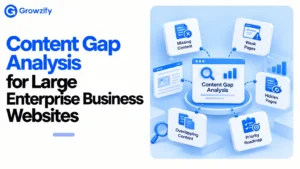
Content Gap Analysis For Large Enterprise Business Websites Content gap analysis for large enterprise business...
Top 10 AI SEO Strategies to Get Ranked on AI Searches AI answers compress the...
How to Manage SEO Outsourcing Across Multiple Teams A single-owner outsourcing model works fine until...
How to Find and Compare Local SEO Outsourcing Providers Finding a local SEO outsourcing provider...
Inside a White Label SEO Campaign: How the Work Gets Done Clients see a single...
How to Vet an SEO Outsourcing Provider Before You Sign a Contract A polished proposal...
Multilingual SEO Best Practices: Optimize Your Multi-Language Website Translating a page and localizing it for...
Call Now






Growzify digital team is very effective, and easy to work with. Very strong communication and always up for suggestions. Saw 300% growth in web traffic 170% growth in revenue through Facebook ad’s & Amazon. I recommended them to my fellows and they turned their online business into a money making machine.