How to Outsource SEO Without Losing Your Rankings
How to Outsource SEO Without Losing Your Rankings Rankings don’t...
Read More →

Ranking an enterprise ecommerce website requires a technically sound site, clear architecture, strong internal linking, and useful product and category pages. Consistent product information, structured data, fast page experiences, and helpful content can improve visibility. Ongoing monitoring of indexation, organic performance, content quality, and technical issues helps maintain search visibility as products, categories, and customer search behavior evolve.
Methodology: This guide is grounded inGoogle Search Central’s documentationon ecommerce site structure and product data, as well as Ahrefs’ published keyword-volume research and recurring patterns observed in Growzify’s enterprise SEO reviews. Statements attributed to Growzify are practitioner observations, not confirmed Google ranking mechanisms, and the composite example later in this article is illustrative rather than a client case study.
In today’s competitive digital market, scaling an ecommerce website can be challenging. Having the rightecommerce SEO strategyin place can help your products become more visible, reach the right audience, and create more opportunities for organic growth.
A strong ecommerce SEO strategy goes beyond optimizing individual product pages. It involves creating a clear site structure, improving product and category pages, addressing technical SEO issues, understanding search intent, and making sure search engines can discover and understand your content.
When ecommerce SEO fails, the problem is often deeper than rankings alone. Clear product information also makes pages easier for users and systems to interpret. Treat that as a content-quality and representation benefit, not as a confirmed AI-citation factor.
The solution is a structured SEO approach that connects technical foundations, content, product optimization, internal linking, and search intent. Let’s look at how to build an e-commerce SEO strategy that can improve visibility and support sustainable organic growth.
As the digital world continues to evolve, the e-commerce market is changing too. More consumers are turning to online searches to discover products, compare options, and make purchasing decisions. E-commerce SEO helps online stores reach these potential customers when they are actively looking for products.
E-commerce SEO matters because shoppers can discover products across Search, Images, Lens, Shopping surfaces, category results, product results, and increasingly AI-assisted discovery. The challenge for large stores is making the right products discoverable and understandable across a constantly changing catalog.

At enterprise scale, category and product pages serve different search purposes. Treating them the same can make it harder to organize your site and target the full range of searches your customers use.
For a large ecommerce website, the goal is to make these pages work as a connected system rather than optimizing every page in isolation. Growzify’s guide onbuilding an internal linking strategy for large websitescan provide more detail on structuring these connections.
When an ecommerce website has hundreds or even thousands of pages, getting them to rank isn’t just about optimizing each page individually. Search engines need to understand which pages should compete for broad searches, which should target specific product queries, and how those pages work together. That’s where an Ecommerce Ranking Layer Model becomes useful.
| Layer | What differs at enterprise scale | Why it matters |
| Query portfolio | Millions of long-tail variations instead of a short keyword list | Manually mapping every query becomes impractical at enterprise scale. |
| Page-role division | Category pages capture head terms, product pages capture long-tail | Collapsing this distinction wastes the catalog’s structural reach |
| Commerce data and user trusts | Price, availability, variant data, reviews, shipping/return details, and product content need to remain accurate across large catalogs because template/data failures can affect thousands of pages and shopping experiences simultaneously. | A trust or freshness gap on one template affects every page built from it |
| Technical delivery | Crawl capacity, rendering, and indexing all have to work at volume, not just correctness | A technically correct page that never gets crawled or indexed doesn’t compete at all |
Each layer depends on the others working. A perfect category-to-product linking structure doesn’t help if the pages it points to aren’t getting crawled. Strong trust signals on a product page don’t matter if the page itself is buried too deep in the site’s hierarchy to be discovered easily.
Everything starts with making sure search engines can properly access, render, understand, and index the pages that matter. For large e-commerce websites, technical SEO should follow a clear path: Crawlability, Rendering, Indexation, and Ranking
That means making important product and category pages easy to crawl. While controlling duplicate URLs, filters, parameters, pagination, and URL variations that can create complexity. A strong technical foundation should include:
The goal is to make sure the pages with real search and business value can actually reach the point where they are able to compete.
Site architecture tells the audience and search engines how products relate to one another. A scalable structure usually moves naturally from broader topics into more specific ones: Example: Homepage, then Category, then Subcategory and Product
Products should be grouped around meaningful categories and subcategories. Internal links help reinforce which pages are most important. Strong architecture should make it easy to:
The easier the structure is to understand, the easier it becomes for search engines to interpret page relationships and for customers to reach the products they need.
A product page needs to do more than display a title, price, and image. The strongest product pages give shoppers enough information to understand the product, compare their options, and make a confident decision. That can include:
This also supports AEO and AI-search visibility because clear, well-structured product information is easier for search systems to interpret and summarize. A useful question to ask is: Does this page answer the questions someone would naturally have before buying this product? If the answer is yes, the page is much more likely to provide real value.
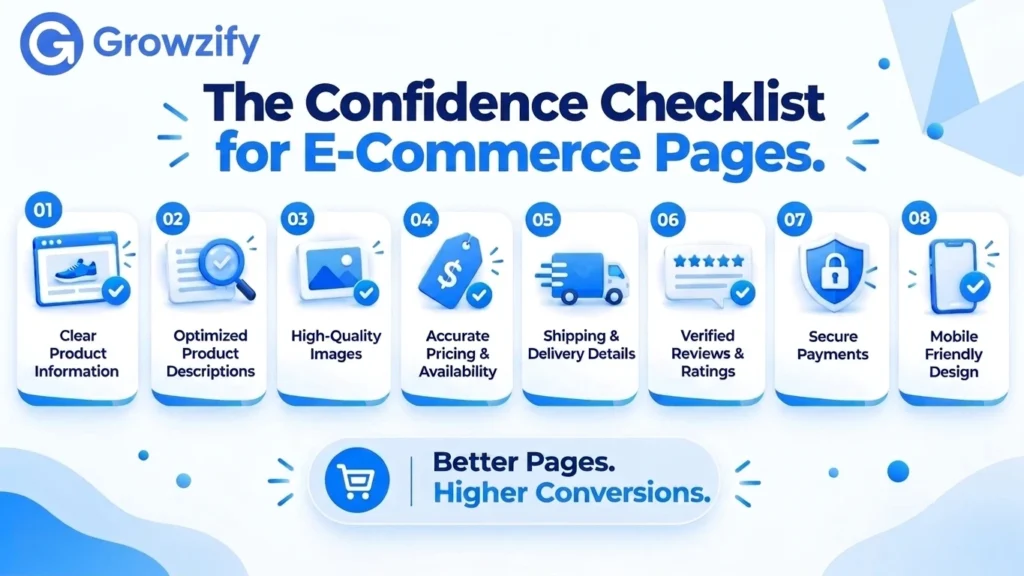
Structured data helps search engines understand product information in a more consistent format. For enterprise e-commerce websites, this becomes especially important because product data may be generated across thousands of URLs. Relevant markup can include:
The website should also keep product data aligned with Merchant Center wherever applicable. The key is consistency. Pricing, availability, variants, reviews, and other product information should tell the same story across the page, structured data, and merchant feeds.
Category pages are often strategically important because they can match broader commercial product-type queries while organizing access to individual products.
They should therefore be built around what shoppers are actually trying to find, compare, or understand.
Strong category pages can:
Avoid turning categories into interchangeable pages where only the keyword changes.
A better question is:
What would make this category genuinely useful to someone deciding what to buy? That is usually a stronger starting point than asking how many keywords can be added to the page.
Enterprise e-commerce content works better when every piece has a clear role in the customer journey.
A useful framework is:
Discovery → Research → Comparison → Purchase → Post-purchase
Content can then support each stage through:
This creates a connected content ecosystem rather than hundreds of isolated keyword-focused articles.
The content introduces customers to the category, helps them understand their options, supports purchasing decisions, and can continue helping them after the sale.
Authority is built through more than the number of backlinks pointing to a website.
For large e-commerce brands, trust can develop through multiple signals, including:
The focus should remain on relevance and credibility.
Prioritize relevant editorial coverage, digital PR, expert contributions, and useful third-party references over acquiring large volumes of low-quality links or mentions.
AI search is changing how information can be discovered, but the foundation remains familiar.
Useful, accurate, well-structured information still matters.
For enterprise e-commerce websites, that means:
Rather than creating content purely for AI systems, focus on becoming a source that both people and search platforms can confidently understand and reference.
The stronger the underlying SEO foundation becomes, the better positioned the site is for both traditional search and emerging AI-driven discovery.
Customers rarely evaluate a product based only on what the brand says about it.
Reviews, customer questions, photos, shipping policies, return information, and other trust signals can all influence the buying decision.
Enterprise sites should pay attention to:
These signals make product pages more useful while helping customers feel more confident about purchasing.
The goal across all of these areas is the same:make important pages easier to discover, easier to understand, and easier to trust.
When technical SEO, architecture, product content, category strategy, structured data, authority, and customer trust all support one another, enterprise e-commerce SEO becomes much more scalable.
That is how a large catalog starts turning its size into a genuine search advantage rather than simply creating more pages to manage.
Ecommerce SEO checklistcan look straightforward from the outside: optimize the pages, target the right keywords, and keep improving rankings. But when a site has thousands of products, categories, filters, and templates, small SEO decisions can quickly turn into site-wide problems. The key is to recognize where these mistakes happen and build a scalable approach to avoid them.
The bigger lesson is simple: enterprise ecommerce SEO needs systems, not just page-level optimization. When every page has a clear purpose and the technical processes support that structure, you can scale the catalog without creating unnecessary ranking conflicts, crawl problems, or outdated search signals.
Set a baseline for the page group before you make changes. Then check the result in four layers, because each answers a different question:
Closing the content gap and improving the business outcome are different claims. The first can be true while the second isn’t yet visible.
Validate against the same cohort you used to diagnose the gap, such as the affected page group, region, or template, rather than relying on sitewide performance.
Treat assisted or influenced conversions according to the attribution model used. They don’t by themselves prove the content created incremental revenue.
Growzify’s guide toenterprise SEO metrics and KPIscovers the revenue side of measurement.
Be cautious about causation. Enterprise results move for many reasons, so treat the data as directional evidence and avoid crediting the analysis for changes it may not have caused.
The volume makes manual targeting impossible. Long-tail queries, those with very low individual search volume, make up the overwhelming majority of all searches; a large catalog is competing for that volume systematically through its structure, not through a manually curated keyword list.
No. Category pages are often a more natural match for broader category-level commercial searches, while product pages are often better suited to specific product, model, SKU, or variant queries. Use actual SERPs and query data to confirm the intended page role rather than forcing both page types to target the same query set.
Google’s documentation discusses structured data primarily in terms of eligibility for enhanced listings and accurate presentation on Shopping surfaces, not a direct ranking boost. At enterprise scale, the practical risk is inconsistency: a template producing inaccurate or missing review and product data affects every page built from it at once.
Inventory churn combined with inconsistent template logic. A single flawed rule for handling out-of-stock, discontinued, or newly launched products applies across the entire catalog simultaneously, rather than affecting one page in isolation.
Treat the catalog as a system rather than a collection of product pages. Search demand, category structure, internal links, product URLs, variants, faceted navigation, structured data, Merchant Center data, inventory lifecycle rules, and measurement must work together at template and cohort level.
Usually they should have different primary roles. Category pages often fit broader product-type and commercial browsing queries, while product pages often fit specific product, model, SKU, and variant searches. Confirm the role from search intent and actual SERPs rather than assigning keywords by page type alone.
Enterprise e-commerce SEO servicesworks best when every part of the site supports the same goal: helping search engines discover the right pages, understand their purpose, and connect them with the searches that matter most to the business.
That means rankings do not depend on one tactic alone. Query targeting, category structure, product pages, technical SEO, internal linking, trust signals, structured data, and content all influence how effectively a large catalog performs in search.
For enterprise stores, the challenge is turning thousands of products and categories into a structure that can consistently create search visibility at scale. A broader enterprise SEO program helps identify where that constraint exists and what needs to change next.

Chitranshu SharmaA growth strategist, digital marketing consultant, and the founder of Growzify, a performance-driven agency helping brands dominate search, shape perception, and build sustainable online visibility. With 8+ years of hands-on experience in Enterprise SEO, Online Reputation Management (ORM), and AI-led traffic generation, Chitranshu has helped startups, public figures, SaaS companies, and cannabis brands outrank competitors — ethically and at scale.

At Growzify, we are dedicated to helping your business achieve its goals. Are you Ready to take the next step?
How to Outsource SEO Without Losing Your Rankings Rankings don’t vanish because someone else is...
AI SEO vs Traditional SEO: The Comparison Guide Most “versus” articles frame two rival camps....

What is AI SEO? How Can Businesses Optimize Their Content for AI Searches A page...

7 White Label SEO Practices That Support Client Retention and Agency Growth White-label SEO helps...
Content Gap Analysis For Large Enterprise Business Websites Content gap analysis for large enterprise business...
Content Mapping for Conversions: A Guide for Large Enterprise Websites Most enterprise sites don’t have...

Top 10 AI SEO Strategies to Get Ranked on AI Searches AI answers compress the...
How to Manage SEO Outsourcing Across Multiple Teams A single-owner outsourcing model works fine until...
Call Now






Growzify digital team is very effective, and easy to work with. Very strong communication and always up for suggestions. Saw 300% growth in web traffic 170% growth in revenue through Facebook ad’s & Amazon. I recommended them to my fellows and they turned their online business into a money making machine.