7 White Label SEO Practices That Support Client Retention and Agency Growth
7 White Label SEO Practices That Support Client Retention and...
Read More →
Content gap analysis for large enterprise business websites is the process of comparing what your audience, buyers, and search engines need against what your site actually provides, then diagnosing whether each gap is missing, weak, hidden, overlapping, or intentionally absent, and ranking the ones that matter by business value. The output isn’t a keyword list. It’s a prioritized backlog of content fixes, each with a named owner and a way to validate the result. At enterprise scale, begin with page groups, templates, regions, or business units, use more than one source of evidence, and remember that absence is not automatically a gap.

An SEO outsourcing checklist is the set of things a business should have ready before handing SEO work to an outside provider: scoped platform access (Search Console, analytics, CMS), documentation of past SEO work and known issues, a captured performance baseline, clearly defined goals with agreed KPI definitions, a scoped budget with explicit exclusions, one accountable internal owner with clear decision rights, and a vetted provider whose actual practices have been checked before signing anything.
Methodology :This guide draws on Forrester’s December 2024 State of Business Buying press release and related Forrester commentary for B2B buying-group data, and on Google’s documentation for AI features, for the Generative AI performance report in Search Console, and for Search Console data history, alongside recurring gap-analysis patterns Growzify observes on large enterprise sites. Forrester’s figures describe B2B buying broadly, not any single industry. The five gap verdicts, the diagnostic sequence, and the prioritization model are Growzify’s practitioner framework, not Google terminology, and the composite examples are illustrative rather than real client cases.
A content gap is any place where what your audience needs and what your site delivers don’t match. The obvious version is a missing page. On large sites, that’s often the smallest category.
Growzify sorts gaps into four verdicts, plus a fifth state for coverage that is absent on purpose. The framework keeps teams from treating every gap as a reason to publish something new.
| Verdict | What it means | Typical evidence | Usual response |
| Missing | No page addresses a topic or question that needs coverage | Relevant queries with no matching page; sales questions with no content answer | Create a new page or section |
| Weak | A page exists but doesn’t satisfy the intent | Intent mismatch, outdated or incomplete information, recurring relevant queries the page fails to address | Improve, restructure, or update |
| Hidden | Relevant content exists but is unintentionally difficult for users or search engines to discover, access, or index where organic visibility is intended | Orphaned pages, unintended noindex or crawl restrictions, weak internal discovery, inaccessible content, or priority pages meant for search that remain unindexed | Fix discovery, access, or indexing |
| Overlapping | Several pages serve substantially the same intent | Multiple URLs with heavy query overlap and similar purpose | Consolidate or differentiate |
| Intentional / N/A | Coverage is absent by design | The topic doesn’t apply, the market doesn’t offer the product, the buyer role is irrelevant, or the content is deliberately private or gated | Leave alone, and record the decision |
Hidden and overlapping gaps are easy to overlook because neither necessarily appears as a visibly missing page. Neither is necessarily solved by writing more.
Absence is not automatically a content gap. A gap exists only where the evidence shows coverage is needed.
Not every unindexed or gated page is a problem. Some URLs are intentionally noindexed, gated for lead generation, or not meant for organic search. A hidden gap only exists where visibility was intended.

Finding a gap doesn’t automatically tell you what to create. Use a simple diagnostic sequence:
Demand → Coverage → Diagnosis → Verdict → Priority → Action → Owner → Validation
This distinction matters because the same symptom can require very different actions. An important topic with no suitable page may justify creation. A strong page blocked from discovery may need a technical or internal-linking fix. Two overlapping pages may need consolidation. A topic irrelevant to a regional market may need no action at all.
Enterprise sites can hide gaps in averages. Sitewide traffic can look healthy while one product line, one region, or one buyer role has almost nothing.
Buying complexity makes this harder.Forrester’s December 2024 State of Business Buying releasereports that, on average, 13 people within an organization are involved in a buying decision. It also reports that 89 percent of purchases involve two or more departments, and that 86 percent of B2B purchases stall during the buying process.
Forrester’s related commentary says the underlying researchsurveyed more than 16,000 global business buyers, so these figures describe B2B buying broadly rather than any one industry.
Forrester doesn’t tie those stalls to content gaps. But the numbers show why coverage for a single reader may not be enough. A site can serve the engineer well and leave the finance approver or security reviewer without an answer.
Ownership adds another layer. Different teams publish to different sections, so nobody sees the full picture unless someone builds it deliberately.
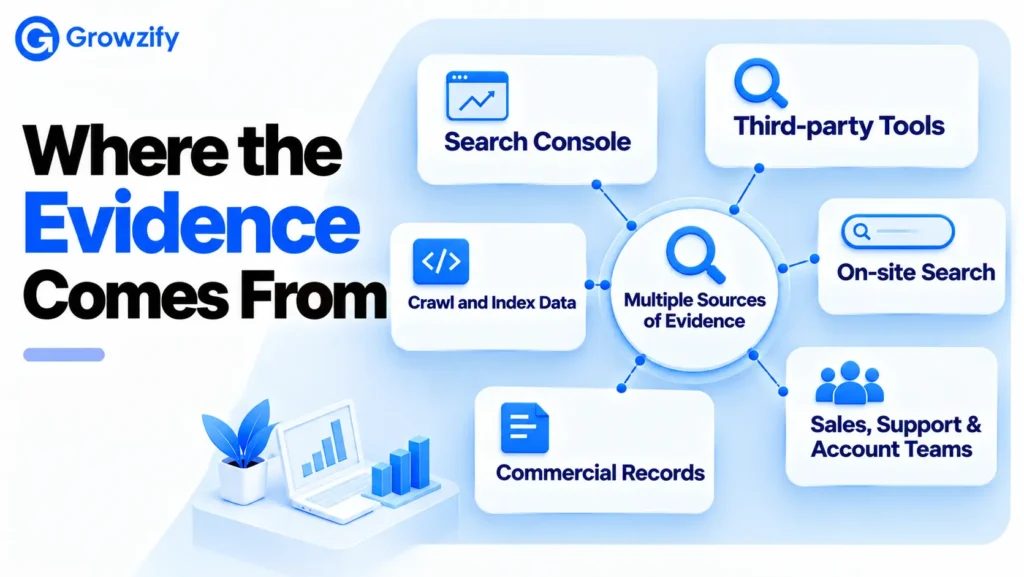
No single tool finds every gap. Use several sources, and treat disagreements between them as clues.
Commercial evidence can outweigh keyword volume where the missing information repeatedly blocks real evaluations or deals.
Treat queries with many impressions and few clicks as investigation candidates, not proof of a gap. Low positions, mismatched titles, SERP features, and brand intent can all produce the same pattern. Stronger evidence is a query-to-page mismatch, a relevant query with no suitable landing page, or recurring demand your pages don’t answer.
Search Console’s standard Performance view offers up to 16 months of data.Google’s traffic-drop debugging guidesuggests the Search Analytics API or bulk data exports to extend it, so organizations that need longer baselines should export and keep their own data.
The steps below build on each other. You don’t need to run them across the whole site at once.
Pick a page group, such as a product line, a region, or a template type. Then write the question you want answered, for example: “Where are we missing answers for enterprise buyers evaluating our security features?”
A specific question keeps the analysis from turning into a giant spreadsheet nobody acts on.
List every URL in the group with its template, topic, intent, owner, indexation status, and basic performance. Pull it from a crawl, your CMS, and analytics rather than relying on memory.
On very large groups, work by template first and sample within each. You’re looking for patterns, not a perfect count.
Sampling should represent meaningful page classes, markets, performance levels, and known risk states. Findings from a sample shouldn’t be described as inventory-wide facts unless an inventory-wide check supports them.
Gather the topics and questions your audience is asking, using the evidence sources above. Group them by topic rather than by individual keyword, since one page can answer several related queries.
Include the questions sales and support hear most often. They may have limited keyword volume but still carry substantial commercial importance.
Ask “missing for whom?” as you go. Enterprise buyers arrive as engineers, procurement leads, finance approvers, and security reviewers. A topic can be well covered for one role and absent for another.
Record two fields for each demand item: the buyer role it comes from, and its business relevance. Not every recurring question deserves organic content. A common support question, for example, may be irrelevant to acquisition.
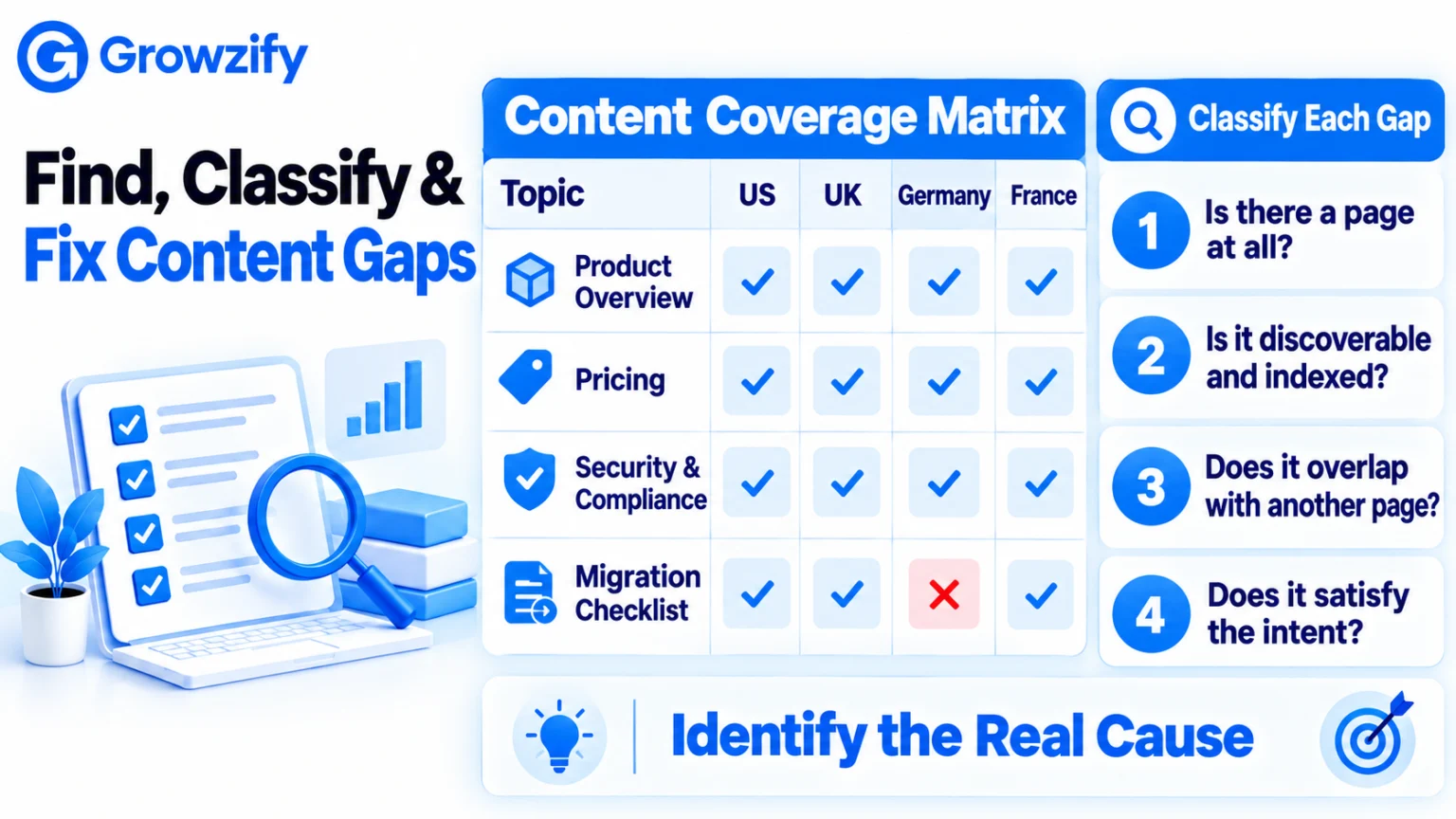
Build a simple coverage matrix. Put topics in rows and the things you care about in columns, such as regions, buyer roles, or page types. Mark each cell as covered, weak, missing, hidden, overlapping, or intentional or not applicable.
The matrix is where enterprise gaps become visible. A topic that looks covered on the main site may be absent from three regional versions.
Here’s a small illustrative excerpt for a fictional software company. The cell labels follow the verdicts above, plus “Covered” where the topic is handled well.
| Topic | Global site | UK site | Germany site | Buyer role served |
|---|---|---|---|---|
| Compliance overview | Weak | Missing | Missing | Security reviewer |
| Integration guide | Covered | Covered | Hidden | Technical evaluator |
| Pricing and terms explainer | Missing | Missing | Missing | Procurement |
| Migration checklist | Covered | Weak | Intentional / N/A | End-user manager |
An illustrative coverage matrix. In this example, the migration checklist is absent from the Germany site because the product isn’t offered there yet. Your topics, regions, and roles will differ.
Read it by column as well as by row. A missing cell can be a content problem. A whole column of “missing” cells may point to a region or business unit that nobody owns, which is a governance problem.
Ask four questions about each gap. They’re diagnostic checks rather than a strict sequence, since one gap can involve more than one of them.
Record the cause separately from the verdict. A verdict says what kind of gap exists, and the cause says why. A hidden gap might be caused by an unintended noindex tag, and a weak page might be caused by targeting the wrong audience or intent. Treating every hidden gap as an internal-linking problem would miss those.
Here’s an illustrative composite, not a real client case. A global B2B software company runs the analysis on its security and compliance pages.
It finds four different problems in one group. No page explains its compliance approach for buyers in one region. A page targeting the main compliance query is generic and thin. A strong technical whitepaper the team wants found in search is gated behind a form and has no internal links pointing to it. And five near-identical integration pages show substantial intent and query overlap, creating a consolidation or differentiation decision.
Gating is a business decision. If lead capture matters more than organic discoverability, the gating may be intentional. The whitepaper is a gap only because the team expected the content itself to be discoverable in Search.
Only one of those four needed a new page. The rest needed improvement, access, and a decision about overlap.
Rate each gap on a simple scale where 1 is low and 3 is high. Split the criteria into two groups.
Desirabilitydecides whether a gap deserves investment:
Deliverabilitydecides how and when it can ship:
Prioritization decides what deserves investment. Sequencing decides when and how it can realistically ship.
Sort by value, evidence, and strategic fit first. Then use effort and dependencies to sequence the work, so a high-value gap with heavy dependencies may start later than a smaller one that’s easy to ship.
| Gap | Value | Evidence | Strategic fit | Effort | Dependencies | Sequence |
| Regional compliance page missing | $3 | 3 | $3 | 2 | 2 | First |
| Whitepaper gated and unlinked | $3 | 2 | $3 | 1 | 2 | Early |
| Generic compliance page weak | $2 | 3 | $3 | 2 | 1 | Next |
| Integration pages overlapping | $2 | 2 | $2 | 2 | 3 | Later |
An illustrative scoring table. Your scale and weights will differ, and judgment still matters.
Don’t add the numbers into one total. High effort and high dependency increase delivery difficulty, and they don’t increase the value of the opportunity. A total would reward the hardest fixes, not the most worthwhile ones.
Turn each prioritized gap into one row in a shared ledger:
Topic → Role or market → Verdict → Evidence → Cause → Action → Target URL → Owner → Dependency → Acceptance criteria → Baseline → Review date
Choose one disposition for each row: create, improve, expose, consolidate, differentiate, localize, or leave alone. “Leave alone” is a valid outcome, and recording it stops stakeholders from assuming every gap is a mandatory task.
A gap without an owner tends to stay a finding. Acceptance criteria say what done looks like, so the owner and reviewer agree on the result before work starts.
Growzify’s guide onbuilding an SEO roadmap for a large websitecovers how to sequence this kind of work across teams.
If your team can find gaps faster than it can fill them, execution capacity becomes the bottleneck. Growzify’sSEO outsourcingservice can take on production while your team keeps ownership of priorities.
Enterprise gaps can follow organizational boundaries because different teams control different sections. The same subject can be well covered by one business unit and absent from another, simply because of who publishes where.
Three checks help surface this:
Not every empty cell is a problem. A regional site may reasonably skip a topic that doesn’t apply to that market. A regional coverage difference isn’t a gap until business relevance has been established for that market.
The point is that the omission should be a decision, not an accident.
Answer engines change what a gap looks like, but not how you find one.
Google’s documentation on AI featuressays a page must be indexed and eligible to appear in Search with a snippet to be shown as a supporting link. It states there are no additional requirements or special optimizations for AI Overviews and AI Mode. That makes hidden gaps matter here too: a strong page that isn’t indexed or snippet-eligible can’t be used as a supporting link.
The same documentation notes that these features may use query fan-out, issuing multiple related searches across subtopics. Growzify therefore recommends checking whether important related subtopics are adequately covered. Treat fan-out as a reason to assess coverage, not as proof that topical depth itself causes AI visibility.
For measurement, Google provides aGenerative AI performance report in Search Console, rolled out to all websites worldwide as of August 31, 2026. It shows impressions for your pages in AI Overviews and AI Mode, broken down by page, country, device, and date. It doesn’t include clicks, click-through rate, or query data.
Use it alongside conventional Search performance, page-group analysis, analytics, and business outcomes. AI visibility shouldn’t be treated as a standalone success metric.
A few habits help:
Set a baseline for the page group before you make changes. Then check the result in four layers, because each answers a different question:
Closing the content gap and improving the business outcome are different claims. The first can be true while the second isn’t yet visible.
Validate against the same cohort you used to diagnose the gap, such as the affected page group, region, or template, rather than relying on sitewide performance.
Treat assisted or influenced conversions according to the attribution model used. They don’t by themselves prove the content created incremental revenue.
Growzify’s guide toenterprise SEO metrics and KPIscovers the revenue side of measurement.
Be cautious about causation. Enterprise results move for many reasons, so treat the data as directional evidence and avoid crediting the analysis for changes it may not have caused.
Content gap analysis compares what your audience needs with what your website provides, then identifies missing, weak, hidden, or overlapping content, separates it from deliberate omissions, and ranks it by business value. On a large enterprise site, it usually starts with page groups and ends with owners and priorities.
A practical enterprise framework is Missing, Weak, Hidden, Overlapping, and Intentional or Not Applicable. Missing means needed coverage doesn’t exist. Weak means it exists but doesn’t satisfy the need. Hidden means useful content is unintentionally difficult to discover or index. Overlapping means several assets substantially serve the same intent. Intentional means the absence is deliberate and needs no action.
Prioritize first by business value, strategic relevance, and confidence that the gap is real. Then sequence delivery according to effort, dependencies, and implementation risk. Don’t combine high effort and high value into one additive score, because implementation difficulty doesn’t make an opportunity more valuable.
A content audit reviews what exists and how well it performs. Gap analysis compares that inventory against demand, so it also finds what’s missing. The two share an inventory, but the questions they answer are different.
There’s no fixed rule. A reasonable approach is to review high-value page groups more often, and to revisit any group after a product launch, migration, redesign, new market, major positioning change, or noticeable shift in search performance.
Google Search Console, analytics, a crawler, and your CMS cover most of the inventory and performance data. Third-party keyword tools, on-site search data, CRM and sales records, and support input fill in demand. No single tool covers everything.
Check the inventory for existing pages on that intent before creating anything. If pages substantially overlap, consider consolidating them or differentiating their intent. Use canonicals for duplicate or appropriately near-duplicate URL variants, not as a workaround for useful pages with overlapping search intent.
No. Some gaps have little commercial value or weak evidence, and others belong to topics outside your expertise or markets you don’t serve. Ranking gaps by value, evidence, and strategic fit, then sequencing by effort and dependencies, shows which ones are worth the work. Leaving a gap alone is a valid decision.
If your organization needs a content gap analysis that spans multiple business units and ends in a prioritized roadmap, Growzify’senterprise SEO servicesteam can lead that work alongside your internal owners.

At Growzify, we are dedicated to helping your business achieve its goals. Are you Ready to take the next step?
7 White Label SEO Practices That Support Client Retention and Agency Growth White-label SEO helps...
Content Mapping for Conversions: A Guide for Large Enterprise Websites Most enterprise sites don’t have...

Top 10 AI SEO Strategies to Get Ranked on AI Searches AI answers compress the...
How to Manage SEO Outsourcing Across Multiple Teams A single-owner outsourcing model works fine until...
How to Find and Compare Local SEO Outsourcing Providers Finding a local SEO outsourcing provider...
Inside a White Label SEO Campaign: How the Work Gets Done Clients see a single...

How to Vet an SEO Outsourcing Provider Before You Sign a Contract A polished proposal...

Multilingual SEO Best Practices: Optimize Your Multi-Language Website Translating a page and localizing it for...
Call Now






Growzify digital team is very effective, and easy to work with. Very strong communication and always up for suggestions. Saw 300% growth in web traffic 170% growth in revenue through Facebook ad’s & Amazon. I recommended them to my fellows and they turned their online business into a money making machine.