How SEO Outsourcing for Startups Helps in Driving Organic Growth
How SEO Outsourcing for Startups Helps in Driving Organic Growth...
Read More →
A startup rarely has enough time or enough people. SEO outsourcing is a way to borrow both, as long as you borrow them in the right order.

SEO outsourcing for startups means a young company hires an outside agency, freelancer, or partner to handle parts of its SEO instead of building a team. It can give a startup specialist skills and execution capacity without immediately building a full internal SEO team. Whether that produces organic growth still depends on the market opportunity, technical foundation, content quality, implementation, competition, positioning, and time. Outsourcing can’t force Google to crawl, index, or rank a new site on a fixed timeline.
Here is what it can and can’t do:
Methodology:This guide draws on Ahrefs’ 2025 study of how long pages take to rank, Google Search Central’s guidance on crawling, hiring an SEO, and generative AI features, and Google’s Search Console Help for the Generative AI performance report, alongside patterns Growzify sees when startups outsource SEO. The Ahrefs data covers pages in its dataset, not startups, so it is context, not a startup-specific forecast. The resourcing options, the stage-based roadmap, the 90-day plan, and the example are practitioner judgment and illustration, not Google rules or real client cases.
Many early-stage companies face similar constraints. The team is small, the budget is limited, and priorities compete for every hour.
SEO can be a practical area to outsource when a startup needs skills or capacity it doesn’t have internally. Three things make it a practical candidate:
Growzify’s guide onwhen to outsource SEOcovers the timing question in more depth.
Be clear about the limits before you spend anything.
| Outsourcing can help with | Outsourcing can’t change |
| Setting up a sound technical foundation | When or whether Google crawls, indexes, and ranks a new site or page |
| Choosing the questions worth targeting first | How competitive the market or query set already is |
| Producing content at a steady pace | The need for original input from your team |
| Avoiding common early mistakes | The fact that no one can guarantee rankings |
| Reporting progress clearly | Seasonality and changes in your market |
The time limits are real.Google’s guidance on requesting a recrawlsays crawling can take anywhere from a few days to a few weeks. That isn’t a guaranteed indexing or ranking timetable for a new startup website. Google also says requesting a crawl doesn’t guarantee that inclusion in search results will happen instantly or even at all.
Ranking timelines vary widely.Ahrefs’ 2025 updateof its time-to-rank study found that 1.74% of 1 million random URLs its crawler saw reached Google’s top 10 within a year. When Ahrefs narrowed the analysis to newly created, non-empty English pages, the figure was 6.11%, which Ahrefs described as possibly a fairer number to use.
Neither figure is startup-specific. Both describe pages in Ahrefs’ dataset, so use them as evidence that timelines vary, not as a forecast for your site. Don’t convert them into a probability that a startup page will or won’t rank, because Ahrefs studied pages in its dataset, not startups running a controlled SEO program.
Ahrefs also found that the average #1 page was about five years old, and it notes that high-volume keywords take longer than low-volume ones.
Google’s guidance on hiring an SEOadds one more limit: no one can guarantee a #1 ranking. Be cautious about any provider who does.
A startup doesn’t need to choose between doing all SEO internally and outsourcing all of it. Use four resourcing options:
Outsourcing is therefore a resourcing decision before it is a growth strategy. It can give a startup skills and execution capacity. Whether that capacity produces organic growth depends on what the company chooses to target, what gets implemented, how useful the resulting pages are, market competition, and time.
Most startups don’t need everything at once. The right work depends on your stage.
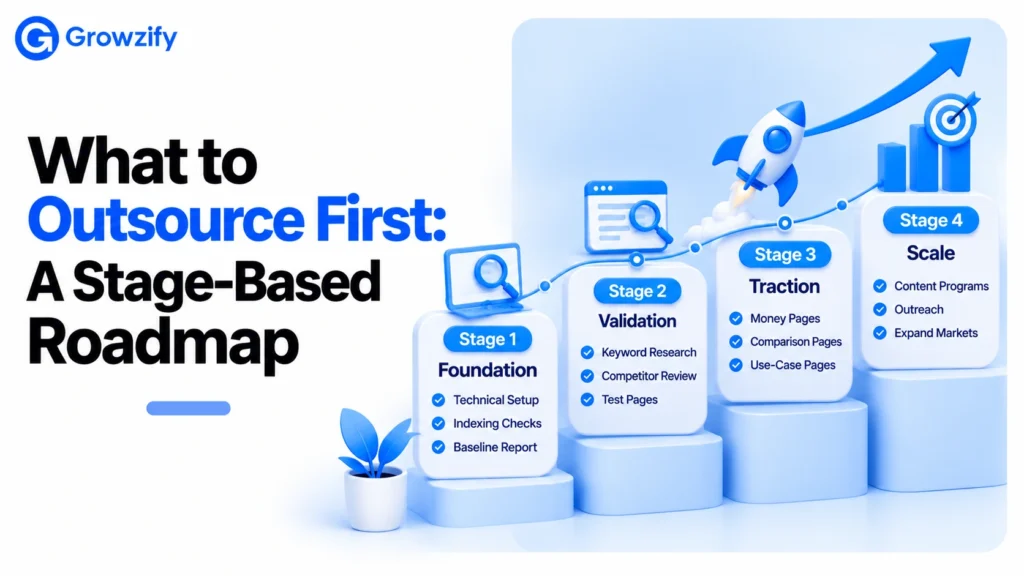
This is a Growzify practitioner framework, not a rule:Foundation → Validation → Traction → Scale. Adjust it to your situation.
| Stage | Typical situation | Good to outsource | Keep in-house |
| 1. Foundation | New or rebuilt site, few pages | Technical setup, indexing checks, site structure, tracking, baseline report | Product facts, positioning, account ownership |
| 2. Validation | Foundation in place, buyers and search demand not yet tested | Buyer-question and keyword research, competitor review, a small set of test pages | Customer insight, expert input, claims review |
| 3. Traction | Some pages live, first signals and leads | Money pages, comparison and use-case pages, reporting | Customer stories, approvals |
| 4. Scale | Steady inbound, evidence of what works | Content programs, outreach, expansion pages | Strategy decisions, brand voice, final approvals |
The stages describe emphasis, not rigid sequential gates. Urgent technical fixes, research, publishing, and measurement can overlap.
Start with the basics. A page that’s inaccessible to Google or excluded from indexing can’t compete normally in Google Search, however good the content is.
Technical eligibility is necessary, but it doesn’t guarantee indexing or ranking. Meeting Google’s technical requirements makes a page eligible for indexing. It doesn’t mean Google will index or rank it.
Ask your provider to check these first:
Growzify’sSEO outsourcing checklistcovers access and handoff preparation in detail.
Before investing heavily, find out which buyer and search problems deserve the investment. A provider can research questions, review competitors, and propose a small set of pages to test.
Focus on pages that match buying intent. For a startup, that often means pages that answer choosing questions, such as how you compare to alternatives, who you’re best for, and what it costs.
Build the assets that early signals support. That might mean the money pages, comparison pages, and use-case pages that are starting to attract the right searches.
A provider can research these questions and draft pages. But the facts must come from you.
Once you have evidence of what works, outsourcing can add capacity. That might mean a regular content plan, outreach for relevant mentions, or pages for new markets.
At this stage, reporting matters more. Agree on what you’ll track, how often, and who reviews it.
Before moving from early work into a large content program, ask:
Don’t outsource content scale simply because the startup has published its first few pages. Scale the parts of the SEO program that have a clear strategic reason and enough evidence to justify continued investment.
You can outsource SEO execution. You can’t outsource product truth. Outsourcing works better when your team stays responsible for the information it’s best placed to provide and check.
A provider can research, interview, structure, write, and optimize. It shouldn’t invent product capabilities, customer outcomes, differentiation, pricing claims, or technical claims.
This doesn’t mean the founder personally does everything. Name an internal subject-matter owner for each area, such as a product lead, sales lead, customer-success lead, or compliance owner.
This matters for another reason.Google’s guide to generative AI featuresasks for unique, helpful content with a unique point of view, and contrasts it with generic “commodity” content. A startup’s first-hand experience is exactly that kind of material. A provider can shape it, but can’t invent it.
This is an illustration, not a real client case. “Lumen Ledger” is a fictional invoicing app for freelancers. It has a 12-page site and no clear SEO setup.
Here’s how the quarter might be split.
Month | Outsourced work | In-house work |
1 | Technical check, tracking setup, baseline report, question research | Customer-problem interview with the product lead |
2 | Three pages: a comparison page, a use-case page, and a pricing explainer | Review facts, add real customer examples |
3 | Fix gaps found in Search Console, plan the next five pages | Decide priorities based on lead quality |
The number of pages here is part of the example, not a recommended monthly publishing quota.
After three months, the startup reviews early signals. It checks whether priority pages are indexed, whether they appear for relevant searches, and whether any visits turn into sign-ups. It doesn’t judge success by rankings alone, because ranking timelines vary.
Cash is tight, so the way you pay matters as much as the amount.
Aprojecthas a clear start, a clear end, and a defined output. An audit, a baseline report, or the first three money pages are good examples. It lets you test a provider without a long commitment.
Aretainerpays for ongoing work. It makes more sense once you know what to keep doing, such as a steady content plan or regular fixes.
Afractional or advisoryarrangement gives you limited senior guidance while your own team executes. It can suit a startup that has writers and developers but lacks SEO strategy and QA.
As a practical starting approach, a startup can begin with a bounded project and move to a retainer once the scope and the working relationship are proven. This is a practitioner suggestion, not a rule.
Whichever you choose, agree three things before you start:
That last point is easy to miss. Reviewing drafts and answering questions takes hours. If nobody on your team has them, the work will slow down whatever you pay.
The vetting process can be lightweight, but it should still verify method transparency, experience, the internal resources the provider needs from you, ownership, and how progress is measured.
Check references, as Google suggests in its hiring guidance. It also warns that if an SEO creates deceptive or misleading content on your behalf, your site could be removed entirely from Google’s index. For a young site, that risk isn’t worth any shortcut.
Be cautious when a provider presents proprietary scores or AI-visibility forecasts as if they came from Google. Google says third-party tools don’t have access to its internal ranking data, and to be wary of tools that claim to be “acceptable” or “approved” by Google Search.
Growzify’s guide onmanaging outsourced SEO for long-term resultscovers how to run the relationship once you’ve chosen.
Startups face a few specific risks.
| Signal | What it tells you | Measurement layer |
| Priority pages indexed | Whether the URLs you intend for Search have been selected for indexing | Technical and search state |
| Impressions for relevant queries | Whether you’re starting to appear | Visibility |
| Clicks and click-through rate | Whether people choose your result | Traffic |
| Non-brand queries | Whether you’re found for what you do, not just your name | Audience acquisition |
| Sign-ups, demos, or purchases from search | Whether organic traffic helps the business | Business outcome |
Use Google Search Console for the first four. Use analytics or your CRM for the last one.
Measure intended indexation, not raw index count. A startup doesn’t need every URL indexed, and more indexed pages isn’t automatically better.
Attribution will be imperfect. Some buyers find you through search, then return by typing your name. Ask new leads how they found you, and treat the answers as directional. Distinguish directly observed or attributed conversions from broader influenced or incremental revenue claims.
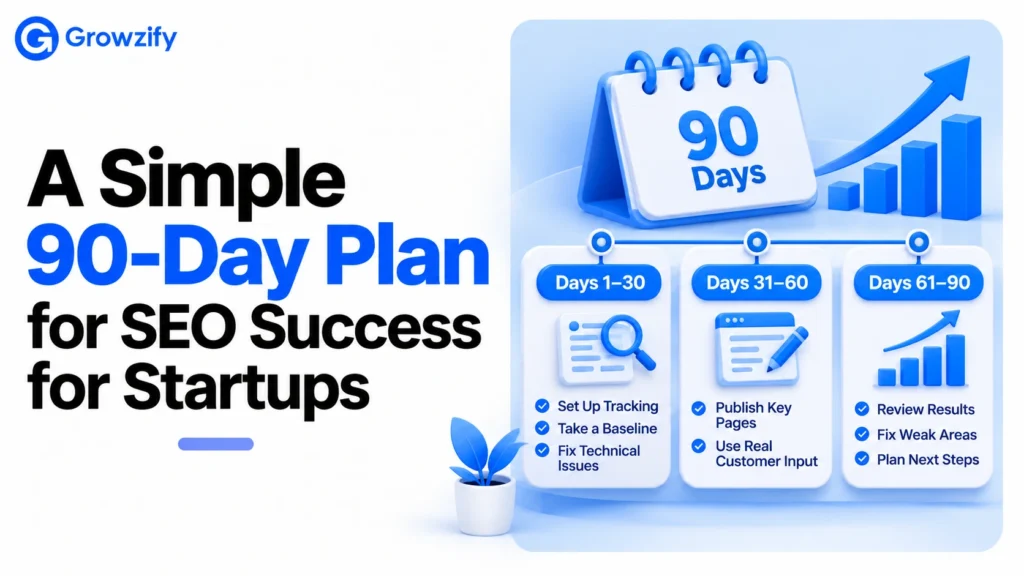
As a practitioner suggestion, here’s a plan you can adapt.
The three phases describe emphasis, not a rigid sequence. A critical technical fix can happen on day one, and research, publishing, and measurement can overlap.
By day 90, a reasonable first-phase goal is to have the technical foundation checked, priority pages published, baseline data in place, and enough early signals to decide what to test next. The actual output depends on the site’s condition, the scope, your resources, and how quickly changes are implemented.
The first 90 days should prove the operating model before they’re expected to prove organic-growth ROI.
AI search adds one more reason to publish distinctive content. Google’s guide says its generative AI features are rooted in its core Search ranking and quality systems, and that you don’t need special files or markup to appear in them.
For many early-stage startups, a separate AI-search program may not be the first priority. Strong technical foundations, clear positioning, and original information support both traditional and generative search visibility.
As a practitioner rule of thumb, hold off on separate AI or GEO work when:
Consider adding AI-specific measurement or access work when the foundation is healthy, your buyers actually use AI discovery, the startup has distinctive content, and the measurement can influence a real decision.
If you want to track AI visibility, Search Console now has aGenerative AI performance report. Google says these insights were rolled out worldwide as of August 31, 2026. The report shows impressions in Google’s AI features by page, country, device, and date. It doesn’t show clicks or queries, so use it as one signal among several.
Some SEO groundwork can begin early, but scaled outsourcing may be premature if:
This isn’t a rule that startups should wait for product-market fit. It’s a check on whether a larger recurring program is ready to be supported.
Many agencies and studios serve startups. If that’s you, the question is different: how to offer SEO without building a full team. Growzify’s guide onhow white label SEO supports startups and small agenciescovers that side.
If you run an agency, studio, or freelance practice that wants a delivery partner, Growzify’swhite label SEO servicesteam can walk through how that works.
It means a startup hires an outside agency, freelancer, or partner to handle parts of its SEO, such as technical setup, research, or content, instead of building an in-house team.
It can give a startup specialist skills and execution capacity without a full internal team. That can help with technical foundations, targeting, content execution, and consistency. Whether it produces organic growth depends on the market, the implementation, content quality, competition, and time. It can’t force Google to crawl, index, or rank a new site on a fixed timeline.
Start with gaps in expertise and infrastructure rather than outsourcing everything. For a new site, that often means technical checks, Search Console and analytics setup, baseline measurement, site structure, and research into high-value buyer questions.
Once those foundations are working, external support can expand into commercial pages, content, outreach, and reporting. Keep product truth, positioning, customer insight, and final factual approval inside the startup.
It can be when the startup has a clear business goal, needs skills or capacity it doesn’t have internally, can supply real product and customer knowledge, and has enough internal capacity to review and implement the work.
Outsourcing is less useful when the startup expects guaranteed fast rankings, can’t support the provider with factual input, or is trying to scale SEO before deciding what it should actually communicate.
There’s no fixed timeline. Google says crawling can take a few days to a few weeks after a recrawl request, which isn’t an indexing or ranking timetable, and it doesn’t guarantee inclusion. In its 2025 study, Ahrefs found that 1.74% of 1 million random URLs reached the top 10 within a year, and 6.11% of newly created, non-empty English pages did. Neither figure is startup-specific or a probability for your site. Track early signals while you wait.
Yes, if a provider uses risky tactics or makes unreviewed changes. Google warns that spam-policy violations and deceptive content can hurt visibility. Ask for methods in writing, check references, and own your accounts.
A reasonable first-phase goal is a checked foundation, priority pages published, and early data on what’s working. The first 90 days should prove the operating model before they’re expected to prove organic-growth ROI. Final ranking and revenue outcomes may take longer and aren’t guaranteed within that window.
If you’re a startup that wants help prioritizing what to outsource and what to keep in-house, Growzify’sSEO outsourcing servicesteam can walk through a first phase with you.

At Growzify, we are dedicated to helping your business achieve its goals. Are you Ready to take the next step?
How Much Does SEO Outsourcing Cost in 2026? Nobody can give you one honest price...
AI SEO Best Practices to Boost Visibility Across LLMs Large language models do not all...

7 AI SEO Content Optimization Strategies to Improve Visibility on AI Search Platforms AI-powered search...
How to Outsource SEO Without Losing Your Rankings Rankings don’t vanish because someone else is...
AI SEO vs Traditional SEO: The Comparison Guide Most “versus” articles frame two rival camps....

How to Rank Ecommerce Sites: Strategies That Actually Work Home Blog SEO How to Rank...

What is AI SEO? How Can Businesses Optimize Their Content for AI Searches A page...

7 White Label SEO Practices That Support Client Retention and Agency Growth White-label SEO helps...
Call Now






Growzify digital team is very effective, and easy to work with. Very strong communication and always up for suggestions. Saw 300% growth in web traffic 170% growth in revenue through Facebook ad’s & Amazon. I recommended them to my fellows and they turned their online business into a money making machine.