


How White Label SEO is an Affordable Solution for Startups and Small Agencies
White label SEO helps startups and small agencies offer professional SEO services without building a full in-house team. This model reduces operational costs while improving scalability and service delivery. Learn how agencies use white label partnerships to grow faster and manage clients more efficiently.

Written byChitranshu Sharma
May 7, 2026
Quick Nav
In today’s digital landscape, as SEO continues to evolve and scale rapidly, competition is growing just as fast. Many startups and small agencies aspire to scale to the next level, and that journey often begins with delivering strong SEO performance. However, building an in-house SEO team from the ground up can be expensive, time-consuming, and difficult to manage early on.
This is where affordable white-label SEO becomes a practical solution for startups and small agencies. It’s a fulfillment model that gives growing businesses access to specialized SEO. Expertise without the burden of hiring full-time teams, investing in expensive tools, or setting up complex internal systems.
With white-label SEO, agencies can take on and deliver projects that would otherwise exceed their capacity from the very beginning. It creates an opportunity to compete with larger players while maintaining cost efficiency. Let’s explore the key factors that make white-label SEO an accessible and scalable option for startups and small agencies.
How White Label SEO Supports Startups and Growing Agencies
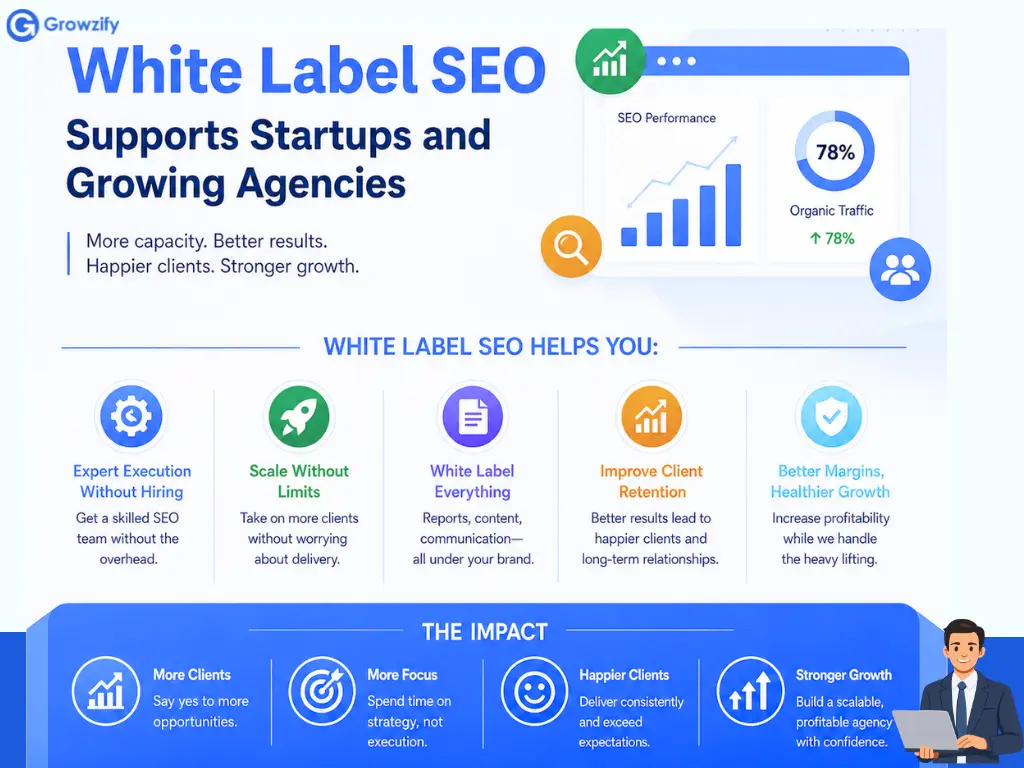
For startups and small agencies, growth often comes with the challenge of delivering high-quality SEO without stretching resources too thin. Building an in-house team takes time, investment, and ongoing management. This is where white-label SEO steps in as a practical support system, helping agencies scale without operational pressure
- Small agencies and startups can offer professional SEO services immediately without an in-house SEO team
- Affordable means right-sized scope and pricing matched to realistic client budgets and agency margins
- The white-label model eliminates fixed costs that make in-house SEO less versatile at small-agency scale. Eliminating costs of salaries, tool stacks, training, and management overhead
- Entry-level white label SEO campaigns start at better prices in general.
Agencies using white-label SEO services through providers start delivering professional SEO within the timeline. When used strategically, white-label SEO becomes a growth enabler and a scalable system. It allows startups and agencies to focus on what truly matters: building client relationships, refining strategy, and scaling confidently, without being held back by execution limitations.
White Label SEO Framework for Small Agency Growth
Scaling a small agency is about building a system that can handle growth without breaking. Many agencies struggle at this stage because SEO delivery becomes complex, time-consuming, and difficult to manage with limited resources.
1. Structured SEO Delivery System
With white-label SEO on board, there is a proper structure to the SEO delivery architecture defined. A small agency must first define how SEO workflows work from onboarding to execution.
- Standardized Deliverable Mapping: Define clear stages for every project, SEO audits, keyword research, technical fixes, content, and reporting—so each client follows the same workflow.
- Avoid Custom Workflow Chaos.Without a defined system, every project becomes unique, slowing delivery and making scaling difficult.
- Predefined Workflows & Timelines:Establish fixed processes, timelines, and milestones to ensure consistency across all campaigns.
- Checkpoint-Based Execution: Introduce review checkpoints at each stage to maintain quality and avoid errors before moving forward.
- Reduced Dependency on Individuals:A structured system ensures work doesn’t rely on specific team members, making operations more stable.
- Improved Turnaround Time:Clear processes and task allocation help deliver results faster without compromising quality.
- Consistent Multi-Client Delivery:Standardization ensures every client receives the same level of service and performance.
- Documented Systems & Tools:Use task management tools, SOPs, and workflows to keep everything organized and trackable.
- Predictable Delivery Cycles.Defined timelines make project execution more reliable and easier to manage.
A well-documented system aligns internal teams and white-label partners, ensuring smooth collaboration. When your delivery is structured, scaling stops being chaotic and starts becoming controlled.
2. Separate the Strategic Layer from the Execution Layer
Growth becomes easier when responsibilities are clearly divided. In a scalable model, agencies should retain control over strategy, client communication, and performance tracking.
- Retain Control Over Strategy:Keep core responsibilities like SEO strategy, planning, and positioning in-house to maintain direction and alignment with client goals.
- Own Client Communication:Agencies should manage all client interactions, updates, and relationship building to ensure trust and consistency.
- Monitor Performance Internally:Track KPIs, results, and overall campaign performance within your agency to stay accountable and informed.
- Reduce Operational Bottlenecks: Separating execution removes workload pressure from internal teams, enabling faster and smoother delivery.
- Maintain Quality with Speed:A structured delegation model ensures work is completed quickly without compromising standards.
- Improve Resource Utilization:Focus your internal team on high-value tasks while execution is handled externally.
- Build a Balanced Growth System:Combining internal strategy with external execution creates a scalable and sustainable agency model.
Technically, this also enables better specialization. Instead of hiring generalists, agencies tap into expert teams already trained in specific SEO functions.
This shift transforms your agency from task-driven to strategy-driven unlocking real scalability.
3. Implement a Modular SEO Service Stack
SEO services should be modular, not scattered. Instead of offering vague SEO services, agencies should break them into defined modules such as technical SEO, on-page optimization, content strategy, and link acquisition. Each module should have clear inputs, outputs, and timelines.
- Seamless Integration with White-Label Teams :A modular setup makes it easier to assign specific tasks to external teams without confusion or overlap.
- Task-Based Assignment & Clarity :Each SEO activity (technical, content, links) can be delegated individually with clear ownership.
- Independent Tracking & Measurement:Every module can be monitored separately, allowing better performance analysis and reporting.
- Improved Accountability & Efficiency:Defined task ownership ensures responsibility, faster execution, and higher quality output.
It also simplifies pricing and packaging, making it easier to sell and scale services. A modular system turns complex SEO into manageable, scalable building blocks.
4. Establish SOPs with Quality Control Layers
Consistency comes from systems, not people. Standard Operating Procedures (SOPs) ensure that every SEO activity follows a defined process. From keyword mapping to technical audits, each step should be documented and repeatable.
- Onboarding SOP:Client goals, niche analysis, baseline audit
- Execution SOP:Task workflows, timelines, responsibilities
- Quality Checks:Multi-level review before delivery
- Reporting SOP:Standard metrics and communication format
Adding quality control layers ensures that deliverables meet agency standards before reaching clients. This minimizes errors and maintains trust.
With strong SOPs, your agency delivers consistency at scale without relying on guesswork.
5. Build a Data-Driven Reporting System
Data is what turns SEO into a business decision. A strong white-label SEO framework includes reporting systems that go beyond rankings.
- Track Meaningful Performance Metrics:Focus on key indicators like organic traffic, keyword rankings, conversions, and revenue impact to measure real SEO success.
- Automated & White-Labeled Reporting:Use automated tools to generate consistent, branded reports that align with your agency’s identity.
- Simplified Data Presentation:Ensure reports are easy to understand, avoiding overly technical jargon for client clarity.
- Use Dashboards for Visual Insights: Leverage dashboards and visualization tools to turn complex SEO data into clear, actionable business insights.
This improves transparency but also strengthens client trust and retention. Technically, integrating tools like Google Analytics, Search Console, and third-party SEO platforms ensures accurate tracking and performance measurement.
When reporting is clear and outcome-focused, clients stay confident and stay longer.
6. Integrate Advanced SEO (Technical + AEO + GEO)
Modern SEO Agencies must integrate traditional SEO with advanced layers like Answer Engine Optimization (AEO) and Generative Engine Optimization (GEO). This includes structured data, schema markup, FAQ optimization, and entity-based content. Technically, this means optimizing for:
- Featured snippets
- Voice search queries
- AI-generated search results
Content should be structured for sers and machines, ensuring higher visibility across evolving search platforms.
This future-proofs your SEO strategy and keeps your agency competitive. Agencies that adapt to modern SEO layers they dominate visibility.
7. Create a Scalable Growth Loop with Feedback Systems
Scaling is a continuous loop. A strong white-label SEO framework includes built-in feedback systems that help refine processes over time. The right white-label partners execute, analyze performance, identify gaps, and continuously optimize workflows.
Start with a small set of clients, test your processes, evaluate results, and improve execution based on real insights. This iterative approach helps build a system that becomes stronger with time.
- Client performance data
- Internal reviews
- Partner insights
This loop helps identify bottlenecks, improve quality, and enhance efficiency. Over time, your system becomes stronger and more scalable.
Instead of reacting to problems, you proactively improve your processes. When feedback drives your system, growth becomes predictable, not accidental.
A strong white-label SEO framework isn’t just about outsourcing; it’s about building a system that supports long-term agency growth. When structure, process, and expertise come together, small agencies gain the ability to scale confidently, deliver consistently, and compete at a higher level.
White Label SEO Case Studies for Growing Agencies
For startups and small agencies, scaling SEO often feels like a trade-off between quality, cost, and capacity. Building an in-house team takes time, while client expectations move fast. This is where white label SEO becomes a practical growth model, allowing agencies to deliver professional results without operational strain.
Case Study 1 : Local Service Agency (Home Services):
A small agency working with local plumbing businesses struggled with inconsistent SEO delivery. By partnering with a white label SEO provider, they streamlined content, local SEO, and link building. Within 4 months, rankings improved, and the agency scaled from 3 to 12 clients without hiring.
Case Study 2 – SaaS Marketing Agency:
A startup agency working with SaaS clients and they needed strong technical SEO and consistent content, but didn’t have the bandwidth. So they brought in a white-label partner to accomplish the targets. That meant audits got done properly, pages were optimized, and authority content went out regularly.
Over time, things started to feel more stable. White label SEO delivered the timely reports for the client’s SEO work with our given SOP’s. Clients stayed longer, results became more predictable, and the team wasn’t constantly scrambling. Instead of juggling execution, they could finally focus on strategy and growth.
Case Study 3 – E-commerce Agency:
An e-commerce agency handling multiple Shopify stores was struggling to keep up with hundreds of product pages that needed optimization, and category pages were barely ranking. Instead of expanding their team, they partnered with a white-label SEO provider.
For one client in the fashion niche, they optimized 150+ product pages, reworked category structures, and built targeted backlinks. Within 3 months, organic traffic increased by ~40%, and new collections started ranking faster without overwhelming the agency’s internal team.
These examples highlight a clear pattern, white label SEO is building a scalable system. It allows agencies to grow confidently, maintain quality, and focus on what truly drives long-term success: strategy, relationships, and consistent results.
From Hustle to Scalable Growth Systems
For startups and small agencies, growth is about building the capacity to serve them consistently. The real constraint is execution. Without systems, even strong demand leads to burnout, missed timelines, and inconsistent results.
White label SEO helps shift this dynamic, where agencies gain access to structured execution that supports scale. Across local services, SaaS, and e-commerce, the advantage is clear: agencies operate more smoothly, retain clients longer, and focus on strategy instead of constant firefighting.
This approach turns SEO from a resource-heavy service into a predictable growth engine. It allows agencies to prioritize relationships, positioning, and long-term planning while maintaining reliable delivery behind the scenes.
In the end, sustainable growth comes from leverage—not just effort. Agencies that build the right systems create a foundation that scales with them consistently and efficiently.
Withwhite-label SEO partnerslike Growzify, agencies gain access to structured workflows and scalable execution models. This helps streamline client campaigns, maintain consistent results, improve retention, and ultimately enables small agencies and startups to grow without operational bottlenecks.
Related reading:SEO Services|White Label SEO Program|Agency SEO Blog

Chitranshu SharmaA growth strategist, digital marketing consultant, and the founder of Growzify, a performance-driven agency helping brands dominate search, shape perception, and build sustainable online visibility. With 8+ years of hands-on experience in Enterprise SEO, Online Reputation Management (ORM), and AI-led traffic generation, Chitranshu has helped startups, public figures, SaaS companies, and cannabis brands outrank competitors — ethically and at scale.
Explore More Articles
How to Find and Compare Local SEO Outsourcing Providers
How to Find and Compare Local SEO Outsourcing Providers Finding a local SEO outsourcing provider...
October 13, 2026Outsourcing
Inside a White Label SEO Campaign: How the Work Gets Done
Inside a White Label SEO Campaign: How the Work Gets Done Clients see a single...
October 13, 2026White Label
How to Vet an SEO Outsourcing Provider Before You Sign a Contract
How to Vet an SEO Outsourcing Provider Before You Sign a Contract A polished proposal...
October 9, 2026Outsourcing

Multilingual SEO Best Practices: Optimize Your Multi-Language Website
Multilingual SEO Best Practices: Optimize Your Multi-Language Website Translating a page and localizing it for...
October 7, 2026SEO
What Makes In-House Enterprise SEO Work Different Day-to-Day?
What Makes In-House Enterprise SEO Work Different Day-to-Day? On a small site, deciding to fix...
October 7, 2026Enterprise

How Core Algorithm Updates Impact Large Sites Differently Than Small Ones
How Core Algorithm Updates Impact Large Sites Differently Than Small Ones A large enterprise site...
October 7, 2026Enterprise
When Should You Outsource SEO? 11 Signs It Makes Sense
When Should You Outsource SEO? 11 Signs It Makes Sense Outsourcing SEO does not necessarily...
September 26, 2026Outsourcing