When Should You Outsource SEO? 11 Signs It Makes Sense
When Should You Outsource SEO? 11 Signs It Makes Sense...
Read More →
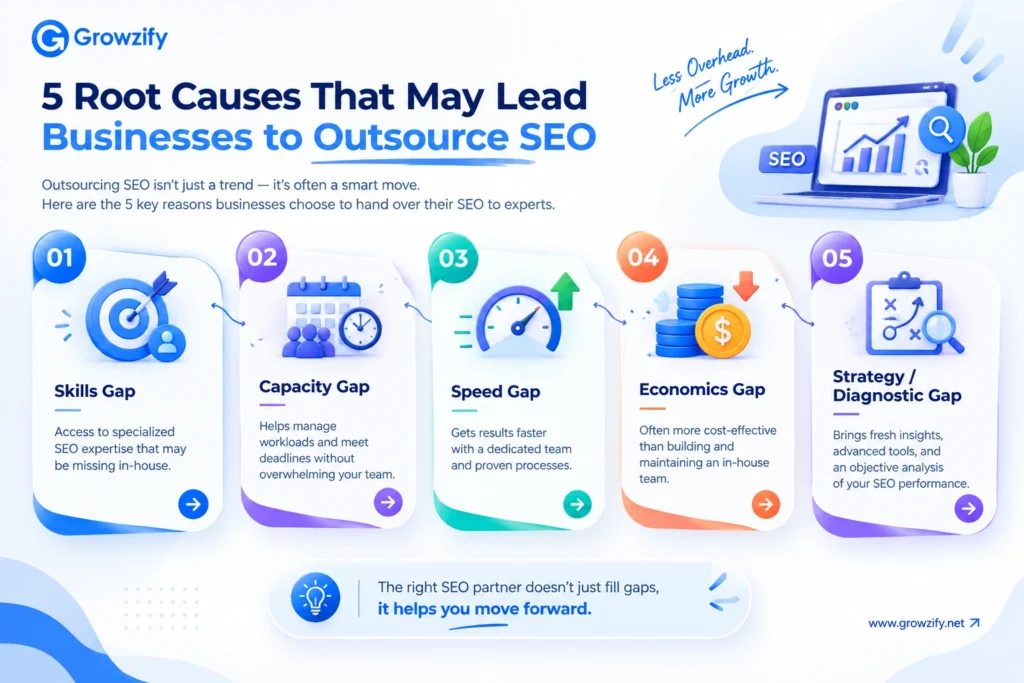
Outsourcing SEO does not necessarily mean an internal team has failed. It can simply mean the required skills, capacity, speed, economics, or strategic clarity no longer fit the current internal setup. A sign tells you what problem to diagnose; it doesn’t automatically tell you to outsource.

The right time to outsource SEO is when a specific, recognizable gap shows up, not when SEO simply “isn’t working.” That gap usually falls into one of five recurring categories: a skills gap (an important capability is missing internally), a capacity gap (SEO work repeatedly misses deadlines because the same people are committed elsewhere), a speed gap (execution needs to start faster than hiring allows), an economics gap (the required internal capability would cost more than outsourcing the same scope), or a strategy/diagnostic gap (effort is going in but nobody internally can explain why results aren’t showing).
Methodology:This guide draws on Google Search Central’s own documentation on evaluating SEO providers, Semrush’s and Shopify’s published research on AI-assisted shopping and search behavior, and recurring patterns Growzify observes helping businesses decide whether to outsource SEO for the first time. Statements attributed to Growzify are practitioner observations, not universal guarantees, and the composite example later in this article is illustrative rather than a specific client case.
Outsourcing too early, before there’s a specific problem to solve, tends to produce a vague engagement with no clear scope, which is hard for any provider to execute well regardless of skill. Waiting too long to address a confirmed skills, capacity, or ownership gap can let missed deliverables and unresolved issues persist longer than necessary.
Growzify sees both patterns regularly: businesses that outsourced too vaguely and businesses that waited too long, which is part of why naming the specific sign matters more than reacting to a general feeling that SEO should be doing better.
The signs below aren’t meant to be scored like a quiz. They’re specific, recognizable patterns worth checking against what’s actually happening inside a business right now, and identifying one is the start of a diagnosis, not the end of it.
SEO can require different capabilities across technical SEO, content, authority development, local search, analytics, and strategy, and an internal team can legitimately split those functions across several people rather than needing one person to master all of them.
Outsourcing becomes worth evaluating when an important capability the current strategy actually requires is missing internally, and there isn’t enough ongoing demand for it to justify building it in-house. Content andtechnical SEOin particular require different capabilities, and depth in each can vary substantially from one practitioner to another.
SEO work competes with sales support, product launches, and client deliverables for the same internal attention. If important SEO work repeatedly misses planned deadlines because the same people are committed to higher-priority responsibilities, that’s evidence of a capacity constraint, not an isolated delay.
It’s worth asking directly whether the work is late because capacity is genuinely insufficient, or because SEO has simply been given lower business priority; those are different problems, and outsourcing addresses the first far more reliably than the second. A single deprioritized item doesn’t necessarily mean much on its own; a consistent pattern of the same work sliding does.

A business that’s genuinely publishing, fixing, and building consistently but still seeing flat organic performance has a different problem than a business that simply hasn’t tried yet, though flat performance on its own doesn’t point to one single cause. It can come from market demand shifts, SERP changes, competitor activity, measurement issues, or genuine strategy problems.
If meaningful SEO work is being implemented but expected outcomes aren’t appearing, the next step should be diagnosis rather than simply increasing output. An independent specialist becomes useful once the internal team has already reviewed the obvious causes and needs a second perspective.
Crawl errors, slow page speed, broken structured data, and indexing problems don’t always announce themselves loudly. They can persist, recur after releases, or go unnoticed entirely, and the underlying cause isn’t always the same: sometimes nobody internally has the skill to diagnose the issue, sometimes the capable person simply doesn’t have the time, and sometimes releases keep reintroducing problems because nobody owns validating them after deployment.
If important crawlability, indexing, rendering, structured-data, or performance issues repeatedly go undiagnosed, external technical expertise is worth evaluating, though it’s worth being clear about which of those causes is actually driving the pattern before assuming more execution capacity alone will fix it.
Hiring and onboarding a permanent specialist usually introduces a longer setup path than activating an already-vetted external provider, though a provider still needs its own vetting, contracting, access, and onboarding time before work genuinely starts.
Where a business has a time-sensitive SEO need, help from SEO outsourcingsupport can meaningfully shorten the lead time to execution compared with a full recruiting cycle. That’s a claim about when work can start, not a promise about when results appear, since those follow a different, less controllable timeline.
International SEO, a new language, or a new regulated vertical each carry specific technical and content requirements a generalist in-house team may not have encountered before.
External specialists can provide that expertise temporarily during an expansion without requiring the business to build the capability permanently in-house, though that expertise should still be validated for the specific market, language, and regulatory context involved rather than assumed from generic SEO experience alone.
AI-assisted research is becoming another discovery layer alongside traditional search.Semrush’s 2026 studyof 1,030 U.S. shoppers who had used AI tools found 77% use AI and traditional search together, with only a small minority relying mostly on AI.
Shopify reportsthat AI-chatbot referral sessions to its merchants grew more than eightfold year over year by Q1 2026, though organic search still referred more total traffic than every tracked AI platform combined; that figure is ecommerce-platform data specific to Shopify storefronts, worth treating as a directional signal for commerce rather than a universal pattern across every industry.
A competitor’s appearance in a defined set of relevant queries in AI search overviews is an observationis a visibility observation, not proof outsourcing is necessary on its own. First, confirm those queries are actually commercially relevant, that the measurement is repeatable, and that the internal team genuinely lacks experience evaluating brand and entity representation, relevant content coverage, third-party mentions, and citation patterns in AI results, before treating the gap as something that requires outside help.
If outsourcing is being considered specifically for AI-search or generative-engine optimization, it’s also worth asking a provider to separate recommendations grounded in official platform documentation from its own testing, and from whatever a third-party monitoring tool happens to report.
A single hire provides one person’s particular mix and depth of skills; broader or more specialized SEO requirements, technical, content, and link building together, for example, may still require additional expertise once salary, benefits, tools, and management overhead are all counted.
Outsourcing tends to be more economical when a business needs capabilities that would require several internal roles but doesn’t have enough sustained SEO workload to keep those roles well utilized. The comparison should be made using the actual cost of the specific internal capability needed versus the proposed outsourced scope, not a universal revenue threshold.
Growzify’sdetailed cost comparison between an in-house SEO team and outsourced deliverywalks through that math in depth for agencies weighing the same delivery-model decision for their own client work; the underlying cost logic (fixed team cost versus usage-linked outsourced cost) applies to any business, even though that specific guide is written for an agency audience.
A business publishing content and tracking a few metrics isn’t the same as a business that can explain, in plain terms, whether its SEO investment is producing results. A dashboard is evidence that data is available, not evidence that anyone can actually interpret it.
If reporting exists but the business can’t connect SEO activity to agreed goals or explain what should change next, that points to an analytics or strategic-interpretation gap, not necessarily a lack of data. External support becomes useful specifically when that interpretation capability isn’t available internally.
A business entering a growth phase often needs to cover far more keywords, locations, or content topics than its current output supports. Outsourcing lets that coverage expand without a proportional increase in permanent staff, which matters especially when the growth might not be permanent.
That additional coverage still needs to be justified by real search demand, business relevance, and quality; scaling page or content volume for its own sake isn’t an SEO objective, andGoogle’s spam policiesspecifically target content produced at scale primarily to manipulate rankings regardless of whether a human, automation, or AI produced it. Scale coverage because there are genuinely more relevant intents worth serving, not simply to add more indexable pages.
In some businesses, SEO sits with a broader marketing role rather than a dedicated specialist, layered on top of that person’s actual job. That’s a reasonable starting point, and a generalist with enough time and genuine depth can manage SEO effectively.
It becomes a constraint specifically when the role lacks the time, specialist depth, or clear ownership that the current strategy actually requires, not simply because the title isn’t “SEO specialist.”
The following is an illustrative, composite scenario built from patterns Growzify sees businesses go through before deciding to outsource, not a specific named client.
Consider a 20-person B2B software company where SEO had been handled by the same marketing generalist who also managed email campaigns and social media. Content got published roughly monthly, technical issues were fixed only when something visibly broke, and nobody could say with confidence whether the current approach was actually working.
The trigger wasn’t a single dramatic event; it was three of the signs above showing up at once: SEO consistently lost out to other priorities, a competitor had begun appearing repeatedly across a defined set of commercially relevant AI-search queries the company was monitoring for its core product category, and building a specialized internal team wasn’t realistic at the company’s current marketing budget.
Rather than waiting for a bigger crisis to force the decision, the company brought in outsourced support specifically for technical SEO andAI-search visibility in overviews and LLMs, while keeping content strategy and brand voice decisions internal.
The scope stayed narrow and specific, tied to the signs that had actually shown up, rather than a broad, undefined “help us with SEO” engagement. The company outsourced the constraint, not the department.
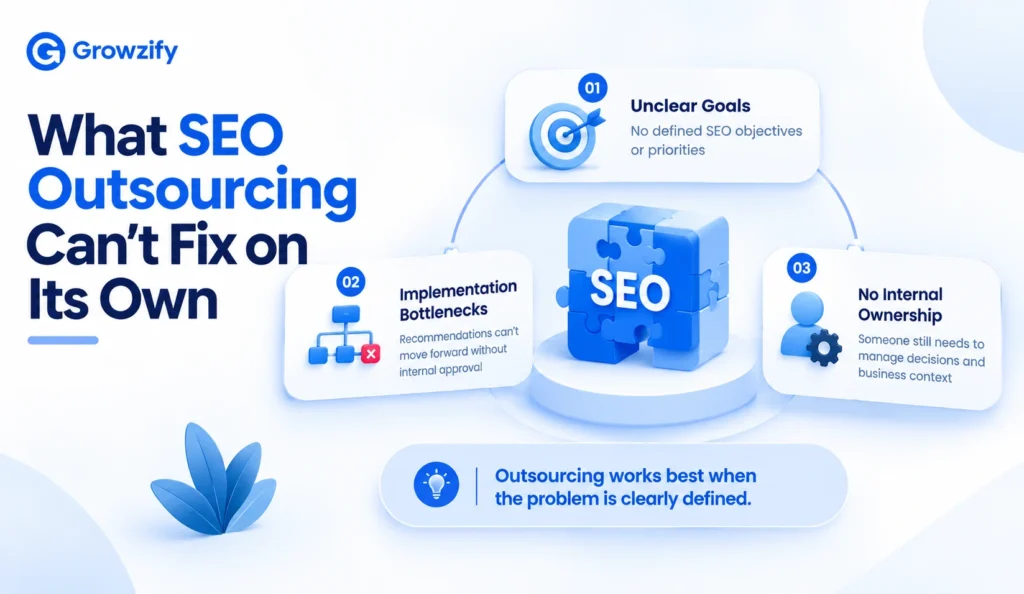
Outsourcing addresses a skills, capacity, speed, economics, or strategy/diagnostic gap; it doesn’t automatically fix a business that hasn’t decided what success actually looks like, or a website with fundamental product-market issues no amount of SEO execution can compensate for.
A provider can execute well and still produce disappointing results if the underlying goals were vague going in, since good execution against the wrong priorities still produces the wrong outcome.
It also can’t solve an implementation bottleneck by itself. If nobody internally can approve or deploy technical, content, or product changes, an outside provider’s recommendations can simply pile up into a better-documented backlog rather than actually shipping.
And it doesn’t remove the need for someone internally to own the relationship: even a fully outsourced engagement needs a named person who can approve decisions, answer questions about the business, and evaluate whether the work is actually serving real goals, not just producing activity.
Growzify’scomparison of outsourced SEO against building an in-house teamcovers this trade-off in more depth, including the scenarios where keeping SEO in-house is still the better call.
Once outsourcing looks appropriate,Google’s own current guidancerecommends evaluating a provider’s previous work, methods, and expectations directly, rather than taking guarantees or tooling claims at face value, regardless of which sign prompted the search for outside help.
Grouping the signs above by root cause makes it easier to see what actually needs solving, since the right response differs depending on which category applies. The middle column is a starting point worth investigating, not a determined fix.
| Root cause | Signs it shows up in | Possible response |
| Skills gap | 1, 6, 2007 | A specialist project, targeted training, a new hire, or an external partner |
| Capacity or process gap | 2, 4, 10, 11 | Reprioritization, a process change, a new hire, or external capacity, depending on which is actually the bottleneck |
| Speed gap | $5 | Vetted external support where it’s genuinely faster to activate than hiring |
| Economics gap | $8 | Comparing utilization-adjusted internal cost against external delivery cost |
| Strategy / diagnostic gap | 3, 9 | An independent audit or second opinion before expanding execution further |
A business showing signs from only one category has a narrower, more clearly scoped problem than one showing signs across several categories at once. Multiple gaps may justify evaluating broader support, but the actual solution should still be scoped to the specific underlying problems rather than chosen based on the number of signs alone.
A skills, capacity, speed, economics, or strategy gap tells you what problem needs solving. It doesn’t automatically determine the operating model that should fix it.
Outsourcewhen the capability is needed now but demand, utilization, or strategic importance doesn’t justify building the full capability internally.
Hirewhen the work is persistent, strategically important, and stable enough to keep internal capacity meaningfully utilized.
Fix the processwhen the necessary expertise already exists internally, but work is being blocked by unclear ownership, competing priorities, slow approvals, or an implementation bottleneck, since buying more strategy won’t unstick a backlog nobody can approve.
Use a hybrid modelwhen strategic ownership or client context genuinely belongs internally while specialist execution or capacity varies over time.
This is why the decision should start with the gap rather than with a provider’s pitch. Outsource the constraint, not automatically the department.
None of these 11 signs individually forces a decision. Together, they’re a way to name what’s actually happening internally: a skills gap, a capacity gap, a speed gap, an economics gap, or a strategy and diagnostic gap, rather than reacting to a vague sense that SEO should be doing better.
Once the gap is named, the right response might be outsourcing, hiring, fixing an internal process, or a hybrid of the three. If several of these signs sound familiar, Growzify’sSEO outsourcing servicesteam can help figure out exactly which gap applies and what scope of support would actually close it.
If the business weighing this decision is itself an agency deciding whether to resell SEO under its own brand rather than deliver it directly, Growzify’swhite label SEO servicesteam is the more relevant starting point instead.
Outsourcing is worth evaluating when a business has a persistent skills, capacity, speed, economics, or diagnostic gap that can’t be solved efficiently within the current operating model. The presence of a gap doesn’t automatically require full outsourcing; a specialist project, an internal hire, a process change, or a hybrid structure may be the better intervention depending on which gap actually applies.
No. Falling rankings are a symptom, not a diagnosis. Check demand shifts, SERP changes, technical problems, measurement issues, and competitive activity, along with internal execution, before concluding that an external provider is the right response.
No. Outsourcing can simply mean the business needs specialist capability, additional capacity, or a different cost structure that the current internal setup doesn’t provide, not a verdict on the team’s competence.
Yes. Many businesses outsource specific disciplines, technical SEO or link building, for example, while keeping content strategy or brand decisions internal. Scoping the engagement to the specific gap tends to work better than an undefined “handle everything” arrangement.
There’s no single SEO-results timeline. An outsourced provider may be able to begin execution sooner than a newly recruited employee, but when performance changes become measurable depends on the specific work, the site’s starting point, and how search systems process those changes.
A single mild sign isn’t necessarily a strong case for outsourcing on its own. It’s worth checking whether that one sign is likely to compound over the next few quarters; an isolated technical backlog is different from a persistent skills gap that will keep resurfacing.
Is it cheaper to outsource SEO than hire in-house?
It depends on the specific capability needed and how much sustained workload exists to support it, since outsourcing avoids the fixed cost of salary, benefits, and tools that exist regardless of workload, while an in-house hire doesn’t. There’s no universal revenue threshold; the comparison needs to be run using the business’s own actual cost and workload figures rather than a flat “always cheaper” claim.
Not necessarily. Many businesses keep strategic direction and brand decisions internal while an outsourced partner handles execution, provided that division of responsibility is agreed clearly at the start rather than left ambiguous.
Yes, and it’s a reasonable path once volume and internal expertise justify it. Keeping ownership of core accounts, analytics, and documented strategy throughout the outsourced engagement makes that eventual transition smoother, since the business isn’t starting from zero if it later brings the work back in-house.
Outsourcing without naming the specific gap first. A vague “help us with SEO” engagement is harder for any provider to execute well than a scope tied to a specific sign, a skills gap, a capacity gap, a speed need, an economics decision, or a strategy question, since the provider knows exactly what problem they’re being brought in to solve.

At Growzify, we are dedicated to helping your business achieve its goals. Are you Ready to take the next step?
Call Now






Growzify digital team is very effective, and easy to work with. Very strong communication and always up for suggestions. Saw 300% growth in web traffic 170% growth in revenue through Facebook ad’s & Amazon. I recommended them to my fellows and they turned their online business into a money making machine.