When Should You Outsource SEO? 11 Signs It Makes Sense
When Should You Outsource SEO? 11 Signs It Makes Sense...
Read More →
Focus on building a structured partnership with your SEO provider. It covers setting clear goals, defining responsibilities, creating a shared roadmap, maintaining communication, measuring meaningful outcomes, and continuously refining the strategy for sustainable organic growth.

Managing outsourced SEO for long-term results requires more than reviewing monthly deliverables. The business needs a system for setting goals, defining decision rights, moving recommendations into implementation, measuring search and business outcomes separately, reviewing provider performance, and changing priorities when evidence or business conditions change. The external provider can own agreed execution, but the business still needs internal ownership of approvals, implementation dependencies, measurement definitions, and strategic direction.
These days, digital experiences shape how people discover, evaluate, and connect with a business. Behind every strong online presence is often a mix of strategy, expertise, and consistent execution. As SEO becomes more complex and competitive, businesses are increasingly looking beyond their internal teams for the right expertise and resources to keep organic growth moving forward.
Outsourcing SEO can give a business access to specialized expertise, scalable execution, and a broader range of skills without building a large in-house team. But hiring an SEO agency or external partner does not automatically create long-term organic growth.
The way the partnership is managed matters just as much as the SEO work itself. Clear goals, defined responsibilities, consistent communication, meaningful reporting, and regular strategic reviews help turn outsourced SEO from a collection of tasks into a sustainable growth process.
The goal is to create the right structure for your internal team and SEO partner to work toward the same outcomes. From setting clear goals and responsibilities to building documented SEO workflows and measuring performance, each step plays a role in makingoutsourced SEO services more effective. Let’s walk through how to build and manage that structure for long-term results.

Beforeoutsourcing SEO, it is important to agree on what success actually means for the business. Without clear goals, SEO can quickly turn into a list of completed tasks keyword research, content creation, technical fixes, link building, and monthly reporting without a clear connection to business growth.
What do we want SEO to achieve?Depending on the business, the goals could include:
Once the goals are clear, establish a starting baseline. Look at current organic traffic, rankings, conversions, visibility, and other relevant metrics. This gives teams a clear point of comparison and makes it easier to measure whether the SEO strategy is actually moving the business forward.
The clearer the starting point and desired outcome, the easier it becomes to prioritize the right SEO work and evaluate progress over time.
A structured SEO management system creates clarity from the outset. It aligns business goals, SEO priorities, responsibilities, timelines, and workflows so internal teams and external partners understand what needs to happen and why. Establishing this foundation early reduces confusion, improves collaboration, prevents unnecessary delays, and ensures that outsourced SEO activities remain aligned with measurable business objectives and long-term growth.
Publishing 20 articles is an activity. Increasing qualified organic traffic from those articles is an outcome. Resolving 50 technical findings is a delivery measure. Successful crawling, rendering, canonicalization, or indexing is a technical outcome. Improved search visibility is a search outcome. Leads or revenue are business outcomes. Those stages should be measured separately rather than treated as one result. This distinction keeps the partnership focused on impact rather than simply volume of work. For broader guidance on evaluatingSEO performance, Google Search Central provides useful context on monitoring and assessing changes in organic search.
Outsourced SEO works best when both sides know what they own. The SEO partner may be responsible for research, strategy, recommendations, content planning, technical audits, optimization, reporting, and ongoing analysis. The internal team may control website development, approvals, brand guidelines, product information, subject-matter expertise, and implementation resources.
Problems arise when these responsibilities remain unclear. A clearly defined framework forSEO partnership responsibilitiescan help establish who owns specific deliverables, approvals, reporting, implementation, and quality control.
| Area | SEO Partner | Internal Team |
| SEO strategy | Lead | Review and align |
| Keyword research | Lead | Provide business context |
| Content strategy | Lead | Provide expertise and approvals |
| Technical recommendations | Lead | Implement or coordinate |
| Content approval | Support | Own |
| Website changes | Recommend | Implement |
| Reporting | Prepare | Review |
| Business priorities | Input | Own |
The exact division will vary by organization, but the principle remains the same: every important SEO responsibility should have a clear owner.
A long-term SEO strategy needs more than a monthly task list.Build an SEO roadmapthat connects SEO initiatives to business priorities and organizes them by impact, effort, dependencies, and urgency. A roadmap could include:
The roadmap should also remain flexible. SEO does not operate in isolation from the business. New products, website migrations, market changes, competitors, and changes in customer demand can all affect priorities.
A good roadmap provides direction without becoming rigid.
Even a strong SEO strategy can struggle when execution is disorganized. A defined workflow makes it easier to move recommendations from planning to implementation.
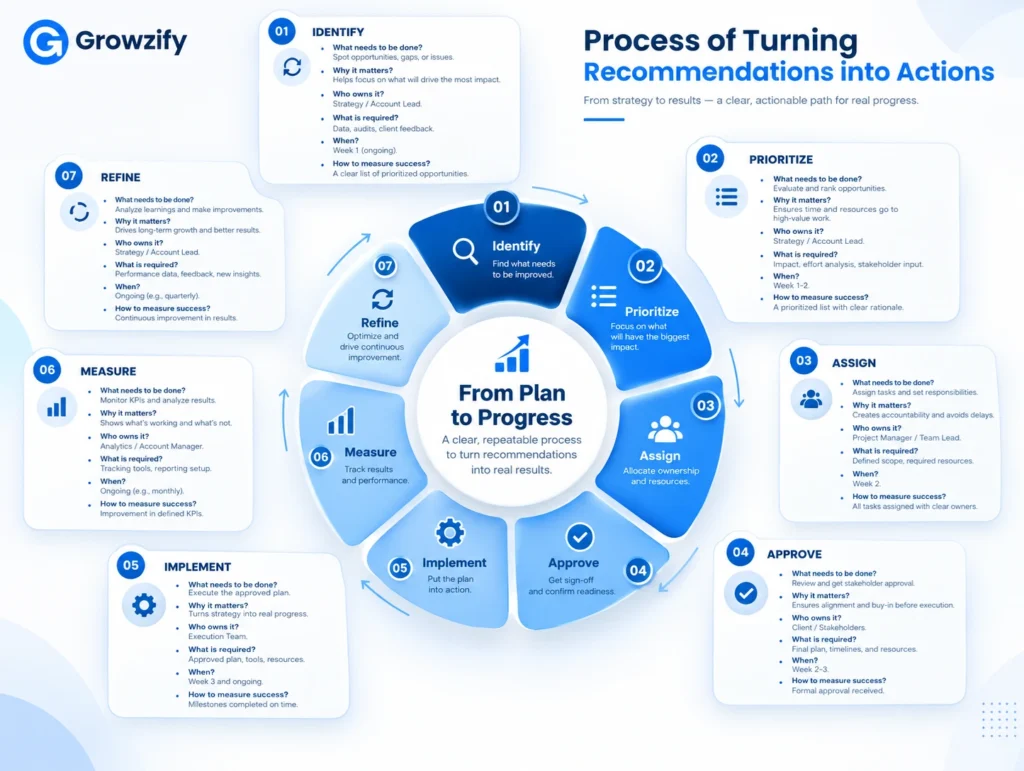
Centralizing this information in a shared project-management system can also reduce unnecessary communication and prevent important tasks from getting lost in email threads or meetings. Even a strong SEO strategy can struggle when execution is disorganized. A defined workflow makes it easier to move recommendations from planning to implementation, whilebackend SEO systemshelp keep those processes organized as work moves between teams.
With a well-defined management structure, businesses can keep outsourced SEO focused, accountable, and adaptable. Clear ownership, organized workflows, regular performance reviews, and shared priorities make it easier to identify what is working and where adjustments are needed. Over time, this creates a more efficient partnership, stronger execution, better decision-making, and a sustainable approach to achieving long-term organic growth.
Outsourced SEO does not require constant meetings. It requires the right conversations at the right frequency. To keep recommendations aligned with business priorities. Create clear channels for updates, feedback, and decision-making throughout implementation. Regular reviews help teams stay accountable, identify gaps early, and maintain progress. A practical structure could include:
Use these for operational matters:
Use these to understand:
Take a broader view of the program:
This structure prevents every meeting from becoming a status update and creates space for strategic decision-making.
Consistent communication keeps everyone informed and responsibilities clearly understood. Ongoing reviews make it easier to measure results, address challenges, and refine the approach. Together, they turn recommendations into sustained improvements with measurable business impact
Managing Outsourced SEO for Long-Term Growth requires a structured approach that connects external expertise with internal business goals. Clear expectations, measurable KPIs, effective collaboration, and defined responsibilities help organizations maintain strategic alignment while building sustainable organic visibility, qualified traffic, and business value.
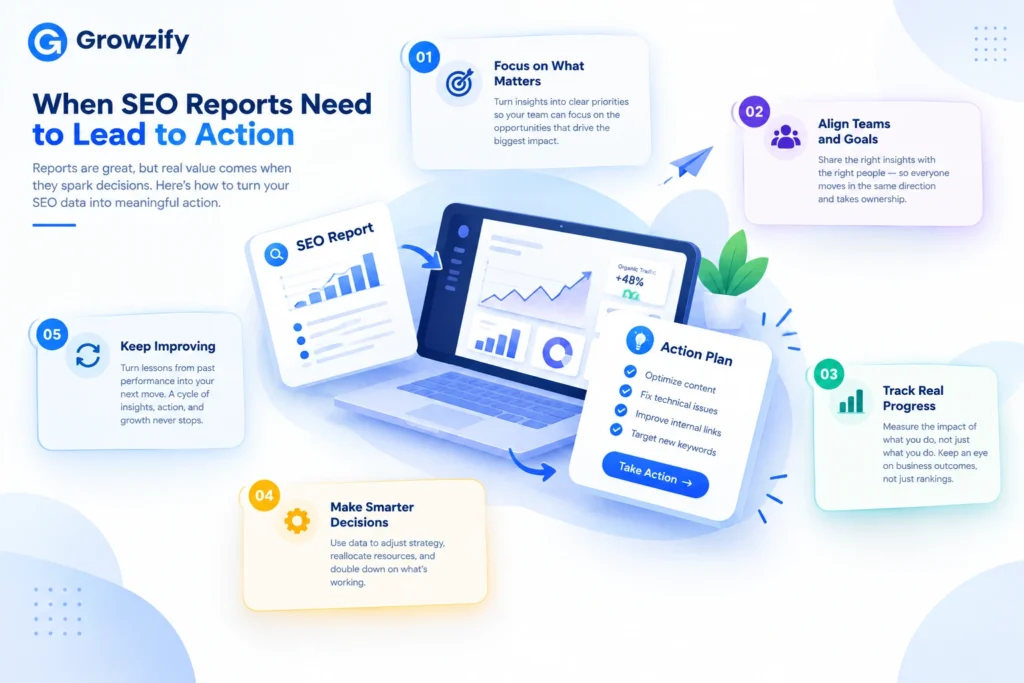
Rankings matter, but they are only one signal of SEO performance. Connect SEO reporting to business outcomes such as organic traffic, qualified leads, conversions, revenue, non-brand visibility, topic visibility, landing-page performance, content-assisted conversions, and technical SEO health. The right metrics should reflect the customer journey and organizational objectives.
A useful SEO report should explain what changed, what the evidence suggests may have contributed, what remains uncertain, and what happens next. What worked, what underperformed, and what happens next. Instead of reporting only traffic increases, identify the pages, topic clusters, search opportunities, and conversions driving performance. This creates a continuous feedback loop between action, evidence, and strategy.
Set clear standards for brand voice, search intent, content quality, internal linking, technical SEO, compliance, approvals, and reporting. This provides visibility while allowing the SEO partner to manage execution efficiently.
SEO depends on developers, content teams, product experts, and marketing stakeholders. Share updates about new products, markets, launches, redesigns, migrations, campaigns, and positioning changes so the strategy remains aligned with business priorities.
Review SEO performance to identify winning initiatives, emerging opportunities, underperforming activities, resource gaps, and market changes. Reallocate effort based on evidence rather than letting the original strategy run unchanged.
Combine SEO expertise with internal subject-matter knowledge through a workflow of research → intent → prioritization → briefing → expert input → review → publishing → measurement → optimization. Prioritize technical SEO recommendations using impact, urgency, effort, and dependencies, with clear owners and follow-up measurement.
Maintain shared documentation covering strategy, technical decisions, content priorities, experiments, performance, and competitor insights. A strong partnership also welcomes questions, evidence, and constructive challenges when recommendations lack business rationale or results repeatedly fall short.
Successful outsourced SEO is built through continuous measurement, collaboration, and refinement. When organizations maintain clear ownership, review performance regularly, and adapt strategies to changing search behavior and business priorities, external SEO expertise becomes a scalable advantage that supports sustainable organic growth and measurable results.
Avoid These Common Outsourced SEO Management Mistakes by establishing clear expectations before work begins. Poor communication, unclear ownership, weak reporting, and excessive focus on rankings can limit results.
Google’s own guidance for businesses evaluating SEO providersis explicit that no one can guarantee a specific ranking, and it warns businesses to be cautious of providers using secretive methods or refusing to explain their work clearly.
For businesses where AI-assisted discovery is relevant, ongoing SEO reviews can now includeGoogle Search Console‘sgenerative-AI visibility reportsalongside conventional Search performance. Treat this as an additional visibility layer rather than a replacement for clicks, conversions, qualified traffic, or commercial outcomes.
Those same warnings are just as relevant eighteen months into a relationship as they are during initial vetting. A provider that starts offering vague explanations, resists walking through its methodology, or asks for broader account access than the current work actually requires is worth the same scrutiny a business would apply before signing in the first place.
A structured management approach helps businesses maintain strategic control, improve collaboration, and ensure outsourced SEO efforts remain connected to measurable business objectives.
Avoiding these mistakes creates a stronger foundation for sustainable SEO performance. Clear responsibilities, meaningful reporting, regular communication, and evidence-based decisions help organizations get greater value from external expertise. When SEO management remains strategic and collaborative, businesses can scale organic growth while maintaining quality, accountability, and long-term alignment.
The way SEO work is outsourced can affect cost, control, communication, and scalability. If you’re comparing different delivery models, this guide breaks down the differences betweenwhite label SEO, freelancers, and offshore teams.
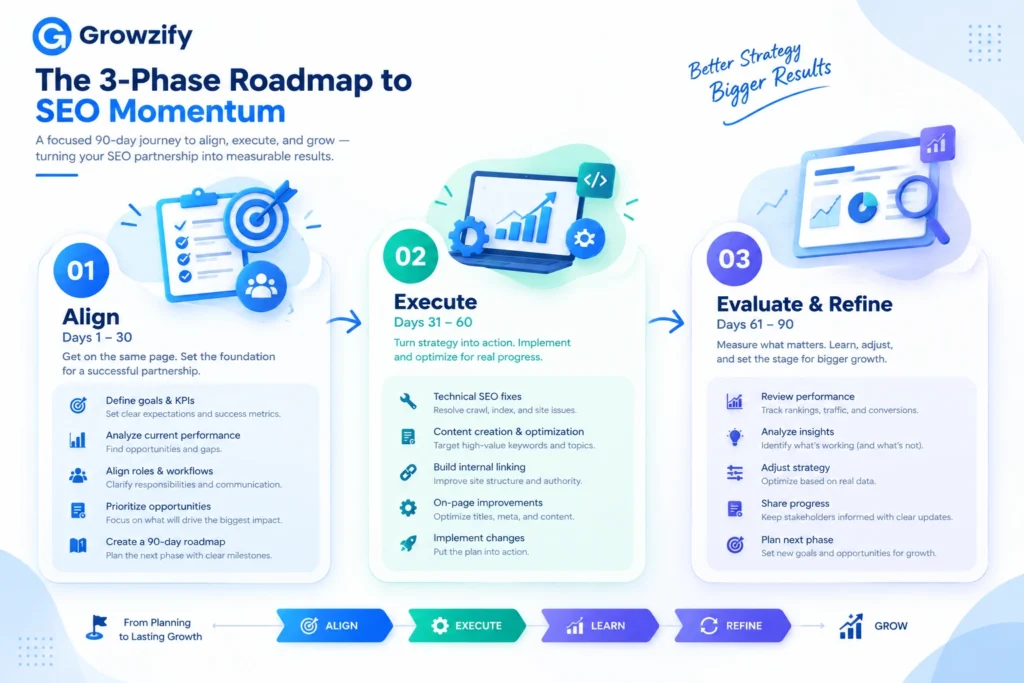
Illustrative 90-Day Partnership Establishment Cycle should be viewed as a flexible starting point, not a fixed timeline. The ideal duration can vary based on business size, website complexity, resources, priorities, and SEO maturity. Use each phase as guidance and adjust it to your organization’s needs. A 90-day framework can provide enough structure to establish the partnership without trying to solve everything at once. Illustrative 90-Day Partnership Establishment Cycle
Focus on understanding the current situation.
The outcome should be a shared understanding of where the business is and where SEO needs to go.
Move the highest-priority initiatives into implementation. This may include:
Track implementation closely enough to identify blockers without micromanaging every task.
At the end of the first 90 days, review:
Then use those findings to build the next-quarter roadmap.
The 90-day cycle should repeat, with each cycle becoming more informed by actual performance. The 90-day framework provides a practical structure for establishing priorities, improving collaboration, and building measurable SEO momentum. However, progress rarely follows an identical schedule for every organization. Review results regularly, adapt timelines when needed, and focus on meaningful outcomes rather than simply completing each phase.
A successful outsourced SEO relationship is not simply one where the agency delivers everything listed in a contract. Look for signs that the partnership is becoming more effective over time. These include:
The strongest sign is that SEO starts functioning as an integrated part of the broader marketing and growth process rather than an isolated activity.
Managing outsourced SEO for long-term results is ultimately about creating the right conditions for collaboration, accountability, and continuous improvement. Start with clear business goals, defined ownership, a shared roadmap, consistent execution, meaningful measurement, and regular strategic reviews. When these elements work together, outsourcing becomes more than task delegation; it becomes a structured growth system.
The real value lies in building a partnership that can adapt as search, markets, and business priorities evolve. For businesses seeking structured support, Growzify’s white label SEO services and SEO outsourcing solutions provide a framework built around sustainable performance and ongoing SEO management. If your business or agency wants that management process built in from the start rather than figured out reactively, Growzify’swhite label SEO servicesandSEO outsourcingteams structure engagements around exactly this kind of ongoing governance.
Set clear business goals, define responsibilities, establish communication routines, create a shared roadmap, monitor meaningful KPIs, and review the strategy regularly.
Operational progress can be reviewed weekly or biweekly, while monthly reviews are useful for performance analysis. A broader strategic review every quarter can help determine whether priorities need to change.
Reports should cover meaningful performance trends, completed initiatives, important findings, challenges, opportunities, and recommended next steps—not just rankings and task counts.
The timeframe varies depending on the website, market, competition, technical condition, content quality, and scope of work. Some improvements may appear relatively quickly, while broader organic growth generally requires sustained execution and measurement.
Measure SEO against the business objectives it is intended to support. Relevant indicators can include qualified organic traffic, leads, conversions, revenue contribution, search visibility, content performance, and technical health.
The internal team should remain involved in strategy, business priorities, approvals, subject-matter expertise, and implementation dependencies while allowing the SEO partner to manage agreed areas of execution.
Reconsider the strategy when performance consistently falls short of agreed objectives, priorities no longer reflect business needs, recommendations lack evidence, or the SEO program is producing activity without meaningful progress.
Evaluate both SEO outcomes and provider operations. Search performance can include relevant visibility, qualified traffic, and business outcomes, while provider performance can include deliverable quality, rework, implementation follow-through, communication, documentation, and issue resolution. One should not be used as a substitute for the other.

At Growzify, we are dedicated to helping your business achieve its goals. Are you Ready to take the next step?

Call Now






Growzify digital team is very effective, and easy to work with. Very strong communication and always up for suggestions. Saw 300% growth in web traffic 170% growth in revenue through Facebook ad’s & Amazon. I recommended them to my fellows and they turned their online business into a money making machine.