AI SEO Best Practices to Boost Visibility Across LLMs
AI SEO Best Practices to Boost Visibility Across LLMs Large...
Read More →
Large language models do not all find, read, or cite content the same way. The practices that hold up across them are the ones that make your content easy to access, easy to trust, and easy to verify.

AI SEO best practices for visibility across LLMs mean making your content crawlable and indexable, answering questions directly, backing claims with specific and verifiable detail, keeping your brand and facts consistent across the web, and measuring citations separately on each platform. Search-connected assistants such as Google’s AI features, ChatGPT search, Perplexity, and Copilot retrieve live pages, so ordinary SEO foundations still apply.
Methodology:This guide draws on Google Search Central’s documentation on AI features, optimizing for generative AI search, crawlers,AI generated content, and spam policies, Google Analytics Help, OpenAI’s, Anthropic’s, and Perplexity’s published crawler documentation, Microsoft’s announcement of the Bing AI Performance report, and Pew Research Center’s 2025 analysis of AI summaries.
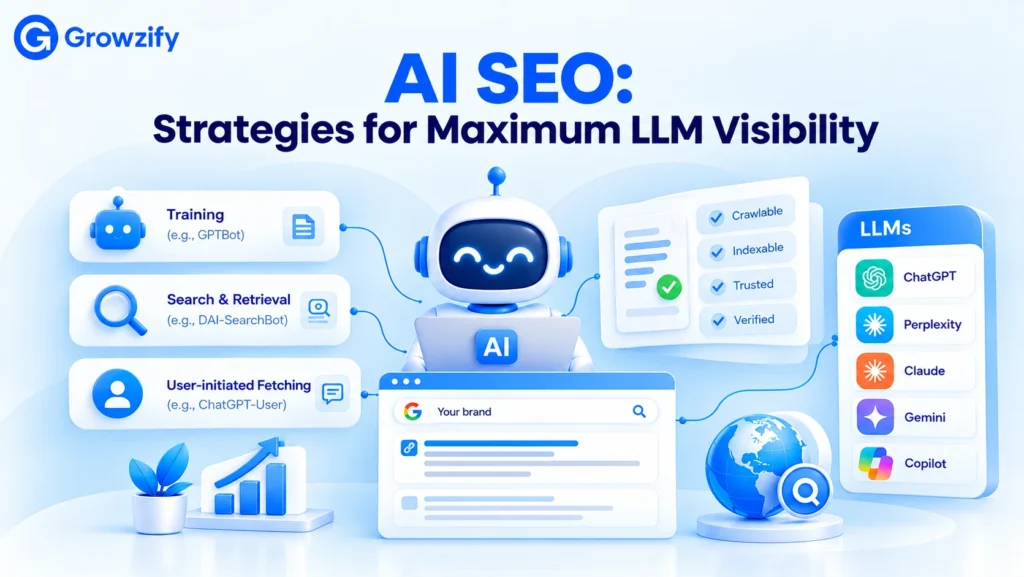
Start with the three different ways an AI system can touch your pages. They are not the same, and they carry different consequences.
Visibility in answers usually depends on the second and third. Blocking a training crawler does not necessarily remove you from search results, and blocking a search crawler can.
This table lists what each company documents about its crawlers.
| Company | Training or AI-use control | Search or retrieval crawler | User-initiated fetcher |
| OpenAI | GPTBot | OAI-SearchBot | ChatGPT-User |
| Anthropic | ClaudeBot | Claude-SearchBot | Claude-User |
| Perplexity | Not used for training, per its docs | PerplexityBot | Perplexity-User |
| Google-Extended (robots.txt control token, not a separate crawler) | Googlebot | Not separately documented |
Google-Extended is different from the other entries in this table because it is a control token, not a separate web crawler. Google’scrawler documentationsays it has no separate user agent string, and that crawling is done with existing Google user agents.
The token lets publishers manage whether crawled content may be used to train future Gemini models and for grounding in Gemini Apps and Grounding with Google Search on Vertex AI. Google says it does not affect a site’s inclusion in Google Search and is not a ranking signal.
These companies publish different crawler and content-use controls. Some are crawler-specific robots.txt rules, while Google-Extended is a product-level control token. Check each provider’s documentation before changing access.

Access restrictions can limit a system’s ability to retrieve and cite current page content. This is the foundation, and it applies to every platform.
For Google, a page must be indexed and eligible to be shown in Search with a snippet to appear as a supporting link in AI Overviews or AI Mode, according toGoogle’s AI features documentation. Indexing and serving still aren’t guaranteed.
Google’s guide to optimizing for generative AI searchadds that a site must also be included in the Search generative AI features setting in Search Console. Check that setting and Google’s current guidance before diagnosing why a page doesn’t appear in generative AI results. Eligibility does not guarantee that Google will select or cite the page.
For other platforms, check the bot rules:
Then check the basics: key content in server-rendered HTML, no accidental noindex tags, working internal links, and fast, stable pages.
Decide deliberately about training. You can allow search crawlers and disallow training crawlers, but that is a business choice, not an SEO tactic.
Search-connected assistants may retrieve and use passages from web pages when constructing answers. A direct opening answer helps readers and may make relevant information easier for retrieval systems to identify.
Use this pattern on pages that target a question:
Google also says its AI features may use a technique that issues multiple related searches across subtopics and data sources to build a response. That means a page can be surfaced for a subtopic of the original question, not only the main query.
So cover the obvious subtopics on the page or in clearly linked pages: definitions, costs, steps, risks, and alternatives.
Growzify’stop 10 AI SEO strategiesarticle covers the wider strategy list. This guide focuses on how the practices apply across platforms.
Specific, verifiable details give readers and downstream systems clearer information to assess than general statements do.
Google also warns that generative models don’t retrieve facts, but predict likely word sequences. Itsguidance on generative AI contentsays to manually fact-check and review AI-generated content for accuracy before publishing. That includes titles, meta descriptions, structured data, and image alt text.
If your team uses AI to draft, build a human review step before anything goes live.
An assistant has to work out who a page is about. Inconsistent names, descriptions, and facts make that harder.
Structured data helps systems understand a page, but it is not a switch that turns on AI visibility. Do not add markup you can’t back up with visible content.
Assistants that search the web can retrieve other pages besides yours. When reliable third-party pages describe your brand consistently, that may give a system more to work with.
Treat this as practitioner judgment. The platforms do not publish a rule that third-party mentions raise citation odds, so avoid promising an outcome.
Worth doing for ordinary brand-building reasons:
Do not buy fake mentions, manufactured reviews, or link schemes. They carry policy and legal risk.
Clear structure helps both readers and retrieval systems.
Keep the page useful when read by a person. If the structure exists only to be extracted, it tends to read poorly.
Out-of-date facts can spread into answers. Set an update routine for pages that carry prices, specifications, laws, or processes.
Several popular tactics have weak support or real risk.
This table summarizes only what the platforms’ own documentation states. It is not a ranking factor list.
| Platform | What the documentation says | What is not documented here |
| Google AI Overviews and AI Mode | Page must be indexed and snippet-eligible, and the site must be included in the Search generative AI features setting in Search Console; no special files or markup needed; may use query fan-out; the two features may use different models | How links are chosen |
| ChatGPT search | OAI-SearchBot is for search; opted-out sites aren’t shown in answers but may appear as navigational links | Selection criteria |
| Perplexity | PerplexityBot surfaces and links sites in search results and isn’t used for model training; Perplexity-User generally ignores robots.txt | Selection criteria |
| Claude | Claude-SearchBot improves search result quality; Claude-User fetches pages for user questions | Selection criteria |
| Microsoft Copilot and Bing | Bing Webmaster Tools includes an AI Performance report with citations, grounding queries, and page-level counts | Which factors drive citation |
Because the selection criteria are not published, tests of “what works” come from third parties and vary. Treat them as hypotheses until you see them hold on your own site.
Measurement is limited, and no single number covers every platform. Use several imperfect signals and keep them separate.
Google Search Console.Google introduced dedicatedSearch Generative AI performance reportsin June 2026, with a global rollout completed by August 31, 2026. They report impressions in generative AI features in Search and Discover. Use them alongside standard Search performance data, and do not treat impressions as clicks, referrals, or conversions.
Bing and Copilot.Microsoft’s AI Performance reportin Bing Webmaster Tools shows citation activity, cited pages, and sampled grounding queries across Copilot, AI summaries in Bing, and select partners. In June 2026, Microsoft addedfour preview features: Intents, Topics, Citation Share, and Compare. Microsoft describes Citation Share as an observational metric, not a ranking system or a measure of traffic share. Citation counts are not rankings, clicks, or proof of business impact.
Google Analytics 4.GA4’sdefault channel groupincludes an AI Assistant channel for visits from sources such as ChatGPT, Gemini, Deepseek, Copilot, or Grok. Google says it excludes Google’s AI Overviews and AI Mode, which count in Organic Search. The channel measures identifiable AI-assistant referral traffic. It does not measure citations or impressions, and visits without usable referral information can still land elsewhere, such as Direct. Review source and medium alongside channel totals.
Prompt testing.Keep a fixed list of questions your customers ask. Run them on a schedule and record whether you are mentioned, which URL is cited, and whether the description is accurate. Answers vary between runs, so look at patterns over time, not single results.
Keep four measurements separate:
| Measurement | What it indicates |
| Search impressions | Visibility in Google’s reported generative AI features |
| AI citations | Pages referenced in supported AI answers, such as in Bing’s report |
| Referral sessions | Visits identifiable as coming from AI assistants |
| Business conversions | Leads, purchases, or other desired actions |
Do not expect traffic to track visibility.Pew Research Center’s analysisof 900 U.S. adults found people clicked a traditional result link in 8% of visits when an AI summary appeared, compared with 15% when it didn’t, and clicked a link inside the summary in 1% of visits. This was one study of Google searches in March 2025, not a forecast for your site.
This plan is a practitioner template. Adjust it to your resources.
This is an illustration, not a real client case. “Northline Metrics” is a fictional analytics software company with a pricing page, a help center, and a blog.
In week 1, it finds its robots.txt blocks every AI crawler by default, including search bots. It decides to allow search crawlers and keep training crawlers disallowed.
It then rewrites its five pages for the highest-value questions so each opens with a direct answer, a short comparison table, and linked sources. It makes sure its company description, product names, and pricing details match across the site and its public profiles.
After a month, its prompt log shows it is mentioned for some questions and not others, with one answer describing an outdated price. It fixes the source page and adds a review date.
It reports prompt-test results, citations where available, and referral sessions as separate items. It does not claim any one change caused the movement.
Keep content crawlable and indexable, answer questions directly, make claims specific and verifiable, keep your entity details consistent, earn credible third-party coverage, and measure each platform separately.
Google says you don’t need new machine-readable files, AI text files, or special markup to appear in Google Search, and that Google Search doesn’t use llms.txt files. The other platforms’ documentation reviewed here doesn’t require one either, so don’t treat it as a requirement.
It depends on what you want. Blocking a search crawler such as OAI-SearchBot can keep you out of that platform’s answers, while blocking a training crawler such as GPTBot addresses model training. Review each company’s documentation before you decide.
No. Answers vary by prompt, user, and time, and no tactic guarantees a mention or citation.
Use Search Console, Bing Webmaster Tools’ AI Performance report, analytics referral data, and a fixed prompt list. None is complete, so compare several and look at trends.
The foundations overlap: crawlability, indexing, quality, and trust. AI SEO adds attention to answer-ready structure, entity consistency, platform-specific crawlers, and measuring citations.
Google says structured data should match the visible page text and that no special schema is required for its AI features. Use it where it accurately describes the page, but don’t expect it to guarantee visibility.
If your business needs support auditing its AI search visibility, reviewing technical SEO, or developing an implementation roadmap, Growzify can help assess the priorities and next steps.

Chitranshu SharmaA growth strategist, digital marketing consultant, and the founder of Growzify, a performance-driven agency helping brands dominate search, shape perception, and build sustainable online visibility. With 8+ years of hands-on experience in Enterprise SEO, Online Reputation Management (ORM), and AI-led traffic generation, Chitranshu has helped startups, public figures, SaaS companies, and cannabis brands outrank competitors — ethically and at scale.

At Growzify, we are dedicated to helping your business achieve its goals. Are you Ready to take the next step?
Chitranshu SharmaA growth strategist, digital marketing consultant, and the founder of Growzify, a performance-driven agency helping brands dominate search, shape perception, and build sustainable online visibility. With 8+ years of hands-on experience in Enterprise SEO, Online Reputation Management (ORM), and AI-led traffic generation, Chitranshu has helped startups, public figures, SaaS companies, and cannabis brands outrank competitors — ethically and at scale.
7 AI SEO Content Optimization Strategies to Improve Visibility on AI Search Platforms AI-powered search...
How to Outsource SEO Without Losing Your Rankings Rankings don’t vanish because someone else is...
AI SEO vs Traditional SEO: The Comparison Guide Most “versus” articles frame two rival camps....
How to Rank Ecommerce Sites: Strategies That Actually Work Home Blog SEO How to Rank...
What is AI SEO? How Can Businesses Optimize Their Content for AI Searches A page...

7 White Label SEO Practices That Support Client Retention and Agency Growth White-label SEO helps...
Content Gap Analysis For Large Enterprise Business Websites Content gap analysis for large enterprise business...
Content Mapping for Conversions: A Guide for Large Enterprise Websites Most enterprise sites don’t have...
Call Now





Growzify digital team is very effective, and easy to work with. Very strong communication and always up for suggestions. Saw 300% growth in web traffic 170% growth in revenue through Facebook ad’s & Amazon. I recommended them to my fellows and they turned their online business into a money making machine.