



Law Firm SEO in AI Search: Which Law Firms LLMs Recommend and Why
AI search platforms and large language models (LLMs) do not recommend law firms at random. They rely on signals such as topical authority, EEAT, content quality, online reputation, brand mentions, and website trustworthiness. This guide explains which types of law firms are most likely to be recommended by AI systems and the SEO strategies that can improve visibility in AI-powered search results and generative answers.

Written byChitranshu Sharma
June 8, 2026
Quick Nav
Law Firm SEO is undergoing a structural shift. Traditional search engines are no longer the only gateway to visibility. AI systems such as ChatGPT, Perplexity, and other large language models are now acting as discovery and recommendation engines for legal services.
These systems do not display ranked lists in the traditional sense. Instead, they generate synthesized answers based on patterns of authority, relevance, and trust across the internet. This changes how law firms are evaluated, compared, and recommended.
In this environment, Law Firm SEO is no longer limited to keywords, backlinks, or technical optimization alone. It now includes entity recognition, topical authority, structured content clarity, and cross-platform reputation consistency.
The firms that understand this shift early will build a long-term advantage in both traditional search visibility and AI-driven recommendations.
Large language models do not rank websites; they identify entities. A law firm is an entity. So is a specific attorney. LLMs are trained on massive datasets that include legal directories, news mentions, court databases, review platforms, and published legal content.
When an AI model encounters a query about a legal topic, it searches its knowledge for entities it associates with that topic. If your firm appears across multiple credible data sources in a consistent way, the model recognizes you as authoritative.
Firms with a fragmented or thin digital presence are essentially invisible to these systems. It is not about domain authority in the traditional sense. It is about data density and entity clarity.
Role of Entity Recognition in Legal SEO
Entity recognition is the process by which AI systems identify who or what something is. For law firms, this means the model needs to understand your firm name, your practice areas, your location, and your key attorneys.
Every time your firm name appears in a legal article, a court filing summary, a news story, or a reputable directory, that is a data point.
LLMs accumulate these signals during training. The more consistent and accurate those mentions are, the stronger your entity profile becomes.
Inconsistencies hurt you. A different address on Yelp than on your website, a misspelled attorney name on Avvo, or a mismatched practice area on a local directory all create noise.
LLMs struggle with noisy entities. They pick firms with clean, confirmed identities. Entity clarity is the foundation of AI search visibility. Before optimizing content, audit every external mention of your firm for consistency.
Content Depth, Topical Clusters, and Authority Signals
AI systems favor firms that own a topic. Not firms that touched it once. A topical cluster is a group of interconnected pages that covers a subject thoroughly.
For a personal injury firm, that might include pages on car accidents, slip and fall cases, medical malpractice, wrongful death, insurance negotiations, and filing deadlines.
Each page links to the others. Together, they signal to both Google and AI systems that your firm genuinely understands this area of law.
Thin content is the enemy. A single generic page about “personal injury law” does not establish authority. AI systems need depth. They need specificity.
A page that explains how comparative negligence works in your state, with real examples and precise legal language, sends a much stronger signal than a vague overview.
Cover your practice areas completely. Answer the questions people actually ask. Write about nuances, exceptions, and local rules. That level of depth is what LLMs extract when forming answers.
Structured Data, Schema Markup, and Website Clarity
Structured data is how your website communicates with machines. AI systems can read your site, but schema markup makes that process faster and more accurate.
For law firms, the most important schema types are LegalService, LocalBusiness, Person (for attorneys), FAQ, and Review. These tell AI crawlers exactly what your firm does, where you operate, who works there, and what clients think of you.
Without a schema, an AI system has to infer this information from your page text. With the schema, you confirm it. Confirmation wins.
Your Name, Address, and Phone Number (NAP) must be identical across your website, Google Business Profile, legal directories, and any schema markup you deploy.
Website structure also matters. A firm with a clean navigation, dedicated practice area pages, location-specific pages, and individual attorney profiles gives AI systems far more to work with than a site with three pages and a contact form.
Local SEO Signals and Geographic Relevance in AI Search
Most legal searches carry local intent.“Divorce lawyer in Austin” or “criminal defense attorney Chicago” are inherently geographic queries. AI systems know this. They factor location signals heavily into legal recommendations.
Your Google Business Profile is still critical.Optimized GBP listings with accurate categories, updated hours, photos, and consistent NAP data feed directly into AI search systems that access real-time local data.
Local citation consistency is equally important.Your firm should appear accurately on Avvo, FindLaw, Justia, Martindale-Hubbell, Super Lawyers, Yelp, and local bar association directories. These sources are frequently referenced by AI models when assembling local legal recommendations.
Location-specific content on your website also strengthens geographic signals. A page titled “Personal Injury Attorney in Denver” with content specific to Colorado law, local courts, and Denver accident statistics is far more geographically relevant than a generic statewide page.
Reviews, Reputation, and Trust Indicators for AI visibility
AI systems treat reviews as structured trust signals. Not just star ratings, but the language inside reviews. When multiple clients describe your attorney as “experienced in DUI cases,” these terms reinforce your practice area expertise in the model’s understanding.
Volume matters. Frequency matters. Recency matters. A firm with 200 reviews over three years is a stronger entity than one with 12 reviews from six years ago. AI systems recognize active, reputable businesses differently from dormant ones.
Awards and recognitions also contribute. Being listed on Super Lawyers, receiving a Martindale AV rating, or appearing in a Best Lawyers publication creates a reference point that AI models learn from. These third-party validations function as reputation citations.
Respond to your reviews. It signals active management of your online presence and contributes to the overall entity health that AI systems evaluate.
How AI Systems Interpret Legal Expertise and Qualifications
AI systems are trained to respect professional authority. In the legal field, that means credentials, bar admissions, years of practice, case outcomes, and peer recognition are all relevant signals.
Attorney bio pages should not be afterthoughts. They should read like detailed professional profiles. Include bar admission states, law school name, years of experience, bar association memberships, and any judicial clerkships.
The more factual and specific a bio is, the more data an AI system has to associate that attorney with a particular expertise domain. Vague bios like “John has over a decade of experience helping clients” provide almost no useful signal.
Specific bios like “John has represented over 400 clients in federal immigration courts across Texas and Oklahoma” give AI systems concrete information to index and reference.
Google’s E-E-A-T framework (Experience, Expertise, Authoritativeness, Trustworthiness) maps directly to what AI systems also look for in legal content. Every piece of content on your site should reflect genuine expertise, not generic advice.
Key differences between traditional SEO and AI-driven SEO
Traditional SEO is about ranking pages. AI-driven SEO is about becoming a trusted source.
In traditional SEO, you optimize for keywords, earn backlinks, and improve technical performance to appear in search results. The user still has to choose you from a list.
In AI-driven SEO, the model makes that choice. You are not competing for position five versus position three. You are competing to be the one firm the AI mentions at all.
Below is a direct comparison of how the two approaches differ:
Signal | Traditional SEO | AI Search SEO |
Primary goal | Rank pages in SERPs | Be cited in AI-generated answers |
Content focus | Keyword density and page optimization | Topical depth and entity authority |
Link signals | Backlinks and domain authority | Entity mentions and citation consistency |
Local signals | GBP and local citations | GBP + NAP consistency + geo-specific content |
Trust signals | Page authority and anchor text | Reviews, credentials, and third-party validation |
Structured data | Helpful for rich snippets | Critical for entity clarity and AI parsing |
Content format | Long-form articles with keywords | Direct answers, FAQs, and conversational content |
Why Law Firms Lose or Gain Visibility in AI-Generated Answers
Law firms gain visibility in AI answersbecause they have established clear entity profiles, produce topically authoritative content, and appear consistently across credible third-party sources.
Law firms lose visibility for predictable reasons. The most common one is entity fragmentation. The firm name is listed differently across directories.
The address is inconsistent. Practice areas are vague or unlisted. AI systems cannot confidently identify the firm as a reliable source.
Another common reason is content shallowness. Firms that publish generic “what is personal injury law” articles without going deeper into jurisdiction-specific details do not register as authoritative. The AI learned from experts. It recommends experts.
Poor review profiles also contribute to invisibility. A firm with few reviews, unresolved complaints, or inconsistent client feedback reads as less trustworthy to AI systems that process reputation signals at scale.
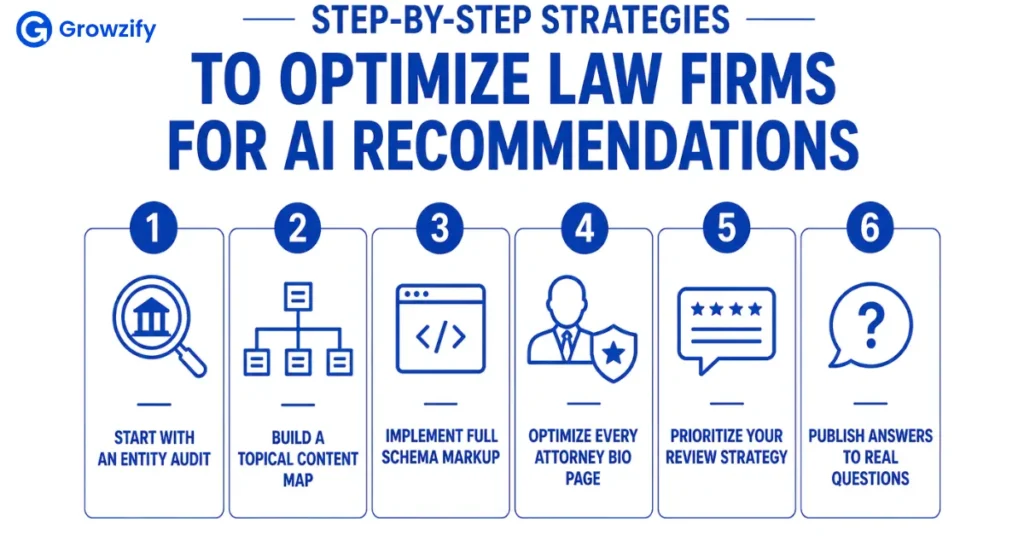
Step-By-Step Strategies for Optimizing Law Firms for AI Recommendations
Start with an entity audit
Search your firm name across Google, AI tools, and legal directories. Note every inconsistency. Fix them all. Make your firm’s digital presence consistent, complete, and verifiable.
Build a topical content map for each practice area
Identify every sub-topic, common question, and jurisdiction-specific nuance. Create dedicated pages for each. Interlink them into a coherent cluster.
Implement full schema markup
Add LegalService, LocalBusiness, Person, FAQ, and Review schema across your site. Use Google’s Rich Results Test to verify implementation.
Optimize every attorney bio page
Include credentials, case experience, bar admissions, and specific outcomes. Write bios as detailed professional profiles, not marketing copy.
Prioritize your review strategy
Ask satisfied clients to leave detailed reviews that mention the practice area and outcome. Respond to all reviews. Build review volume on Google, Avvo, and Justia.
Publish answers to real questions
Use tools like Google’s People Also Ask, legal forums, and client intake data to find the exact questions your target clients ask. Write clear, direct answers to each one. Format them as FAQ content where possible.
Role of Citations, Backlinks, and Mentions in LLM Training Signals
Backlinks remain important for traditional search. But for AI systems, the concept of citation is broader.
An LLM trained on legal news articles, bar association publications, and court records learns which firms are mentioned in credible contexts.
Being quoted as an expert in a legal news article or having your attorneys cited in legal commentary creates the kind of high-quality mentions that feed LLM training data. These are not standard backlinks. They are credibility signals embedded in text that AI systems process.
Guest contributions to legal publications, expert commentary for journalists, and participation in court-reported cases all leave digital traces. Those traces become part of the information landscape that LLMs draw from when answering legal questions.
AI search is conversational by nature. Users ask complete questions. They expect direct answers. Your content should match that format.
A page titled “How Long Does a Divorce Take in California” is more useful to an AI system than a page titled “California Divorce Information.” The former mirrors a real question. The AI can extract a direct answer from it. The latter is a category page with no clear answerable intent.
Structure your content to answer specific questions in the first two to three sentences. Then go deeper. This format allows AI systems to pull clean excerpts when generating responses. Firms whose content surfaces as clean answers get cited more often.
Use natural language throughout. Write the way a knowledgeable attorney would explain something to a first-time client. Avoid jargon for its own sake. Clarity is what AI systems reward.
How to Structure Attorney Bio Pages for LLM recognition
Attorney bio pages are among the most important pages on a law firm website for AI visibility. Yet most firms treat them as filler.
Each bio should include:
- Professional headshot
- Full name
- Bar admission states
- Law school and graduation year
- Practice areas with specific case types
- Notable case experience
- Publications or speaking engagements
- Bar association memberships
- Personal note that makes the attorney human and approachable
Write bio content in the third person. Use the attorney’s full name multiple times. Include the firm name and location.
Reference specific case types by name. This density of factual, specific information is exactly what helps AI systems build a confident entity profile for that attorney.
Create a schema markup entry for each attorney using the Person schema type. Link their bio to their Google Knowledge Panel if one exists.
Connect their profile to LinkedIn and their bar association listing. Every verified connection strengthens its entity signal.
Building a Legal Content Ecosystem that AI Systems Trust
AI systems trust ecosystems, not individual pages. A law firm that publishes one article and a few practice area pages is not an ecosystem. It is a brochure.
An ecosystem includes practice area pillar pages, jurisdiction-specific sub-pages, attorney bios, client FAQ sections, case study summaries, glossary pages for legal terms, news and blog content, and intake-focused landing pages.
These pages reference each other. They cover the same topics from different angles. They leave no important question unanswered.
This density of interconnected, expert-level content is what convinces an LLM that your firm is a credible and complete source of legal information.
It takes time to build. But once built, it compounds. Every new page you add makes the entire ecosystem stronger and more likely to appear in AI-generated recommendations.
Is Your Law Firm Invisible to AI Search? Growzify Can Fix That
Most law firms built their digital presence for a different era. They optimized for keywords. They built backlinks. They focused on page-one rankings. That work still matters. But it is no longer enough.
AI search has changed the rules. ChatGPT, Perplexity, and Google’s AI Overviews now recommend law firms directly inside their answers. Clients read those answers and call the firms they mention. If your firm is not in those answers, you are losing clients to competitors who are.
What Growzify does differently for law firm SEO
Growzify is a digital marketing agency that specializes in helping law firms grow their visibilityin both traditional search and AI-powered discovery systems. The approach goes beyond basic SEO.
The team at Growzify starts with an entity audit. Every external mention of your firm is reviewed for consistency. Name, address, phone number, practice areas, and attorney credentials.
All of it gets aligned across your website, Google Business Profile, and legal directories. That clarity is what AI systems need to confidently recommend your firm.
From there, Growzify builds a topical content strategy tailored to your practice areas. Not generic articles. Deep, jurisdiction-specific content that answers real questions your target clients are asking. Content that is structured for both Google rankings and LLM citations.
Growzify does not chase short-term wins. The goal is to build a law firm’s digital presence into something AI systems recognize as a credible, authoritative source worth recommending again and again.
Core areas Growzify covers for law firm clients
- Entity SEO and AEO optimization
- Local SEO and citation management
- Topical content ecosystems
- Schema markup and structured data
- Review and reputation strategy
- Attorney bio optimization
- AI search visibility tracking
Why law firms trust Growzify
Law firm SEO is a specialized field. Generic marketing agencies often miss what matters most in legal search. Practice area nuance. Jurisdiction-specific signals. The trust hierarchy that AI systems apply to legal content. Growzify understands all of it.
The team works with law firms across practice areas, including personal injury, family law, criminal defense, immigration, estate planning, and business litigation. Each strategy is built around the specific signals that matter for that area of law and that geographic market.
Firms that work withGrowzifydo not just rank higher. They become the firms that AI systems learn to recommend. That is a fundamentally different kind of visibility. It compounds over time. And it is increasingly where legal clients begin their search.
Frequently asked questions
Q: What is Law Firm SEO, and why does it matter more now than before?
A: Law firm SEO is the practice of optimizing a law firm’s digital presence to appear in relevant search results when potential clients look for legal help. It matters more now because AI search tools like ChatGPT and Perplexity have added a discovery layer. These systems actively recommend specific firms in their answers. If your firm is not optimized for both Google and AI search, you are missing a growing share of client inquiries that never reach a traditional search results page.
Q: How does ChatGPT decide which law firm to recommend?
A: ChatGPT draws on patterns learned during training from legal directories, published articles, review platforms, bar association data, and other credible sources. It recommends firms that appear consistently across these sources with clear entity data, strong practice area coverage, and verifiable credentials.
Q: What is the difference between traditional SEO and AI search optimization for law firms?
A: Traditional SEO focuses on ranking pages in Google’s search results through keywords, backlinks, and technical performance. AI search optimization focuses on becoming a trusted entity that AI systems cite in their answers. The underlying signals differ. AI systems weigh topical authority, entity clarity, review reputation, and structured data more heavily than pure keyword density or link counts.
Q: How can Growzify help a law firm improve its visibility in AI search?
A: Growzify specializes in AI-era digital marketing for law firms. The team works on entity optimization, topical content ecosystems, schema markup implementation, local SEO consistency, and reputation management strategies designed specifically to improve how AI models like ChatGPT, Perplexity, and Google’s AI Overviews perceive and recommend law firms.
Q: How long does it take to see results from AI search optimization for a law firm?
A: Timeline varies based on your current digital presence. Firms with existing content and directory listings may see improvements in AI citation frequency within three to six months of systematic optimization. Firms starting from scratch typically need six to twelve months of consistent effort to build the entity profile and content depth that AI systems require. The most important thing is consistency.

Chitranshu SharmaA growth strategist, digital marketing consultant, and the founder of Growzify, a performance-driven agency helping brands dominate search, shape perception, and build sustainable online visibility. With 8+ years of hands-on experience in Enterprise SEO, Online Reputation Management (ORM), and AI-led traffic generation, Chitranshu has helped startups, public figures, SaaS companies, and cannabis brands outrank competitors — ethically and at scale.
Explore More Articles

How to Find and Compare Local SEO Outsourcing Providers
How to Find and Compare Local SEO Outsourcing Providers Finding a local SEO outsourcing provider...
October 13, 2026Outsourcing

Inside a White Label SEO Campaign: How the Work Gets Done
Inside a White Label SEO Campaign: How the Work Gets Done Clients see a single...
October 13, 2026White Label

How to Vet an SEO Outsourcing Provider Before You Sign a Contract
How to Vet an SEO Outsourcing Provider Before You Sign a Contract A polished proposal...
October 9, 2026Outsourcing

Multilingual SEO Best Practices: Optimize Your Multi-Language Website
Multilingual SEO Best Practices: Optimize Your Multi-Language Website Translating a page and localizing it for...
October 7, 2026SEO

What Makes In-House Enterprise SEO Work Different Day-to-Day?
What Makes In-House Enterprise SEO Work Different Day-to-Day? On a small site, deciding to fix...
October 7, 2026Enterprise

How Core Algorithm Updates Impact Large Sites Differently Than Small Ones
How Core Algorithm Updates Impact Large Sites Differently Than Small Ones A large enterprise site...
October 7, 2026Enterprise
When Should You Outsource SEO? 11 Signs It Makes Sense
When Should You Outsource SEO? 11 Signs It Makes Sense Outsourcing SEO does not necessarily...
September 26, 2026Outsourcing