



Why Some Law Firms Dominate AI Search Results, and Others Do Not
Some law firms consistently appear in AI search results because they demonstrate strong authority, trust, technical SEO, and topical expertise. This article explains the key factors that influence AI visibility and how law firms can improve their chances of being featured in AI-generated answers and search overviews.

Written byChitranshu Sharma
June 1, 2026
Quick Nav
“Law firms that dominate AI search results consistently demonstrate strong topical authority, structured expertise, entity recognition, trusted citations, and comprehensive content ecosystems.
While firms that struggle often rely on outdated SEO tactics, thin content, and fragmented digital strategies that AI models cannot confidently extract, interpret, or recommend.”
That single distinction is reshaping legal marketing faster than most law firms realize. Prospective clients no longer only type queries into Google and scroll through blue links.
They ask ChatGPT which personal injury law firm is most reputable in their city. They prompt Gemini to explain what to look for in a criminal defense attorney. They rely on Perplexity to summarize their legal options before picking up the phone.
These AI platforms do not retrieve results randomly. They pull from law firms whose content, authority signals, and digital presence meet a specific and demanding threshold.
Firms that meet that threshold appear repeatedly. Firms that do not remain invisible, even if they rank reasonably well in traditional organic search.
How AI Search Has Changed Legal Marketing
Legal marketing operated on a relatively predictable model for two decades. Rank on page one. Get clicks. Convert visitors. That model still matters, but it no longer tells the whole story.
AI search platforms operate differently from traditional search engines. Google’s algorithm returns a list of links and lets users choose. AI models synthesize information, construct answers, and present conclusions.
The model itself becomes the decision-maker in terms of which sources to cite, which firms to reference, and which expertise to surface. For law firms, this shift has significant consequences.
A firm that ranks on page one for “DUI attorney in Houston” may still be skipped by an AI model if its content lacks the depth, structure, and trust signals required for extraction and citation.
Meanwhile, a firm with slightly lower organic rankings but significantly richer content architecture may be referenced repeatedly in AI-generated answers.
The criteria that determine AI visibility are distinct from traditional ranking factors in several important ways. Understanding those distinctions is the starting point for any law firm serious about long-term digital growth.
Why Traditional SEO Alone Is No Longer Enough
Traditional law firm SEO focused primarily on three levers: keyword placement, backlink quantity, and local citations. Those tactics built search visibility during a period when Google’s algorithm prioritized exact-match signals and domain authority in relatively straightforward ways.
AI search models evaluate content differently. They look for coherence, depth, factual reliability, and entity clarity. They assess whether a law firm’s digital presence reflects genuine expertise or surface-level optimization.
They cross-reference content against known entities, citations, and authoritative sources to determine whether a firm is genuinely trustworthy.
A law firm page stuffed with keywords but lacking substantive legal insight will not be cited by ChatGPT, regardless of how many backlinks point to it.
A 500-word practice area page with no schema markup, no author credentials, and no supporting content ecosystem will not appear in a Google AI Overview, even if it sits on page one of traditional results.
Traditional SEO is a necessary foundation. It is no longer a sufficient strategy on its own.
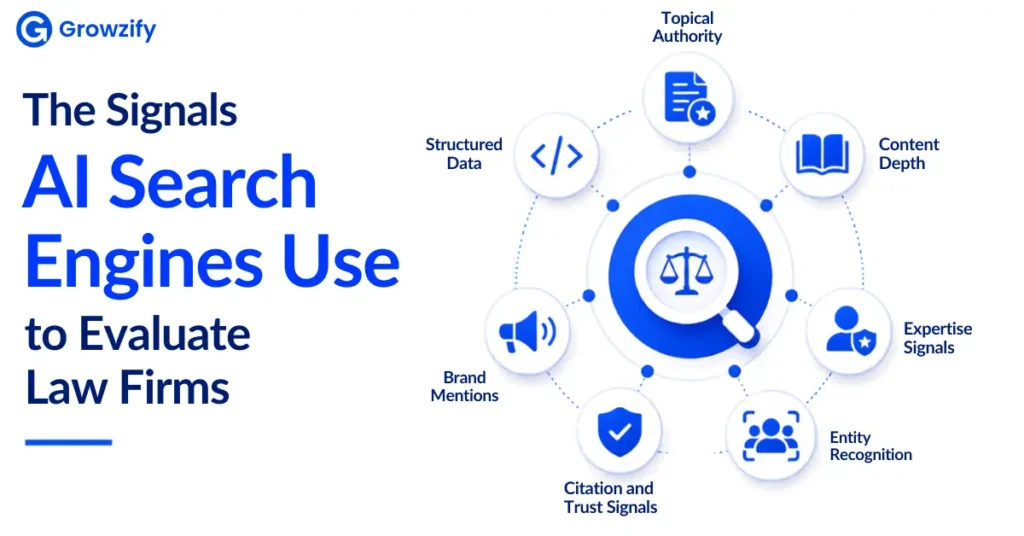
The Signals AI Search Engines Use to Evaluate Law Firms
Understanding what AI search models look for requires moving beyond keyword metrics and into the territory of knowledge representation and trust architecture.
Topical Authority
Topical authority means owning a subject comprehensively, not just ranking for a few keywords. A personal injury law firm with a single “Car Accident Attorney” page holds almost no topical authority in AI terms.
A law firm demonstrates topical authority when it maintains a comprehensive hub page supported by detailed content on negligence standards, comparative fault, statutes of limitations, insurance negotiations, medical documentation, and case valuation.
This interconnected content structure helps AI search engines recognize the firm’s depth of knowledge and subject-matter expertise across the entire practice area.
AI models are trained on vast corpora of content and can detect the difference between a firm that understands its practice area and one that is simply present online.
Firms with genuine topical authority on their primary practice areas are significantly more likely to be referenced in AI-generated legal answers.
Content Depth
Depth is not the same as length. A 3,000-word article that repeats the same points is not deep. A 1,200-word article that answers layered questions, addresses edge cases, defines legal concepts clearly, and provides actionable guidance is.
AI models extract from content that provides genuine information gain. Law firm content that reads as a copy of every other firm’s website, with identical boilerplate language and no unique legal insight, fails this test consistently.
Expertise Signals
AI platforms look for evidence that content was produced by or under the oversight of a qualified professional. Author bylines with attorney credentials, state bar numbers, law school affiliations, years in practice, and links to professional profiles all reinforce expertise signals.
Content that references specific case outcomes, legal standards by jurisdiction, and practical procedural knowledge demonstrates experience that generic content cannot replicate.
Entity Recognition
In the context of AI search, an entity is a clearly defined, recognizable subject. Law firms that appear as structured entities in Google’s Knowledge Graph, in legal directories, in state bar association records, and in reputable publications are more easily recognized and referenced by AI models.
Entity recognition is built through consistent name-address-phone information, schema markup, Google Business Profile optimization, and mentions across authoritative external sources.
A law firm that exists as a recognized entity in the broader information ecosystem is infinitely more citable than one that exists only as a website.
Citation and Trust Signals
AI models are trained to prefer sources they can verify. Backlinks from authoritative legal publications, mentions in news media coverage, citations in legal scholarship, and references from educational institutions all function as trust signals.
The type of citation matters as much as the quantity. A single reference from a state bar journal carries more weight than dozens of links from low-authority directories.
Brand Mentions
Unlinked brand mentions, the appearance of a firm’s name in relevant online conversations without a hyperlink, contribute to AI recognition.
Mentions in legal forums, bar association newsletters, client review platforms, and practitioner communities all signal that a firm has a recognized presence beyond its own website.
Structured Data
Schema markup translates a website’s content into a language that machines can parse clearly. For law firms, the relevant schema types include LegalService, Attorney, LocalBusiness, FAQ, and BreadcrumbList.
AI models can extract structured data more efficiently than unstructured prose. A law firm website with complete schema implementation makes it significantly easier for AI systems to identify what the firm does, where it operates, and what questions its content answers.
Why Some Law Firms Consistently Appear in AI Search Results
The firms that appear repeatedly in AI-generated legal answers share a consistent profile.
- They have invested in content depth across their primary and secondary practice areas.
- They have structured that content with clear hierarchies, FAQ sections, and definition-first writing that mirrors how AI models construct answers.
- They have built verified entity profiles across multiple platforms.
- Their attorneys have recognizable professional presences.
- Their website architecture is technically clean, fast, and crawlable.
- They have earned citations from sources that AI models treat as reliable.
- Those citations appear not just in backlink profiles but in earned media coverage, directory listings, and peer references within the legal community.
- They write for human readers with expert knowledge, not for search algorithms with keyword calculators.
The result is content that AI models trust because it resembles the quality of sources those models were trained on.
Common Reasons Law Firms Fail to Gain AI Visibility
Most law firms that struggle with AI search visibility are not making catastrophic mistakes. They are making a consistent set of smaller errors that collectively signal low authority to AI systems.
The most common patterns are:
Thin practice area pages.A single page per practice area with 400 words, a phone number, and a generic call to action provides nothing for AI to extract or cite.
No topical content depth.The firm has landing pages but no supporting blog content, guides, FAQs, or educational resources. AI models have nothing to reference beyond the firm’s name and location.
Missing or incomplete schema markup.Without structured data, AI systems must infer what the firm does from unstructured text. Inference introduces uncertainty. Certainty requires structured implementation.
No author expertise signals.Content published without attribution or without visible attorney credentials lacks the E-E-A-T foundation that AI models require to treat a source as authoritative.
Weak entity presence.The firm does not appear in legal directories, has no Google Knowledge Panel, and has inconsistent NAP information across the web. AI models cannot confidently identify the firm as a reliable entity.
Outdated content.Law changes. Legal standards shift. Content that has not been updated in two or more years may contain outdated information, which actively damages a firm’s trustworthiness in AI evaluation.
Generic language.Content that could apply to any law firm in any market signals zero differentiation and zero expertise. AI models pull from sources that provide specific, accurate, and distinctive information.
The Relationship Between SEO, AEO, and GEO for Law Firms
These three disciplines are complementary, not competing.
SEObuilds the foundation. It ensures the website is technically sound, properly structured, and visible to search engine crawlers. It creates the organic traffic pipeline that supports the firm’s broader visibility.
AEO (Answer Engine Optimization)builds on that foundation by structuring content to directly answer specific questions.
It prioritizes question-and-answer formatting, definition-first writing, and concise, accurate responses that AI and voice search platforms can extract and surface.
GEO (Generative Engine Optimization)extends visibility into AI-generated content environments.
It focuses on creating content that AI models will reference, cite, and summarize when answering user queries.
It requires a higher standard of expertise, a richer content ecosystem, and a more deliberate approach to entity and citation building.
For law firms, all three must operate together. A technically strong SEO foundation without an AEO structure leaves featured snippet and AI Overview opportunities uncaptured.
Rich AEO content without GEO-level authority and entity signals fails to reach AI chat platforms. GEO investment without foundational SEO results in content that AI models cannot reliably find or verify.
The firms that dominate across all three disciplines treat them as an integrated strategy, not separate projects.
How AI Models Identify the Most Trustworthy Legal Sources
AI models like ChatGPT, Gemini, Claude, and Perplexity are trained on large datasets of existing text. They develop probabilistic associations between sources and reliability based on how frequently those sources appear in high-quality contexts.
Law firms earn stronger trust signals when they are featured in respected legal publications, cited by bar associations, and consistently listed in reputable legal directories.
When attorneys are referenced in educational resources and media coverage, AI search engines are more likely to associate the firm with credibility, authority, and reliability.
Beyond training data, retrieval-augmented AI models that access live web content evaluate sources using similar signals to Google’s Search Quality Evaluator Guidelines.
Content that demonstrates experience, expertise, authoritativeness, and trustworthiness gets retrieved and cited. Content that does not get passed over.
For practical purposes, law firms should treat every trust signal they can establish as cumulative. No single action creates AI visibility.
A consistent pattern of credible, expert-driven presence across the digital ecosystem eventually becomes self-reinforcing.
Content Strategies That Improve AI Search Visibility
Law firms looking to improve AI visibility should focus on strategies that build genuine authority rather than optimizing for algorithmic shortcuts.
Build question-first content.Identify the specific questions your prospective clients ask at each stage of their legal journey.
Write dedicated content that answers each question directly, accurately, and at an appropriate depth. Format those answers so AI models can extract them cleanly.
Create legal definition hubs.AI models frequently pull from content that clearly defines legal terms and concepts. A law firm that publishes precise, accessible explanations of the legal concepts relevant to its practice areas builds credibility as a definitional source.
Develop state-specific and jurisdiction-specific content.General legal content is abundant online.
Jurisdiction-specific content, covering how specific laws apply in your state, what your local court processes look like, and how local legal standards differ from national norms, is rarer and more citable.
Update existing content regularly.AI models treat recency as a trust signal in time-sensitive subjects. Legal content that references current statutes, recent case law, and updated procedural rules signals reliability.
Use FAQ sections strategically.Every practice area page, every blog post, and every guide should include a structured FAQ section with direct, concise answers. These sections are among the most extractable content formats for AI systems.
Build internal linking as a knowledge map.A well-structured internal linking architecture signals to AI systems how your content relates to each other.
It demonstrates that your firm has built a knowledge base, not just a collection of isolated pages.
Building a Legal Content Ecosystem Instead of Isolated Pages
The most powerful shift a law firm can make in its content strategy is moving from page-by-page thinking to ecosystem thinking.
An isolated practice area page exists on its own. It has no supporting context, no depth beneath it, and no related content reinforcing it. It answers one search query and nothing else.
A content ecosystem works differently. A personal injury practice area hub links to supporting articles on each injury type, the legal process, damages calculation, comparative fault, and what to expect at trial.
Each supporting article reinforces the hub. Each piece adds a layer of expertise to the firm’s topical authority. Together, they create a resource that AI models can mine for multiple related queries.
The hub-and-spoke model is the most effective architecture for law firm content ecosystems. The hub is the authoritative practice area page.
The spokes are the deep-dive supporting articles that answer every sub-question within that practice area.
The internal links between them signal structural knowledge to both search engines and AI retrieval systems.
Law firms that have built genuine content ecosystems around their primary practice areas are the ones that consistently appear in AI-generated answers. This is not a coincidence.
The Future of Law Firm Search Marketing
The trajectory is clear. AI-mediated search will continue to expand. The percentage of legal queries answered directly by AI platforms rather than traditional search result pages will grow.
Voice search, AI assistants, and embedded AI tools in legal research platforms will all pull from the same pool of trusted, structured, authoritative content.
Law firms that invest now in topical authority, entity recognition, technical SEO, and content ecosystems will compound those investments over time.
The firms that continue optimizing primarily for yesterday’s ranking signals will find themselves progressively less visible as the search landscape shifts beneath them.
Local SEO will remain important. Proximity still matters for legal services. But local visibility alone will not generate the kind of AI search presence that produces high-intent client inquiries at scale.
The future belongs to law firms that operate as genuine knowledge authorities, not just as locally optimized websites.
How Growzify Digital Helps Law Firms Increase AI Search Visibility
Growzify Digital specializes in legal SEOand AI search visibility for law firms at every stage of growth. The approach at Growzify Digital begins with a comprehensive audit of a firm’s current content architecture, entity signals, technical SEO health, and topical authority gaps.
This audit identifies exactly where the firm stands in relation to AI search visibility benchmarks and maps out the specific work required to close the gap.
From there,Growzify Digitalbuilds content ecosystems tailored to each firm’s practice areas, markets, and client personas.
Every piece of content is written to answer real questions from real prospective clients, optimized with appropriate schema markup, and reinforced with internal linking that signals genuine topical depth.
Beyond content, Growzify Digital supports entity building through directory optimization, Google Business Profile management, and earned media strategies that build the kind of trust signals AI models use to verify credibility.
The result is a law firm digital presence that performs across traditional organic search, Google AI Overviews, and AI chat platforms, building sustained visibility in every channel where prospective clients are searching for legal help.
Building the Digital Authority AI Search Engines Trust
The difference between law firms that dominate AI search and those that remain invisible is rarely about luck or budget. More often, it comes down to strategy, consistency, and a long-term commitment to quality content.
AI search platforms favor firms that have built genuine topical authority, demonstrated expertise, earned citations from trusted sources, and created content that AI systems can easily understand and reference. Strong entity recognition and clear content structures also play an important role.
Law firms that continue relying on thin content, outdated SEO tactics, or disconnected digital strategies will find it harder to gain visibility in AI search. Methods that worked in previous search environments are becoming less effective.
In contrast, firms that invest in building authority, publishing comprehensive content, and strengthening trust signals will continue to expand their visibility as AI search grows.
AI search is not a future trend. It is already shaping how people discover legal services. The firms taking action today are more likely to be the ones AI assistants recommend when prospective clients ask which law firm they should contact.
Frequently Asked Questions
Why do some law firms appear in ChatGPT and Gemini answers while others do not?
Law firms that appear in AI-generated answers have built strong topical authority, earned citations from trusted sources, structured their content for AI extraction, and established verified entity recognition across the web. AI models pull from sources they can verify as credible, and law firms that consistently demonstrate expertise across a rich content ecosystem meet that threshold.
What is the difference between SEO, AEO, and GEO for law firms?
SEO focuses on technical website health and organic search visibility.
AEO (Answer Engine Optimization) structures content to directly answer specific questions so AI platforms and voice search can extract and surface those answers.
GEO (Generative Engine Optimization) builds the authority and entity signals needed for AI models like ChatGPT, Gemini, and Perplexity to reference and cite a law firm’s content in generated responses.
All three are required for complete visibility in modern legal search.
How does topical authority help a law firm rank in AI search results?
Topical authority signals to AI models that a law firm has comprehensive, trustworthy knowledge of its practice areas rather than surface-level coverage. A firm with deep, structured content covering every relevant sub-topic within a practice area is significantly more likely to be cited in AI-generated answers.
How can Growzify Digital help my law firm appear in AI search results?
Growzify Digital audits a law firm’s existing content, entity signals, and technical SEO health to identify specific visibility gaps in AI search. From there, Growzify Digital builds structured content ecosystems, implements schema markup, optimizes entity recognition across directories and platforms, and develops an authority strategy designed to meet the trust and depth thresholds that AI models use to select sources for citation.
What content format is most likely to be cited by AI platforms like Perplexity and Google AI Overviews?
Content that answers questions directly before expanding, uses clear definition-first writing, includes structured FAQ sections, cites verifiable facts, and is organized with logical heading hierarchies performs best in AI retrieval. Content written by credentialed attorneys, updated regularly, and supported by schema markup is especially well-positioned for AI citation.

Chitranshu SharmaA growth strategist, digital marketing consultant, and the founder of Growzify, a performance-driven agency helping brands dominate search, shape perception, and build sustainable online visibility. With 8+ years of hands-on experience in Enterprise SEO, Online Reputation Management (ORM), and AI-led traffic generation, Chitranshu has helped startups, public figures, SaaS companies, and cannabis brands outrank competitors — ethically and at scale.
Explore More Articles

Managing Redirect Chains and Canonical Tags at Enterprise Scale
Managing Redirect Chains and Canonical Tags at Enterprise Scale A single redirect rule written five...
September 4, 2026Enterprise

How to Build a Technical SEO Monitoring Stack for Large Websites
How to Build a Technical SEO Monitoring Stack for Large Websites A technical SEO regression...
September 2, 2026Enterprise

Identifying and Fixing Thin Content Pages on Large Websites
Identifying and Fixing Thin Content Pages on Large Websites A page can be 2,000 words...
September 2, 2026Enterprise

How to Deploy and Maintain Structured Data and Rich Snippets Across a Website with Thousands of Pages
How to Deploy and Maintain Structured Data and Rich Snippets Across a Website with Thousands...
September 1, 2026Enterprise

Pre-Deployment Technical SEO Checklist for Large Enterprise Websites
Pre-Deployment Technical SEO Checklist for Large Enterprise Websites A single enterprise deployment can introduce a...
September 1, 2026Enterprise
How to Fix Core Web Vitals and Page Speed for an Enterprise Website
How to Fix Core Web Vitals and Page Speed for an Enterprise Website Enterprise Core...
August 31, 2026Enterprise

Robots.txt Best Practices for Complex, Large Enterprise Websites
Robots.txt Best Practices for Complex, Large Enterprise Websites A single overly broad robots.txt rule can...
August 27, 2026Enterprise