



The Future of Law Firm SEO: Search Beyond Google
Law firm SEO now extends beyond Google to AI platforms, voice assistants, and legal directories. Firms should optimize structured data, conversational content, and specialized profiles to capture client intent and secure long-term leads.

Written byChitranshu Sharma
June 10, 2026
Quick Nav
For years, law firm SEO has meant one thing: getting your firm to rank on the first page of Google. That goal hasn’t disappeared, but it’s no longer the whole picture. Search has split into multiple channels.
Someone searching for a personal injury attorney might type a query into Google, ask ChatGPT for a recommendation, use Perplexity to compare local firms, or get an AI Overview that answers their question without a single click to any website.
If your firm’s visibility strategy starts and ends with traditional Google rankings, you’re optimizing for a smaller share of how people actually find legal help today. This shift isn’t theoretical.
It’s already changing how potential clients discover, evaluate, and choose attorneys, and the firms that adapt early are positioning themselves to be the answer AI systems give, not just a link buried in search results.
How Search Behavior Is Changing
Search behavior is shifting from traditional keyword searches to AI-generated answers, voice queries, and multi-platform discovery, changing how people find and evaluate law firms online.
AI-Generated Answers Are Replacing Some Searches Entirely
Google’s AI Overviews now appear above traditional search results for a significant share of legal queries. When someone asks “what should I do after a car accident in [city],” Google may generate a direct answer summarizing key steps, sometimes citing sources, sometimes not.
For law firms, this means a portion of searches that used to drive clicks to a website now end with the user getting their answer directly on the search results page. The query still happened.
The visibility opportunity still exists. But the path to that visibility runs through being cited in the AI-generated answer, not just ranking below it.
Conversational Search Changes How People Phrase Questions
Voice assistants and AI chat tools have shifted how people search. Instead of typing “Calgary divorce lawyer,” someone might ask their phone, “Who’s a good divorce lawyer near me that handles high-asset cases?”
These conversational queries are longer, more specific, and closer to how people actually talk. Content built around short keyword phrases doesn’t always match this pattern. Content built around real questions, with clear, direct answers, does.
Multi-Platform Discovery Is Now Normal
A potential client researching legal representation might use several platforms in the same search session. They might start with a Google search, switch to ChatGPT to ask follow-up questions, check Google Maps for reviews, and then use Perplexity to compare firm credentials side by side.
Each of these platforms pulls information differently. Some crawl websites directly. Some rely on structured data.
Some prioritize content that demonstrates clear expertise and citations from credible sources. A firm that’s only optimized for one of these platforms is invisible on the others.
Zero-Click Searches Are Becoming More Common
A “zero-click search” is exactly what it sounds like: the user gets their answer without clicking through to any website. Featured snippets, AI Overviews, and direct answer boxes all contribute to this trend.
This doesn’t mean your content stops mattering. It means the value of your content shifts. Even if a user doesn’t click through immediately, being the source an AI system cites builds awareness and trust.
When that same person is ready to hire an attorney, the firm whose name they recognized from an AI answer has an advantage, even without a direct click that day.
Why Traditional Law Firm SEO Is No Longer Enough
Traditional Law Firm SEO is no longer enough because visibility now depends on AI recommendations, citations, and trusted content, not just rankings.
Ranking Versus Visibility Are Different Goals
Ranking number one for “personal injury lawyer [city]” used to be the finish line. Now it’s one part of a bigger picture. A firm can rank well in traditional search results and still be absent from AI Overviews, ChatGPT recommendations, or Perplexity citations.
Visibility now means showing up across multiple search surfaces, not just one ranking position on one platform.
A firm that ranks third on Google but gets cited consistently in AI-generated legal answers may generate more qualified inquiries than a firm ranking first that AI systems never reference.
Getting Cited in AI Answers Requires a Different Approach
AI search platforms don’t rank pages the way traditional search engines do. They generate answers by pulling information from sources they consider credible, well-structured, and directly relevant to the question asked.
For a law firm, this means content needs to directly answer specific legal questions in a format that’s easy for AI systems to extract and summarize.
A page that talks broadly about “our firm’s approach to family law” without addressing specific questions clients actually ask is much less likely to be cited than a page that directly answers “how is child support calculated in [jurisdiction].”
Entity Recognition Affects Whether AI Systems Trust Your Firm
AI search systems build an understanding of who you are as a business, what you do, where you operate, and how credible you are, based on signals across the web. This is sometimes called entity recognition.
For law firms, entity signals include consistent business information across directories, a clear connection between the firm’s website and its attorneys’ professional credentials.
Apart from this, it includes mentions and citations from legal directories and news sources, and structured data that explicitly tells search engines what kind of business you are and what services you provide.
A firm with strong entity signals is more likely to be recognized as a credible source on a specific topic. A firm with inconsistent or thin entity signals is harder for AI systems to confidently recommend, even if its content is well-written.
Topical Authority Matters More Than Individual Page Rankings
Topical authority means demonstrating depth of knowledge across an entire subject area, not just one page. A firm with a single strong page about “estate planning” competes differently than a firm with a comprehensive set of pages covering wills, trusts, probate, power of attorney, and estate tax planning.
AI search systems and traditional search engines both increasingly favor sources that demonstrate this kind of comprehensive coverage. One page, however well-optimized, rarely establishes the depth of expertise that broader topical coverage does.
The Rise of AI Search Platforms
AI search platforms are changing how people find information by delivering direct answers, trusted recommendations, and cited sources instead of traditional lists of search results.
Google AI Mode and AI Overviews
Google’s AI-driven search features generate summarized answers directly within search results, often before any traditional listings appear. These answers draw from a combination of Google’s index, structured data, and content that demonstrates clear expertise on the topic.
For AI search optimization, this meansstructuring legal contentso that specific questions have specific, extractable answers.
Google’s AI features tend to favor content that’s well-organized with clear headings, direct answers near the top of relevant sections, and supporting detail that reinforces the answer’s credibility.
Gemini
Gemini, Google’s conversational AI assistant, draws on a combination of web content and Google’s broader knowledge systems. When someone asks Gemini a legal question, particularly something jurisdiction-specific like “what’s the process for filing for divorce in Alberta,” Gemini’s response depends on finding clear, accurate, well-attributed information.
Firms whose content directly addresses jurisdiction-specific legal processes, written in plain language with clear structure, are better positioned to inform these responses.
ChatGPT
ChatGPT has become a starting point for legal research for a growing number of people, particularly for general questions before they decide whether they need an attorney at all.
Someone might ask ChatGPT, “do I need a lawyer for a small claims case,” get a general answer, and then search for local representation if the answer suggests they do.
ChatGPT’s responses to legal questions tend to draw on training dataand, in browsing-enabled versions, real-time web content.
Content that clearly explains legal concepts, processes, and when professional representation matters tends to inform these responses more reliably than pages focused primarily on firm credentials.
Perplexity
Perplexity functions as an answer engine that provides direct responses with cited sources. For legal queries, Perplexity often pulls from a combination of legal information sites, government resources, and law firm content that directly addresses the question asked.
Because Perplexity shows its sources, being cited here has a direct visibility benefit. Users can see which firm’s content informed the answer and click through if they want more information.
Legal Research Assistants
Beyond general AI platforms, legal-specific research tools and AI assistants integrated into legal directories and bar association resources are becoming more common.
These tools often pull from curated legal content databases, which means firms that contribute clear, accurate legal information to recognized industry sources may see their expertise reflected in these tools as well.
How These Platforms Choose What to Reference
Across all of these platforms, a few patterns hold consistently. Content that directly answers a specific question is more likely to be referenced than content that talks around a topic.
Content from sources that demonstrate clear subject matter expertise, such as content written or reviewed by a licensed attorney, carries more weight.
Content that’s well-structured, with clear headings and organized information, is easier for AI systems to parse and extract. And content that’s part of a broader, topically consistent body of work signals authority more than an isolated page.
Building Law Firm SEO for AI Search
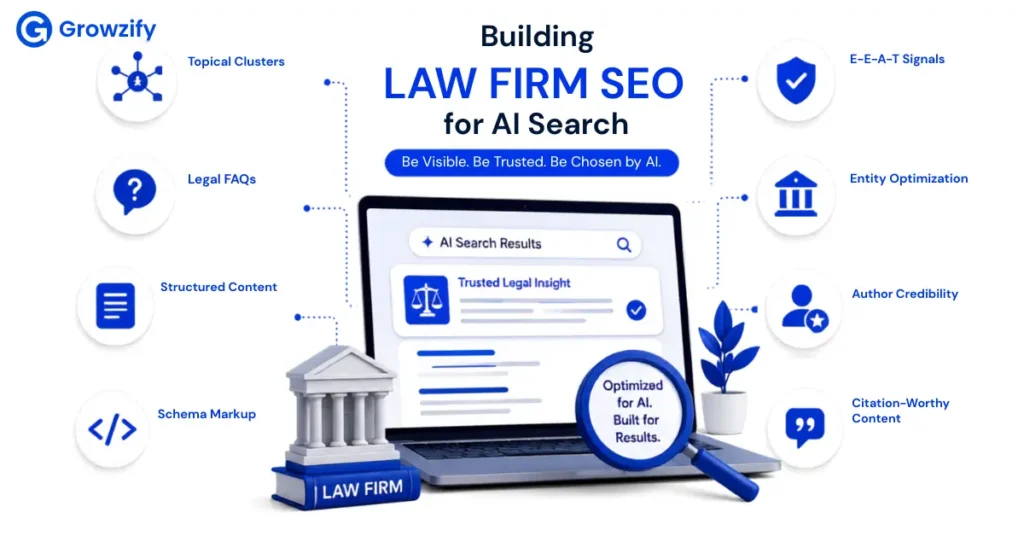
Topical Clusters
Rather than treating each practice area page as a standalone piece of content, organize content into clusters. A core practice area page, such as “Family Law,” should connect to a network of related pages covering specific topics: child custody, divorce proceedings, or prenuptial agreements.
Each of these pages should link back to the core practice area page and to each other where relevant.
This structure helps both traditional search engines and AI systems understand the full scope of what your firm handles and how deeply you understand the subject area.
Legal FAQs
FAQ sections aren’t just useful for visitors. They’re one of the most directly extractable content formats for AI search systems. A well-written FAQ that asks “how long does probate take in [jurisdiction]” and answers it clearly in two or three sentences is exactly the kind of content AI Overviews and answer engines are built to surface.
For legal content marketing, FAQs work best when they reflect real questions clients ask, written in the same language clients use, not formal legal terminology that doesn’t match how people search.
Structured Content
Content structure matters more than ever. Pages that use clear, descriptive headings, break information into digestible sections, and place direct answers near the start of each section perform better across AI search platforms.
A practical example: instead of a single long paragraph explaining the divorce process, break it into headed sections covering filing requirements, timelines, required documentation, and what happens at each stage.
This structure makes it easy for an AI system to extract the specific piece of information relevant to a user’s question.
Schema Markup
Schema markup is code added to a website that explicitly tells search engines what different pieces of content represent. For law firms, relevant schema types include LegalService, Attorney, FAQPage, LocalBusiness, and BreadcrumbList.
This structured data helps search engines and AI systems understand your firm’s location, practice areas, attorney credentials, and the specific questions your content answers.
E-E-A-T Signals
E-E-A-T stands for Experience, Expertise, Authoritativeness, and Trustworthiness. For legal content, which falls into the “Your Money or Your Life” category that search engines scrutinize closely, these signals matter significantly.
Practical E-E-A-T signals include attorney bios with verifiable credentials and bar admissions, content authored or reviewed by licensed attorneys with their names and credentials displayed.
It also includes case results and client outcomes presented accurately, and clear information about the firm’s experience in specific practice areas.
Entity Optimization
Entity optimization means making sure search engines and AI systems have a clear, consistent understanding of who your firm is.
This includes consistent name, address, and phone number information across your website, directories, and review platforms, a Google Business Profile that’s complete and accurate.
Author Credibility
Content attributed to a named attorney with visible credentials carries more weight than unattributed content. When an AI system evaluates whether to cite a source on a legal question, content written by someone identifiable as a qualified professional in that area is a stronger signal than anonymous content.
Citation-Worthy Content
Citation-worthy content directly answers a specific question, provides accurate and current information, is written clearly enough to be summarized without losing meaning, and comes from a source with established credibility on the topic.
This is the combination AI search platforms look for when deciding what to reference in generated answers.
What Law Firms Should Focus on in 2026 and Beyond
- Build out comprehensive practice area clusters rather than standalone pages. Depth across a topic area matters more than a single highly optimized page.
- Audit your content for direct answers. For every page, ask whether someone could find a clear, specific answer to a real question within the first few sentences of a relevant section.
- Strengthen attorney bio pages with complete, verifiable credentials. These pages support E-E-A-T signals across your entire site, not just on the bio page itself.
- Implement schema markup across your site, particularly for practice area pages, attorney profiles, FAQ sections, and location information.
- Monitor how your firm appears across AI platforms. Periodically ask ChatGPT, Gemini, and Perplexity questions related to your practice areas and location to see whether your firm appears in responses.
- Maintain consistency across directories and review platforms. Entity recognition depends on consistent information appearing in multiple places, not just on your website.
- Keep content current. Legal processes, requirements, and timelines change. AI systems favor content that reflects current information, and outdated content can actively work against your visibility.
Common Mistakes Law Firms Make
Publishing Generic Content
Generic content that could apply to any firm in any location doesn’t help with law firm digital marketing goals. A page about “personal injury claims” that doesn’t address jurisdiction-specific timelines, requirements, or processes provides little value to AI systems looking for specific, citable information.
Ignoring User Intent
Not every search has the same intent. Someone searching “what is a power of attorney” wants an explanation. Someone searching “power of attorney lawyer near me” wants to hire someone.
Content that treats every page the same way, regardless of what the searcher actually wants, misses opportunities on both ends.
Weak Practice Area Pages
A practice area page that’s a few paragraphs of general description, without addressing specific scenarios, common questions, or jurisdiction-specific details, doesn’t provide enough substance for AI systems to draw from.
Poor Content Structure
Long, unbroken blocks of text are difficult for both readers and AI systems to process. Content without clear headings, without FAQ sections, and without a logical flow from general information to specific details underperforms across both traditional and AI search.
Lack of Expertise Signals
Content without attribution, without connection to a named attorney, and without indications of the firm’s actual experience in a practice area sends a weaker trust signal.
How Growzify Helps Law Firms Adapt to Modern Search
Growzify works with law firms to build Law Firm SEO strategiesthat account for how search has expanded beyond traditional Google rankings. This starts with understanding where a firm currently stands, not just in Google’s search results, but across AI Overviews, Gemini, ChatGPT, and Perplexity.
A core part of this work involves AI search optimization: restructuring existing content and building new content so that it directly answers the questions potential clients are asking, in formats that AI systems can extract and cite.
This includes FAQ development, content restructuring around clear headings and direct answers, and schema markup implementation.
Growzifyalso focuses on topical authority building, helping firms move from isolated practice area pages to comprehensive content clusters that demonstrate depth across each area of law the firm handles.
This involves mapping out the related questions and subtopics within each practice area and building content that addresses them in a connected, organized way.
The goal across all of this work is future-focused visibility: positioning a firm’s content so it performs well not just in today’s search landscape, but as AI-driven search continues to take up a larger share of how people find legal information and legal representation.
Search isn’t consolidating around a single platform. It’s spreading across AI Overviews, conversational assistants, answer engines, and traditional search results, often within the same research session for a single potential client.
The Firms That Adapt Will Lead
Law Firm SEOthat accounts for this reality looks different than the SEO playbook of even a few years ago. It’s less about chasing a single ranking position and more about building content that’s structured, specific, and credible enough to be referenced wherever someone is searching.
Firms that start building this kind of content now, with clear topical authority, strong expertise signals, and content structured for direct answers, are positioning themselves to be visible across every search surface that matters.
The firms that wait until AI search becomes the obvious default will be playing catch-up against competitors who started building this foundation today.
Frequently Asked Questions
Q: What is the future of Law Firm SEO?
A: The future of Law Firm SEO involves optimizing for visibility across multiple search surfaces, not just traditional Google rankings. This includes AI Overviews, conversational AI platforms like ChatGPT and Gemini, and answer engines like Perplexity. Firms need to focus on topical authority, structured content, clear expertise signals, and content that directly answers specific legal questions in formats AI systems can extract and cite.
Q: How does AI search affect law firm visibility?
A: AI search affects visibility by changing how potential clients find information. Instead of clicking through multiple search results, users often receive direct answers from AI Overviews or AI assistants, sometimes without visiting any website. For law firms, this means visibility now depends on being cited as a source within these AI-generated answers, which requires content that’s well-structured, accurate, and demonstrates clear legal expertise.
Q: Can law firms get clients from platforms other than Google?
A: Yes. Potential clients increasingly use ChatGPT, Gemini, and Perplexity to research legal questions and compare attorneys before deciding who to contact. While these platforms may not always drive direct website traffic the way Google does, being referenced or cited by them builds awareness and credibility that can influence which firm a person ultimately chooses to contact.
Q: What is answer engine optimization for law firms?
A: Answer engine optimization, or AEO, is the practice of structuring legal content so that AI-driven search platforms can easily extract and cite direct answers to specific questions. For law firms, this includes writing clear FAQ sections, organizing content with descriptive headings, providing direct answers early in each section, and using schema markup to help AI systems understand the content’s context and relevance.
Q: How can Growzify help improve Law Firm SEO?
A: Growzify helps law firms build SEO strategies that address both traditional search rankings and visibility across AI search platforms. This includes restructuring content for AI search optimization, building topical authority through connected practice area content, implementing schema markup, and strengthening expertise signals that support both Google rankings and citation likelihood across AI Overviews, Gemini, ChatGPT, and Perplexity.

Chitranshu SharmaA growth strategist, digital marketing consultant, and the founder of Growzify, a performance-driven agency helping brands dominate search, shape perception, and build sustainable online visibility. With 8+ years of hands-on experience in Enterprise SEO, Online Reputation Management (ORM), and AI-led traffic generation, Chitranshu has helped startups, public figures, SaaS companies, and cannabis brands outrank competitors — ethically and at scale.
Explore More Articles

How to Find and Compare Local SEO Outsourcing Providers
How to Find and Compare Local SEO Outsourcing Providers Finding a local SEO outsourcing provider...
October 13, 2026Outsourcing

Inside a White Label SEO Campaign: How the Work Gets Done
Inside a White Label SEO Campaign: How the Work Gets Done Clients see a single...
October 13, 2026White Label

How to Vet an SEO Outsourcing Provider Before You Sign a Contract
How to Vet an SEO Outsourcing Provider Before You Sign a Contract A polished proposal...
October 9, 2026Outsourcing
Multilingual SEO Best Practices: Optimize Your Multi-Language Website
Multilingual SEO Best Practices: Optimize Your Multi-Language Website Translating a page and localizing it for...
October 7, 2026SEO
What Makes In-House Enterprise SEO Work Different Day-to-Day?
What Makes In-House Enterprise SEO Work Different Day-to-Day? On a small site, deciding to fix...
October 7, 2026Enterprise
How Core Algorithm Updates Impact Large Sites Differently Than Small Ones
How Core Algorithm Updates Impact Large Sites Differently Than Small Ones A large enterprise site...
October 7, 2026Enterprise
When Should You Outsource SEO? 11 Signs It Makes Sense
When Should You Outsource SEO? 11 Signs It Makes Sense Outsourcing SEO does not necessarily...
September 26, 2026Outsourcing