


How Law Firms Can Rank in Google's AI Overviews
Google’s AI Overviews are changing how users discover legal services online. This guide explains how law firms can improve their chances of appearing in AI-generated search results by strengthening topical authority, optimizing content for user intent, implementing structured data, enhancing EEAT signals, and building a trusted online presence. Learn the strategies that help legal websites gain greater visibility in AI-powered search experiences.

Written byChitranshu Sharma
June 3, 2026
Quick Nav
Law firms rank in Google’s AI Overviews by building deep topical authority, publishing content, strengthening E-E-A-T signals, implementing structured data, and maintaining a consistent Law Firm SEO strategy. This gives Google’s AI systems enough confidence to extract, summarize, and surface their content above organic results.
That answer is precise because the mechanism is precise. Google’s AI Overviews do not pull from random high-ranking pages. They pull from sources that meet a specific and demanding set of content, authority, and trust requirements.
For law firms, meeting those requirements is both a significant opportunity and a growing urgency. AI Overviews appear at the very top of search results, above the traditional blue links, above local map packs, and above paid ads.
A firm whose content is cited in an AI Overview receives instant authority positioning in front of a prospective client who has not yet clicked a single result.
What Are Google's AI Overviews?
Google’s AI Overviews are synthesized answer panels generated by Google’s large language model and displayed at the top of search results pages for qualifying queries.
Unlike featured snippets, AI Overviews synthesize information from multiple sources to construct a comprehensive answer.
Google attributes those sources with links, which means appearing in an AI Overview drives both visibility and credible referral traffic.
For legal queries, AI Overviews frequently appear when someone searches for legal processes, types of attorneys, explanations of rights, and legal costs. These are high-intent searches from people actively seeking legal help.
Being cited in those AI Overviews puts a law firm directly in the path of that intent.
Why AI Overviews Matter for Law Firms
Traditional organic rankings are competitive but navigable. A firm can invest in Law Firm SEO, build authority over time, and earn page one visibility for relevant keywords. That model still matters.
AI Overviews introduce a different dynamic. They answer the question before the user clicks anything.
A prospective client searching “what should I look for in a personal injury attorney” may read the AI Overview, click through to the cited law firm, and make contact without visiting any other result.
The firm that gets cited wins the interaction before the competition even gets a look. For queries with strong informational or investigative intent, AI Overviews appear in a majority of results.
Legal searches are heavily weighted toward those intent types; prospective clients research before they call.
That research phase is now often answered by AI, and the firms whose content feeds those answers are the ones building trust before the first conversation.
How AI Selects Legal Content for Overviews
Google’s AI does not select content at random from the top ten results. It evaluates content for accuracy, depth, authority, and clarity.
It looks for pages that directly answer the query, support their answers with logical reasoning, and come from sources that Google can verify as legitimate and expert.
For legal content specifically, Google applies YMYL (Your Money or Your Life) standards. This means the bar for inclusion is higher than in most other industries.
Legal information affects people’s rights, finances, and freedoms. Google holds content in this category to a stricter standard of accuracy and authority.
A practice area page with 400 words and a phone number does not meet that standard. A detailed, attorney-reviewed guide that explains a legal process clearly, defines relevant terms, addresses common questions, and provides actionable guidance does.
The distinction between those two content types is where most law firms either earn or lose their AI Overview positioning.
The Role of Law Firm SEO in AI Visibility
Strong Law Firm SEOis the prerequisite for AI Overview inclusion, not an alternative to it. Google’s AI systems draw from content that ranks well and from sources that Google already trusts.
A website with poor technical health, thin content, and no backlink authority is unlikely to be cited in an AI Overview, regardless of how well individual pages are written.
Law Firm SEO builds the foundation that AI visibility requires. It ensures the website is technically accessible, that the firm has established domain authority, and that individual pages signal relevance and expertise for their target queries.
Without that foundation, even excellent content struggles to gain the trust signals required for AI selection.
Build Topical Authority Around Practice Areas
Topical authority is the single most important content signal for AI Overview inclusion. A law firm that publishes one page per practice area has surface-level coverage.
A firm that builds a structured content hub around each practice area, with supporting articles, FAQs, definitions, process explanations, and jurisdiction-specific guidance, demonstrates comprehensive knowledge of that subject.
Google’s AI systems can detect the difference. They are more likely to pull from a firm that has clearly invested in understanding and explaining a legal subject.
For a personal injury firm, topical authority means having content that covers negligence, comparative fault, medical documentation, damages calculation, and the litigation timeline.
Not one article. A structured ecosystem of interconnected content that maps the entire subject. That depth is what earns citation.
Create Content That Directly Answers Legal Questions
AI Overviews are built to answer questions. The content they draw from is content that answers questions well.
The most effective format for Law Firm SEO content targeting AI Overviews starts with a direct answer to the stated or implied question.
This mirrors how AI systems structure their own outputs. When a firm’s content follows the same structure, it becomes significantly easier for the AI to extract and reformat that content into a synthesized answer.
Question-based subheadings, FAQ sections, definition paragraphs, and step-by-step process explanations are all high-extraction formats.
They give AI systems clear signals about what a section answers and how that answer is structured. Every practice area page and every blog post should include at least one of these formats. Ideally, all of them.
Strengthen E-E-A-T Signals for Legal Websites
E-E-A-T stands for Experience, Expertise, Authoritativeness, and Trustworthiness. For legal content, these signals are not optional. They are requirements.
Experienceis demonstrated through content that reflects real-world legal practice. Specific procedural knowledge, jurisdiction-aware explanations, and practical guidance signal that the content comes from someone who has done this work, not just researched it.
Expertiseis communicated through author attribution. Every piece of legal content should carry a byline that links to an attorney profile with verifiable credentials, bar number, law school, years of practice, and relevant case experience.
Authoritativenessis built through external recognition. Citations from legal publications, mentions in news coverage, bar association listings, and peer references all reinforce a firm’s standing as a credible source.
Trustworthinessis established through website security, accurate information, transparent contact details, consistent NAP data, and honest representation of services without exaggerated claims or misleading guarantees.
All four must be present and visible. Google’s AI systems evaluate them collectively.
Optimize Attorney Profiles and Expertise Pages
Attorney profiles are an underused E-E-A-T asset in most Law Firm SEO strategies. A strong attorney profile page includes the attorney’s full name, bar admission details, law school, years in practice, and speaking engagements.
This information serves two purposes. It signals expertise to Google’s AI systems, which look for identifiable human authorities behind legal content. It also builds trust with prospective clients who research attorneys before making contact.
Attorney profiles should also be consistent across the website, the firm’s Google Business Profile, state bar directories, LinkedIn, and legal-specific platforms.
Consistent entity representation across platforms reinforces recognition by AI systems and search engines alike.
Use Structured Data to Help AI Understand Content
Structured data, implemented through schema markup, translates a website’s content into a machine-readable format that AI systems can parse efficiently and accurately.
For law firms, the most important schema types are:
Legal Serviceidentifies the firm as a legal services provider, specifies practice areas, and ties the entity to a geographic location.
Attorneymarks up individual lawyer profiles with credentials, specializations, and contact information.
The FAQ Pagesignals to Google that a section of content contains question-and-answer pairs, which directly increases the likelihood of AI extraction.
Local Businessreinforces geographic relevance and supports map pack and local AI Overview appearances.
Breadcrumb Listcommunicates site structure to crawlers, supporting logical content hierarchy signals.
Implementing these schema types correctly gives Google’s AI systems a structured map of the firm’s content, removing the ambiguity that prevents citation.
Improve Local Search Signals
Many AI Overview appearances for legal queries include local context. “Personal injury attorney near me” is a high-frequency search patterns that trigger AI Overviews with geographic components.
Winning those locally contextualized AI answers requires strong local SEO foundations.
A fully optimized Google Business Profile with consistent business information, current hours, practice area categories, and regular posts signals active local relevance.
Responses to reviews, both positive and critical, reinforce trustworthiness. Local citations across legal directories and general business directories must be consistent.
The firm’s name, address, and phone number should match exactly across every platform. Inconsistencies confuse AI systems and reduce confidence in the firm’s entity data.
Location-specific content on the website, covering local court systems, jurisdiction-specific legal standards, and community-relevant legal topics, reinforces geographic authority that AI systems use.
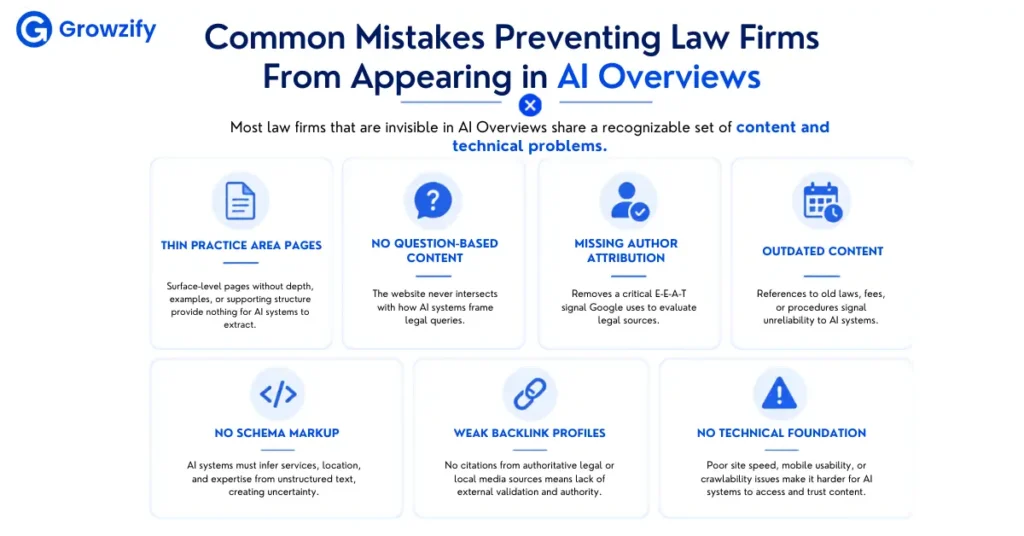
Common Mistakes Preventing Law Firms From Appearing in AI Overviews
Most law firms that are invisible in AI Overviews share a recognizable set of content and technical problems.
Thin practice area pagesthat cover a topic at a surface level without depth, examples, or supporting structure provide nothing for AI systems to extract.
No question-based contentmeans the firm’s website never directly intersects with how AI systems frame legal queries.
Missing author attributionon legal content removes one of the most important E-E-A-T signals Google uses to evaluate legal sources.
Outdated contentthat references superseded laws, old fee structures, or discontinued procedures signals unreliability to AI systems trained to prefer accurate, current information.
No schema markupmeans AI systems must infer the firm’s services, location, and expertise from unstructured text, introducing uncertainty that reduces citation likelihood.
Weak backlink profileswithout any citations from authoritative legal or local media sources mean the firm lacks the external validation AI systems use to confirm authority.
Correcting even two or three of these issues in a structured way typically produces measurable improvement in AI Overview visibility within a few months.
Future Trends in AI Search for Legal Marketing
The shift toward AI-mediated search is accelerating, not stabilizing. Google continues expanding AI Overview coverage to a broader range of query types.
Bing Copilot, Perplexity, and ChatGPT are capturing an increasing share of informational legal searches. Voice search through AI assistants is growing in legal query volume.
Each of these channels pulls from the same pool of credible, structured, authoritative content.
A law firm that invests in building that content today is compounding its visibility advantage across every AI searchchannel simultaneously.
The firms that treat AI Overview optimization as an isolated tactic will see inconsistent results.
The firms that treat it as an integrated component of a mature Law Firm SEO strategy will build sustainable, platform-independent visibility that grows stronger as AI search continues to expand.
Action Plan for Law Firms
Translating the principles in this article into practice requires a prioritized sequence of work.
Start with a technical audit to confirm the website is crawlable, fast, and structurally sound. Identify and fix any indexing errors, speed issues, or mobile performance problems before investing in content.
Map your practice areas against the questions your prospective clients are actually asking. Build content hubs around each practice area with supporting articles, FAQ sections, and jurisdiction-specific guidance.
Add author attribution to every piece of legal content. Create detailed attorney profile pages with verifiable credentials and consistent information across all platforms.
Implement schema markup for LegalService, Attorney, FAQPage, and LocalBusiness at a minimum.
Audit your Google Business Profile and local citations for accuracy and completeness. Develop a review generation process to build ongoing social proof.
Begin a targeted link-building effort focused on legal publications, local media, and bar association resources.
Review and update existing content to ensure accuracy, depth, and alignment with current legal standards in your jurisdiction.
How Growzify Digital Positions Law Firms for AI Overview Visibility
Growzify Digital specializes in Law Firm SEOwith a specific focus on the signals that drive AI search visibility.
Every Growzify engagement begins with a gap analysis that identifies exactly where a firm’s content, technical structure, and authority signals fall short of AI Overview requirements.
That analysis produces a prioritized roadmap, not a generic checklist, but a firm-specific plan built around the practice areas, markets, and competitive landscape that apply to that client.
Growzify’s content team produces legal content that is accurate, jurisdictionally appropriate, and structured for AI extraction.
Every piece is built to:
- Serve real prospective client questions
- Formatted for featured snippet
- AI Overview candidacy
- Optimized with the schema markup that AI systems need to extract and cite content confidently.
The link-building and entity-building work Growzify executes focuses on the quality citations that Google’s AI systems recognize as trust signals, legal directories, and bar association references.
Law firms that work with Growzify are not just investing in rankings. They are building the kind of digital authority that AI search systems are designed to surface, consistently and repeatedly, as AI-mediated search continues to grow.
Preparing Your Law Firm for the Future of Search
Google’s AI Overviews are not a feature that law firms can afford to ignore. They sit above every other result type.
They answer questions before a single click happens. And they consistently favor the firms that have done the difficult, unglamorous work of building genuine authority.
That work is Law Firm SEO done at its highest level. Technical precision, content depth, E-E-A-T signals, structured data, local authority, and a content ecosystem that covers every question a prospective client might ask before picking up the phone.
The law firms that have built this foundation are already appearing in AI Overviews. The ones that have not are invisible in those results, even when they rank well in traditional organic search.
The window to build that foundation before AI search becomes the dominant client acquisition channel is still open. But it is narrowing.
The firms that move now will compound that advantage. The ones that wait will spend significantly more later trying to close a gap that is widening every month.
Frequently Asked Questions
What types of legal queries most commonly trigger Google’s AI Overviews?
Google’s AI Overviews appear most frequently for informational and investigative legal queries. Searches like “what is the statute of limitations for car accidents” and “what to look for in a criminal defense attorney” regularly trigger AI Overview panels.
Does a law firm need to rank on page one to appear in an AI Overview?
Not necessarily on position one, but strong organic visibility is closely correlated with AI Overview inclusion. Google’s AI systems draw primarily from content it already trusts and indexes well. Firms with poor domain authority, thin content, or technical SEO problems are unlikely to be cited regardless of individual page quality. Improving overall Law Firm SEO health increases the probability of AI Overview inclusion across multiple query types.
How does schema markup specifically help law firms appear in AI Overviews?
Schema markup gives Google’s AI systems a structured, machine-readable map of a law firm’s content. The FAQPage schema directly marks up question-and-answer pairs for AI extraction. LegalService schema identifies what the firm does and where it operates. The attorney schema attaches credentials to specific professionals.
How long does it typically take for a law firm to start appearing in AI Overviews after improving its content and SEO?
Most law firms that implement a structured content and authority strategy begin seeing AI Overview appearances within three to six months for less competitive queries. Highly competitive practice areas in major markets may take six to twelve months before consistent AI Overview visibility develops.
How does Growzify Digital help law firms improve their visibility in Google’s AI Overviews specifically?
Growzify Digital approaches AI Overview visibility as a structured, multi-layer strategy. The process begins with a content and authority audit that identifies specific gaps preventing AI extraction. The combined effect is a law firm digital presence that AI search systems can confidently extract, trust, and surface across multiple high-intent legal query types.

Chitranshu SharmaA growth strategist, digital marketing consultant, and the founder of Growzify, a performance-driven agency helping brands dominate search, shape perception, and build sustainable online visibility. With 8+ years of hands-on experience in Enterprise SEO, Online Reputation Management (ORM), and AI-led traffic generation, Chitranshu has helped startups, public figures, SaaS companies, and cannabis brands outrank competitors — ethically and at scale.
Explore More Articles
Managing Redirect Chains and Canonical Tags at Enterprise Scale
Managing Redirect Chains and Canonical Tags at Enterprise Scale A single redirect rule written five...
September 4, 2026Enterprise
How to Build a Technical SEO Monitoring Stack for Large Websites
How to Build a Technical SEO Monitoring Stack for Large Websites A technical SEO regression...
September 2, 2026Enterprise

Identifying and Fixing Thin Content Pages on Large Websites
Identifying and Fixing Thin Content Pages on Large Websites A page can be 2,000 words...
September 2, 2026Enterprise

How to Deploy and Maintain Structured Data and Rich Snippets Across a Website with Thousands of Pages
How to Deploy and Maintain Structured Data and Rich Snippets Across a Website with Thousands...
September 1, 2026Enterprise
Pre-Deployment Technical SEO Checklist for Large Enterprise Websites
Pre-Deployment Technical SEO Checklist for Large Enterprise Websites A single enterprise deployment can introduce a...
September 1, 2026Enterprise
How to Fix Core Web Vitals and Page Speed for an Enterprise Website
How to Fix Core Web Vitals and Page Speed for an Enterprise Website Enterprise Core...
August 31, 2026Enterprise

Robots.txt Best Practices for Complex, Large Enterprise Websites
Robots.txt Best Practices for Complex, Large Enterprise Websites A single overly broad robots.txt rule can...
August 27, 2026Enterprise