


Technical SEO for Law Firm Websites: Core Ranking Factors
This guide explains the essential technical SEO factors that help law firm websites rank higher in search results. It covers website speed, mobile usability, crawlability, indexing, structured data, internal linking, Core Web Vitals, XML sitemaps, HTTPS security, and schema implementation. The article also highlights how technical SEO improves visibility, user experience, and lead generation for law firms targeting competitive legal search terms.

Written byChitranshu Sharma
May 28, 2026
Quick Nav
Most law firms concentrate their SEO investment on content development and local visibility. Both are essential for growth. However, there is a foundational layer that determines whether that investment fully translates into rankings and traffic performance.
That layer is technical SEO.
A law firm may publish high-quality practice area pages, earn authoritative backlinks, and maintain an optimized Google Business Profile.
Yet if the website suffers from crawl errors that block indexation, mobile rendering issues that limit usability, or slow page speed that increases bounce rates above 70%.
Technical SEO forms the infrastructure that supports every other element of Law Firm SEO. It ensures search engines can reliably access your pages, interpret their content, evaluate authority signals, and serve them to relevant users.
In highly competitive legal markets, even small differences in ranking positions, such as between positions three and eight, can significantly impact consultation volume and lead generation.
Why Technical SEO Matters for Law Firm Websites
Legal search is among the most competitive categories in Google’s index. Personal injury, criminal defense, family law, and corporate legal keywords attract firms with significant marketing budgets.
In that competitive environment, technical disadvantages function as compounding penalties. A law firm website with a four-second mobile load time is not just slower than a competitor’s two-second site.
It is ranked lower by Google’s Core Web Vitals evaluation system and converts those remaining visitors at a lower rate because the experience signals low quality.
Every technical deficiency has a specific, measurable cost. Crawl errors mean Google cannot index the pages you have invested in creating.
Missing schema markup means your pages are ineligible for rich results and less accessible to AI search systems.
Poor internal linking structure means ranking authority earned by high-performing pages is not distributed to the pages that need it most.
Strong Law Firm SEO performance requires technical foundations that are not just adequate, but genuinely competitive with the firms currently occupying the positions you are targeting.
Core Technical SEO Ranking Factors for Law Firms
Site Speed Optimization
Page speed is a direct Google ranking factor, a user experience signal, and a conversion variable simultaneously. All three dimensions affect law firm consultation volume.
Google measures site speed through Core Web Vitals, a set of performance metrics that evaluate the loading, interactivity, and visual stability of your pages.
Largest Contentful Paint (LCP)
It measures how long the main content block of your page takes to load. Google’s threshold for a “good” LCP is under 2.5 seconds. Most law firm websites with full-width hero images, embedded video, and multiple plugin scripts fail this threshold on mobile.
Interaction to Next Paint (INP)
It measures how quickly your page responds to user interactions. The standard is under 200ms. Pages with excessive JavaScript execution, multiple third-party tracking scripts, and heavy widget loading frequently exceed this threshold.
Cumulative Layout Shift (CLS)
The acceptable threshold is below 0.1. Late-loading banner ads, fonts that substitute before loading, and images without defined dimensions are common CLS contributors on law firm sites.
The practical improvement strategies for each factor:
- Compress and properly size images before uploading. WebP format delivers significantly smaller file sizes than JPEG or PNG without visible quality loss.
- Defer non-critical JavaScript loading so it does not block the initial page render.
- Eliminate unused CSS and JavaScript from plugins that are not actively contributing to the page experience.
- Use a content delivery network (CDN) to serve static assets from servers geographically closer to each visitor’s location.
- Specify explicit width and height attributes for all images to prevent layout shifts during loading.
The measurable impact of these improvements extends beyond rankings. A law firm that reduces mobile load time from 5.2 seconds to 1.8 seconds typically sees bounce rates drop and contact form completion rates improve, directly affecting consultation volume from organic traffic.
Mobile Responsiveness
Google indexes the mobile version of your website first. Mobile indexing is not a secondary consideration, it is the primary evaluation framework Google uses for every site.
More than 65% of legal searches happen on mobile devices. Criminal defense and personal injury searches skew even higher toward mobile, as people experiencing legal emergencies are reaching for their phones rather than laptops.
A mobile-responsive law firm website is not simply a website that displays on a small screen. Genuine mobile optimization includes:
Tap target sizing.Buttons, links, and form fields must be large enough to tap accurately on a touchscreen. Google recommends a minimum size of 48 pixels by 48 pixels for interactive elements. Law firm contact forms with small radio buttons and dropdown menus on mobile fail this standard consistently.
Text readability without zooming.Body text should be at least 16 pixels. Smaller text requires pinching to zoom, which increases bounce rates and signals a poor mobile experience.
No interstitial popups on mobile.Google explicitly penalizes pages with intrusive interstitials that cover the main content on mobile.
Consultation request popups that cover the full screen on mobile entry pages create both ranking penalties and user experience problems.
Visible contact information above the fold.On mobile, the most important conversion element for a law firm is a phone number that is immediately visible and tappable.
If a potential client has to scroll to find contact information, a meaningful percentage of them leave before finding it.
Crawlability and Indexing
Google cannot rank what it cannot find, and it cannot find what it cannot crawl. Crawlability issues are among the most commonly overlooked technical problems in law firm websites.
They have direct consequences for the pages that should be generating consultation requests.
Robots.txt misconfigurationis a common issue. A robots.txt file that accidentally blocks practice area pages, location pages, or the entire site from crawling is a significant indexing problem.
Every law firm website should verify that robots.txt allows crawling of all pages intended to rank.
Canonicalization errorscreate duplicate content signals that dilute ranking authority. A law firm website accessible at both www.example.com and example.com without a canonical tag is presenting two versions of the same site to Google.
HTTP and HTTPS versions of the same URLs are another common canonicalization problem.
Orphaned pagesare pages with no internal links pointing to them. If a practice area page or location page has no links from elsewhere on your site, Google may not discover it or may assign it low crawl priority.
Every important page on a law firm website should be reachable from the main navigation, a related page, or a sitemap.
XML sitemap managementensures Google has a complete map of every page you want indexed. The sitemap should include all practice area pages, location pages, attorney bio pages, and key blog content.
It should exclude pages that are intentionally non-indexed such as thank-you pages, client portal login pages, and administrative pages.
Crawl budget considerationis more relevant for larger law firm websites with hundreds of pages. Google allocates a finite crawl budget to each domain based on perceived authority and site health.
Redirect chains, excessive pagination, and large volumes of low-value pages can consume crawl budgets that should be directed toward high-priority content.
Structured Data and Schema Markup
Schema markup is the most significant technical SEO gap in the legal industry. The majority of law firm websites have no structured data implementation at all.
This means they are missing rich result eligibility and providing AI search systems with less structured information than competitors who have implemented schema correctly.
Schema markup communicates to Google and AI systems what your website is about in a language that machine systems read efficiently. For law firm websites, the most important schema types are:
LegalService schemaon practice area pages. This explicitly identifies the page as describing a legal service, includes the service type, the geographic area served, and can include pricing information where appropriate.
Attorney schemaon individual attorney bio pages. This structures the attorney’s name, credentials, bar admissions, areas of practice, and contact information in a format that AI systems can extract and cite accurately.
LocalBusiness schemaon the firm’s contact or homepage. This provides the firm’s name, address, phone number, hours of operation, and geographic service area in a consistently structured format that supports local search rankings and map pack eligibility.
FAQ schemaon practice area pages and blog content with structured Q and A sections. Properly implemented FAQ schema makes individual question-answer pairs eligible for featured snippet extraction and increases the likelihood of content appearing in Google AI Overviews.
BreadcrumbList schemaon interior pages. Breadcrumb structured data helps Google understand your site’s hierarchy and can result in breadcrumb navigation appearing in search result snippets rather than the full URL.
The implementation method matters. Schema should be added using JSON-LD format, included in the page header, and validated using Google’s Rich Results Test before deployment.
Internal Linking Architecture
Internal linking is the mechanism through which ranking authority flows from strong pages to pages that need support. It also communicates content hierarchy and topical relationships to Google’s crawlers.
Most law firm websites have weak internal linking structures that leave practice area pages and location pages isolated from the domain’s strongest authority sources.
The hub-and-spoke modelis the most effective internal linking architecture for law firm websites. Each major practice area functions as a hub page, and supporting pages covering specific charge types, geographic locations, legal processes, and FAQ content function as spokes linking back to the hub.
A personal injury firm using this model would have a primary personal injury hub page with strong authority, linking outward to individual pages for car accidents, trucking accidents, and medical malpractice.
Each of those spoke pages links back to the hub and to one or two related spoke pages. Blog content about personal injury topics links to the most relevant practice area page.
This architecture serves three functions simultaneously. It helps Google understand topical relationships between pages. It distributes authority from high-performing pages to pages targeting competitive keywords.
And it creates logical navigation pathways that keep visitors moving toward practice area pages and contact forms.
Anchor text optimizationwithin internal links communicates keyword relevance. An internal link pointing to a personal injury practice area page with anchor text “personal injury attorney services” provides a relevance signal that a generic “click here” anchor does not.
Fixing orphaned pagesthrough internal link additions is often one of the fastest ways to improve the indexing frequency of important pages on a law firm website.
Advanced Technical SEO Strategies for Law Firm SEO
HTTPS and Website Security
HTTPS is a baseline ranking signal and a trust requirement for legal websites. Any law firm site still operating on HTTP is at a direct ranking disadvantage and presenting a security warning to visitors in most modern browsers. SSL certificate installation is non-negotiable.
Beyond basic HTTPS, law firm websites should implement:
- HTTP Strict Transport Security (HSTS) headers that prevent protocol downgrade attacks
- Proper redirect chains from HTTP to HTTPS without intermediate redirects
- No mixed content errors where HTTP resources are loaded on HTTPS pages
Pagination and URL Structure
Law firm blog and resource sections with large content libraries need careful pagination handling. Infinite scroll implementations often prevent Google from crawling and indexing paginated content beyond the initial view.
Traditional pagination with clearly linked page numbers performs more reliably from a crawl perspective. URL structure should reflect content hierarchy clearly.
A URL like domain.com/practice-areas/personal-injury/car-accidents communicates both to Google and to users what the page covers.
Compare this to domain.com/page?id=4872, which provides no topical signal whatsoever.
Page Experience Signals Beyond Core Web Vitals
Google’s page experience evaluation extends beyond Core Web Vitals to include:
- Absence of intrusive interstitials that block content on mobile
- Safe browsing status (no malware or deceptive content)
- HTTPS security
- Mobile usability compliance
A clean page experience report in Google Search Console confirms that none of these factors are negatively affecting how Google evaluates your pages.
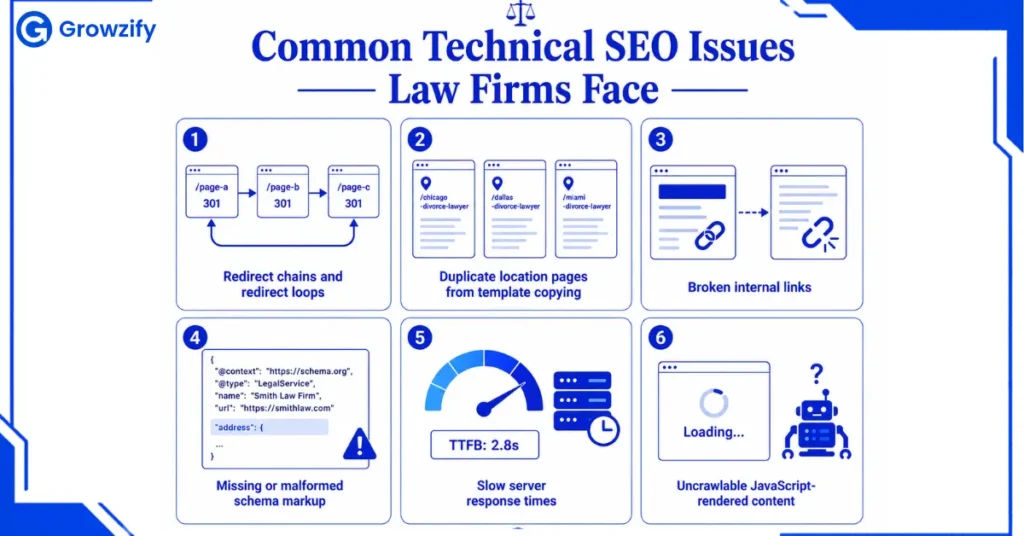
Common Technical SEO Issues Law Firms Face
These problems appear consistently in technical audits of law firm websites and represent the most common causes of underperformance despite content and local SEO investment.
Redirect chains and redirect loops.Multiple sequential redirects slow page loading and lose link authority at each step. A law firm that has undergone multiple website redesigns without cleaning up redirects often has complex chains that consume both page speed and crawl efficiency.
Duplicate location pages from template copying.City pages created by duplicating a template and changing the city name produce near-identical content at multiple URLs. Google filters duplicate content and may not rank any version of these pages effectively.
Broken internal links.Removed pages that are still linked from other pages on the site generate 404 errors that interrupt crawling and create poor user experiences for visitors who follow those links.
Missing or malformed schema markup.Schema that is syntactically incorrect, references URLs that do not match the page, or is implemented in a deprecated format provides no ranking benefit and may generate structured data errors in Google Search Console.
Slow server response times.Even optimized front-end code cannot compensate for a hosting server that responds slowly. Law firms using low-cost shared hosting in competitive markets where competitors use managed cloud hosting face a baseline speed disadvantage.
Uncrawlable JavaScript-rendered content.Law firm websites built on JavaScript frameworks that render content client-side may present empty page shells to Googlebot. Important content that is not visible in the HTML source without JavaScript execution may not be indexed at all.
How Growzify Improves Technical SEO for Law Firms
Growzify Digital approaches technical Law Firm SEOwith a structured, audit-first process designed to uncover the exact technical issues limiting a firm’s ranking performance before any optimization work begins.
Every engagement starts with a comprehensive technical SEO audit. This includes Core Web Vitals analysis, crawlability testing through crawl simulation and Google Search Console review.
Indexing analysis for all major practice area and location pages, schema markup validation, internal linking evaluation, and a full assessment of HTTPS and page experience signals.
Once the audit is complete, we create a prioritized remediation roadmap based on projected SEO impact.
Critical issues affecting indexation, crawl access, or Core Web Vitals are addressed first. Secondary performance limitations are resolved in later optimization phases to maintain a structured implementation process.
Schema Markup for Law Firm Websites
We implement complete legal schema frameworks across relevant page types, including LegalService, Attorney, LocalBusiness, FAQ, and BreadcrumbList schema.
Every implementation is tested through Google’s Rich Results Test before deployment and monitored through Google Search Console to maintain structured data accuracy and coverage.
Internal Linking Architecture Optimization
For law firm websites with disconnected or inconsistent internal linking, we redesign the architecture using a hub-and-spoke framework.
This process includes mapping the full content structure, identifying authority-driving pages, and building logical internal pathways that strengthen priority practice area and location pages.
Site Speed and Core Web Vitals Optimization
We improve Core Web Vitals performance through image optimization, JavaScript deferral, CSS cleanup, server-side improvements, and CDN integration where appropriate.
Each optimization is benchmarked before and after implementation to measure improvements in LCP, INP, and CLS performance metrics.
Crawl Efficiency and Indexation Improvements
We identify crawl inefficiencies caused by redirect chains, low-value indexed pages, XML sitemap inconsistencies, and robots.txt configuration issues.
For larger law firm websites with complex structures, we also use log file analysis to understand how search engines are interacting with the site and prioritize technical fixes more accurately.
The result is a stronger technical SEO foundation that allows every other aspect of a law firm’s SEO strategy to perform more effectively without being limited by underlying technical barriers.
Contact Growzify Digital to schedule a technical SEO audit and identify the specific issues affecting your current law firm search rankings.
Frequently Asked Questions
What is technical SEO and why does it matter specifically for law firm websites?
Technical SEO is the process of optimizing a website’s infrastructureso that search engines can efficiently crawl, index, and evaluate its content. For law firm websites, technical SEO matters because legal search is highly competitive, and even small technical disadvantages compound into ranking gaps that affect consultation volume.
How does site speed affect law firm search rankings and client conversions?
Site speed affects law firm rankings through Google’s Core Web Vitals evaluation system, which directly influences page experience scores and ranking eligibility for competitive legal keywords. Beyond rankings, slow load times increase bounce rates among potential clients, particularly on mobile, where most urgent legal searches occur.
What schema markup should a law firm website implement for better SEO performance?
Law firm websites should implement Legal Service schema on practice area pages to explicitly identify the service type and geographic coverage. Attorney schema on individual bio pages structures credential and contact information for AI search systems. LocalBusiness schema supports map pack rankings and local search visibility.
How does internal linking structure impact Law Firm SEO performance?
Internal linking distributes ranking authority from high-authority pages to pages targeting competitive keywords and communicates topical relationships to Google’s crawlers. A law firm using a hub-and-spoke internal linking model, where a comprehensive practice area hub page links to and receives links from specific related pages, builds topical authority signals that support competitive keyword rankings.
How does Growzify approach technical SEO audits for law firm websites?
Growzify Digital conducts technical SEO audits for law firm websites through a structured evaluation of Core Web Vitals performance, crawlability and indexation status, schema markup implementation and errors, internal linking architecture, redirect chain integrity, and page experience signals.

Chitranshu SharmaA growth strategist, digital marketing consultant, and the founder of Growzify, a performance-driven agency helping brands dominate search, shape perception, and build sustainable online visibility. With 8+ years of hands-on experience in Enterprise SEO, Online Reputation Management (ORM), and AI-led traffic generation, Chitranshu has helped startups, public figures, SaaS companies, and cannabis brands outrank competitors — ethically and at scale.
Explore More Articles
How to Find and Compare Local SEO Outsourcing Providers
How to Find and Compare Local SEO Outsourcing Providers Finding a local SEO outsourcing provider...
October 13, 2026Outsourcing
Inside a White Label SEO Campaign: How the Work Gets Done
Inside a White Label SEO Campaign: How the Work Gets Done Clients see a single...
October 13, 2026White Label

How to Vet an SEO Outsourcing Provider Before You Sign a Contract
How to Vet an SEO Outsourcing Provider Before You Sign a Contract A polished proposal...
October 9, 2026Outsourcing

Multilingual SEO Best Practices: Optimize Your Multi-Language Website
Multilingual SEO Best Practices: Optimize Your Multi-Language Website Translating a page and localizing it for...
October 7, 2026SEO
What Makes In-House Enterprise SEO Work Different Day-to-Day?
What Makes In-House Enterprise SEO Work Different Day-to-Day? On a small site, deciding to fix...
October 7, 2026Enterprise
How Core Algorithm Updates Impact Large Sites Differently Than Small Ones
How Core Algorithm Updates Impact Large Sites Differently Than Small Ones A large enterprise site...
October 7, 2026Enterprise
When Should You Outsource SEO? 11 Signs It Makes Sense
When Should You Outsource SEO? 11 Signs It Makes Sense Outsourcing SEO does not necessarily...
September 26, 2026Outsourcing