



How to Structure Legal Content for AI Search Engines
AI search engines favor legal content that is well-structured, authoritative, and easy to understand. This guide explains how law firms can organize content using clear headings, concise answers, FAQ sections, schema markup, and strong EEAT signals to improve visibility in AI-generated search results and increase the likelihood of being cited by AI platforms.

Written byChitranshu Sharma
June 9, 2026
Quick Nav
Most law firms think the problem is that they lack enough content. The real problem, in most cases, is that the content they already have is poorly organized.
“To structure legal content for AI search engines, organize content around specific practice areas, use clear heading hierarchies, create topic clusters, add strategic internal links, answer common legal questions, and implement structured data. Well-organized content helps AI systems better understand your legal expertise,making your law firm more likely to appear in AI-generatedrecommendations and search results.”
AI search engines do not read individual pages in isolation. They interpret relationships between topics, practice areas, locations, entities, and user intent across an entire website.
Content quality still matters. But without deliberate structure, even well-written legal content struggles to register as authoritative in AI systems.
ChatGPT, Perplexity, Gemini, and other AI platforms are increasingly making decisions about which law firms to surface based on how clearly that website communicates.
Many law firms have invested in good content but remain invisible in AI-generated answers because their information is stored in disconnected pages, buried in poor navigation, or spread across competing topic signals.
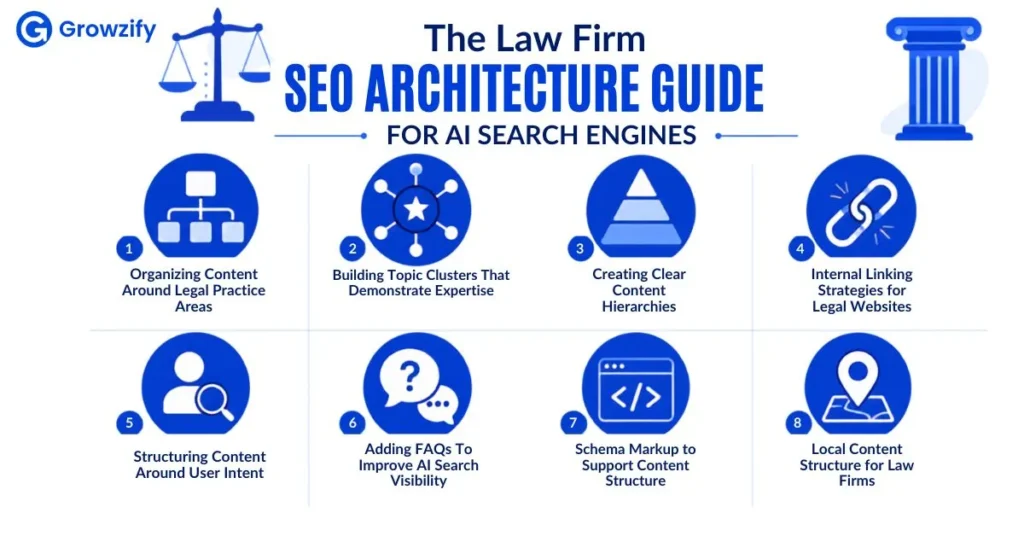
The Law Firm SEO Architecture Guide for AI Search Engines
Traditional search engines operate primarily on keywords. You publish a page targeting a specific phrase, optimize the technical elements, build some links, and the page either ranks or it does not.
Structure helps in traditional SEO, but raw optimization signals can compensate for weak organization to a meaningful degree. AI search works on a different logic entirely.
AI systems like ChatGPT and Perplexity are not keyword matchers. They are comprehension systems. They have been trained on enormous volumes of text and have developed the ability to assess whether a source genuinely understands a subject or is simply present on the web.
To make that assessment, AI systems look at more than the words on a single page.
- They evaluate whether a law firm’s content forms a coherent, connected knowledge structure around its practice areas.
- They look at how topics relate to each other.
- They assess whether supporting information exists to back up the claims on primary pages.
- They check whether the website’s organization reflects a firm with deep expertise or one that has assembled a collection of loosely connected landing pages.
A well-structured law firm website communicates expertise through its architecture. A poorly structured one leaves AI systems uncertain about what the firm actually specializes in.
For Law Firm SEO in the current landscape, content structure is not a secondary concern. It is a primary competitive variable.
Organizing Content Around Legal Practice Areas
The foundation of a well-structured law firm website is practice area organization. This sounds obvious, but most law firm sites get it wrong in ways that genuinely damage their AI visibility.
The correct model is a hub-and-spoke architecture.
The hub pageis the main practice area page. For a personal injury firm, this would be the Personal Injury Law hub page. This page does not try to answer every possible question about personal injury.
Its job is to establish the firm’s comprehensive coverage of this practice area, introduce the key sub-topics it handles, and provide clear navigation to the supporting content that covers each sub-topic in depth.
The spoke pagesare the supporting articles and service pages that sit beneath each hub. For a personal injury hub, spokes might include pages on car accident claims, slip and fall injuries, medical malpractice, wrongful death, insurance disputes, and the litigation process.
Each spoke covers one topic in genuine depth. Each spoke links back to the hub and to other relevant spokes.
The resultis a content structure that mirrors the way an expert actually thinks about a practice area. A personal injury lawyer does not know personal injury law as one undifferentiated subject.
They know it as a network of interconnected topics, procedures, and legal standards. A hub-and-spoke content structure communicates that same depth of connected knowledge to AI systems.
The mistake most law firms make is creating one page per practice area and calling it done. That is not a hub. That is a listing. A listing tells an AI system you exist in a space. A hub with supporting spokes tells it you own the space.
Building Topic Clusters That Demonstrate Expertise
Topic clusters formalize the hub-and-spoke concept into a deliberate content planning strategy. A topic cluster is a group of content pieces that together cover a subject comprehensively.
The pillar page is the central, authoritative resource for the topic. The cluster articles cover every meaningful sub-topic, question, and related concept within that subject. Every cluster article links to the pillar page. The pillar page links to every cluster article.
For a family law firm, a well-built divorce topic cluster might look like this:
Pillar page:Divorce Law in Alberta
Cluster articles:
- Grounds for Divorce in Canada
- How to File for Divorce in Alberta
- Contested vs. Uncontested Divorce: What Is the Difference?
- Divorce and Property Division in Alberta
- Spousal Support After Divorce: How It Works
- How Long Does a Divorce Take in Alberta?
- Child Custody During Divorce Proceedings
- Separation Agreements vs. Divorce Orders
Each of these articles is substantial, accurate, and directly helpful to someone researching divorce in Alberta. Together, they make the pillar page the center of a knowledge ecosystem on divorce law that AI systems can recognize as authoritative coverage.
The important distinction between topic clusters and traditional service pages is depth and connection. A traditional service page describes what the firm does. A topic cluster demonstrates that the firm genuinely understands the subject it is practicing in.
AI systems recommend firms that demonstrate understanding. They do not recommend firms that merely describe services.
Creating Clear Content Hierarchies
Every page on a law firm’s website should have a logical heading structure that mirrors how information is organized in the real world.
H1 headingsshould be clear, direct, and descriptive of the page’s primary topic. One H1 per page. It should communicate immediately what the page is about and reflect the primary intent of the people landing on that page.
H2 headingsdivide the page into major sections. Each H2 should represent a distinct aspect of the topic being covered. Think of H2s as chapter titles. They should be informative enough to stand alone as summaries of the section beneath them.
H3 headingsbreak H2 sections into specific sub-points. They are where detailed explanations, specific scenarios, and direct answers to narrow questions live. H3s are particularly valuable for AI extraction because they give AI systems a clear label for each specific piece of information on the page.
Beyond individual pages, the overall site structure should reflect a logical hierarchy. Homepage at the top. Practice area pages are one level down.
Supporting content another level down. Geographic pages connected to their relevant practice areas. All of these levels should be navigable through clear internal links.
A law firm website where a user can navigate from the homepage to any specific piece of content in three clicks or fewer has strong structural clarity.
A site where users (and AI crawlers) have to search or scroll through ambiguous menus to find specific content is communicating organizational confusion to AI systems.
Hierarchy is not just a user experience feature. It is a signal of how well a firm has organized its knowledge, and AI systems interpret it accordingly.
Internal Linking Strategies for Legal Websites
Internal links are the connective tissue of a well-structured law firm website. Without them, even well-organized content exists as isolated islands rather than a coherent knowledge network.
Contextual internal linksare the most valuable. These are links placed within the body text of a page that connect to a related piece of content. When a page about personal injury settlements mentions the litigation process, linking that phrase to the firm’s litigation process article creates an explicit topical connection that AI systems can follow and interpret.
Practice area connectionsshould be built systematically. Every spoke page in a practice area cluster should link to the hub page. The hub page should link to every spoke. This bidirectional linking creates a closed content loop that clearly communicates to AI systems that these pages form a unified knowledge structure.
Geographic connectionsare important for local AI search visibility. A firm serving Calgary, Airdrie, and Cochrane should have location-specific pages that are clearly connected to the relevant practice area pages.
A Calgary divorce law page should link to and from the main divorce law hub. This geographic-to-practice-area linking pattern helps AI systems understand both what the firm does and where it does it.
Educational content linkingstrengthens the connection between informational content and service-oriented pages. A blog post answering “what happens to the family home in a divorce in Alberta” should link to the family law practice area page and to the property division page.
This connection signals that the educational content supports the firm’s practice expertise, not that it exists as separate, unrelated information.
The volume of internal links matters less than their relevance and consistency. A small number of well-placed, contextually meaningful internal links communicates more to AI systems than a large number of random cross-links with no thematic logic.
Structuring Content Around User Intent
One of the most practical shifts law firms can make in their content strategy is organizing pages around the specific intent behind user queries rather than around broad service categories.
Legal clients move through distinct stages before hiring an attorney. Each stage carries a different type of question and a different type of content needed.
Informational intentis at the beginning of the journey. The person has a problem they do not fully understand yet. They are searching for explanations, definitions, and general guidance. Content that targets informational intent should be educational, clear, and genuinely helpful without requiring any commitment from the reader.
Research intentcomes next. The person now understands their situation better and is researching options. They want to understand how the legal process works, what outcomes are possible, what factors affect their situation, and what the process looks like from start to finish.
Commercial intentreflects someone who has decided they need a lawyer and is evaluating their options. They want to understand what the firm does, how it works, what it costs, and whether it handles cases like theirs. Practice area pages, attorney profiles, and case experience content all serve commercial intent.
Local intentis the geographic layer that runs across all stages. “Divorce lawyer in Calgary” is a local commercial intent. “How does property division work in Alberta?” is a local informational intent. Structuring content to address the geographic context of the user’s query is essential for local AI search visibility.
Most law firm websites serve commercial intent adequately and informational or research intent poorly. That gap is exactly where AI visibility is won or lost.
Adding FAQs To Improve AI Search Visibility
FAQ sections are among the most consistently undervalued elements of legal content structure. AI systems extract answers from content that is formatted to be extracted. Questions followed by direct, concise answers are exactly that format.
When an AI platform like Perplexity or ChatGPT is generating a response to a legal query, it actively looks for clear question-and-answer pairings that match the intent of the query.
Beyond AI extraction, well-structured FAQ sections serve another structural function. They cover the long-tail, conversational, and specific questions that main page content cannot efficiently address without becoming unwieldy.
A personal injury page cannot answer every possible question a potential client might have. But a FAQ section at the bottom of that page can address eight to twelve of the most common specific questions in a concise, well-organized format.
The cumulative effect is significant. A law firm that has thoughtful FAQ sections on every practice area page, every supporting article, and every major location page.
Each of those FAQ entries is a potential answer source for an AI platform responding to a related query.
Schema Markup to Support Content Structure
Schema markup is the technical layer that translates a well-organized website into machine-readable signals that AI and search systems can process directly without inferring information from unstructured prose.
For law firms, schema markup is not optional if AI visibility is a priority.
Legal Service schemais the most important schema type for law firm websites. It explicitly identifies the firm as a legal services provider, specifies its practice areas, and connects those services to a geographic location.
Without this schema, AI systems must piece together this information from scattered content across the site.
Attorney schemadocuments individual lawyers with verifiable credentials, including bar admissions, law school affiliations, areas of specialization, and professional profiles.
When attorney information is marked up with structured data, it becomes far easier for AI systems to associate specific legal expertise with specific named professionals at the firm.
FAQ Page schemamarks up question-and-answer content in a format that search engines and AI systems can extract directly. It is the technical counterpart to the content structure of the FAQ sections discussed above.
Without the FAQ Page schema, AI systems must identify FAQ content through inference. With it, the question-and-answer pairs are explicitly labeled for extraction.
Organization schemaprovides basic but important entity data: the firm’s name, address, phone number, website, founding date, and social profiles. This schema anchors the firm as a clearly defined entity in structured data, which supports entity recognition across AI systems.
Breadcrumb List schemacommunicates the site’s hierarchical structure to crawlers, reinforcing the content hierarchy visible in the navigation. It tells search and AI systems exactly where each page sits within the overall site architecture.
Schema implementation should be treated as a permanent component of the site’s technical foundation, not as an optional enhancement. AI systems that can read structured data are more likely to recommend the firms whose data they can read confidently.
Local Content Structure for Law Firms
Geographic relevance is a significant factor in how AI systems respond to legal queries with local intent. Structuring local content correctly is animportant dimension of Law Firm SEOthat is frequently handled poorly.
City and service area pagesshould not be identical templates. Each location page should contain genuinely differentiated content relevant to that market. A page that says the same things as the Edmonton page, with just the city name changed, provides no local authority signal.
Geographic authorityis built through the combination of location page content, Google Business Profile optimization, local citation consistency, and mentions across local publications and community resources. AI systems construct local relevance signals from all of these sources collectively.
Local legal resourcesare an often-overlooked content opportunity. A page that links to or references the Alberta Courts website, local legal aid resources, or Alberta Law Society information adds genuine local utility and signals that the firm is embedded in the local legal ecosystem rather than operating generically.
Location and practice area connectionsshould be explicitly structured. A firm serving multiple cities should have clear internal linking between each city page and the corresponding practice area content.
A Calgary divorce law page should link to the main divorce law hub. This geographic-to-topic connection helps AI systems build accurate associations between the firm, its services, and its markets.
The goal of local content structure is to make a firm’s geographic presence and legal expertise feel like one integrated identity rather than a website that has been replicated across multiple location pages.
How Growzify Helps Law Firms Build AI-Ready Content Structures
Building a content architecture that performs in AI search requires more than understanding the principles. It requires a systematic process, consistent execution, and the expertise to make decisions specific to each firm’s practice areas, markets, and competitive environment.
Content architecture planningat Growzify begins with a full audit of a firm’s existing content structure. The audit identifies hub-and-spoke gaps, orphan pages, thin service content, missing FAQ sections, structural linking deficiencies, and intent mapping problems.
The output is a clear, prioritized map of where the firm’s content structure needs to be rebuilt, expanded, or reorganized to support AI search visibility.
Topic cluster developmentis a core Growzify deliverable. For each primary practice area, Growzify develops a cluster plan that specifies the pillar page, every supporting article, the internal linking architecture, and the FAQ content required to build comprehensive topical authority.
Every cluster is built to cover the full range of user intent stages, from initial educational queries to local commercial searches.
Entity optimizationis treated as a distinct and systematic work stream. Growzify audits all platforms where the firm and its attorneys appear, corrects inconsistencies, completes missing profiles, and develops structured documentation across directories and legal platforms.
This work runs parallel to content development and reinforces the authority signals that content alone cannot create.
Schema implementationis built into every Growzify content engagement. Legal Service, Attorney, FAQ Page, Organization, and Breadcrumb List schema are implemented consistently across the site as part of the technical foundation that makes the content readable to AI systems at the machine level, not just the human level.
AI search readiness reviewsgive Growzify clients a regular assessment of how their content structure is performing in terms of AI visibility signals. These reviews identify new gaps as the firm grows, new practice areas are added, and new geographic markets are entered.
Long-term authority buildingis the cumulative outcome of Growzify’s approach. Every content cluster developed, every entity signal strengthened, and every schema element implemented adds a layer to the firm’s AI search authority that becomes more valuable over time. The firms working with Growzify are not optimizing for a single algorithm update.
Growzify Digital approaches Law Firm SEO as a content architecture discipline, not just a content production service.
Frequently Asked Questions
Q: How does content structure affect AI search rankings for law firms?
A: AI search systems evaluate law firm websites not as collections of individual pages but as interconnected knowledge structures. A well-organized website with clear practice area hubs, supporting content clusters, strong internal linking, and consistent schema markup communicates subject matter expertise in a way that AI systems can interpret and act on.
Q: What is the difference between topic clusters and traditional service pages?
A: Traditional service pages describe what a law firm does. They are typically single pages that summarize a practice area and invite contact. Topic clusters demonstrate that a firm genuinely understands the subject matter it practices in. A topic cluster includes a central pillar page supported by multiple articles covering specific sub-topics, each connected through internal links. The difference is depth and connectivity.
Q: Can a small law firm compete in AI search with better content organization?
A: Yes, and content organization is precisely where smaller firms can close the gap with larger competitors most efficiently. Larger firms often have broad content coverage but inconsistent depth. A smaller firm that focuses its content investment on two or three core practice areas and builds genuinely comprehensive topic clusters around those areas can develop higher topical authority in those specific areas than a larger firm with spread-thin coverage.
Q: How often should law firms update and restructure their content?
A: Content structure should be reviewed on a consistent, planned schedule rather than treated as a one-time project. A practical approach is to conduct a full content audit annually, checking for structural gaps, orphan pages, thin content, outdated information, and internal linking deficiencies. Individual pages and clusters should be updated whenever the underlying law changes, when new questions emerge from client interactions, or when a cluster’s performance in search or AI visibility declines.
Q: How does Growzify help law firms create AI-friendly content frameworks?
A:Growzify builds Law Firm SEO content frameworksthat are specifically designed for AI search visibility, not just traditional organic rankings. The process begins with a structural audit that identifies every gap between where a firm’s content architecture currently stands and where it needs to be to meet AI search standards. From there, Growzify develops practice area topic clusters, implements the FAQPage and LegalService schema across the site. Then build the internal linking architecture that systematically strengthens the entity signals that AI systems use to verify a firm’s expertise and legitimacy.

Chitranshu SharmaA growth strategist, digital marketing consultant, and the founder of Growzify, a performance-driven agency helping brands dominate search, shape perception, and build sustainable online visibility. With 8+ years of hands-on experience in Enterprise SEO, Online Reputation Management (ORM), and AI-led traffic generation, Chitranshu has helped startups, public figures, SaaS companies, and cannabis brands outrank competitors — ethically and at scale.
Explore More Articles

How to Find and Compare Local SEO Outsourcing Providers
How to Find and Compare Local SEO Outsourcing Providers Finding a local SEO outsourcing provider...
October 13, 2026Outsourcing

Inside a White Label SEO Campaign: How the Work Gets Done
Inside a White Label SEO Campaign: How the Work Gets Done Clients see a single...
October 13, 2026White Label

How to Vet an SEO Outsourcing Provider Before You Sign a Contract
How to Vet an SEO Outsourcing Provider Before You Sign a Contract A polished proposal...
October 9, 2026Outsourcing

Multilingual SEO Best Practices: Optimize Your Multi-Language Website
Multilingual SEO Best Practices: Optimize Your Multi-Language Website Translating a page and localizing it for...
October 7, 2026SEO
What Makes In-House Enterprise SEO Work Different Day-to-Day?
What Makes In-House Enterprise SEO Work Different Day-to-Day? On a small site, deciding to fix...
October 7, 2026Enterprise
How Core Algorithm Updates Impact Large Sites Differently Than Small Ones
How Core Algorithm Updates Impact Large Sites Differently Than Small Ones A large enterprise site...
October 7, 2026Enterprise
When Should You Outsource SEO? 11 Signs It Makes Sense
When Should You Outsource SEO? 11 Signs It Makes Sense Outsourcing SEO does not necessarily...
September 26, 2026Outsourcing