



Proven Law Firm SEO Strategies for 2026
This guide explores proven law firm SEO strategies for 2026 to help attorneys improve search visibility, attract qualified clients, and stay competitive. It covers local SEO, AI Overview optimization, content marketing, technical SEO, authority building, and conversion-focused practices that drive sustainable growth and more case inquiries.

Written byChitranshu Sharma
June 22, 2026
Quick Nav
Law firms are competing for visibility in a search environment that has changed dramatically over the past few years. Potential clients are no longer limited to typing a keyword into Google and browsing a list of search results. Today, they expect immediate, accurate answers across multiple search platforms.
They ask Google’s AI Mode a question. They get an AI Overview before they even see traditional results. They ask ChatGPT or Gemini who the best personal injury lawyer in their city is. And increasingly, they trust the answer they get.
This shift has made law firm SEO more important, not less. Every firm that used to rely on referrals or print ads is now investing in digital visibility, which means the competition for the same searches has grown sharper.
At the same time, local search still drives the majority of legal client inquiries. Someone searching “divorce attorney near me” or “DUI lawyer in Austin” is looking for immediate help, and they choose from whoever shows up first.
SEO for law firms remains one of the highest return marketing channels available to attorneys. Unlike paid ads, organic visibility keeps generating leads long after the initial investment.
A well-optimized law firm website can produce consultation requests for years, not just for the weeks a campaign is funded.
What Is Law Firm SEO?
Law firm SEO is the process of improving a law firm’s visibilityin organic search results, local search listings, and AI-generated answers so that potential clients can find the firm when searching for legal help.
It combines several disciplines working together:
Organic search visibilityfocuses on ranking a firm’s website for the keywords potential clients actually use, such as practice area terms and location-based searches.
Local SEOensures the firm appears in Google Maps results and the local pack, which is critical since most legal searches have local intent.
Content strategybuilds the pages, guides, and resources that answer client questions and demonstrate the firm’s knowledge of specific practice areas.
Technical SEOmakes sure the website itself is fast, crawlable, and structured in a way search engines and AI systems can understand.
Authority buildingearns the backlinks, citations, and trust signals that tell search engines a firm is credible and worth recommending.
None of these works well in isolation. A firm with great content but a slow website will struggle to rank. A firm with strong local SEO but thin practice area pages will rank but convert poorly. Law firm SEO done correctly treats all five as one connected system.
Why Law Firm SEO Matters More in 2026
AI Overviews Are Changing How Clients Find Attorneys
Google’s AI Overviews now appear above traditional search results for many legal queries. These summaries are generated from content Google considers authoritative and well-structured.
If your firm’s website is not built in a way that AI systems can easily parse and cite, you are increasingly invisible at the very top of the search experience, regardless of how you rank below it.
Voice Search Reflects How People Actually Ask for Help
When someone says, “find me a lawyer near me who handles workers’ comp,” that phrasing is different from how they would type a search.
Voice queries tend to be longer, more conversational, and more specific. Firms that build content around natural language questions capture this traffic. Firms that only target short keyword phrases miss it.
Local Intent Still Drives Most Legal Searches
The vast majority of people searching for legal help search with location in mind, even when they do not type a city name. Google understands this and weights local relevance heavily for legal queries.
A firm with strong local SEO consistently outperforms a firm with a bigger budget but weaker local signals.
Trust Signals Carry More Weight Than Ever
Legal services fall under what Google calls Your Money or Your Life content, meaning search engines hold legal websites to a higher standard for expertise, experience, authority, and trust.
A firm bio page with no credentials, a website with no client reviews, or content with no real legal insight will struggle to rank, no matter how well it is technically optimized.
Competition Among Firms Has Intensified
More law firms have invested in digital marketing over the past several years, which means the bar for ranking has risen. Strategies that worked in 2020 are no longer enough. Firms that want visibility in 2026 need a more comprehensive and more current approach.
Consumer Search Behavior Has Shifted
People research more before contacting a firm. They read reviews, compare practice area pages, and sometimes ask an AI assistant to summarize options before ever visiting a website. A firm’s entire online presence, not just its homepage, now factors into whether it gets chosen.
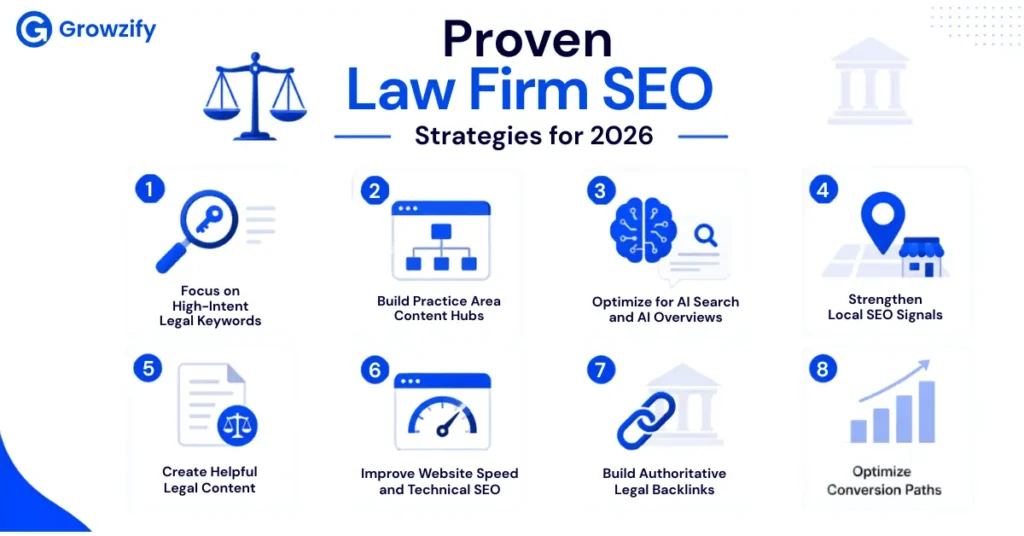
Proven Law Firm SEO Strategies for 2026
1. Focus on High-Intent Legal Keywords
Not all keywords are equal. The most valuable searches for a law firm combine a practice area with a location, because they represent someone ready to take action.
Practice area keywordsdescribe the specific legal service, such as “personal injury attorney,” “estate planning lawyer,” or “criminal defense lawyer.”
Location-based keywordsnarrow the search to where the client needs help, such as “personal injury attorney in Denver” or “estate planning lawyer near downtown Chicago.”
Commercial intent keywordssignal someone is ready to hire, including phrases like “hire a lawyer,” “free consultation attorney,” or “best rated divorce lawyer.”
Long tail opportunitiescapture more specific, lower competition searches such as “lawyer for rear end car accident no injuries” or “how to find a probate attorney for a small estate.” These phrases convert at a high rate because the searcher’s need is already well defined.
A strong law firm SEO strategy targets all four categories, not just the obvious head terms every competitor is already chasing.
2. Build Practice Area Content Hubs
Most law firm websites have a handful of thin practice area pages and call it done. That approach rarely ranks well in 2026.
A practice area hub starts with one strong, comprehensive page covering a specific area of law, such as personal injury. That page becomes the center of a content cluster, supported by detailed subpages covering car accidents, slip and falls, wrongful death, and other related topics.
Internal linking ties these pages together so visitors and search engines can see the full depth of the firm’s expertise in that area.
This structure also builds topical authority, which is how Google determines whether a website genuinely understands a subject or is just dabbling in it.
Firms that build these hubs consistently outrank firms with isolated, unconnected pages, even when both have similar word counts.
3. Optimize for AI Search and AI Overviews
Ranking in AI-generated answers requires a different mindset than ranking in traditional search alone. Search engines and AI tools need clear signals about your law firm.
They should instantly understand who you are, where you serve clients, and what legal services you provide. AI systems rely heavily on these signals to understand and trust a website.
Structured answers matter because AI systems favor content that directly answers a question in the first sentence or two, rather than burying the answer under paragraphs of introduction. Writing in this answer in the first style improves both AI Overview visibility and featured snippet eligibility.
Expertise signals, including attorney bios with real credentials, bar admissions, and case experience, give AI systems and human readers a reason to trust the content’s source.
Content depth matters because thin pages rarely get cited. AI systems tend to pull from pages that thoroughly cover a topic, since that depth signals genuine authority rather than a surface-level summary.
4. Strengthen Local SEO Signals
Local SEO remains the backbone of law firm visibility, and it deserves consistent attention rather than a one-time setup.
Google Business Profile optimization includes accurate categories, complete service descriptions, regular photo updates, and active management of posts and updates.
Reviews influence both rankings and conversions. Firms that build a simple, consistent process for asking satisfied clients to leave reviews see steady improvement in local rankings over time.
Local citations across legal directories, bar association listings, and review platforms reinforce a firm’s legitimacy and location to search engines.
NAP consistency, meaning the firm’s name, address, and phone number match exactly across every platform, prevents confusing signals that can quietly suppress local rankings.
Service area definition matters for firms serving multiple cities or counties. Clear service area pages help the firm rank in each market it actually serves, rather than relying solely on the location of its physical office.
5. Create Helpful Legal Content
Search engines and AI systems both reward content that genuinely helps people, not content written purely to rank.
FAQs answer the specific questions potential clients ask before contacting a firm, such as “how much does a personal injury lawyer cost” or “what happens at a DUI arraignment.”
Legal guides walk readers through processes step by step, such as what to expect during a divorce filing or how a workers’ compensation claim typically proceeds.
Case-related educational content explains legal concepts in plain language, helping potential clients understand their situation before they ever pick up the phone.
Client-focused resources, such as checklists or document preparation guides, give visitors something useful immediately, which builds trust before the first conversation even happens.
This kind of content also performs well in AI Overviews and chatbot responses, since these systems prioritize content written to inform rather than to sell.
6. Improve Website Speed and Technical SEO
A law firm’s content can be excellent and still underperform if the website itself has technical problems. Nobody likes waiting for a slow website. Google doesn’t either.
Core Web Vitals help measure whether your site loads quickly and provides a smooth experience for visitors. Mobile responsiveness is essential since most legal searches happen on phones.
A site that is hard to navigate or read on mobile loses potential clients immediately. Crawlability ensures search engines can actually access and read every important page on the site, including practice area pages and location pages that sometimes get buried in poor site structures.
Indexation issues, such as pages accidentally blocked from search engines, are more common than most firms realize and can silently remove valuable pages from search results entirely.
Site architecture, meaning how pages are organized and linked, affects both user experience and how easily search engines understand the relationships between practice areas, locations, and supporting content.
7. Build Authoritative Legal Backlinks
Backlinks remain one of the strongest trust signals in SEO, but quality matters far more than quantity for law firms.
A single link from a respected legal publication or local news outlet carries more weight than dozens of links from low-quality directories.
Legal directories with strong reputations, such as established bar association listings and recognized legal rating platforms, still provide meaningful value when chosen carefully.
Digital PR, including being quoted as a legal expert in news articles or contributing to local publications, builds both backlinks and brand credibility simultaneously.
Local partnerships with community organizations, sponsorships, or business associations can generate relevant local backlinks while also strengthening the firm’s reputation in its community.
Thought leadership, such as publishing original commentary on legal trends or notable cases, attracts natural links from other websites referencing that expertise.
8. Optimize Conversion Paths
Ranking well means nothing if visitors do not contact the firm once they arrive. Contact forms should be short, clearly visible, and easy to complete on mobile devices. Long, complicated forms discourage submissions from people who are often dealing with stressful situations.
Consultation requests should be prominently placed and repeated throughout longer pages, not buried at the bottom where visitors may never scroll.
Call tracking allows firms to measure which pages and keywords actually generate phone calls, which is often the primary conversion point for legal services.
Trust elements, including client testimonials, case results where appropriate, and clear attorney credentials, reassure visitors during a decision that often feels high stakes and personal.
User experience improvements, such as clear navigation and fast loading pages, reduce the friction between a visitor finding your site and actually reaching out.
9. Use Data and Analytics to Guide SEO Decisions
Law firm SEO should never run on guesswork once real data is available.
Search Console shows which queries are bringing visitors to the site and where rankings are improving or slipping, which helps prioritize future content and optimization work.
GA4 tracks how visitors behave once they land on the site, revealing which pages keep attention and which ones cause people to leave quickly.
Conversion tracking connects SEO performance directly to consultation requests and phone calls, showing which efforts are actually producing clients rather than just traffic.
Lead quality analysis goes a step further, helping firms understand whether the leads coming from organic search match the type of cases the firm actually wants to take.
Performance monitoring on a consistent schedule, rather than a one-time audit, allows a firm to catch ranking drops or technical issues early, before they significantly affect lead volume.
Common Law Firm SEO Mistakes to Avoid
Keyword stuffing, where a page repeats a phrase unnaturally to try to rank, reads poorly to visitors and can actually hurt rankings under modern search algorithms.
Thin legal content, such as a practice area page with only two or three sentences, fails to demonstrate real expertise and rarely ranks for competitive terms.
Ignoring local SEOis one of the most costly mistakes a firm can make, since the majority of legal searches have local intent that an unoptimized Google Business Profile simply cannot capture.
Poor website structure, where practice areas and locations are scattered without logical organization, confuses both visitors and search engines, trying to understand the site.
Duplicate practice area pages, often created when a firm expands to new locations by copying the same content with a new city name, can trigger duplicate content issues that suppress rankings across all the affected pages.
Neglecting technical SEO, such as ignoring slow page speeds or broken links, undermines even the best content strategy.
Buying low-quality backlinksfrom link farms or irrelevant websites can do more harm than good, sometimes triggering search engine penalties that take months to recover from.
How AI Is Changing SEO for Lawyers
AI-generated search experiences are reshaping the first impression a potential client has of a law firm. Instead of clicking through to a website immediately, many users now read an AI summary first and only visit a website if that summary prompts further interest.
Search intent itself is evolving as people phrase queries more conversationally, asking full questions rather than typing fragmented keywords. Firms that write content addressing real questions, rather than just inserting keywords, are better positioned for this shift.
Content quality expectations have risen sharply. AI systems are trained to recognize genuinely informative, well-organized content and tend to deprioritize generic or repetitive writing that offers little real insight.
E-E-A-T signals, meaning experience, expertise, authoritativeness, and trustworthiness, have become central to how both Google and AI systems evaluate legal content. A firm that clearly demonstrates real courtroom experience, credentialed attorneys, and a track record of results has a meaningful advantage over firms with vague, impersonal content.
How Long Does Law Firm SEO Take?
Law firm SEO is not instant, and any agency promising overnight rankings should be approached with caution.
Short-term wins, such as Google Business Profile improvements and quick technical fixes, can show measurable progress within the first 30 to 60 days, particularly in local search visibility.
Medium-term growth, including improved rankings for moderately competitive keywords and increased organic traffic, typically becomes noticeable within three to six months of consistent work.
Long-term authority building, which includes ranking for highly competitive practice area terms in larger markets, generally takes six months to a year or more, depending on the level of existing competition and the firm’s starting point.
The firms that see the strongest long term results are the ones that commit to consistent, ongoing SEO work rather than treating it as a short project with a defined end date.
Why Choose Growzify for Law Firm SEO
Growzify works specifically within the legal industry, which means our strategies are built around how legal clients actually search and decide, not generic SEO templates applied to every industry.
Our campaigns are data-driven from the start. We track rankings, traffic, and most importantly, consultation requests and calls, so firms know exactly what their investment is producing.
Our technical SEO capabilities address the underlying website issues that quietly limit so many law firm websites, from page speed to crawlability to structured data implementation.
Our content strategy is built around real client questions and genuine practice area expertise, not thin pages designed only to include a keyword.
Our local SEO expertise reflects a deep understanding of how Google evaluates legal businesses locally, from Google Business Profile management to citation consistency to review generation.
We focus on long-term growth because that is how law firm SEO actually works. Sustainable rankings come from consistent investment, not short bursts of activity followed by long gaps.
Effective Strategies for Scaling a Law Firm in 2026
Law firm SEO in 2026 looks different from what it did even a few years ago, but its core purpose has not changed. It connects people who need legal help with the firms best positioned to provide it, at the exact moment they are searching for that help.
AI Overviews, voice search, and evolving consumer behavior have raised the bar for what it takes to be visible. Firms that treat SEO for law firms as an ongoing investment will continue to capture the clients searching for them. Firms that treat it as a one-time project will keep losing ground to competitors who do not.
Consistent, well-executed law firm SEO remains one of the most reliable ways for attorneys to grow their practice in a search environment that keeps getting more competitive and more automated.
Frequently Asked Questions
What is Law Firm SEO?
Law firm SEO is the process of optimizing a law firm’s website and online presence to improve visibility in search engines, local search results, and AI-generated answers. It combines technical optimization, content strategy, and local SEO to help potential clients find a firm when searching for legal help.
How long does SEO for law firms take to show results?
Most firms see initial improvements in local visibility within 30 to 60 days. Meaningful traffic and ranking growth for moderately competitive terms typically develops within three to six months, while ranking for highly competitive practice areas can take six months to a year or more.
Is local SEO important for attorneys?
Yes, local SEO is essential for attorneys because most legal searches have local intent. People searching for legal help typically want an attorney near them, and a strong local SEO presence, including an optimized Google Business Profile and consistent citations, is often what determines which firm gets the call.
How much should a law firm invest in SEO?
Investment varies based on market competitiveness, practice areas, and growth goals, but most law firms invest a few hundred to several thousand dollars per month for comprehensive SEO. Highly competitive markets and practice areas typically require a larger investment to see meaningful results.
Why should law firms choose Growzify for SEO services?
Growzify specializes in legal industry SEO, combining technical expertise, content strategy, and local SEO into data-driven campaigns built specifically around how legal clients search and choose an attorney. Our focus on measurable results, including consultation requests and calls, helps firms understand exactly what their SEO investment is producing.

Chitranshu SharmaA growth strategist, digital marketing consultant, and the founder of Growzify, a performance-driven agency helping brands dominate search, shape perception, and build sustainable online visibility. With 8+ years of hands-on experience in Enterprise SEO, Online Reputation Management (ORM), and AI-led traffic generation, Chitranshu has helped startups, public figures, SaaS companies, and cannabis brands outrank competitors — ethically and at scale.
Explore More Articles

How to Find and Compare Local SEO Outsourcing Providers
How to Find and Compare Local SEO Outsourcing Providers Finding a local SEO outsourcing provider...
October 13, 2026Outsourcing

Inside a White Label SEO Campaign: How the Work Gets Done
Inside a White Label SEO Campaign: How the Work Gets Done Clients see a single...
October 13, 2026White Label

How to Vet an SEO Outsourcing Provider Before You Sign a Contract
How to Vet an SEO Outsourcing Provider Before You Sign a Contract A polished proposal...
October 9, 2026Outsourcing

Multilingual SEO Best Practices: Optimize Your Multi-Language Website
Multilingual SEO Best Practices: Optimize Your Multi-Language Website Translating a page and localizing it for...
October 7, 2026SEO

What Makes In-House Enterprise SEO Work Different Day-to-Day?
What Makes In-House Enterprise SEO Work Different Day-to-Day? On a small site, deciding to fix...
October 7, 2026Enterprise

How Core Algorithm Updates Impact Large Sites Differently Than Small Ones
How Core Algorithm Updates Impact Large Sites Differently Than Small Ones A large enterprise site...
October 7, 2026Enterprise
When Should You Outsource SEO? 11 Signs It Makes Sense
When Should You Outsource SEO? 11 Signs It Makes Sense Outsourcing SEO does not necessarily...
September 26, 2026Outsourcing