



Local SEO Strategies for Law Firms: How to Rank Number One on Google Local Pack
This guide explains how law firms can improve Google Maps rankings using local SEO strategies such as Google Business Profile optimization, local citations, reviews, location pages, and local keyword targeting to increase visibility and client inquiries.

Written byChitranshu Sharma
May 25, 2026
Quick Nav
When someone needs a lawyer, they are rarely browsing casually. They are dealing with a pressing legal issue and need qualified help quickly. In 2026, that search almost always begins on Google.
It typically includes a location signal, either entered directly, such as “divorce attorney in Phoenix,” or automatically inferred from the searcher’s device location.
“Law firms improve Google Maps rankings by optimizing their Google Business Profile, building consistent local citations, generating verified client reviews, and creating location-focused legal service pages.”
Google responds by showing a local map pack before any organic results. Those three map listings receive the substantial majority of clicks and calls for legal queries.
A law firm not appearing in that map pack is losing potential clients to competitors before a single organic result is even read.
Local SEO for law firms is the system that determines which firms appear in those positions. It is not the same as general SEO.
It operates on a different set of ranking signals, requires a different content strategy, and connects directly to the phone calls and consultation requests.
For personal injury firms, criminal defense practices, family law attorneys, immigration lawyers, and multi-location legal practices, local map pack visibility is often the single highest-value SEO outcome available.
The investment in local SEO compounds over time and delivers a cost-per-case that consistently underperforms paid search alternatives over any 18-month horizon.
How Google Maps Rankings Work
Google determines local map pack rankings using three core factors. Understanding them precisely is the foundation of every effectivelocal SEO strategy for law firms.
Relevancemeasures how well your Google Business Profile and associated website content match what a searcher is looking for.
A personal injury firm that selects “Personal Injury Attorney” as its primary category publishes practice-area content that matches how clients search.
They maintain consistent keyword signals across all platforms and will rank more relevantly than a firm with a generic “Lawyer” category and thin website content.
Distancereflects the geographic proximity of the firm to the searcher’s location or the location specified in the search query.
This factor is partially outside a firm’s control, but it is addressed strategically through the use of service area settings in Google Business Profile.
Through the geo-targeted landing pages that signal relevance for specific cities and counties beyond the firm’s physical office location.
Prominencemeasures how well-known and authoritative Google perceives your firm to be.
Google Maps rankings are influenced by several factors working together. These include the quality and quantity of client reviews, strong backlinks from trusted legal and local websites, and consistent business information across directories.
Google also considers engagement signals connected to your Google Business Profile, such as clicks, calls, and activity levels.
Law firms that focus on only one or two ranking factors often struggle to achieve long-term local visibility. Strong performance across all areas is what drives higher local rankings.
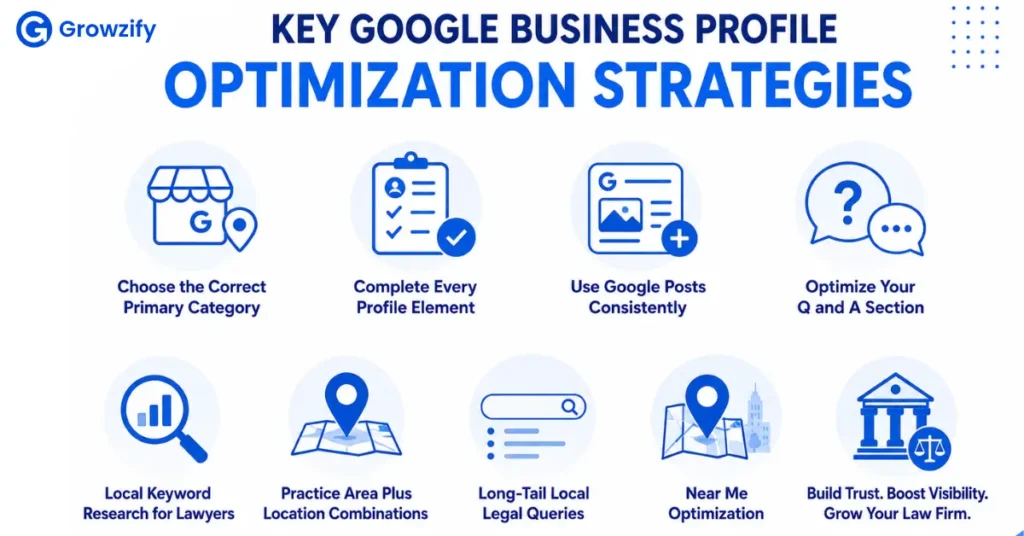
Key Google Business Profile Optimization Strategies
Your Google Business Profile is the most direct ranking lever inlocal SEO for law firms. It is also the most commonly mismanaged asset in legal digital marketing.
Choose the Correct Primary Category
Category selection is one of the most impactful decisions you make in your GBP setup. Google uses your primary category as a primary relevance signal. “Personal Injury Attorney” and “Immigration Attorney” will outperform “Lawyer” or “Law Firm” for practice-area-specific searches in almost every market.
Select the primary category that matches your highest-volume, highest-revenue practice area. Add secondary categories for every additional practice area your firm actively handles.
Firms with multi-practice profiles should prioritize the category that drives the most valuable consultations.
Complete Every Profile Element
Many law firms leave their GBP profiles partially completed. Incomplete profiles send weak relevance signals and underperform against fully completed competitor profiles.
Every field should be populated:
- Business description with natural keyword integration (practice areas, city, client outcomes)
- All relevant service areas covering every city and county your firm serves
- Practice area services listed individually within the GBP services section
- Business hours, including holiday hours and appointment availability
- Website link pointing to your optimized law firm homepage
- Phone number consistent with your website and all directory listings
Use Google Posts Consistently
Google Posts appear within your GBP and signal active profile management. Law firms that post weekly, highlighting legal topics, firm news, and practice area information, show measurably stronger local engagement than firms that post infrequently or never.
Posts also provide additional keyword surface area for relevance signals. A criminal defense firm posting about DUI defense outcomes in a specific county is reinforcing its category relevance and geographic signals simultaneously.
Optimize Your Q and A Section
Google’s Questions and Answers section on your GBP is often ignored and frequently populated by users with questions your firm should be answering proactively.
Seed your Q and A section with the questions potential clients most commonly ask, and answer them clearly with the relevant practice area and geographic keywords included naturally.
This content appears in search results and is indexed by Google. It is also parsed by AI search systems looking for authoritative answers to legal queries.
Local Keyword Research for Lawyers
Keyword research for law firm local SEO is more granular than general SEO keyword research. The goal is to identify the specific search queries that potential clients in your geographic market use when they need the legal services your firm provides.
Practice Area Plus Location Combinations
The core of law firm local keyword targeting is the combination of practice area and location. These queries carry the clearest commercial intent and the most direct connection to consultation requests.
Examples of high-intent local legal keywords:
- Car accident lawyer in [city]
- DUI attorney near me [city]
- Child custody attorney [city] [state]
- Immigration lawyer free consultation [city]
- Criminal defense attorney [county] [state]
Map these combinations across every practice area you serve and every geographic market where your firm wants visibility. Each unique combination is a potential landing page target.
Long-Tail Local Legal Queries
Long-tail keywords reflect how potential clients actually phrase their searches, particularly in voice search and conversational AI queries. These queries are less competitive and often convert at higher rates because they reflect specific situations.
Examples:
- What to do after a car accident in [city]
- How much does a divorce lawyer cost in [state]
- Can I fight a DUI charge in [county]
- Best immigration lawyer for visa renewal in [city]
Content that answers these questions directly and completely captures voice search traffic, appears in featured snippets, and gets cited in AI-generated answer summaries.
Near Me Optimization
“Near me” searches are among the highest-intent legal queries on mobile. Google infers location from the searcher’s device and returns results calibrated to their actual position.
Building High-Authority Local Citations
Local citations are mentions of your firm’s Name, Address, and Phone number (NAP) on external websites. Consistent, authoritative citations are a foundational local ranking signal that directly influences your Google Maps position.
Priority Citation Sources for Law Firms
Legal-specific directories carry the highest relevance weight for law firm local SEO:
- Avvo (complete attorney profile with practice areas and peer reviews)
- Justia (free attorney directory with strong domain authority)
- FindLaw (attorney directory and legal content platform)
- Martindale-Hubbell (peer-rated legal directory with AV rating system)
- Super Lawyers (selective, application-based legal directory)
- Lawyers.com (Martindale-connected consumer-facing directory)
- HG.org (legal directory with significant organic visibility)
- Your state bar association attorney directory
Beyond legal-specific directories, general business directories carry local authority signals:
- Google Business Profile (primary)
- Bing Places for Business
- Apple Maps
- Yelp
- Better Business Bureau
- Chambers of Commerce (local and state)
- Nextdoor (particularly valuable for small local practices)
NAP Consistency Is Non-Negotiable
The single most common citation error that suppresses law firm local rankings is inconsistent NAP data. Your firm’s name, address, and phone number must be identical across every platform where it appears. Not approximately identical, but identical.
This means:
- “Suite 400” versus “Ste. 400” is an inconsistency
- “The Smith Law Firm” versus “Smith Law Firm” is an inconsistency
- A changed phone number that hasn’t been updated across directories is an inconsistency
Perform a citation audit before beginning any local link-building campaign. Resolve existing inconsistencies before creating new citations.
Growzify Digitalconducts citation audits as a standard component of every law firm’s local SEO engagement.
Review Management Strategies for Law Firms
Reviews are a direct local ranking factor and the primary trust signal that converts a Google Maps impression into a consultation call.
Firms with more reviews, higher ratings, and consistent management of their review profiles outperform competitors across all three of Google’s local ranking factors.
Build a Review Acquisition System
Waiting for clients to leave reviews organically produces slow, inconsistent review accumulation. Law firms that build structured review acquisition processes generate significantly higher review velocity than those that don’t.
A compliant review acquisition system for law firms includes:
- Post-matter follow-up communication that thanks the client and includes a direct link to your Google review form
- A review request process is reviewed by your state bar compliance team to ensure it meets advertising and solicitation guidelines
- Staff training on how to mention the review request naturally in client conversations
- Consistent timing of review requests calibrated to when clients are most satisfied (typically at case resolution)
Respond to Every Review
Review responses are visible to potential clients and are indexed by Google. Responding to every review, positive and negative, signals active profile management.
For negative reviews, respond professionally, avoid revealing confidential information, and demonstrate your firm’s commitment to client service without being defensive.
Potential clients reading a thoughtful response to a negative review often view that response more positively than the review itself.
Diversify Your Review Platform Presence
Google reviews carry the most direct local ranking weight, but reviews on Avvo, Martindale, Justia, and Yelp also contribute to your overall prominence signals.
A firm with strong Google review volume and active review presence across multiple legal platforms sends stronger combined authority signals than one concentrated on a single platform.
Creating Location-Specific Practice Area Pages
Geo-targeted landing pages are the content foundation of law firm local SEO. They allow firms to rank organically for city-specific practice area searches.
What a High-Performing Geo-Targeted Legal Page Includes
A properly built geo-targeted practice area page is not a template with the city name substituted. It includes locally specific content that demonstrates genuine relevance to that geographic area:
- Reference to local courts where cases in that practice area are typically heard
- Local procedural information relevant to the practice area in that jurisdiction
- State-specific statute references where applicable
- Local attorney credentials and bar admissions relevant to that jurisdiction
- FAQs that reflect how clients in that specific location phrase their legal questions
- Client testimonials (where permissible) from clients in that geographic area
- Local schema markup with geo-coordinates for the targeted location
Internal Linking Architecture for Multi-Location Firms
Multi-location law firms should build a clear internal linking structure that connects the main practice area hub pages to each geo-targeted landing page. This architecture distributes page authority from high-performing content to location-specific pages and helps Google understand the geographic scope of the firm’s services.
Mobile SEO and User Experience
More than 65% of legal searches occur on mobile devices. Potential clients searching for attorneys during or immediately after a legal situation are overwhelmingly using smartphones. Mobile performance is both a ranking factor and the primary conversion environment for legal leads.
Mobile Performance Standards
Google’s Core Web Vitals are the technical benchmarks that determine mobile ranking eligibility:
- Largest Contentful Paint (LCP):The main content of your page must load within 2.5 seconds on mobile. Most law firm websites fail this threshold due to large, unoptimized images and render-blocking scripts.
- Cumulative Layout Shift (CLS):Page elements should not shift unexpectedly as the page loads. Layout instability on mobile frustrates users and signals poor page quality to Google.
- Interaction to Next Paint (INP):Your page must respond to user interactions within 200 milliseconds. Slow interaction response rates increase bounce rates and reduce conversion.
Mobile Conversion Architecture
A mobile page that ranks but doesn’t convert is incomplete work. Law firm mobile pages should include:
- Click-to-call phone number in a fixed or highly visible position at the top of every page
- Simplified contact forms that require minimal typing on a mobile keyboard
- Trust signals (Google rating, years of experience, notable case results) are visible without scrolling
- Clear, specific calls-to-action that match the intent of each page (“Get Your Free Injury Consultation,” “Speak to a Defense Attorney Tonight”)
Local Link Building Strategies
Backlinks from locally relevant, authoritative sources strengthen your firm’s prominence signals and contribute to both organic and local map pack rankings.
High-Value Local Link Sources for Law Firms
Local media and press coverage:Attorneys who contribute legal commentary to local news outlets, appear in local television news segments, or are quoted in local publications earn editorial links from sources with strong local authority.
Proactive media outreach, positioning your attorneys as subject matter experts, is an underused local link acquisition strategy for most firms.
Bar association and legal organization memberships:Active participation in your state and local bar associations, specialty bar associations, and legal aid organizations typically comes with profile pages and directory listings.
Community sponsorships:Sponsoring local events, youth sports programs, community organizations, and charitable initiatives often includes a link from the organization’s website. These links carry local relevance signals and contribute positively to the firm’s overall prominence.
Legal education partnerships:Law firms that participate in law school clinics, mock trial programs, or legal scholarship programs often receive links from law school websites, which carry high domain authority in the legal space.
Chamber of Commerce memberships:Local chamber of commerce websites maintain member directories with links. Chamber authority varies by location, but membership links consistently contribute to local citation and authority profiles.
Common Local SEO Mistakes Law Firms Make
These patterns appear consistently in local SEO audits for law firms that are not ranking competitively despite having invested in digital marketing.
Using the wrong primary GBP category.“Lawyer” or “Law Office” instead of the specific practice area category significantly reduces relevance matching for practice-area-specific local searches.
Inconsistent NAP data.A single data point difference between your website, your Google Business Profile, and your directory listings is enough to suppress local rankings. This is the most common and most fixable local ranking issue.
No location-specific landing pages.Firms serving multiple cities without dedicated landing pages for each location cannot rank locally in those cities. A firm in Denver serving Boulder, Aurora, and Lakewood without individual pages for those cities is invisible in those markets.
Minimal or inconsistent review acquisition.A competitor with 180 reviews at 4.8 stars will consistently outrank a firm with 22 reviews at 4.6 stars for map pack positions, regardless of other optimizations.
No schema markup.LegalService, Attorney, and LocalBusiness schemas provide structured data that Google and AI systems use to understand your firm’s identity, location, and services. Firms without schema markup lose rich result eligibility and AI citation opportunities.
Mobile pages that don’t convert.Ranking in the local pack but losing the consultation call because your mobile page loads slowly, buries the phone number, or presents a confusing user journey is a conversion failure that compounds every month the issue remains unaddressed.
How Growzify Digital Helps Law Firms Rank Higher
Growzify Digital is a specialist law firm SEO agencythat builds local search dominance systems for personal injury firms, criminal defense practices, family law attorneys, immigration lawyers, and multi-location legal practices.
Our local SEO methodology for law firms covers every layer of the ranking system:
Google Business Profile audit and optimization:We review your current GBP setup based on your practice area, competitors, and local market. Then we optimize categories, service areas, descriptions, and Q&A sections to improve local visibility and map rankings.
Citation audit and cleanup:We audit your listings across legal and local directories to find NAP inconsistencies. Our team corrects outdated or mismatched information before building new citations, helping strengthen local SEO performance.
Geo-targeted content strategy:We create location-specific practice area pages for every city you serve. Each page includes locally relevant content, structured schema markup, and internal linking that supports stronger organic and Google Maps rankings.
Review generation system:We help implement a consistent review request process designed around state bar compliance. This supports steady review growth across Google and trusted legal review platforms.
Local authority link building:We run outreach campaigns focused on local media, legal associations, directories, and community partnerships to help build stronger local authority and improve map pack visibility.
AI search optimization:Our content is structured for AI Overviews, voice search, and LLM-based search platforms. This helps your law firm appear across modern search experiences where potential clients are actively looking for legal services.
Request a local SEO audit from Growzify Digitaland get a clear picture of exactly what is limiting your firm’s Google Maps visibility and what a structured strategy to improve it would look like.
Future of Local SEO for Attorneys
The local SEO landscape for law firms keeps evolving, but the overall direction is becoming easier to predict and prepare for.
AI-generated search results are growing quickly.
Google’s AI Overviews now show more locally focused legal answers pulled from trusted and well-structured law firm websites.
Firms with strong E-E-A-T signals, clear schema markup, and detailed local content are more likely to get featured, and this trend will continue to grow.
Voice search is also becoming more important.
People now search for legal help using natural, conversational questions through mobile devices and smart speakers.
Law firms creating FAQ-focused content with conversational wording are better positioned for these searches.
Hyperlocal content is becoming a bigger competitive advantage.
In highly competitive cities, firms creating content for specific neighborhoods, suburbs, and counties often perform better than firms only targeting broad city-level keywords.
Review signals continue to influence local rankings more heavily.
Google increasingly looks at review quality, recency, keyword relevance, and rating consistency when evaluating local businesses.
A strong and active review profile can create a major competitive advantage.
Mobile optimization is no longer optional.
Faster websites, stronger Core Web Vitals, and smooth mobile experiences are becoming essential for both rankings and conversions.
Law firms that continuously improve mobile performance are more likely to stay ahead in competitive local search results.
How Law Firms Build Sustainable Local Search Growth?
Google Maps rankings are not a mystery. They are the predictable output of a structured system of signals that Google evaluates to determine which law firms are most relevant, most prominent, and most proximately useful to each searcher.
Law firms that understand that system and execute against it methodically build durable local search dominance that generates consistent consultation volume at a fraction of the ongoing cost of paid advertising.
The strategy is layered but learnable:
- Optimize your Google Business Profile with precise category selection and complete content
- Build citation consistency across every platform where your firm appears
- Develop a structured review acquisition process
- Create geo-targeted landing pages for every market you serve
- Build local authority through legal directories and community partnerships
- Ensure your website delivers a fast, conversion-focused mobile experience.
Each layer compounds on the others. The firms holding the top three map positions in your market didn’t get there through a single tactic.
They built systems that address every ranking signal simultaneously and execute consistently over time.
Contact Growzify Digital to discuss a local SEO strategybuilt for your law firm’s specific market, practice areas, and growth objectives.
Frequently Asked Questions
How long does it take for a law firm to rank on Google Maps?
Most law firms see initial Google Maps ranking movement within 60 to 90 days of implementing a complete local SEO strategy, including Google Business Profile optimization, citation cleanup, and review acquisition.
Achieving a stable top-three map pack position for competitive practice area keywords in major markets typically takes four to eight months of consistent execution.
What is the most important factor for law firm Google Maps rankings?
Google evaluates relevance, distance, and prominence simultaneously, and all three must be strong for competitive local rankings. If one factor is prioritized over others, Google Business Profile category accuracy and completeness is the highest-leverage single optimization because it directly influences which searches trigger your listing.
How many Google reviews does a law firm need to rank in the local map pack?
No fixed review count guarantees a map pack position, because the competitive threshold varies by market and practice area. In smaller markets, 30 to 50 reviews with a strong average rating may be sufficient.
Can a law firm rank on Google Maps in cities where it has no physical office?
Yes, through a combination of Google Business Profile service area configuration and hyperlocal landing pages. Google allows businesses to define service areas beyond their physical location.
Why choose Growzify Digital for law firm local SEO?
Growzify Digital specializes in law firm SEO with a structured local SEO methodology that addresses every Google Maps ranking factor. It includes Google Business Profile optimization, citation consistency, review acquisition systems, geo-targeted content creation, local link building, and AI search readiness.

Chitranshu SharmaA growth strategist, digital marketing consultant, and the founder of Growzify, a performance-driven agency helping brands dominate search, shape perception, and build sustainable online visibility. With 8+ years of hands-on experience in Enterprise SEO, Online Reputation Management (ORM), and AI-led traffic generation, Chitranshu has helped startups, public figures, SaaS companies, and cannabis brands outrank competitors — ethically and at scale.
Explore More Articles
How to Find and Compare Local SEO Outsourcing Providers
How to Find and Compare Local SEO Outsourcing Providers Finding a local SEO outsourcing provider...
October 13, 2026Outsourcing
Inside a White Label SEO Campaign: How the Work Gets Done
Inside a White Label SEO Campaign: How the Work Gets Done Clients see a single...
October 13, 2026White Label

How to Vet an SEO Outsourcing Provider Before You Sign a Contract
How to Vet an SEO Outsourcing Provider Before You Sign a Contract A polished proposal...
October 9, 2026Outsourcing

Multilingual SEO Best Practices: Optimize Your Multi-Language Website
Multilingual SEO Best Practices: Optimize Your Multi-Language Website Translating a page and localizing it for...
October 7, 2026SEO
What Makes In-House Enterprise SEO Work Different Day-to-Day?
What Makes In-House Enterprise SEO Work Different Day-to-Day? On a small site, deciding to fix...
October 7, 2026Enterprise

How Core Algorithm Updates Impact Large Sites Differently Than Small Ones
How Core Algorithm Updates Impact Large Sites Differently Than Small Ones A large enterprise site...
October 7, 2026Enterprise
When Should You Outsource SEO? 11 Signs It Makes Sense
When Should You Outsource SEO? 11 Signs It Makes Sense Outsourcing SEO does not necessarily...
September 26, 2026Outsourcing