


Importance of Technical SEO for Law Firms in 2026
Technical SEO plays a crucial role in helping law firms improve search visibility, website performance, and user experience. This guide explains the key technical SEO factors that can boost rankings, support AI search visibility, and drive more qualified leads in 2026.

Written byChitranshu Sharma
June 24, 2026
Quick Nav
Most law firms invest heavily in content, local listings, and backlinks while completely overlooking the technical foundation their website sits on. That gap is becoming costly.
As AI-powered search systems take over a larger share of how people find attorneys, the firms with clean, fast, technically sound websites are the ones getting found. Everyone else is fighting an uphill battle that they do not fully understand.
Competition among law firms online has intensified every year. More firms now run active SEO campaigns, which means the bar for ranking keeps rising. At the same time, Google and AI search tools have raised their quality expectations.
A website that loads slowly, confuses search engines with a messy structure, or fails basic security standards struggles to compete, regardless of how good the legal content is.
This is where technical SEO comes in. It is a part oflaw firm SEOthat rarely gets attention in client meetings but quietly determines whether everything else works.
What Is Technical SEO for Law Firms?
Technical SEO is the practice of optimizing a website’s infrastructure so that search engines can crawl, index, and understand it correctly. For law firms, this means making sure Google and AI search systems can find every practice area page, read the content accurately, and trust the site enough to rank it.
Four concepts sit at the center of technical SEO.
Crawlingis how search engines discover pages on your website by following links. If a page has no internal links pointing to it, search engines may never find it at all.
Indexingis the process of storing a discovered page in a search engine’s database so it can appear in results. A page can be crawled but still excluded from indexing if it has quality issues or technical errors.
Site architecturerefers to how pages are organized and connected. A law firm site with a clear structure, separating practice areas, locations, and resources, helps both visitors and search engines understand what the firm offers.
Performance and securitycover how fast a site loads and whether it runs on a secure connection. Both factors directly affect rankings and user trust.
Technical SEO is not a one-time fix. It is ongoing maintenance that keeps a law firm website healthy as it grows.
Why Technical SEO Matters More Than Ever in 2026
Technical SEO matters more in 2026 because AI search systems and Google’s own quality standards now demand a level of site performance and clarity that older websites were never built for.
AI search systems like Google AI Overviews, ChatGPT, Gemini, and Perplexity pull information directly from web pages to generate answers.
If these systems cannot easily crawl and parse a law firm’s website, that firm becomes invisible in AI-generated responses, even if its content is excellent.
Google’s quality standards have grown stricter, particularly for legal content, which falls under what Google calls Your Money or Your Life topics.
Sites with technical weaknesses send signals that can undermine the trust Google needs to rank legal pages.
Search experience expectations have shifted as users compare every website against the fastest, cleanest sites they interact with daily. A slow law firm website feels outdated by comparison, and visitors notice within seconds.
Mobile-first indexing means Google primarily evaluates the mobile version of a website when determining rankings.
A law firm site that performs poorly on phones is at a structural disadvantage, no matter how strong its desktop version looks.
Legal industry competition has grown sharper as more firms invest inSEO for lawyers. When competitors are evenly matched on content, technical performance often becomes the deciding factor in who ranks higher.
How Technical SEO Impacts Law Firm Rankings
Technical SEO issues affect rankings by limiting how much of a website search engines can actually access, trust, and serve to users.
Organic traffic drops when important pages are not indexed properly or when slow load times cause visitors to leave before a page even finishes loading. Google tracks these signals and treats them as a sign of poor quality.
Keyword rankings suffer when technical errors prevent search engines from fully understanding what a page is about.
A practice area page with broken structured data or confusing URL patterns can underperform even when the written content is strong.
Lead generation declines when technical friction, such as slow forms or broken mobile navigation, stops potential clients from completing a contact request after they find the site.
Visibility in local search depends partly on technical signals tied to the website, including page speed and mobile usability, which work alongside Google Business Profile signals to determine local rankings.
Visibility in AI-generated answers depends heavily on whether AI systems can crawl and extract clear information from a site. Pages with poor structure or blocked content rarely get cited, regardless of their actual quality.
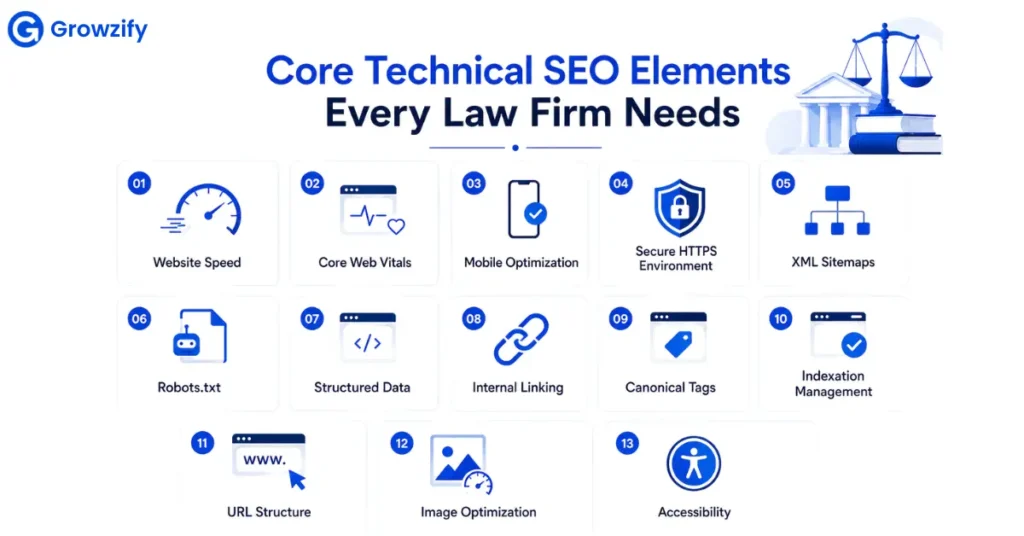
Core Technical SEO Elements Every Law Firm Needs
Website Speed
Page speed affects both rankings and conversions. A law firm site that takes more than three seconds to load on mobile loses a meaningful share of visitors before they see anything. Compressing images, reducing unnecessary scripts, and using reliable hosting are the most common fixes.
Core Web Vitals
Core Web Vitals measure loading speed, interactivity, and visual stability using specific metrics that Google tracks directly. Poor scores on these metrics can hold back rankings even when content quality is high. Law firm sites often struggle here due to heavy image galleries or bloated page builders.
Mobile Optimization
Most legal searches happen on phones, especially urgent searches like “criminal defense lawyer near me.” A mobile-optimized site loads quickly, displays clearly without zooming, and makes contact information easy to tap. Mobile experience is no longer optional forlaw firm SEO; it is foundational.
Secure HTTPS Environment
HTTPS encrypts data between a visitor’s browser and the website. Google has treated HTTPS as a ranking signal for years, and browsers now actively warn users when a site lacks it. For a law firm asking visitors to submit personal case details through a contact form, HTTPS is also a basic trust requirement.
XML Sitemaps
An XML sitemap lists every important page on a website and helps search engines discover them efficiently. Law firms with dozens of practice areas and location pages benefit significantly from a clean, updated sitemap that ensures nothing gets missed during crawling.
Robots.txt
This file tells search engines which parts of a site they should or should not crawl. Misconfigured robots.txt files sometimes accidentally block important pages, such as practice area sections, from being crawled at all. Reviewing this file should be part of every technical audit.
Structured Data
Structured data is code added to a webpage that helps search engines and AI systems understand specific details, such as a law firm’s name, address, practice areas, and reviews. Schema markup for LocalBusiness, Attorney, and FAQ content improves how clearly a firm’s information appears in search results and AI-generated answers.
Internal Linking
Internal links connect related pages across a website, helping both visitors and search engines navigate logically between practice areas, location pages, and supporting content. Strong internal linking also distributes authority across a site, helping newer or less prominent pages rank.
Canonical Tags
Canonical tags tell search engines which version of a page is the official one when duplicate or similar content exists. Law firms with multiple location pages that share similar content often need canonical tags to avoid confusing search engines about which page to rank.
Indexation Management
Indexation management ensures the right pages are indexed, and the wrong ones are not. Thin pages, outdated blog posts, or duplicate content can quietly dilute a site’s overall quality signals if left indexed without review.
URL Structure
Clean, descriptive URLs help both users and search engines understand a page’s content at a glance. A URL like example.com/personal-injury-lawyer-denver communicates far more than a string of random characters or numbers.
Image Optimization
Large, uncompressed images are one of the most common causes of slow law firm websites. Optimizing file size, using modern formats, and adding descriptive alt text improves both speed and accessibility.
Accessibility
An accessible website works well for visitors using screen readers, keyboard navigation, or other assistive technology. Beyond serving more potential clients, accessibility improvements often overlap directly with technical SEO best practices, including proper heading structure and descriptive alt text.
Technical SEO Mistakes That Hurt Law Firm Websites
Slow pagescaused by heavy images or outdated hosting quietly push potential clients away before they read a single word of content.
Broken linkscreate dead ends for visitors and waste the crawling budget search engines allocate to a site, especially on older law firm websites that have changed page structures over time.
Duplicate content, often created by copying practice area pages across multiple city pages with minimal changes, confuses search engines about which page deserves to rank.
Poor site structureleaves practice areas and locations scattered without logical organization, making it harder for both visitors and search engines to understand what the firm actually offers.
Missing schemamarkup means search engines and AI systems have to guess at basic facts about a firm instead of reading them directly from structured data.
Crawl errors, such as server errors or redirect loops, can prevent search engines from accessing entire sections of a website without anyone noticing for months.
Indexation issuessometimes block important pages from search results entirely, often due to an accidental noindex tag left over from development.
Weak internal linkingleaves valuable pages isolated, making them harder for search engines to find and harder for visitors to discover while browsing the site.
How Technical SEO Supports Local Law Firm SEO
Technical SEO and local SEO work together rather than separately. A technically strong website reinforces every local ranking signal a law firm builds elsewhere.
Google Business Profilevisibility improves when the website it links to loads quickly and provides consistent business information. A slow or broken website linked from an otherwise strong profile can quietly undermine local trust signals.
Local rankingsbenefit from site speed and mobile performance, which Google factors into how it ranks businesses for “near me” and location-based searches.
Practice area pagesneed a clean technical structure to rank for competitive terms like “divorce attorney” or “DUI lawyer,” especially in cities with heavy competition among firms.
Location pages, particularly for firms serving multiple cities, require careful technical handling to avoid duplicate content issues while still ranking individually in each market.
Local search trust signals, including HTTPS security and structured data, help Google verify that a law firm is a legitimate, well-maintained business worth recommending to nearby searchers.
Technical SEO and AI Search Visibility
AI search visibility depends on whether AI systems can clearly extract accurate information from a law firm’s website, which is fundamentally a technical SEO function.
AI Overviews pull content directly from indexed web pages, favoring sites with clear structure, fast load times, and well-implemented schema markup that clarifies exactly what a page covers.
ChatGPTrecommendations rely on training data and retrieval methods that favor well-structured, authoritative content. A technically sound website is more likely to be cited accurately when users ask about attorneys in a specific practice area or location.
Geminiresponses, integrated directly into Google’s search experience, draw heavily on the same technical signals that influence traditional rankings, making technical SEO a shared foundation for both.
Perplexityresults prioritize sources that are easy to crawl and clearly attributed, which rewards law firm sites with clean technical structure and proper citation-friendly formatting.
Future AI-powered search experiences will likely continue favoring websites that are fast, well-structured, and rich in clear, accurate entity information.
Firms that invest in technical SEO now are building a foundation that will keep paying off as these systems evolve.
Technical SEO Checklist for Law Firms in 2026
Use this checklist as a starting point for reviewing your firm’s website.
- Confirm site speed scores well on mobile and desktop
- Review Core Web Vitals in Google Search Console
- Test mobile usability across multiple devices
- Verify HTTPS is active sitewide with no mixed content warnings
- Confirm that an updated XML sitemap is submitted to Google
- Review robots.txt for accidental blocking of important pages
- Implement schema markup for LocalBusiness, Attorney, and FAQ content
- Audit internal linking between practice area and location pages
- Apply canonical tags where duplicate or similar content exists
- Check the indexation status of all key pages in Search Console
- Review URL structure for clarity and consistency
- Compress and properly tag all images sitewide
- Test accessibility basics, including heading structure and alt text
- Fix all broken links and redirect chains
- Remove or improve thin, outdated content
Why Law Firms Partner With Growzify for Technical SEO
Growzify approaches technical SEOas the foundation that every other part of a law firm’s marketing depends on, rather than treating it as a one-time setup task.
Technical audits at Growzify go beyond a generic checklist, identifying the specific issues holding back a particular firm’s website, from page speed bottlenecks to structured data gaps.
Law firm SEO expertise means the technical work is always considered alongside how legal clients actually search, not applied as a generic template borrowed from unrelated industries.
Local SEO integration ensures technical improvements directly support Google Business Profile performance and local map rankings, rather than existing as a separate workstream.
Content strategy is built on top of a technically sound foundation, since even the strongest legal content underperforms on a slow or poorly structured website.
AI search optimization is included as part of the technical process, with structured data and content formatting designed to help a firm’s information appear clearly in AI Overviews and chatbot responses.
Ongoing monitoring keeps a law firm’s technical health stable over time, catching new crawl errors, speed regressions, or indexation issues before they affect rankings or lead generation.
Technical SEO Is the Foundation of Sustainable Law Firm Growth
Content, local listings, and backlinks all matter, but none of them perform well on a technically broken website. Technical SEO is the part of SEO for law firms that determines whether everything else a firm invests in actually has a chance to work.
In 2026, that foundation matters more than ever. AI search systems demand clean, fast, well-structured websites to generate accurate answers. Google continues raising its quality bar for legal content specifically.
And competition among law firms keeps increasing, which means technical advantages that once felt minor now make a measurable difference in rankings and lead generation.
Firms that treat technical SEO as an ongoing priority, not a one-time fix, build a website that keeps performing well as search engines and AI systems continue to evolve. That stability is what turns SEO from a short-term campaign into long-term, sustainable growth.
Frequently Asked Questions
What is technical SEO in law firm SEO?
Technical SEO in law firm SEO refers to optimizing a website’s infrastructure, including speed, mobile usability, security, and site structure, so search engines and AI systems can crawl, index, and understand the site correctly. It forms the foundation that supports content, local SEO, and link-building efforts.
Why is technical SEO important for SEO for lawyers?
Technical SEO is important for SEO for lawyers because even strong legal content cannot rank well on a slow, poorly structured, or insecure website. Search engines and AI systems prioritize sites that load quickly, work well on mobile, and provide clear, accurate information through proper technical implementation.
How often should a law firm perform a technical SEO audit?
Most law firms should perform a comprehensive technical SEO audit at least twice a year, with ongoing monitoring in between for issues like broken links, crawl errors, and speed regressions. Firms actively publishing new content or expanding to new locations may benefit from more frequent reviews.
Can technical SEO improve local law firm rankings?
Yes, technical SEO directly supports local law firm rankings by improving site speed, mobile performance, and structured data, all of which work alongside Google Business Profile signals to influence local search visibility. A technically strong website reinforces the trust signals that local rankings depend on.
Why should law firms choose Growzify for technical SEO services?
Law firms choose Growzify for technical SEO because the agency treats technical health as the foundation for every other part of a campaign, combining detailed audits, local SEO integration, and AI search optimization into one coordinated strategy rather than addressing technical issues in isolation.

Chitranshu SharmaA growth strategist, digital marketing consultant, and the founder of Growzify, a performance-driven agency helping brands dominate search, shape perception, and build sustainable online visibility. With 8+ years of hands-on experience in Enterprise SEO, Online Reputation Management (ORM), and AI-led traffic generation, Chitranshu has helped startups, public figures, SaaS companies, and cannabis brands outrank competitors — ethically and at scale.
Explore More Articles

How to Find and Compare Local SEO Outsourcing Providers
How to Find and Compare Local SEO Outsourcing Providers Finding a local SEO outsourcing provider...
October 13, 2026Outsourcing

Inside a White Label SEO Campaign: How the Work Gets Done
Inside a White Label SEO Campaign: How the Work Gets Done Clients see a single...
October 13, 2026White Label

How to Vet an SEO Outsourcing Provider Before You Sign a Contract
How to Vet an SEO Outsourcing Provider Before You Sign a Contract A polished proposal...
October 9, 2026Outsourcing

Multilingual SEO Best Practices: Optimize Your Multi-Language Website
Multilingual SEO Best Practices: Optimize Your Multi-Language Website Translating a page and localizing it for...
October 7, 2026SEO

What Makes In-House Enterprise SEO Work Different Day-to-Day?
What Makes In-House Enterprise SEO Work Different Day-to-Day? On a small site, deciding to fix...
October 7, 2026Enterprise

How Core Algorithm Updates Impact Large Sites Differently Than Small Ones
How Core Algorithm Updates Impact Large Sites Differently Than Small Ones A large enterprise site...
October 7, 2026Enterprise
When Should You Outsource SEO? 11 Signs It Makes Sense
When Should You Outsource SEO? 11 Signs It Makes Sense Outsourcing SEO does not necessarily...
September 26, 2026Outsourcing