Inside a White Label SEO Campaign: How the Work Gets Done
Inside a White Label SEO Campaign: How the Work Gets...
Read More →

Clients see a single point of contact and a branded report each month. What they don’t see is the sequence of scoping, execution, review, and iteration happening behind that single relationship, and that sequence is what actually determines whether the work holds up.

Vetting an SEO outsourcing provider before you sign a contract means tracing the provider’s important claims through evidence rather than accepting a sales pitch: reviewing real work samples, checking references directly rather than reading testimonials on their own site, confirming the actual method behind any promised outcome, and watching for a short list of known red flags, guaranteed rankings, secretive methods, and unsolicited outreach among them. The goal isn’t finding a perfect provider. It’s ruling out the ones whose claims, methods, or access requests could put your site, data, or budget at risk before you’ve committed to them.
Methodology: This guide draws on Google Search Central’s own SEO and spam-policy documentation, Clutch’s published research on marketing outsourcing trends, and recurring operational patterns Growzify observes running white-label campaigns for agency partners. Statements attributed to Growzify are practitioner observations, not universal guarantees, and the composite example later in this article is illustrative rather than a specific client case.
Outsourcing part of a service line isn’t a fringe practice in marketing anymore. Clutch’s survey of 1,000 business decision-makers found that roughly 26% planned to outsource digital marketing work in the following year. That research isn’t specific to agencies outsourcing SEO delivery to a white-label partner, but it illustrates the broader, growing use of external marketing capacity that the same logic applies to.
For a white-label arrangement to work smoothly, the agency needs to preserve a consistent client experience regardless of which team performs the backend execution. The workflow underneath a white-label engagement exists to make that possible: consistent quality, a single communication channel, and reporting that reads as if it came entirely from the agency itself.

This is a practitioner framework Growzify uses to structure how a campaign actually moves from a signed scope to ongoing delivery, not a fixed industry standard every provider follows identically.
| Phase | What happens | Partner’s role | Agency’s role | Approval point |
| Scoping and onboarding | Defining deliverables, access, brand guidelines, reporting format | Collect access, context, and requirements | Provide client context, credentials, and constraints | Onboarding marked complete |
| Audit and strategy | Technical, content, and competitive analysis to set priorities | Produce audit findings and a prioritized plan | Validate priorities against client fit | Strategy approved |
| Execution | Technical fixes, content production, link-building activity | Produce agreed work to spec | Unblock dependencies, answer questions | Task marked complete |
| Quality review | Checking work against brand standards and client context | Internal QA against acceptance criteria | Client-context review before delivery | Deliverable accepted |
| Reporting and iteration | Branded reporting, results review, next-cycle priorities | Compile evidence and draft narrative | Approve narrative, present to client | Report approved |
Each phase feeds the next, and skipping or compressing the review phase specifically creates a significant quality-control risk for whatever ships to the client afterward. The “approval point” column matters as much as the work itself: a phase without a clear approval moment tends to drift into the next one without anyone actually confirming it’s finished. When vetting an SEO outsourcing provider, these details help you assess how the provider handles challenges once the work begins.

Onboarding sets the terms for everything that follows, which is why rushing it tends to cause problems much later in a campaign. It typically starts with access: the white-label partner needs read or edit access to the client’s website, analytics, and Search Console property, scoped only to what the work actually requires. A useful default is starting with the least privilege a task genuinely needs, read-only for audit and analytics tools where no changes are being made, editor access only where the work requires publishing or editing, and administrative access reserved for the rare cases that technically require it, then increasing permissions only when a specific task calls for it.
Brand guidelines come next, not just a logo and color palette, but the agency’s own tone of voice, reporting format, and any client-specific context the execution team needs to avoid generic recommendations. A retailer with strict legal review requirements and a local service business with none of that need different handling from day one, not after the first deliverable gets flagged internally.
Credential handling deserves its own attention here. Individually assigned accounts, rather than shared logins, keep permissions traceable and easy to revoke; multi-factor authentication where a platform supports it, and avoiding credentials sitting in email or chat threads, are basic hygiene worth confirming explicitly rather than assumed.
Where a white-label partner serves multiple agency clients at once, each client’s credentials, briefs, assets, and reporting data should stay logically separated, so material from one account can’t accidentally surface in another client’s deliverables.
It’s also worth knowing upfront whether a partner uses subcontractors, freelancers, offshore specialists, or vendors for parts of the work, and if so, what those subcontractors can access and who remains accountable for their output. Subcontracting itself isn’t a quality problem; an agency simply needs visibility into it to make an informed decision about the arrangement.
The last onboarding step is agreeing on a communication cadence between the agency and the white-label team specifically, separate from the cadence the agency keeps with its own client. That internal channel is what keeps the client-facing relationship clean, since questions and clarifications happen there instead of leaking into client conversations.
Not every workstream needs the same level of agency sign-off, and treating them all identically tends to either slow down low-risk work unnecessarily or wave through changes that deserved a second look.
| Work type | Typically autonomous | Typically needs agency approval |
| Data gathering and audits | Yes | Strategy derived from findings |
| Content drafts | Yes | Before publication |
| Metadata updates | Often | Depends on scope agreed |
| Redirects, canonicals, robots.txt changes | Rarely | Yes, especially at scale |
| Link outreach | Within pre-agreed policy | Campaign rules and targets upfront |
| Client-facing reporting | Draft, yes | Final narrative before it reaches the client |
Redirects, canonical tags, robots.txt rules, structured data, and template or navigation changes carry a wider blast radius than most other SEO work, since a mistake in any of them can affect far more than the single page it was meant to fix. Changes in that category are worth requiring explicit approval for, along with a documented rollback plan and a check after deployment to confirm the change behaved as intended.
Where the white-label partner is responsible for strategy, the engagement typically begins with a technical and competitive audit, checking crawlability, indexing status, site speed, on-page structure, and how the client currently compares to competitors ranking for its priority terms. An execution-only engagement instead starts from an agency-approved strategy or brief, with the partner responsible for carrying it out rather than defining it. Either way, Google’s own SEO documentation is a useful anchor, since it frames SEO work as an ongoing process of implementing changes and then observing results, not a single setup task.
That audit produces a prioritized list, not a to-do list of everything technically imperfect on the site, weighed by roughly expected impact, confidence in that impact, effort required, and how much risk a given change carries if something goes wrong. On a genuinely large or complex account, technical debt can run deep, and treating every finding as equally urgent tends to bury the handful of fixes that actually matter most behind a long list of minor ones.
The strategy that comes out of this phase gets reviewed by the agency before execution starts, not after, and this is also where the engagement should specify whether the partner is advisory only, execution-authorized for defined workstreams, or authorized to implement changes directly, since agencies vary widely on how much production access they’re comfortable extending. That review step keeps the recommendations aligned with what the agency already knows about the client, information the white-label team wouldn’t necessarily have from the audit data alone.

Execution splits into three broad categories, and most campaigns run some mix of all three depending on what the audit surfaced.
Technical work covers fixes to crawlability, indexing, page speed, structured data, and any rendering issues affecting how search engines process the site. A successful implementation means the intended change was deployed correctly; it doesn’t by itself guarantee improved crawling, indexing, ranking, or traffic, which are separate outcomes worth validating on their own rather than assumed from the fact that a fix shipped.
Content work covers new pages, existing page updates, and the on-page optimization tying content to the priority terms identified in strategy. Good content execution still requires the client-specific context established during onboarding, since generic content produced without that context tends to need heavy revision later; for regulated industries specifically, health, finance, legal, the onboarding record should also cover approved sources, any restricted claims, and whether subject-matter or compliance review is required before publication.
Link acquisition can include outreach, digital PR, partnerships, and other legitimate promotional activity aimed at earning relevant mentions and links, not links created primarily to manipulate rankings, which Google’s spam policies explicitly define as link spam.
Google is also specific that paid or sponsored links aren’t a policy violation as long as they’re marked with a rel=”sponsored” or rel=”nofollow” attribute so they don’t pass ranking credit; an agency is better off agreeing on prohibited tactics and link-quality criteria with a partner before outreach begins rather than evaluating placements only after they appear.
Link-acquisition timelines are also harder to control than the other two categories, since results depend partly on outreach targets and publishers responding, not just internal execution speed.
None of these three categories run in isolation from each other in practice. A technical fix that improves crawlability can affect how quickly newly published content gets discovered, and a strong piece of content can itself become the asset a link-building effort is built around, which is why the strategy phase sequences these categories deliberately rather than treating them as separate, unrelated workstreams.
Deadline pressure can tempt teams to compress this phase, which increases the risk of errors reaching the client, and it’s also the phase that protects the agency’s reputation the most directly. Work coming back from a white-label team still needs an internal check against brand voice, factual accuracy, and client-specific context before it’s packaged for delivery.
Review intensity can decrease over time, but that shift is worth basing on measured performance, QA pass rate, revision rate, and how often deliverables miss a stated requirement, rather than trust alone.
Early in a partnership, treating every deliverable as needing review is the safer default, since the agency normally retains client-facing accountability for what’s delivered under its brand; the underlying white-label agreement should separately define the partner’s own responsibility for errors, rework, and any missed service levels.
This is also where scope clarity from onboarding pays off. A well-scoped deliverable is faster to review because the reviewer knows exactly what it was supposed to accomplish; a vaguely scoped one requires the reviewer to reconstruct intent before they can even judge the output.
A deliverable is genuinely done, not just produced, once the agreed work is complete, any required evidence is attached, QA has passed, and approvals are recorded; it’s worth agreeing on that definition before work starts rather than discovering the gap during a delivery dispute.
When something does go wrong, a simple escalation path, flag the issue, assess the impact, propose options, assign a decision owner, document the resolution, avoids ad hoc handling in the moment. Sorting issues by rough severity, minor revisions with no client impact, deadline or quality risk, and anything touching production systems, client data, or legal exposure, helps route each one to the right level of urgency without turning every hiccup into a crisis.
Reporting is where a white-label arrangement most visibly succeeds or fails at maintaining a consistent client experience. A properly white-labeled report carries the agency’s own branding, terminology, and format, not a generic template with a logo swapped in.
A clear report keeps a few layers of evidence separate rather than blending them into one undifferentiated update: what work actually shipped, what technical or visibility signals changed as a result, any business outcomes where that data is available, and interpretation of what might be contributing to a given result.
Collapsing “activity happened” and “results improved” into the same sentence is one of the more common ways a report overstates what it can actually support. It’s also worth tracking each recommendation’s status explicitly, recommended, approved, implemented, or validated, since a suggestion sitting in a strategy document is a meaningfully different state from a change that’s live and confirmed working.
The agency should approve the report’s narrative before it reaches the client, particularly anywhere the report attributes a cause or predicts a future outcome, since that’s exactly the language most likely to overclaim if it isn’t checked.
Consistency across reporting cycles matters as much as the format of any single report; a client comparing month three against month one should see a coherent narrative, not disconnected snapshots that make it hard to track whether priorities from an earlier cycle actually got addressed.
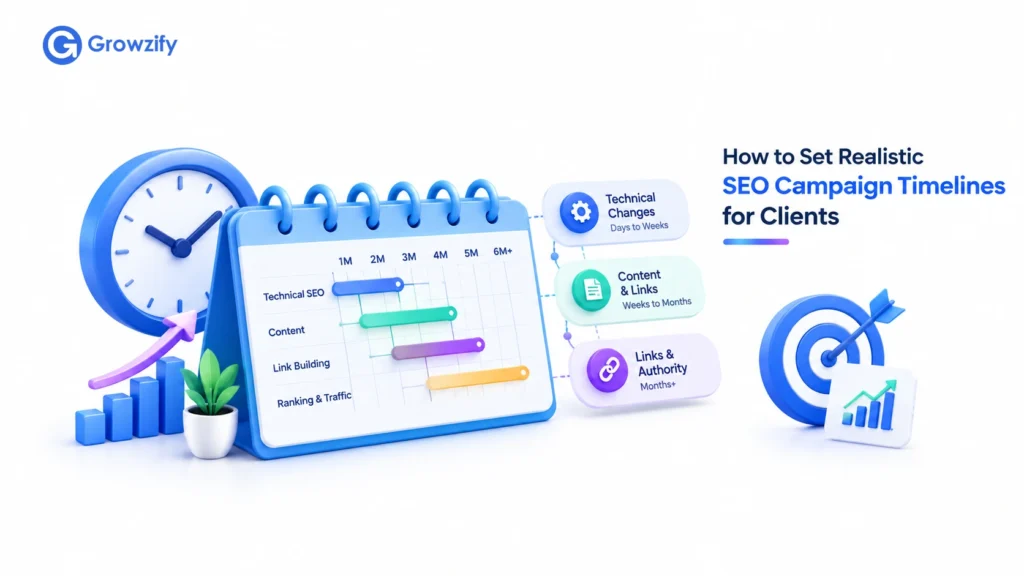
Setting accurate timeline expectations internally is part of making the workflow function smoothly, since a white-label team getting pressured for results faster than SEO actually works tends to produce worse outcomes, not better ones.
Google’s own SEO documentation is direct that “some changes might take effect in a few hours, others could take several months,” and recommends waiting several weeks before assessing whether a given change had a beneficial effect at all.
Some technical changes can be observed relatively quickly after deployment and recrawl, while others, a canonical change, a large migration, a structured-data rollout, can take longer to fully propagate or become visible in reporting.
Content and link-building outcomes generally sit on a longer, less predictable timeline still, since content needs to be discovered and evaluated and link building depends on external responses that don’t happen on a fixed schedule. The actual timing for any specific site depends on the change itself, site scale, crawl activity, competition, and other factors Google doesn’t fully document.
Communicating that difference to the client, ideally before the campaign starts rather than after month one produces less dramatic results than hoped, is something the agency’s account manager handles directly, informed by what the white-label team can realistically tell them about each work type’s typical timeline.
There isn’t one universal model for how visible a white-label partner is to the end client, and being explicit about which one applies avoids confusion later. Some engagements keep the partner entirely behind the scenes, with no client contact at all. Others are assisted, where the partner might join internal working sessions but never a client call.
A smaller number are specialist-visible, where the partner participates in client meetings under an agreed positioning. None of these is inherently correct; the agency’s own client contracts and disclosure expectations should determine which applies, and it’s worth confirming explicitly rather than left ambiguous.
The following is an illustrative, composite scenario built from patterns Growzify sees running white-label campaigns for agency partners, not a specific named client.
Consider a regional home services company signed by a mid-sized agency for ongoing SEO. During onboarding, the agency shares the client’s brand voice guidelines and flags that the client’s leadership reviews all published content personally, a detail that shapes how much lead time content execution needs built into the schedule.
The audit surfaces a mix of findings: several technical issues affecting mobile page speed, thin service-area pages that could be expanded, and a competitor consistently outranking the client for its highest-value local terms. The agency reviews the resulting priority list and confirms the technical fixes and service-area content should come first, based on their own knowledge of the client’s business priorities.
Execution proceeds across both categories in parallel, with the technical fixes moving faster since they don’t require external review. The content drafts route through the agency’s own team before reaching the client, adding the lead time the onboarding conversation had already flagged as necessary. If the relevant validation data, Search Console, page-speed tooling, or crawl logs depending on the specific issue, showed improvement on the affected technical metrics by the second reporting cycle, the agency could report that specifically, while making clear that the content and early link-building work were still too early to evaluate, rather than presenting everything as a single undifferentiated “SEO progress” update.
Suppose instead the first round of content drafts came back rejected, not for writing quality, but because the client’s specific approval criteria had never actually been captured during onboarding. That would be worth treating as a scoping failure to correct at the source, rather than a writer problem to solve by simply assigning someone else to the same underspecified brief.
Letting work start before acceptance criteria are defined. Without an agreed definition of “done,” disputes over whether a deliverable is actually complete become far more likely.
Granting more system access than a task requires. Broad access by default creates unnecessary security exposure and makes it harder to track who’s actually responsible for a given change.
Treating “delivered” as “implemented.” A recommendation sitting in a document isn’t the same as a change that’s actually live and confirmed working.
Reporting activity as if it were outcome. Publishing pages, acquiring links, or fixing technical errors doesn’t automatically prove a ranking, traffic, or revenue impact on its own.
Skipping internal review to save time. Compressing the quality-control phase under deadline pressure is exactly when brand-voice or factual errors are most likely to reach a client.
Treating onboarding as a formality. A rushed onboarding without real brand and client context can increase the risk of generic, client-misaligned first-cycle work that needs heavy revision, which costs more time than a proper onboarding would have.
Setting client expectations around timelines the work can’t actually meet. Promising fast results for link-building or content work specifically sets up a difficult conversation once the realistic timeline becomes apparent.
For an agency evaluating a specific white-label partner, the answers to these questions reveal more about how mature the operation actually is than any pitch deck will.
Growzify’s guide on the key questions worth asking before choosing a white label SEO partner covers this evaluation process in more depth, and the comparison of white label SEO against hiring an in-house specialist is worth reading alongside it for agencies still weighing whether external delivery is the right model at all.
Who owns client communication in a white-label SEO workflow?
Typically, the agency remains the client-facing point of contact while the white-label team works behind the scenes, with branding, communication, and reporting staying under the agency’s own name. Whether the external partnership itself is disclosed to the client depends on the agency’s own agreements, client expectations, and any contractual requirements involved.
How much does the agency need to review before work goes to the client?
Early in a partnership, reviewing every deliverable is the safer default. Review intensity can decrease once the partner repeatedly meets agreed acceptance criteria with low revision and defect rates, though final accountability for what reaches the client stays with the agency.
How long does a typical campaign take to show results?
It varies by work type and by the specific change involved. Some technical changes can be observed relatively quickly after deployment and recrawl, while others take longer to propagate; content and link-building outcomes generally operate on a longer, less predictable timeline, since they depend on discovery, evaluation, and, in the case of link building, external responses.
What happens if the agency and the white-label team disagree on strategy?
The agency’s review step in the audit and strategy phase is exactly where this gets resolved, before execution starts. The agency retains final say, since it has direct context about the client that the execution team may not.
Can this workflow scale across multiple clients at once?
It can, provided each account has its own documentation, access controls, ownership, and QA process kept separate from the others. Documentation reduces cross-account confusion, but it doesn’t by itself replace actual delivery capacity; a partner still needs enough real bandwidth to run several accounts well at once.
What tools or access does an agency typically need to share to get started?
Usually read or edit access to the client’s website content management system, analytics platform, and Search Console property, scoped specifically to what the execution work requires rather than full administrative access by default. Sharing exactly what’s needed, and nothing more, keeps the arrangement clean from both a security and an accountability standpoint.
A mature white-label SEO workflow doesn’t just hide execution behind the agency’s brand; it makes ownership, access, approval, quality standards, and evidence explicit at every stage, so recommended, approved, implemented, and validated stay clearly distinct states rather than getting collapsed into one vague “done.”
If your agency is exploring what a white-label SEO partnership would actually look like day-to-day, Growzify’s white label SEO services team can walk through the specific workflow, from onboarding through reporting, before you commit to anything.

At Growzify, we are dedicated to helping your business achieve its goals. Are you Ready to take the next step?
How to Vet an SEO Outsourcing Provider Before You Sign a Contract A polished proposal...

Multilingual SEO Best Practices: Optimize Your Multi-Language Website Translating a page and localizing it for...
What Makes In-House Enterprise SEO Work Different Day-to-Day? On a small site, deciding to fix...

How Core Algorithm Updates Impact Large Sites Differently Than Small Ones A large enterprise site...
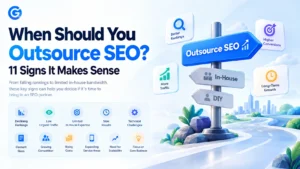
When Should You Outsource SEO? 11 Signs It Makes Sense Outsourcing SEO does not necessarily...
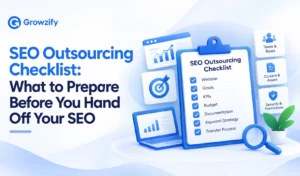
SEO Outsourcing Checklist: What to Prepare Before You Hand Off Your SEO SEO handoffs can...
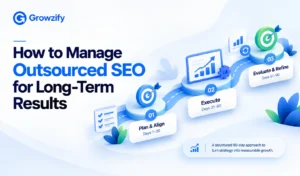
How to Manage Outsourced SEO for Long-Term Results Focus on building a structured partnership with...
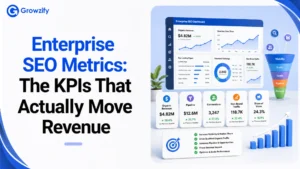
Enterprise SEO Metrics: The KPIs That Actually Move Revenue Enterprise SEO success depends on measuring...
Call Now






Growzify digital team is very effective, and easy to work with. Very strong communication and always up for suggestions. Saw 300% growth in web traffic 170% growth in revenue through Facebook ad’s & Amazon. I recommended them to my fellows and they turned their online business into a money making machine.