How to Manage SEO Outsourcing Across Multiple Teams
How to Manage SEO Outsourcing Across Multiple Teams A single-owner...
Read More →
A large enterprise site can watch one product category climb while a neighboring one falls, on the same domain, in the same core update, for reasons that turn out to have nothing to do with each other. Untangling which is which is a fundamentally harder diagnostic problem than it is on a smaller site.

Core algorithm updates impact large sites differently than small ones mainly because diagnosing the impact is harder, not because Google treats large sites through a different mechanism. A large site typically has more templates, content types, markets, and business units than a small one, which means the same broad reassessment can plausibly land unevenly across the domain, and a single sitewide traffic number can hide meaningful movement concentrated in one specific segment.
Methodology:This guide is grounded in Google Search Central’s own documentation on core updates and spam policies, alongside Google’s own reporting on its March 2024 core update and its 2026 Search Console generative AI performance reporting, and recurring patterns observed in Growzify enterprise SEO reviews. Statements attributed to Growzify are practitioner observations, not confirmed Google ranking mechanisms, and the composite example later in this article is illustrative rather than a client case study.
Google’s own documentation on core updatescompares it to revisiting an old list of favorite restaurants: some entries drop years later, not because the food got worse, but because new places opened and existing ones evolved, changing where everything ranks relative to everything else.
Google’s documentation is explicit that “these changes are broad in nature, and don’t target specific sites or individual web pages,” and that a page moving down in rankings “isn’t necessarily ‘bad’; there are just other” pages that better satisfy the reassessment. A core update is a broad change to Google’s ranking systems intended to improve the helpfulness and reliability of search results overall, not a penalty aimed at a particular website.
This is where diagnosing a large site genuinely gets harder, and it follows directly from what a core update actually does. How an individual page moves can depend on that page’s own content, intent, and competition, while Google’s own guidance also points to sites with a sustained large drop toward assessing the site as a whole, not page characteristics in isolation. Google doesn’t document a separate mechanism for large sites specifically; the difference is structural exposure, not a different process.
A large enterprise site can plausibly contain a product catalog built from a shared template, a blog with genuinely original long-form pieces, a support section with thin auto-generated pages, and content owned by five different teams with five different quality bars, all under one domain.
A single broad update doesn’t have to treat that domain as one unit, since the pages within it aren’t necessarily uniform to begin with. InGrowzify enterprise SEOreviews, we frequently encounter this kind of segment-level difference: one part of a site moving while another stays flat, which is exactly why a single sitewide average is often insufficient for diagnosis at this scale, even though we don’t have data comparing how often that pattern occurs on large sites versus small ones specifically. A domain-level organic average is an aggregation, not a diagnosis; it’s a starting number to segment, not an answer in itself.

This is a practitioner framework Growzify uses to classify how a core update’s timing actually correlated with a given site’s traffic, not a Google-documented process. Distinguishing which pattern occurred is the first diagnostic step, since each one points toward a different set of things worth investigating, not a predetermined cause.
| Pattern | What it looks like | What to investigate first |
| Sitewide movement | Most pages move in the same direction together | Sitewide content-quality patterns, technical changes, and broader query or demand shifts |
| Segment-specific movement | One template, section, or content type moves while others stay flat | Characteristics shared by the affected cohort: template, topic, search intent, content quality, and technical configuration |
| Mixed movement | Different segments move in opposite directions simultaneously | What actually differs between the gaining and declining cohorts, before assuming a single common cause |
| Query- or intent-specific movement | A cohort’s overall numbers look stable, but a specific query type, brand versus non-brand, a particular market, or a particular search type moved underneath that stable total | Whether the movement is concentrated in one intent, geography, device, or search vertical rather than spread evenly across the cohort’s queries |
Treating segment-specific, mixed, or query-specific movement as if it were sitewide is a common mistake worth naming directly: a fix aimed at the whole site when the actual problem sits in one template, or one query intent within an otherwise healthy template, wastes effort on pages that were never the issue, while leaving the actual affected segment unaddressed.
URL-based segmentation, by template or section, is the obvious starting cut, but it’s rarely the only one that matters on a genuinely large, diverse site. This is a practitioner reference for the dimensions worth crossing against each other before settling on “the affected cohort,” not a fixed checklist every investigation needs to run in full.
| Dimension | Example values |
| URL cohort or template | Product, category, blog, location, documentation |
| Topic or subject area | Different practice areas, product lines, or content verticals |
| Query intent | Informational, commercial, transactional, navigational |
| Brand status | Branded versus non-branded queries |
| Market or language | Different countries or locales the same template serves |
| Search type | Web Search, Images, Video, News |
| Page age | Newly published versus long-established versus legacy content |
| Technical state | Canonical configuration, indexability, rendering, template version |
The useful diagnostic cohort is the smallest meaningful group that shares enough characteristics to actually test a hypothesis against, without being so narrow that ordinary query-level noise starts to dominate the result. “The blog declined” is rarely specific enough to act on; “a legacy buying-guide template, for commercial-intent queries, in one market” usually is.
Scaled content abuse is a Google spam policy, not a documented mechanism of core updates specifically, and it’s worth being precise about that distinction before treating the two as the same investigation.Google’s own spam policyon scaled content abuse defines it as content where “many pages are generated for the primary purpose of manipulating search rankings and not helping users,” explicitly regardless of whether that content was produced through automation, human effort at scale, or generative AI.
Volume itself isn’t the violation; a site can have millions of genuinely useful pages without triggering this policy at all. The determining factor is why the pages were created and whether they help users, not how many exist.
Enterprise sites often operate high-volume, templated publishing systems, category pages, location pages, and programmatically generated landing pages, which makes governance of that kind of scaled publishing especially relevant. That’s a reason to check programmatic content specifically as part of any core-update investigation, not evidence that a movement was actually caused by this policy.
Google’s own reporting on its March 2024 changes is worth citing here with a caveat attached.Google’s own account of that updatereported “45% less low-quality, unoriginal content in search results,” exceeding the 40 percent reduction Google had initially expected. That announcement covered both core ranking system changes and updated spam policies together; the figure reflects Google’s broader quality work overall, not a measurement specific to scaled content abuse enforcement or to enterprise sites.
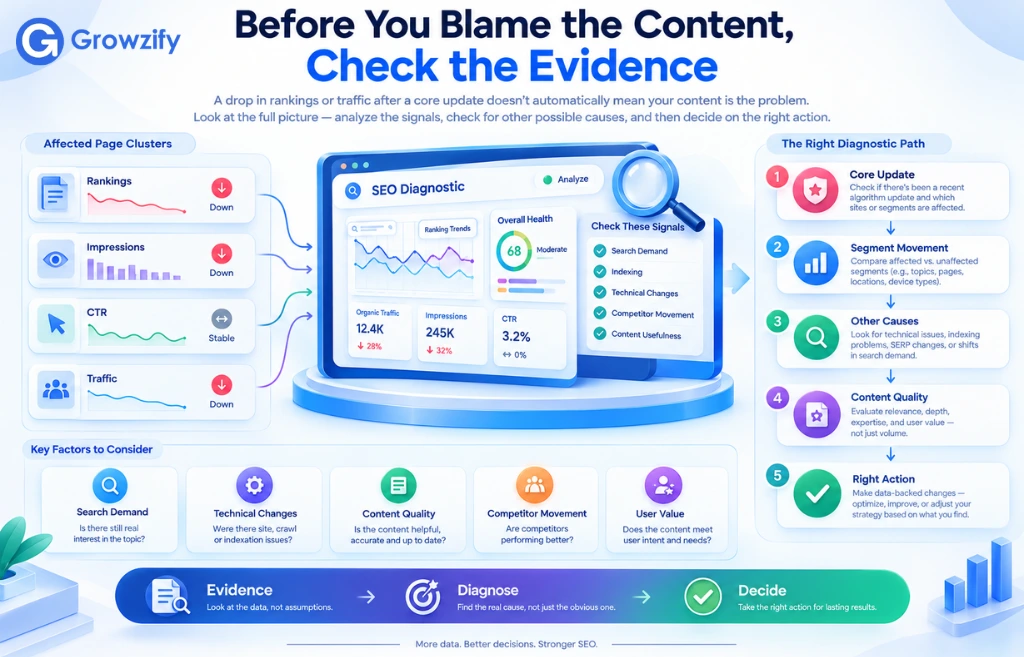
Google’s own core update documentation lays out a baseline diagnostic workflow that applies to any site, and it’s worth following before layering enterprise-specific segmentation on top of it. Google recommends waiting at least a full week after a core update completes before analyzing anything in Search Console, then comparing that week against a comparable week before the update started rolling out, to pinpoint what actually changed.
It also recommends distinguishing a small position shift, dropping from position 2 to 4, where Google specifically advises against making changes to already-performing content, from a large one, dropping from position 4 to 29, which warrants a deeper look, and checking whether the movement is specific to Web Search, Images, Video, or News rather than assumed to be uniform across all of them.
That week-before-versus-week-after comparison is a useful starting point rather than a universal experimental design, and it’s worth an enterprise-specific caveat: on a site with meaningful seasonality, promotions, or product-launch cycles, a naive pre/post comparison can accidentally compare a promotional spike against a normal week, or a normal week against a holiday dip, and mistake business timing for update impact. Validating the pattern against a comparable period from the prior year, and against known business events, catches this before it produces a false conclusion.
That baseline workflow doesn’t establish that a core update caused a given movement on its own; a change that correlates with an update’s timing could equally trace to a concurrent technical deployment, a migration, an indexing change, seasonality, a security or manual-action issue, or a shift in search demand.
Correlation with a core update tells you when to investigate; it doesn’t tell you what caused the movement. Ruling out these alternatives, or confirming the timing genuinely lines up, is worth doing before attributing a change to the update specifically.
At enterprise scale, that same workflow simply has more surface area to cover. This is particularly important when handling enterprise SEO for large websites, where grouping Search Console performance data by URL pattern, template, or business unit can reveal whether a change that coincides with the update affected the whole site or only a specific section.
This segmentation work depends on the same kind of URL and template classification that Growzify’s guide on controllingindex bloat across millions of URLscovers for a related diagnostic purpose. The underlying discipline, grouping a large URL inventory into meaningful cohorts before concluding, is what makes this kind of diagnosis tractable at enterprise scale instead of guesswork.
A traffic decline can happen even when rankings hold steady, if search demand for the affected queries itself fell. Rankings can drop while clicks stay relatively flat, if demand for those queries rose at the same time. CTR can fall even when position barely moves, if the search results themselves changed, a new SERP feature, a competitor’s result becoming more prominent, or the query set now surfacing more generative AI features instead of traditional listings.
Before treating a traffic decline as a content-quality problem, it’s worth decomposing the affected cohort into impressions, position, CTR, and clicks, and identifying which part of that chain actually changed, rather than assuming clicks falling means rankings fell for content-quality reasons.
Google’s 2026 generative AI performance reporting in Search Console is relevant here specifically because it changes what’s visible: Google rolled out a dedicated report showing impression data for AI Overviews, AI Mode, and Discover, worldwide by the end of August 2026, alongside the classic Performance report where clicks generated through those surfaces continue to land. For an affected query set, checking whether its search-result composition shifted toward these generative surfaces is worth doing before assuming every drop in clicks reflects a traditional ranking reassessment of the page itself.
Before treating a traffic change as core-update impact, it’s worth ruling out competing explanations that commonly overlap with an update’s rollout window on a large, actively maintained site.
A concurrent deployment or release affecting the same templates, an indexing, canonical, or robots.txt change, a tracking or analytics configuration change, an inventory, pricing, or availability shift, a promotional or seasonal period, a change in query demand unrelated to rankings, a SERP feature or generative-AI surface change for the affected queries, or a competitor gaining ground independently of anything Google’s core systems reassessed.
None of these need a lengthy investigation on their own; a short pass through the list before committing to a core-update explanation is usually enough to catch the obvious ones.
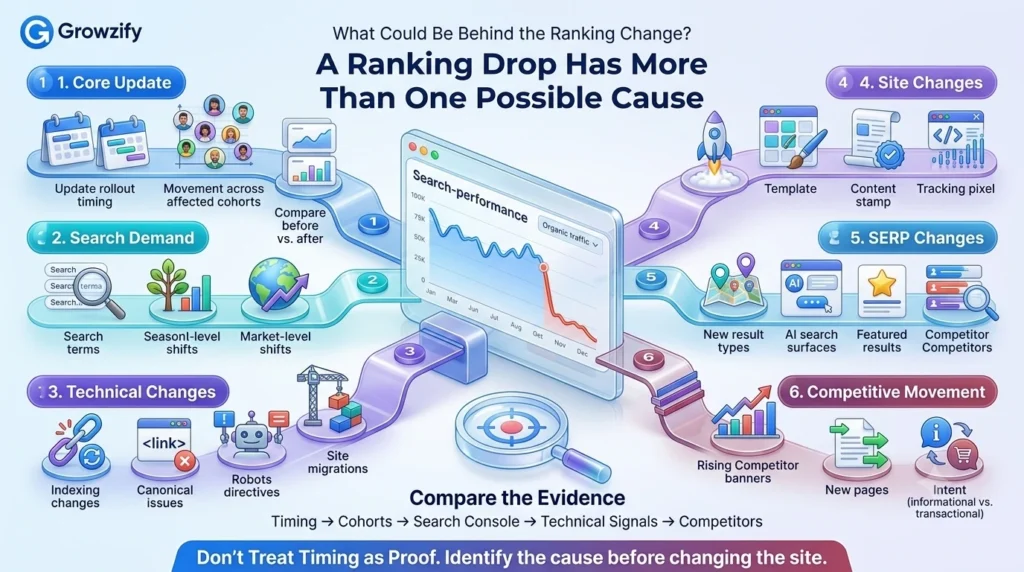
One of the more useful diagnostic moves after isolating an affected segment is comparing it directly against a cohort on the same site that held steady or improved, and against competitors now ranking well for the same affected queries: what’s genuinely different in depth, uniqueness, intent match, technical configuration, freshness, or editorial process between the declining pages and the ones still performing.
A difference identified this way is a hypothesis worth testing, not proof of a causal mechanism; if the declining pages average 800 words and the stable ones average 1,500, that’s a lead to investigate further, not evidence that word count itself was the deciding factor.
It’s also worth checking whether the dominant result type for the affected queries changed at all, rather than assuming the existing page type is still the right one to defend. A blog article that used to rank for a commercial query can lose ground not because its content quality dropped, but because Google’s results for that query shifted toward product or category pages, forums, or video content instead. In that case, the fix isn’t necessarily improving the blog article; it may be recognizing that a different page type on the site is now the more appropriate one to compete with that query.
Google’s own guidance explicitly recommends avoiding “quick fix” changes, made because someone heard a particular element was bad for SEO, in favor of meaningful, sustainable improvements to the pages actually affected. Reflexively deleting dates, adding bylines everywhere, padding word counts, or mass-refreshing timestamps without evidence those specific things are the problem tends to waste effort without addressing whatever actually changed.
Google’s guidance is similarly direct that deleting content should be a last resort, considered only when the content genuinely can’t be salvaged, and that removing entire sections of a site is itself a signal worth reflecting on, since it suggests those sections may have been built for search engines rather than people in the first place. A core-update response is better scoped around the specific cohort and characteristics an investigation actually identifies, not a generic list of things the internet says core updates reward.
Google’s own guidance is direct that recovery timing varies: “some changes can take effect in a few days, but it could take several months.” Google also notes that sites don’t necessarily have to wait for the next announced major core update to see the effect of genuine improvements, since Google continually makes updates to its search algorithms, including smaller core updates, outside the major named releases. Google doesn’t document either timeline as being longer specifically for large sites; it’s worth separating three different clocks that are easy to conflate.
The first is implementation time: how long it takes an organization to actually build, test, and deploy a fix. At enterprise scale, a fix that traces to one shared template has to go through development, QA, and a coordinated release across every page built from that template, which is a genuinely larger undertaking than editing a handful of individual pages, and also a more leveraged one once it ships.
Growzify’s guide on theenterprise technical SEO checklist covers the broader recurring review that a template-level fix like this fits inside, and the guide onbuilding an SEO roadmap for a large websitecovers how to prioritize a fix like this against other competing technical work.
The second clock is Google’s own reassessment timeline once the fix is actually live, and that’s the “days to several months” range Google documents, which can register through smaller, ongoing updates rather than only the next major named release.
The third clock, easy to overlook, is the business-observation clock: even once Google’s systems have reassessed a page, enough traffic and conversion data has to accumulate to actually confirm a recovery, separate from noise, seasonality, or other concurrent changes. Conflating any of these three clocks with each other is what usually produces a premature conclusion that a fix “didn’t work.”
The following is an illustrative, composite scenario built from patterns Growzify sees across enterprise reviews, not a specific named client or a real audit result.
Suppose a large marketplace site sees a modest, roughly flat change in overall organic traffic in the weeks after a core update completes, a number that on its own would suggest nothing significant happened.
Segmenting the data by content type tells a different story: the product and category pages held essentially steady, while a specific cohort, older buying-guide articles built from a shared template with minimal original content per page, dropped sharply and in a timeframe that correlates with the update.
The sitewide number alone would have missed this entirely. The decline in the buying guides was largely offset by stability elsewhere on the site.
Confirming the pattern would require checking whether the affected articles shared common traits. These could include the same template, a similar thin structure, or overlapping topics with little differentiation. This type of analysis is especially important when applying anenterprise SEO strategy at scaleacross large websites.
The affected articles should then be compared directly with stable or gaining articles covering adjacent topics. It is also important to check whether the queries they previously ranked for now show a different mix of result types.
Other explanations should be ruled out before reaching a conclusion. These could include a recent release or a seasonal shift.
If those factors do not explain the decline, the shared characteristics of this template-driven cohort may be materially associated with the performance drop.
Reading only the sitewide traffic number.A flat or modest overall change can hide a significant segment-specific movement in either direction.
Applying a sitewide fix to a segment-specific problem.Rewriting content across an entire site when the actual issue traces to one template wastes effort on pages that were never affected.
Assuming volume-driven content is automatically the problem.A large template-generated content set isn’t automatically thin or manipulative; the relevant distinction is whether the pages provide genuine user value or were generated at scale primarily to manipulate search rankings.
Attributing a movement to the core update without ruling out other causes.A change that coincides with an update’s timing can just as easily trace to a concurrent release, a migration, seasonality, or a shift in search demand; confirming the timing genuinely lines up matters before treating the update as the explanation.
Making changes while the update is still rolling out.Adjustments made mid-rollout make it harder to tell later which change, if any, actually correlated with the outcome.
Looking only at what declined, without checking what gained.Internal cohorts that held steady or improved, and competitors now ranking well for the same queries, are often the fastest way to identify what’s genuinely different about the affected pages.
Expecting recovery to run on a predictable, size-based timeline.Google’s own guidance says effects can appear within days or take several months, and it doesn’t document that window as longer specifically for large sites; what typically takes longer on enterprise websites is building and deploying the fix itself.
The following is an illustrative, composite scenario built from patterns Growzify sees during SEO handoffs, not a specific named client or a record of measured timings.
Consider a mid-sized retail brand that decided to outsource SEO for the first time after years of managing it loosely in-house. The business signed with a provider quickly, motivated by a competitor’s recent visibility gains, without preparing much beyond a verbal “help us rank better.”
The opening phase was consumed by logistics: the provider didn’t have Search Console access because nobody remembered which employee account originally set it up, there was no record of a site migration from roughly a year and a half earlier that had quietly broken several redirects, and no one internally had the authority to approve the provider’s first round of recommended changes without escalating to a director who was traveling.
Once access was sorted and the migration history surfaced, the actual technical assessment moved much faster. The delay hadn’t been a provider capability problem; it had been a preparation problem.
An internal team is often well positioned to run this diagnosis on its own when the site has a clean URL and template taxonomy already in place, Search Console data is reliably exportable, deployment and release history is well documented, the affected cohort is fairly obvious once segmented, and the relevant content owners are available to weigh in on what changed.
Specialist support tends to become more useful once movement spans multiple sections with no clear common thread, the inventory is large enough that segmentation itself requires significant tooling, several migrations or releases overlap with the update’s timing in ways that are hard to disentangle, no existing cohort taxonomy exists to segment against, the cause remains genuinely confounded after a reasonable internal investigation, or the business risk of the wrong remediation is high enough to warrant an independent second read on the diagnosis.
No. Google’s own documentation is explicit that core updates are broad and don’t target specific sites or individual pages; they reassess relevance and quality across the web generally, and any single site’s movement is a byproduct of that broader reassessment.
Different sections can serve different queries, topics, and user needs, and can also differ in content quality, competition, template, and technical configuration. A broad reassessment doesn’t need to move a diverse site in one direction; it can correlate with different movement across different cohorts for any combination of those reasons, which is why isolating the actual affected segment matters more than assuming a single sitewide cause.
Not because they’re large. Google’s policy applies based on why and how pages are created, whether the primary purpose was to manipulate rankings rather than help users, not based on site size. Enterprise sites may need stronger governance around their publishing systems simply because those systems can generate large URL volumes quickly, but scale itself doesn’t increase policy risk.
Google’s own guidance says it varies, from a few days to several months, and that timeline isn’t documented as being longer specifically because a site is large. Google also notes that improvements don’t necessarily require waiting for the next major named core update, since smaller core updates happen continuously. What does tend to take longer at enterprise scale is the implementation step before that clock even starts: building, testing, and deploying a fix at the template level, across every page built from it, is a bigger undertaking than editing a handful of individual pages on a smaller site.
Should I delete underperforming content after a core update?
Not by default. Google’s own guidance describes deleting content as a last resort, worth considering only when it genuinely can’t be salvaged, and specifically flags removing entire sections of a site as a signal worth reflecting on rather than a routine fix.
How do I check whether a core update affected my whole site or just one part of it?
Segment Search Console performance data by URL pattern, template, content type, query intent, and market rather than relying on the property-level total. A flat overall number can still hide a meaningful movement concentrated in one specific segment.
Diagnosing core update impact accurately at scale depends on the same URL segmentation and template-level thinking that runs through most enterprise technical SEO work. The two propositions worth carrying forward from this guide are that a domain-level organic average is an aggregation, not a diagnosis, and that correlation with a core update’s timing tells you when to investigate, not what caused the movement.
If your organization’s traffic moved after a recent core update and you’re not sure whether the whole site was affected or just one part of it, Growzify’soutsourcing SEO Services team can segment the data, isolate the actual cause, and scope the fix to match.

At Growzify, we are dedicated to helping your business achieve its goals. Are you Ready to take the next step?

Call Now






Growzify digital team is very effective, and easy to work with. Very strong communication and always up for suggestions. Saw 300% growth in web traffic 170% growth in revenue through Facebook ad’s & Amazon. I recommended them to my fellows and they turned their online business into a money making machine.