What is Private Label SEO? How is it Different From White Label SEO?
What is Private Label SEO? How is it Different From...
Read More →
Ask five SEO providers for the difference, and you may get five answers. The useful question is what each one actually delivers, and what the contract says.

Private label SEO generally describes an arrangement where an external provider fulfills SEO that an agency sells under its own brand. Depending on the agreement, the provider may stay completely behind the scenes or support client-facing work under defined branding and communication rules. In SEO, there is no widely recognized standard that reliably separates private label from white label. Some providers use the terms interchangeably, while others use “private label” for greater customization, exclusivity, reserved capacity, or deeper agency branding.
Methodology :This guide draws on the Private Label Manufacturers Association (PLMA) for the retail meaning of “store brands,” Google Search Central’s guidance on hiring an SEO, and Google’s Search Console Help on permission levels, alongside patterns Growzify sees in agency and provider agreements. We could not identify a recognized SEO industry standard that defines a mandatory difference between the two terms, so the distinctions below describe how providers commonly use the words, not a standard.
Private label is a long-established retail and manufacturing term for goods produced by one company and sold under another seller’s brand. The Private Label Manufacturers Association (PLMA) puts it simply:store brands are the products that carry the retailer’s name or private brands. Think of a supermarket’s own cereal. A factory makes it, and the store sells it under its own name.
“White label” is also widely used for products and services that one company produces and another rebrands. The two terms don’t have one universally accepted historical or commercial distinction.
A common commercial shorthand separates them like this:
Usage varies even outside SEO, so treat this as a useful comparison model rather than a universal definition. SEO providers later adopted both terms to describeoutsourced SEO servicessold under an agency’s brand, and not all of them kept the retail meaning.
When we compared how providers describe the terms, three patterns appeared. This is Growzify’s reading, not a formal survey.
| Pattern | What the provider says | What it means for you |
| Same thing | “Private label and white label are interchangeable” | Judge the service, not the word |
| Private label is more tailored | “Private label means custom processes, deeper branding, maybe exclusivity” | Ask exactly what is custom |
| Reseller is a third model | “Reseller means the provider may be visible to the client” | Check who talks to the client |
These are provider naming conventions, not service categories enforced by an industry standard.
Because all three are in use, a proposal that says “private label” doesn’t tell you much by itself. It tells you what that provider wants to emphasize.
A few reasons explain why the terms stay muddled.
The practical answer is to treat the label as a starting question. If a provider says “private label,” ask what’s different. If they can’t point to something specific, you may be paying for a word.
White label SEO is the more widely used term. A provider performs SEO work, and an agency presents it as its own. The agency typically owns the client relationship, sets the price, and handles communication.
Growzify’s guide onwhat white label SEO is and how it workscovers the basics in detail. This guide focuses on how it compares with private label.
Treat this table as a list of questions, not definitions.It shows one common setup under each name, not a standard.
| Area | One common “white label” setup | One common “private label” setup | What actually matters |
| Customization | Standard packages | Plans shaped around your clients | Which parts can you actually change? |
| Exclusivity | Usually none | Sometimes limited by niche or area | Is it written in the contract? |
| Branding depth | Your logo on reports | Your brand on dashboards, emails, and documents | Check a live sample |
| Client contact | Provider stays behind the scenes | Provider may join calls under your name | Who is allowed to speak to clients? |
| Ownership | Depends on the contract | Depends on the contract | Who owns accounts, work product, data, and rights? |
| Pricing | Per account or package | May involve higher minimums or reserved capacity where customization or exclusivity is part of the offer | What are the minimums, transition, and exit terms? |
Many white label providers offer everything in the “private label” column. Many “private label” providers offer little more than a standard package. So the column headings don’t decide anything.
“Reseller” describes your role, not the work. A reseller sells SEO that someone else delivers. White label and private label describe how that fulfillment is branded and structured.
Some providers use the word differently. In certain cases, “reseller SEO” means a model where the provider may deal with the client directly, or where branding is lighter. Others use it as a synonym for white label.
So ask. Whatever the label, you need to know what the client sees, who they speak to, and who holds the relationship.
“White label,” “private label,” and “reseller” aren’t precise enough on their own to tell an agency how the relationship will work. Before comparing providers, translate the label into operating terms:
Two providers can use different labels and still offer nearly identical operating models. Two providers using the same label can offer very different relationships.
The next six sections cover the first six items in detail. Decision rights follow in their own section.
Ask what you can actually change. Can you shape the strategy, reporting format, content voice, and approval steps? Or do you choose from fixed packages?
Customization isn’t automatically better. It can slow setup and raise cost. It makes sense if your clients have unusual needs or your brand relies on a distinct method.
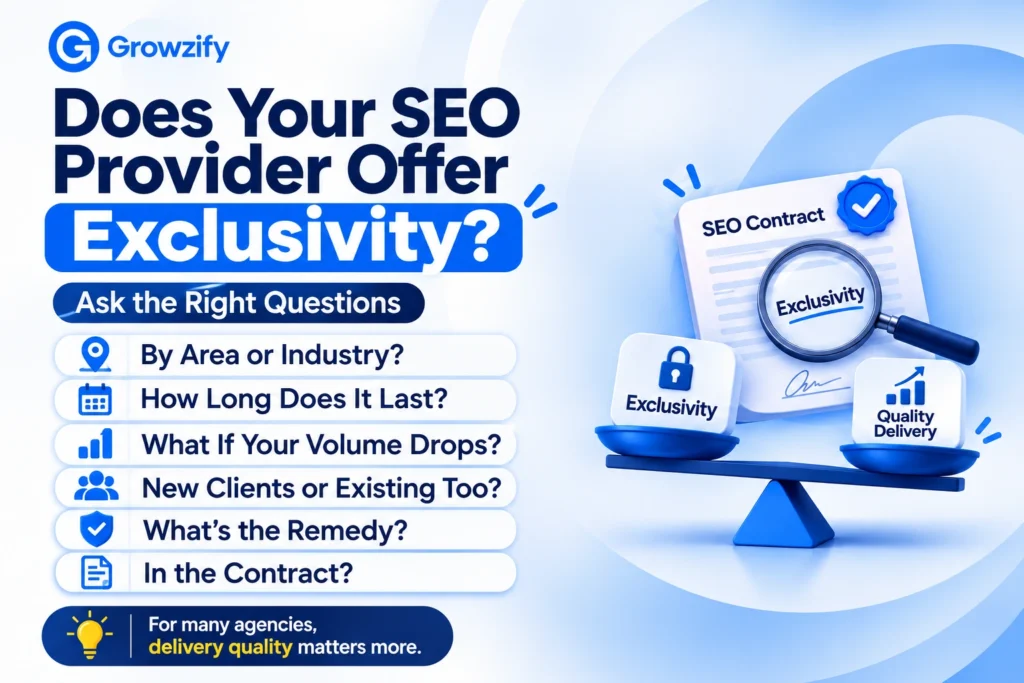
Exclusivity means a provider agrees to limit who else it serves, such as one agency per city or industry.
Sales material may imply exclusivity without defining it in the contract. If it matters to you, require the scope and conditions to be written into the agreement, and get answers to these questions:
For many agencies, delivery quality matters more than exclusivity. Your clients are more likely to notice stalled results than to learn who your competitors use.
Basic branding puts your logo on a PDF. Deeper branding can include a dashboard on your own domain, emails and documents in your name, and no provider names in file properties or footers.
Also check login URLs and the sender names on automated emails, which are common places for branding to leak.
Whatever you agree, check a live sample before you sign. Look at the footer, the file name, and every link.
Some agencies want the provider fully invisible. Others let provider specialists join technical calls under the agency’s name. Provider invisibility is a commercial arrangement, not part of the definition of good outsourced SEO.
Both can work. Agree on the rules early:
“Ownership” covers four different questions. Separate them:
A provider can transfer client work product without transferring ownership of its underlying proprietary process or software.
For accounts, the client should own theirs.Search Console permission levelsshow why. An Owner has full control, including adding and removing users, while a Restricted user has view rights on most data. Give providers the lowest access that lets them work.
The client should also retain a verified ownership method under its own control, rather than relying only on delegated ownership provided through an agency or vendor. A Search Console property needs at least one verified owner or users lose access.
Ownership of written work and intellectual property is a legal drafting question. Growzify’s guide onwhat a good white label SEO contract should includecovers it, and a lawyer in your jurisdiction should review any real agreement.
Compare how you pay, not just how much. Look for:
Reserved or customized capacity can raise switching risk, so ask:
Growzify’swhite label SEO pricing guidecovers wholesale tiers and margins.
The service label doesn’t tell you who holds decision rights. The operating agreement should.
For each material workstream, assign four separate rights:
| Provider A: “White label SEO” | Provider B: “Private label SEO” | |
| Monthly minimum | None | Higher minimum |
| Reporting | Logo on a PDF | Dashboard on the agency’s domain |
| Exclusivity | None | Promised on the sales call |
| Contract language on exclusivity | Not applicable | None |
| Ownership of work | Not stated | Not stated |
| Implementation rights | Recommendations only | Recommendations only |
| Who talks to clients | Agency only | Agency only |
At first glance, Provider B looks more premium. But when Brightline reads the contract, Provider B’s exclusivity isn’t in writing, and neither contract covers ownership. Neither provider is cleared to implement changes either.
So Brightline asks both providers to add ownership and implementation terms, and asks Provider B to put exclusivity in the agreement or drop the premium. The labels turned out to matter less than the paper.
Use the same list with every provider, whatever they call their program. It makes the answers easy to compare.
Write down the answers, and ask for any promise that matters to be added to the agreement.
Branding someone else’s work as your own doesn’t mean misleading the client about what they’re buying. Clients care about results, accountability, and who’s responsible.
A few practical habits help:
Disclosure rules and expectations vary by contract, client, and jurisdiction. If you’re unsure what you must say, ask a lawyer rather than guessing.
This is a practitioner guide, not a rule. Choose by need, not by label.
| Your situation | What to look for |
| Testing SEO with a few clients | Low minimums, short notice, a pilot project |
| Steady roster of SEO clients | A named contact, branded dashboards, clear quality checks |
| Distinctive method you want to protect | Customization options, written ownership terms, confidentiality, and limits on provider reuse |
| Need territory or niche protection | Exclusivity in writing, with clear limits and a remedy |
| Strong account management but limited SEO operations | Standardized fulfillment, clear QA, predictable communication, and reporting support |
For first-time setup, Growzify’sbackend SEO systems guideshows how a provider plugs into an agency’s workflow.
Don’t take any label on trust. Ask for evidence.
It generally describes an arrangement where an external provider fulfills SEO that an agency sells under its own brand. The term is often used to suggest more customization, deeper branding, reserved capacity, or exclusivity, but providers use it inconsistently.
Sometimes. SEO has no widely recognized standard that requires the two terms to mean different things. Many providers use them interchangeably, while others use “private label” to describe additional customization, deeper branding, reserved capacity, or exclusivity. Compare the actual scope, branding, client-contact rules, ownership, pricing, and contract terms rather than choosing by the label alone.
Private label describes how the service is branded and delivered. Reseller describes your role in selling it. Some providers also use “reseller” for models where the provider is more visible to the client, so confirm what a provider means.
Sometimes. Providers that offer customization or reserved capacity may charge higher minimums. But a higher price doesn’t prove a better service, so compare what’s included.
There’s no single legal answer based on the label alone. White label and private label fulfillment are established commercial models, but the obligations in a specific arrangement depend on its contracts, intellectual-property rights, what the agency represents to clients, confidentiality obligations, and applicable law. Nothing in this guide is legal advice, so have a lawyer review any agreement.
Some providers offer limited exclusivity, such as by niche or area. If it matters to you, it needs to be in the contract with clear limits and a remedy.
Choose by need. A new SEO offering usually calls for low commitment and a pilot. A distinctive method calls for customization and written ownership terms.
If you’re an agency comparing white label and private label options, Growzify’swhite label SEO servicesteam can walk through what’s included, what’s flexible, and what goes in the agreement.

Chitranshu SharmaA growth strategist, digital marketing consultant, and the founder of Growzify, a performance-driven agency helping brands dominate search, shape perception, and build sustainable online visibility. With 8+ years of hands-on experience in Enterprise SEO, Online Reputation Management (ORM), and AI-led traffic generation, Chitranshu has helped startups, public figures, SaaS companies, and cannabis brands outrank competitors — ethically and at scale.

At Growzify, we are dedicated to helping your business achieve its goals. Are you Ready to take the next step?
White Label SEO Dashboard: 10 Best Tools for Agencies To Create It A client doesn’t...
The Complete Guide to White Label SEO Onboarding for Agencies and Resellers A lot of...
What is White Label SEO Reporting: Tools, Metrics, and Best Practices A report can look...
How SEO Outsourcing for Startups Helps in Driving Organic Growth A startup rarely has enough...

How Much Does SEO Outsourcing Cost in 2026? Nobody can give you one honest price...
AI SEO Best Practices to Boost Visibility Across LLMs Large language models do not all...

7 AI SEO Content Optimization Strategies to Improve Visibility on AI Search Platforms AI-powered search...
How to Outsource SEO Without Losing Your Rankings Rankings don’t vanish because someone else is...
Call Now





Growzify digital team is very effective, and easy to work with. Very strong communication and always up for suggestions. Saw 300% growth in web traffic 170% growth in revenue through Facebook ad’s & Amazon. I recommended them to my fellows and they turned their online business into a money making machine.