


How Enterprise SEO Helps Brands to Scale and Maximise ROI
Enterprise SEO helps brands scale efficiently by combining technical optimization, strategic content, automation, and data-driven insights to improve search visibility, maximize ROI, increase qualified organic traffic, and drive sustainable long-term business growth.

Written byChitranshu Sharma
July 29, 2026
Quick Nav
Enterprise SEO enables brands to scale efficiently by improving visibility across thousands of pages, markets, and customer journeys through a unified SEO strategy. As technical improvements, content, and authority compound over time, brands attract more qualified traffic, increase conversions, and reduce acquisition costs. Thus, they generate sustainable long-term ROI without continually increasing marketing spend.
In today’s digital era, enterprise brands face more competition than ever. Every day, thousands of businesses compete for the same search visibility, customer attention, and clicks. The challenge is no longer just creating more content or launching more campaigns. It’s about finding a scalable way to stay visible as websites, product catalogs, and global markets continue to grow. So, how do the biggest brands consistently earn organic traffic, strengthen their online presence, and keep growing their business?
The answer lies inEnterprise SEO. Rather than treating SEO as a collection of isolated tasks,Enterprise SEO manages optimization across thousandsor even millions of pages through scalable technical improvements, content strategies, automation, and governance. It helps large organizations improve search visibility consistently while keeping complex websites efficient, organized, and aligned with business goals.
Let’s understand how Enterprise SEO helps brands scale and maximize ROI. Unlike paid marketing, where traffic ends when spending stops, Enterprise SEO compounds over time. Every technical improvement, content management, and authority signal strengthens thousands of pages, driving sustainable organic growth, lower acquisition costs, and long-term business value.
What Are the Key Components of Enterprise SEO?
Enterprise SEO succeeds because it combines multiple disciplines into one scalable strategy. Instead of focusing on isolated optimizations, it builds systems that improve search visibility, user experience, and business performance across thousands of pages. Each component supports the others, creating sustainable growth and long-term ROI. The core components of Enterprise SEO include:
- Technical SEO to improve crawlability, indexing, and website performance.
- Content strategy that builds topical authority and drives organic traffic.
- Site architecture and internal linking to strengthen navigation and page discoverability.
- International and multi-location SEO for expanding into new markets.
- Automation and AI workflows to streamline repetitive SEO tasks.
- Analytics, reporting, and governance to measure performance and align teams around business goals.
Together, these components create a scalable SEO framework that helps enterprise brands grow efficiently while maximizing long-term returns.
What Makes Enterprise SEO Work at Scale?
Unlike most marketing channels, where results stop when the budget runs out, Enterprise SEO delivers compounding returns. A single technical improvement can increase the visibility of thousands of pages, while high-quality content continues attracting traffic and backlinks for years.
Rather than optimizing individual pages, Enterprise SEO relies on scalable systems, automation, and standardized processes that improve performance across an entire website. This multiplier effect is what enables enterprise brands to scale organic growth, maximize ROI, and build a sustainable competitive advantage. Let’s explore the key pillars that make this possible.
Scalable Technical SEO That Improves Sitewide Visibility
Technical SEO is the foundation of every successful enterprise website. A single technical improvement can enhance the performance of thousands of pages, making it one of the highest-impact investments for large organizations. Key focus areas include:
- Improving crawlability and indexability
- Optimizing site architecture
- Strengthening internal linking across large websites
- Implementing structured data at scale
- Resolving duplicate content and indexing issues
When search engines can crawl and understand a website more efficiently, every section of the site benefits, not just individual pages.
Example:An eCommerce retailer discovers thousands of product pages aren’t being indexed because of incorrect canonical tags. After fixing the issue once, search engines can properly crawl and index the entire catalog. Instead of improving a handful of pages, one technical update increases the visibility of thousands of products, resulting in higher organic traffic and revenue.
Building a Content Engine That Compounds Over Time
Unlike paid advertising, great content keeps generating value long after it’s published. Enterprise SEO focuses on creating a scalable content ecosystem rather than isolated blog posts. This includes:
- Building topic clusters around core business themes
- Creating evergreen resources that remain valuable over time
- Leveraging programmatic SEO for large content libraries
- Refreshing existing content to maintain rankings
- Using AI to streamline research, optimization, and content workflows
As more authoritative content is added and continuously improved, each new page strengthens the visibility of the entire website, creating a compounding growth effect.
Example:A SaaS company creates a comprehensive content hub around project management, publishing guides, templates, comparisons, and tutorials. As new articles link to existing ones, the entire topic cluster gains authority. Over time, the content ranks for hundreds of related keywords, continually attracting qualified traffic and leads without requiring additional advertising spend.
Scaling SEO Across Multiple Markets and Locations
Enterprise brands rarely serve just one audience. Whether expanding internationally or targeting multiple regions, Enterprise SEO helps businesses maintain consistent visibility while adapting to local search behavior. A scalable international strategy includes:
- International SEO best practices
- Hreflang implementation
- Multi-location SEO
- Regional keyword research
- Localized content and landing pages
This enables brands to grow organically across different countries, languages, and markets without creating disconnected SEO strategies.
Example: A global retailer expands into the UK, Germany, and Australia using localized landing pages, regional keyword research, and hreflang implementation. Instead of duplicating the same content, each market receives locally optimized pages, helping the brand rank for country-specific searches while delivering a more relevant experience to customers in every region.
Optimizing Technical Performance for Sustainable Growth
As websites grow, technical complexity increases. Enterprise SEO ensures performance remains strong even as thousands of pages are added. Areas of focus include:
- Improving Core Web Vitals
- Optimizing crawl budget
- Managing indexation efficiently
- JavaScript SEO optimization
- Maintaining scalable site architecture
Strong technical performance helps search engines process large websites more efficiently while delivering a better user experience.
Example:A news publisher improves Core Web Vitals by optimizing images, reducing JavaScript, and implementing faster page loading across its website. These changes improve loading and interaction performance across the article library. The publisher should then measure whether the rollout affects engagement, search visibility, conversions, and crawl behaviour instead of assuming that every performance improvement will produce ranking growth.
Aligning Teams Around a Unified SEO Strategy
Enterprise SEO isn’t owned by one department. It succeeds when multiple teams work toward the same business objectives. A successful Enterprise SEO program connects:
- Marketing teams
- Content creators
- Developers
- UX designers
- Product teams
- Analytics and business intelligence teams
With clear governance and shared processes, organizations can scale SEO initiatives more quickly while maintaining quality and consistency across all departments.
Example:A large enterprise launches a new product category where marketers create content, developers implement technical recommendations, designers improve user experience, and analysts monitor performance. By following shared SEO guidelines and workflows, every team contributes toward the same goal, allowing the company to scale organic growth faster while maintaining consistency across the website.
Ultimately, Enterprise SEO succeeds because it transforms individual optimizations into scalable systems that deliver organization-wide impact. The following core components work together to improve visibility, streamline operations, and create sustainable organic growth that continues driving ROI as the business expands.
How Enterprise SEO Helps Brands Maximize ROI
Scaling traffic is only part of the equation. The real value of Enterprise SEO lies in its ability to generate sustainable business returns while improving marketing efficiency.
Unlike channels that require continuous spending to maintain visibility, Enterprise SEO compounds over time. Every technical improvement, content investment, and authority signal continues delivering value long after the initial work is completed. As search visibility grows, brands benefit from:
- Lower customer acquisition costs (CAC)
- Higher organic traffic and revenue
- More qualified leads and conversion opportunities
- Long-term, compounding traffic growth
- Reduced dependence on paid advertising
- Greater acquisition of high-CLV customer segments when keyword, content, and conversion strategies are aligned with the customers the business is best positioned to retain.
Instead of paying for every click, Enterprise SEO builds a durable acquisition channel that becomes more valuable over time.
The true strength of Enterprise SEO is how technical excellence, scalable content, automation, and cross-functional collaboration work together. When these components operate as one system, they help enterprise brands grow faster, expand into new markets, and maximize ROI through sustainable organic growth.
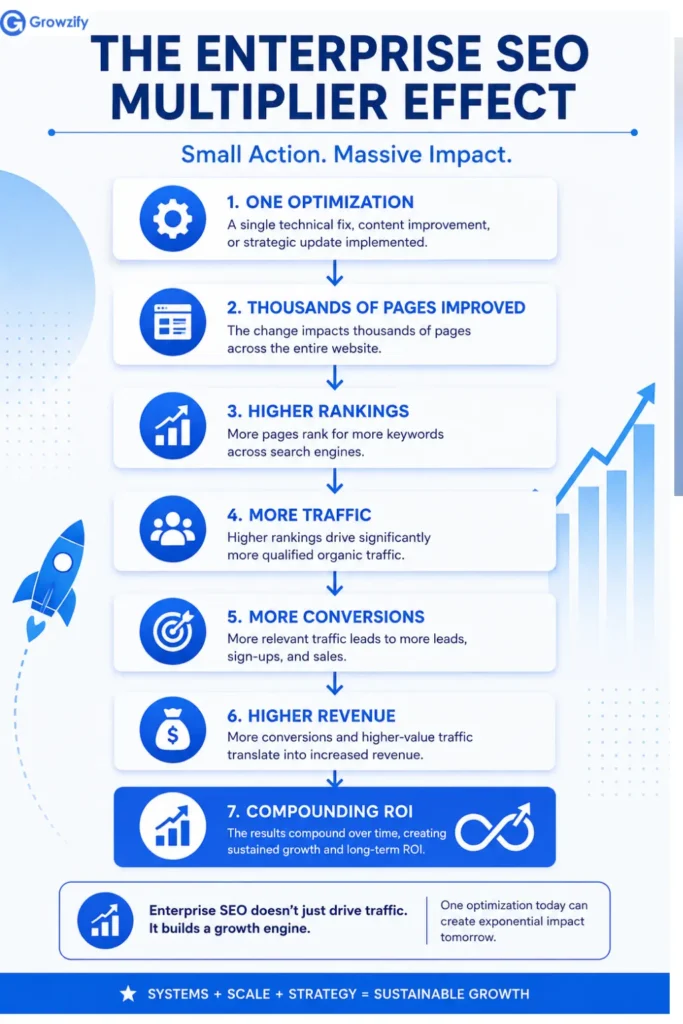
One strategic SEO optimization can create a compounding growth engine that improves visibility, drives conversions, and maximizes long-term ROI across your entire website.
AI and Automation in Enterprise SEO
Managing SEO for thousands of pages manually is no longer practical. That’s why AI and automation have become essential parts of Enterprise SEO. Rather than replacing strategy, AI enhances it by helping teams work faster, uncover actionable insights, and automate repetitive tasks. This allows SEO professionals to spend more time on strategic planning, content quality, technical optimization, and long-term business growth.
This approach aligns with guidance fromGoogle Search Central,Each well-differentiated page can strengthen a topic cluster when it satisfies a distinct search need, adds original value, and is connected through deliberate internal linking. Publishing overlapping, thin, or unmaintained pages can instead create cannibalisation, index bloat, and ongoing maintenance costs..
Some of the most valuable AI applications in Enterprise SEO include
- AI-assisted content planning:Identify topic gaps, cluster keywords, and build content calendars based on search intent.
- Internal linking automation:Discover relevant linking opportunities across large websites to improve authority and navigation.
- Schema generation:Automatically create and validate structured data for products, articles, FAQs, and other page types.
- Technical SEO audits:Continuously monitor crawl errors, broken links, duplicate content, and indexing issues.
- Predictive SEO:Analyze search trends to identify emerging opportunities before competitors.
- Workflow automation:Simplify reporting, content optimization, redirects, metadata updates, and routine SEO tasks.
Example:An enterprise retailer using AI can automatically identify hundreds of products missing schema markup and generate recommendations in minutes, reducing work that would otherwise take weeks.
Ultimately, AI can increase throughput and surface patterns that would be difficult to review manually, but its output requires human validation. At enterprise scale, an incorrect automated recommendation can propagate across thousands of URLs, so approval rules, testing, rollback controls, and quality assurance are essential.
Helps enterprise teams scale SEO more efficiently while keeping human expertise at the center of strategy.
How to Measure Enterprise SEO ROI Using the Right KPIs
Higher rankings are valuable, but they don’t tell the full story of Enterprise SEO success. The real question is: How do you measure whether your SEO investment is generating meaningful business returns? The answer lies in tracking the right Key Performance Indicators (KPIs). Rather than focusing solely on rankings or traffic, enterprise organizations measure how SEO contributes to revenue, customer acquisition, operational efficiency, and long-term business growth. Monitoring these KPIs provides a clear, data-driven view of SEO performance and helps business leaders evaluate the true return on their investment. Key metrics to monitor include:
- Organic Revenue:Measure the total revenue generated from organic search visitors using GA4 or your CRM.
Example: If organic visitors generate $250,000 in quarterly sales, that’s your organic revenue contribution.
- Organic Conversions:Track completed goals such as purchases, demo requests, or form submissions from organic traffic.
Example:If 1,500 of 20,000 organic visitors request a demo, your organic conversion rate is 7.5%.
- Share of Voice (Search Visibility):Measure the percentage of keyword visibility your brand owns compared with competitors using SEO tools.
Example:Your Share of Voice increases from 18% to 27%, indicating stronger market presence.
- Non-Brand Organic Traffic:Monitor visits from generic, non-branded keywords to evaluate your ability to attract new audiences.
Example:Traffic from “enterprise SEO platform” grows by 35% while branded searches remain stable.
- Indexed Pages:Compare the number of important pages indexed in Google Search Console against the total pages you want indexed.
Example:The proportion of priority canonical URLs indexed increases from 75% to 92%, while duplicate and low-value indexed URLs decline. This indicates better index coverage of commercially important pages.
- Crawl Efficiency:Measure crawl activity, crawl errors, and server responses using Search Console or log-file analysis.
Example:Server errors, redirect waste, duplicate crawl paths, and non-indexable URL requests decline, allowing a greater share of Googlebot activity to reach priority URLs. Whether those URLs are indexed still depends on canonicalisation, content quality, duplication, rendering, and index demand.
- Keyword Visibility:Track how many target keywords rank in the Top 3, Top 10, or Top 20 search results.
Example: The number of Top 10 keywords grows from 1,200 to 1,850 within six months.
- Customer Acquisition Cost (CAC):Divide total SEO investment by the number of customers acquired through organic search.
Example:Spending $40,000 to acquire 400 customers results in an SEO CAC of $100 per customer.
- Return on Investment (ROI):Compare revenue generated from SEO with the total cost of your SEO program.
Example: If SEO generates $500,000 in revenue from a $100,000 investment, the ROI is 400%.
- Assisted Conversions:Measure conversions where organic search influenced the customer journey, even if it wasn’t the final touchpoint.
Example: Use GA4 attribution-path reporting and CRM journey data to understand where organic search introduces, assists, or completes conversions. Report the attribution model and lookback assumptions because channel credit changes according to the selected methodology.
Example:If technical improvements increase indexed pages by 30% and organic revenue grows by 20% while customer acquisition costs decline, the SEO strategy is creating measurable business value, not just better rankings.
Ultimately, the success of Enterprise SEO isn’t measured by rankings alone but by its ability to generate lasting business value. By attracting qualified traffic, increasing conversions, reducing customer acquisition costs, and driving consistent organic revenue. Enterprise SEO becomes a scalable growth engine that delivers measurable ROI and sustainable business growth for the long term.
Original Framework: The Enterprise SEO Maturity Model
Not every enterprise SEO program delivers the same return, and maturity isn’t just one score. It’s a set of capabilities that typically develop unevenly across an organization. The table below breaks maturity into seven dimensions so a program can be assessed honestly rather than assigned a single vague label.
| Dimension | Level 1 | Level 2 | Level 3 | Level 4 |
| Technical control | Reactive fixes | Scheduled audits | Automated monitoring | Preventive, template-level architecture |
| Content operations | Ad hoc publishing | Documented workflow | Portfolio governance | Demand and lifecycle optimization |
| Data and attribution | Traffic reporting | Conversion reporting | CRM integration | Incrementality testing and forecasting |
| Governance | Individual ownership | Defined stakeholders | Cross-functional RACI | Executive operating model |
| Automation | Minimal | Task-level | Workflow-level | Controlled, monitored orchestration |
| International SEO | Reactive | Market templates | Central-local governance | Portfolio-level optimization |
| AI search visibility | Unmeasured | Manual spot checks | Prompt and source tracking | Integrated traditional and AI-answer visibility |
Enterprise SEO maturity is built through continuous optimization, smarter workflows, and measurable business outcomes. Use this framework to evaluate where your organization stands today, identify opportunities for improvement, and create a roadmap toward scalable, long-term organic growth. As your SEO maturity increases, so does your ability to maximize visibility, revenue, and ROI.
Enterprise SEO: Driving Growth That Compounds Over Time
At its core, Enterprise SEO is about building a system that grows stronger with every optimization. Every technical improvement, content update, and strategic enhancement adds lasting value to your website, creating momentum that continues long after the work is done. Enterprise SEO helps brands build sustainable visibility, attract qualified customers, lower acquisition costs, and increase revenue over time.
Growzify helps streamline yourEnterprise SEO workflow with scalable strategies,technical expertise, and data-driven optimization. Whether you’re managing thousands of pages or expanding into new markets, our approach enables your team to work more efficiently, improve search visibility, and drive sustainable organic growth that supports long-term business success.
Frequently Asked Questions
What ROI can a business realistically expect from enterprise SEO?
First Page Sage’s proprietary campaign data reports materially different SEO returns and break-even periods by industry. These figures should be treated as directional agency benchmarks rather than guaranteed enterprise outcomes. Actual ROI depends on site condition, margins, sales cycles, attribution methodology, competition, implementation capacity, and the total cost included in the calculation.
Why does enterprise SEO ROI improve over time instead of staying flat?
Enterprise SEO ROI should preferably compare incremental gross profit attributable to organic search against the full cost of the programme. Revenue-based calculations can be reported separately but may overstate economic return when margins differ across products or customer segments.
How is enterprise SEO ROI different from ROI on smaller SEO campaigns?
The core mechanism is the same, but scale amplifies it. A single fix or content asset touches far more revenue-generating surface area on a large site, which is why the same quality of work tends to produce a larger multiplier effect at enterprise scale.
What’s the biggest factor that erodes enterprise SEO ROI?
Uncoordinated execution between teams, most commonly content and technical teams working from separate roadmaps, which creates internal competition between pages and wastes the compounding effect that scale is supposed to provide.
Does enterprise SEO reduce the need for paid advertising?
It typically reduces blended customer acquisition cost over time rather than eliminating paid channels, since paid media still serves time-sensitive campaigns and testing that organic search isn’t suited for.
How should enterprise SEO ROI be reported to executive leadership?
In financial terms leadership already trusts: revenue attributed to organic search, the trend in blended customer acquisition cost, and payback period, rather than traffic or ranking metrics alone.
Can a company calculate enterprise SEO ROI without outside help?
Yes, using the standard formula of net revenue attributed divided by total investment, but getting the inputs right, particularly full investment cost including internal labor, requires more rigor than most internal reporting processes are set up to provide by default.

Chitranshu SharmaA growth strategist, digital marketing consultant, and the founder of Growzify, a performance-driven agency helping brands dominate search, shape perception, and build sustainable online visibility. With 8+ years of hands-on experience in Enterprise SEO, Online Reputation Management (ORM), and AI-led traffic generation, Chitranshu has helped startups, public figures, SaaS companies, and cannabis brands outrank competitors — ethically and at scale.
Explore More Articles
How to Find and Compare Local SEO Outsourcing Providers
How to Find and Compare Local SEO Outsourcing Providers Finding a local SEO outsourcing provider...
October 13, 2026Outsourcing
Inside a White Label SEO Campaign: How the Work Gets Done
Inside a White Label SEO Campaign: How the Work Gets Done Clients see a single...
October 13, 2026White Label

How to Vet an SEO Outsourcing Provider Before You Sign a Contract
How to Vet an SEO Outsourcing Provider Before You Sign a Contract A polished proposal...
October 9, 2026Outsourcing

Multilingual SEO Best Practices: Optimize Your Multi-Language Website
Multilingual SEO Best Practices: Optimize Your Multi-Language Website Translating a page and localizing it for...
October 7, 2026SEO

What Makes In-House Enterprise SEO Work Different Day-to-Day?
What Makes In-House Enterprise SEO Work Different Day-to-Day? On a small site, deciding to fix...
October 7, 2026Enterprise

How Core Algorithm Updates Impact Large Sites Differently Than Small Ones
How Core Algorithm Updates Impact Large Sites Differently Than Small Ones A large enterprise site...
October 7, 2026Enterprise
When Should You Outsource SEO? 11 Signs It Makes Sense
When Should You Outsource SEO? 11 Signs It Makes Sense Outsourcing SEO does not necessarily...
September 26, 2026Outsourcing