


How Enterprise SEO Works for Websites with Millions of Pages
Enterprise SEO enables large websites with millions of pages to improve crawl efficiency, indexing, technical performance, and content optimization, helping scale organic visibility, increase search rankings, and support long-term business growth.

Written byChitranshu Sharma
July 13, 2026
Quick Nav
Enterprise SEO is the process of optimizing very large websites, often with hundreds of thousands or millions of URLs, so search engines can efficiently crawl, index, and rank them. Unlike traditional SEO, it depends on scalable site architecture, crawl budget management, templated automation, and strong internal linking systems rather than page-by-page manual work.
Modern enterprise websites are growing faster than ever, with some managing millions of pages across multiple products, regions, languages, and business units. At this scale, traditional SEO methods simply aren’t enough. Without a structured system, businesses often struggle with crawl budget issues, duplicate content, slow indexing, inconsistent optimization, and declining search visibility.
Enterprise SEO solves these challenges by using scalable processes, automation, technical optimization, and strategic content management. Instead of optimizing pages individually, create a framework that helps search engines efficiently discover. Along with understanding and ranking millions of pages while supporting long-term business growth.
Here’show enterprise SEO actually worksbehind the scenes: the technical infrastructure it depends on, the mistakes that show up most often at scale, and the practices that fix them. If you manage a website that’s outgrown spreadsheet-based SEO, this article will show you what a scalable system looks like.
A Familiar Problem for Growing Websites
Take an e-commerce brand running 2 million product pages across dozens of categories and regional storefronts. Or a media publisher pushing out 300 articles a week across multiple verticals. Or a SaaS company that just launched in 12 new countries and now has to manage SEO across a dozen language variants.
Each of these businesses hits the same wall eventually. The tactics that worked when they had 200 pages, writing unique meta descriptions, manually building internal links, and checking indexation one page at a time, simply stop working at scale. There aren’t enough hours in the day, and the cost of manual oversight grows faster than the site does.
This is exactly where enterprise SEO comes in. It’s not “regular SEO but bigger.” It’s a fundamentally different approach built around systems, templates, and automation instead of individual page optimization.
Crawl budget guidance from search engines makes this distinction explicit. It’s generally not something small sites need to worry about, but it becomes a real constraint once a site crosses into the hundreds of thousands or millions of URLs.
That single technical detail explains why enterprise SEO exists as its own specialty. When you’re managing an enterprise website, you’re not just optimizing content; you’re managing how search engines allocate limited attention across an enormous surface area.
Industry research consistently points to the same conclusion: as site size grows, technical SEO and information architecture matter more than any single piece of content.
What Is Enterprise SEO?
Enterprise SEO is the practice of optimizing websites with 10,000 to millions of pages using scalable systems, such as templated automation, crawl budget management, and rules-based internal linking, instead of manual, page-by-page optimization.
It combines:
- Technical SEO infrastructure built for scale (crawling, indexing, site speed, structured data)
- Content systems that use templates, governance, and automation instead of one-off writing
- Cross-team coordination between SEO, engineering, product, and content teams
- Enterprise-grade tools capable of monitoring millions of URLs simultaneously
The core difference from traditional SEO isn’t the goal; ranking well and earning organic traffic is still the objective. The difference is the method.
You can’t manually optimize a million pages. You have to build systems that optimize pages automatically, at the template and architecture level.
Here’s how the two approaches compare directly:
Factor | Traditional SEO | Enterprise SEO |
Typical site size | Under a few thousand pages | 10,000 to millions of pages |
Optimization method | Manual, page-by-page | Template and rule-based automation |
Primary constraint | Content quality and backlinks | Crawl budget and indexation |
Internal linking | Manually added links | Rules-driven modules and hubs |
Monitoring | Manual spot checks, basic analytics | Log file analysis, enterprise crawlers, bulk API data |
Team structure | One SEO or a small team | Cross-functional: SEO, engineering, content, regional teams |
Reporting cadence | Page or campaign level | Segment and template level, tracked as KPIs |
Why Enterprise SEO Matters for Large Websites
At scale, small inefficiencies become massive problems. A meta title template with a flaw doesn’t affect one page; it affects 500,000 pages. A broken canonical tag rule doesn’t create one duplicate content issue; it creates millions.
Enterprise SEO matters because:
- Crawl budget is finite.Search engine bots won’t crawl every page of a massive site every day. If your architecture wastes crawl budget on low-value pages, your important pages get crawled less often.
- Indexation isn’t guaranteed.Google indexes what it deems worth indexing. Large sites frequently discover that 30-40% of their pages sit in “Crawled – currently not indexed” status in Google Search Console.
- Revenue is directly tied to visibility.For ecommerce and marketplace sites, unindexed or poorly optimized product pages represent lost revenue at scale.
- Manual QA doesn’t scale.You need monitoring systems, not spreadsheets, to catch technical issues before they compound.
Businesses that need enterprise SEO include large ecommerce retailers, multi-location franchises, SaaS platforms with usage-generated pages, online marketplaces, news and media publishers, and multinational brands managing localized content across regions.
Not sure where your own site stands? Growzify’s enterprise SEO team typically starts new engagements with a focused crawl and log file audit, since it surfaces the biggest indexation leaks within days, not months.
How Enterprise SEO Works for Websites with Millions of Pages
This is the core of enterprise SEO: a set of interconnected systems that work together so that search engines can efficiently discover, understand, and rank enormous volumes of content.
Scalable Site Architecture
Everything starts with architecture. A well-structured enterprise website uses a shallow, logical hierarchy, typically no more than 3-4 clicks from the homepage to any given page. Category pages act as hubs that distribute authority down to subcategories and individual product or content pages.
Flat architecture matters because search engines use internal link structure as a signal of importance. A page buried eight clicks deep signals low priority, regardless of its actual content quality.
Managing Crawl Budget
Crawl budget is the number of pages a search engine bot will crawl on your site within a given time period. For enterprise sites, wasting this budget on filtered URLs, duplicate parameter pages, or thin content pages means your genuinely valuable pages get crawled less frequently.
Practical crawl budget management includes:
- Blocking low-value URL patterns (filters, session IDs, internal search results) via robots.txt
- Consolidating duplicate content with canonical tags
- Reducing redirect chains, which waste crawl requests
- Fixing server response times, since slow servers reduce how much a bot will crawl per visit
- Removing or noindexing thin, outdated, or cannibalizing pages
Indexation at Scale
Indexation and crawling are related but distinct. A page can be crawled and still not indexed if Google decides it lacks unique value. Enterprise teams monitor indexation ratios (indexed pages divided by total submitted pages) as a core KPI, not an afterthought.
XML sitemaps play a critical role here. Large sites typically use sitemap index files that split URLs into segments of 50,000 or fewer, organized by content type or freshness, so teams can isolate exactly which segment of the site has indexation problems.
Automation and Templates
You cannot hand-write a unique title tag for 3 million product pages. Enterprise SEO relies on dynamic templates that pull structured data (product name, category, brand, location) into title tags, meta descriptions, and headers programmatically.
The skill isn’t writing individual tags; it’s designing templates smart enough to avoid duplication while still reading naturally. For example: {Product Name} | {Category} | Buy Online at {Brand} produces unique, relevant titles automatically across an entire catalog.
Internal Linking Systems
At scale, internal linking has to be rules-based. Common enterprise systems include:
- Related product or article modules driven by taxonomy or purchase data
- Breadcrumb navigation reinforces hierarchy
- Contextual in-content links inserted via CMS rules rather than manual editing
- Hub pages that aggregate and link out to clusters of related content
Enterprise Content Strategy
Content at scale needs governance: style guides, approval workflows, and clear ownership across teams, agencies, and regions. Enterprise content strategy usually separates content into tiers: high-priority pages that deserve custom optimization and long-tail or programmatic pages that rely on strong templates.
Technical SEO Infrastructure
This includes Core Web Vitals monitoring across page types, JavaScript rendering audits (critical for React- or Angular-based enterprise sites), log file analysis to see exactly how bots crawl the site, and a scalable redirect management system for legacy URLs during migrations.
Structured Data
Schema markup (Product, Article, Organization, FAQ, Breadcrumb) needs to be implemented at the template level, so it applies automatically across every relevant page type. This is what powers rich results and increasingly feeds AI Overviews and other generative answer engines with structured, trustworthy signals about your content.
International SEO
Multinational businesses need correctly implemented hreflang tags, region-specific content (not just translation), and clear signals about which country and language each page targets. Errors here often cause the wrong regional page to rank in the wrong market.
Monitoring Millions of URLs
Enterprise teams rely on log file analyzers, custom crawlers (Screaming Frog at scale, Botify, OnCrawl), and API-level integrations with Google Search Console to sample and monitor indexation, crawl frequency, and ranking changes across segments of the site rather than page by page.
Common Enterprise SEO Challenges
- Crawl budget wastefrom faceted navigation and filter URLs
- Duplicate contentacross near-identical product variants or location pages
- Slow-moving engineering cycleswhere SEO fixes wait behind product roadmaps
- Siloed teamswhere content, dev, and SEO don’t share visibility
- Legacy CMS limitationsthat make template-level changes difficult
- Cannibalizationbetween thousands of similar pages competing for the same query
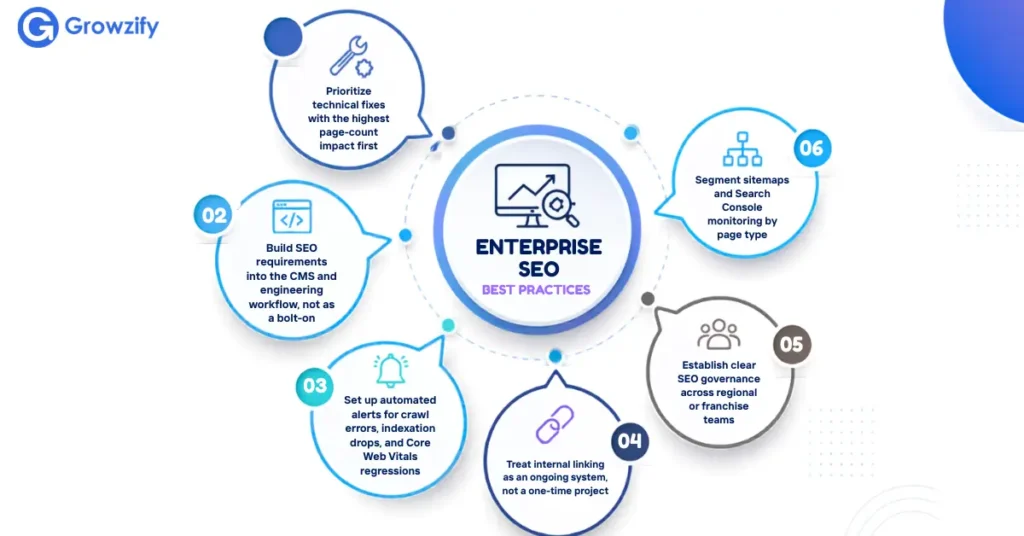
Enterprise SEO Best Practices
- Prioritize technical fixes with the highest page-count impact first
- Build SEO requirements into the CMS and engineering workflow, not as a bolt-on
- Set up automated alerts for crawl errors, indexation drops, and Core Web Vitals regressions
- Treat internal linking as an ongoing system, not a one-time project
- Establish clear SEO governance across regional or franchise teams
- Segment sitemaps and Search Console monitoring by page type
Enterprise SEO Tools Worth Considering
Enterprise teams generally combine several tool categories: enterprise crawlers (Botify, OnCrawl, Screaming Frog at scale), rank tracking and research platforms (Ahrefs, Semrush), log file analysis tools, and Google Search Console’s bulk data export via BigQuery for sites too large for the standard UI.
Choosing tools that support API access and bulk data handling is non-negotiable once you cross into millions of URLs.
Signs Your Website Needs Enterprise SEO
- Your site has more than 10,000 indexable pages
- Google Search Console shows a large gap between submitted and indexed URLs
- Your team can’t manually audit new pages fast enough
- You operate across multiple regions, languages, or brands
- Crawl stats show declining crawl frequency on important pages
Enterprise SEO Maturity Model: Where Does Your Site Stand?
Most enterprise sites fall into one of four stages. Use this to spot where your own site sits before prioritizing fixes.
- Reactive: SEO issues get discovered after they’ve hurt rankings. No crawl monitoring in place.
- Managed:Sitemaps, canonicals, and templates exist, but changes still require manual engineering requests.
- Systemized:Crawl budget, indexation, and structured data are monitored on a dashboard, with alerts for regressions.
- Autonomous:Templates self-correct based on monitoring signals, and SEO requirements are built into the CMS and deploy pipeline by default.
Most large sites operate at Stage 1 or 2 without realizing it. Moving to Stage 3 alone typically resolves the majority of crawl and indexation waste described above.
Getting an outside read on which stage you’re actually at, rather than the stage you assume you’re at, is usually the fastest way to move forward. This is the kind of assessmentGrowzify runs as the first step in most enterprise SEO engagements.
Key Takeaways
Enterprise SEO isn’t about doing traditional SEO more times; it’s about building systems, architecture, and automation that let search engines efficiently understand a massive site.
The businesses that get this right treat crawl budget, indexation, templates, and internal linking as engineering problems, not just content tasks. Get the infrastructure right, and rankings follow at scale.
Frequently Asked Questions
What is the difference between enterprise SEO and regular SEO?
Regular SEO typically focuses on optimizing individual pages one at a time. Enterprise SEO focuses on systems, templates, site architecture, and automation that apply consistently across tens of thousands or millions of pages, since manual optimization isn’t feasible at that scale.
How much does enterprise SEO cost?
Costs vary widely based on site size, technical complexity, and whether work is handled in-house or through enterprise SEO services. Most enterprise engagements include technical audits, crawler tools, and ongoing strategic work, which typically makes them a larger investment than standard SEO retainers.
What tools do enterprise SEO teams use?
Common tools include enterprise-grade crawlers like Botify and OnCrawl, research platforms like Ahrefs and Semrush, log file analyzers, and Google Search Console’s bulk export options for sites too large to review manually.
How long does it take to see results from enterprise SEO?
Technical fixes like crawl budget optimization or indexation cleanup can show measurable improvement within a few months. Broader visibility and ranking gains across a large site typically take six months to a year, since search engines need time to recrawl and reassess millions of URLs.
Why do businesses choose Growzify for Enterprise SEO?
Businesses managing large, complex websites often choose Growzify because scaling SEO across millions of pages requires more than generic advice; it requires specialists who understand crawl budget management, templated content systems, and enterprise CMS constraints.
Experienced enterprise SEO specialists can diagnose indexation gaps, fix architecture issues at the template level, and build monitoring systems that catch problems before they affect large portions of a site, helping organizations scale organic visibility without scaling manual effort.

Chitranshu SharmaA growth strategist, digital marketing consultant, and the founder of Growzify, a performance-driven agency helping brands dominate search, shape perception, and build sustainable online visibility. With 8+ years of hands-on experience in Enterprise SEO, Online Reputation Management (ORM), and AI-led traffic generation, Chitranshu has helped startups, public figures, SaaS companies, and cannabis brands outrank competitors — ethically and at scale.
Explore More Articles
How to Find and Compare Local SEO Outsourcing Providers
How to Find and Compare Local SEO Outsourcing Providers Finding a local SEO outsourcing provider...
October 13, 2026Outsourcing
Inside a White Label SEO Campaign: How the Work Gets Done
Inside a White Label SEO Campaign: How the Work Gets Done Clients see a single...
October 13, 2026White Label

How to Vet an SEO Outsourcing Provider Before You Sign a Contract
How to Vet an SEO Outsourcing Provider Before You Sign a Contract A polished proposal...
October 9, 2026Outsourcing

Multilingual SEO Best Practices: Optimize Your Multi-Language Website
Multilingual SEO Best Practices: Optimize Your Multi-Language Website Translating a page and localizing it for...
October 7, 2026SEO

What Makes In-House Enterprise SEO Work Different Day-to-Day?
What Makes In-House Enterprise SEO Work Different Day-to-Day? On a small site, deciding to fix...
October 7, 2026Enterprise

How Core Algorithm Updates Impact Large Sites Differently Than Small Ones
How Core Algorithm Updates Impact Large Sites Differently Than Small Ones A large enterprise site...
October 7, 2026Enterprise
When Should You Outsource SEO? 11 Signs It Makes Sense
When Should You Outsource SEO? 11 Signs It Makes Sense Outsourcing SEO does not necessarily...
September 26, 2026Outsourcing