


What Is Enterprise SEO? Everything Beginners Need to Know
Enterprise SEO is a scalable approach to optimizing large websites through technical SEO, content strategy, automation, and performance analysis, helping businesses increase search visibility, drive organic traffic, and support sustainable long-term growth.

Written byChitranshu Sharma
July 13, 2026
Quick Nav
Enterprise SEO is the practice of optimizing very large websites, typically 10,000 or more pages, spanning multiple teams, domains, or regions, for organic search visibility. It combines technical SEO, content strategy, and workflow governance to manage search performance at scale.
Unlike traditional SEO, it relies on systems, automation, and cross-team coordination rather than page-by-page fixes, because manual optimization simply is not realistic once a site reaches that size.
Unlike traditional SEO, it relies on systems, automation, and cross-team coordination rather than page-by-page fixes, because manual optimization simply is not realistic once a site reaches that size.
Search has changed dramatically over the last few years. With AI-powered search experiences, Google’s AI Overviews, and increasingly complex websites, simply targeting keywords is no longer enough. Large organizations now manage thousands of pages, multiple products, global markets, and cross-functional teams, making SEO far more challenging than it was before.
This is where enterprise SEO plays a crucial role to refine the online presence of enterprise websites among search engines and audiences. It provides a scalable framework that helps businesses improve search visibility, streamline optimization across large websites, and deliver consistent organic growth. In this guide, you’ll learn what enterprise SEO is, how it works, and why it has become essential for modern enterprises.
Think of large retailers, global SaaS platforms, or major publishers, where a single template change can affect tens of thousands of pages overnight.
What Makes Enterprise SEO Different?
- SEO fundamentals stay the same:Title tags, internal linking, page speed, and quality content remain essential.
- Scale changes everything:Enterprise websites manage thousands or millions of pages, making optimization far more complex than on small websites.
- More teams are involved:SEO updates often require coordination between marketing, developers, designers, legal teams, and quality assurance. A single meta description change can sit in a queue for days waiting on sign-off.
- Execution takes longer:A fix that takes five minutes on a small site may need legal review, an engineering ticket, and a QA pass before it goes live here.
- Higher risk:A single template or technical error can affect thousands of pages at once and significantly impact organic visibility in a single crawl cycle.
- Testing is essential:Enterprise SEO relies on careful testing and phased rollouts to catch problems before they scale, not after.
Who Needs Enterprise SEO?
Enterprise SEO is not reserved for Fortune 500 companies. It applies to any organization where scale, complexity, or structure makes a traditional SEO approach impractical. If fifteen people are trying to manage twenty thousand pages, the math already tells you this isn’t a one-person job anymore. That typically includes:
- E-commerce retailers with large, constantly changing product catalogs
- SaaS companies with extensive documentation, integrations, and feature pages
- Media and publishing companies produce hundreds of articles a month
- Franchises and multi-location businesses managing dozens or hundreds of local pages
- Marketplaces and directories generating pages dynamically from user activity
- Global brands operating across multiple countries, languages, and currencies
If your website has more sections than your team has people to manage them, you are probably already dealing with an enterprise SEO problem, whether or not anyone on the team has called it that yet.
Characteristics of an Enterprise Website
Enterprise websites tend to share a handful of traits, no matter the industry they are in.
- Massive page counts.Enterprise websites often range from tens of thousands to millions of indexed URLs, many of them generated automatically rather than written by hand.
- Multiple subdomains or regional domains.Different markets, product lines, or business units frequently run on separate site structures, sometimes with little coordination between them. A global retailer running five country-specific domains, for example, often has five different SEO setups that were never designed to talk to each other.
- Complex website architecture.Deep folder structures, faceted navigation, and dynamically generated pages are the norm rather than the exception.
- Several content owners.Marketing, product, support, and regional teams often publish independently, each with their own priorities and, sometimes, their own idea of what good SEO looks like.
- Legacy technical debt.Years of redesigns, platform migrations, and plugin changes tend to leave behind redirect chains, orphaned pages, and inconsistent markup that nobody has had time to clean up.
- High-stakes visibility.Organic traffic often represents a meaningful share of revenue for enterprise websites, so ranking drops carry real financial weight, not just a dip in a dashboard.
How Enterprise SEO Works
Enterprise SEO generally follows four repeatable steps:
- Technical audit.Review crawlability, indexation, site speed, and structured data first, since a broken foundation limits everything built on top of it.
- Architecture mapping.Decide how categories, subcategories, and individual pages connect through internal linking.
- Template standardization.Build SEO rules (meta titles, schema, canonical tags) directly into page templates so every new page inherits them automatically.
- Governance and reporting.Set up style guides, CMS checklists, and continuous reporting so quality holds steady as more people publish.
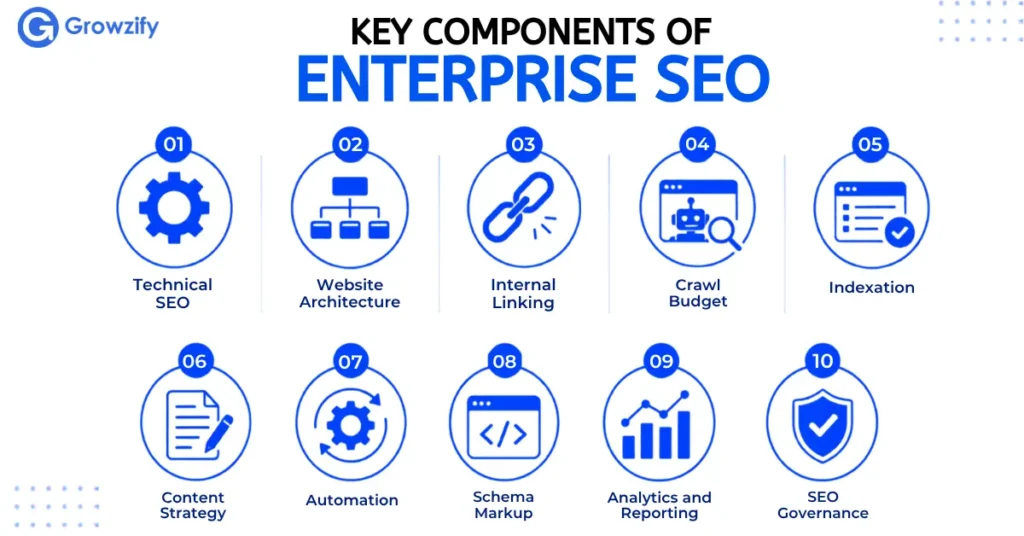
Key Components of Enterprise SEO
Technical SEO
At enterprise scale, technical SEO is not optional polish. It is the foundation on which everything else depends. Site speed, mobile usability, structured data, canonical tags, and proper error handling all need to work correctly across thousands of templates, not just a handful of hand-built pages. If the technical foundation is broken, no amount of content or linking work above it will hold.
Website Architecture
How a site is structured determines how easily both users and search engines can find and understand its content. A clear hierarchy, home, category, subcategory, product or article, helps distribute authority logically instead of burying valuable pages five or six clicks deep where almost nothing links to them.
Internal Linking
Internal linking becomes a genuine strategic lever at scale, not just a nice-to-have. Thoughtful linking patterns help search engines discover new pages faster and pass authority toward priority pages.
On a small site, this tends to happen somewhat naturally. On an enterprise website, it has to be engineered deliberately, often through templated linking modules that update automatically as new pages get published.
Crawl Budget
Search engines do not crawl every page on every website equally. Crawl budget refers to how much time and resources a search engine is willing to spend crawling a given domain within a given window.
On massive sites, wasted crawl budget, spent on duplicate filters, thin pages, or broken URLs, means important pages get crawled less often, which slows down both indexing and re-indexing when content changes. Every page a search engine wastes time crawling is a page it isn’t spending time indexing.
Indexation
Getting pages indexed at scale requires active, ongoing management rather than a one-time setup. Enterprise SEO teams regularly audit which pages are indexed, which are excluded, and why, using tools like XML sitemaps, robots directives, and canonical tags to steer search engines toward the pages that actually deserve visibility.
Content Strategy
An enterprise content strategy has to answer a bigger question than “what should we write next.” It needs a system for prioritizing topics across teams, avoiding duplicate coverage between departments, and making sure new content fits logically into the site’s existing architecture instead of existing as an isolated page with no path leading to it.
Automation
SEO automation handles the tasks that simply do not scale manually: generating meta tags from product data, flagging broken links across a million pages, or auto-updating schema markup the moment a product’s price or availability changes. Automation does not replace strategy. It frees the team to spend its time on strategy instead of repetitive fixes.
Schema Markup
Structured data helps search engines, and increasingly AI systems, understand exactly what a page is about. At enterprise scale, schema markup usually gets built directly into page templates, so product, article, FAQ, or review markup applies consistently without anyone entering it by hand on every page.
Analytics and Reporting
With this many pages and stakeholders involved, reporting needs to answer different questions for different audiences at the same time. Executives want revenue impact. Content teams want page-level performance.
Engineering wants crawl errors and site health. Enterprise SEO reporting is built to serve all three without turning into three separate, disconnected jobs.
SEO Governance
Governance is what keeps everything consistent once multiple teams are involved. This includes style guides, mandatory SEO fields inside the CMS, approval workflows, and clear ownership, so that SEO best practices survive employee turnover, agency changes, and reorganizations instead of quietly falling apart every time someone leaves.
Enterprise SEO vs Traditional SEO
The differences become clearest side by side.
Factor | Traditional SEO | Enterprise SEO |
Website size | Typically under a few hundred pages | Often 10,000 to millions of pages |
Keyword targeting | Individual keywords per page | Keyword clusters mapped across templates and categories |
Technical complexity | Low to moderate | High, spanning multiple CMS platforms and legacy systems |
Content management | Single person or small team | Multiple departments and regional teams |
Teams involved | Marketing only, usually | Marketing, engineering, product, legal, and regional teams |
Automation | Optional | Often essential for basic maintenance |
Reporting | Simple traffic and ranking reports | Multi-stakeholder dashboards tied to revenue |
SEO tools | Standard SEO software | Enterprise-grade platforms with API access and integrations |
Strategy | Page-level optimization | System-level architecture, governance, and scale |
Traditional SEO optimizes pages one at a time, while enterprise SEO optimizes the system those pages run on.
Common Enterprise SEO Challenges
Managing thousands of pages.Simply identifying which pages exist, which ones perform, and which ones are outdated becomes a project of its own once a site passes a certain size.
Duplicate content.Faceted navigation, filtered product listings, and multi-region sites frequently generate near-identical pages that compete against each other. Canonical tags and controlled parameter handling usually resolve most of it.
Multiple stakeholders.When ten teams can publish content, keeping SEO standards consistent takes more than a shared document sitting in a drive somewhere. It takes enforced workflows.
Technical complexity.Legacy platforms, custom-built CMS tools, and years of accumulated redirects make even small technical changes riskier and slower to ship than they should be.
International SEO.Managing hreflang tags, regional domains, currency, and localized content across dozens of markets adds a whole additional layer of technical precision most small sites never have to think about.
Website migrations.Redesigns, replatforming, and domain consolidations carry real risk of traffic loss if redirects, URL structures, and content aren’t mapped before launch day. A full redirect map built ahead of time prevents most of the damage.
Scaling content without losing quality.Producing content fast enough to cover thousands of topics, without it turning into thin, repetitive filler, is one of the hardest balancing acts in enterprise content strategy.
Enterprise SEO Best Practices
- Standardize SEO templates:Use templates for meta titles, schema, and canonical tags so updates can be made across thousands of pages efficiently.
- Monitor crawl budget:Regularly review crawl activity to ensure search engines focus on your most valuable pages.
- Establish SEO governance:Build SEO requirements into your CMS and workflows to maintain consistency across teams.
- Plan internal linking early:Include internal linking as part of your content strategy instead of adding links after publishing.
- Prepare for website migrations:Plan redirects, URL updates, and content changes before launching a redesigned site.
- Create role-based reports:Customize SEO dashboards for executives, marketers, and technical teams so each gets relevant insights.
- Optimize for AI search:Balance traditional SEO and AI Search Optimization based on where your audience searches, whether through Google or AI platforms like ChatGPT and Gemini.
Enterprise SEO and AI Search
Search itself is changing, and enterprise SEO has had to change with it. Google AI Overviews, ChatGPT, Gemini, Claude, and Perplexity are increasingly where people go to get answers, not just a list of links to click through.
AI citation happens when a system like ChatGPT or an AI Overview references your page as a source inside its answer. Ranking happens when your page appears in the traditional list of search results. Enterprise SEO now has to earn both.
This shifts what “visibility” actually means. Ranking in the traditional ten blue links still matters, but AI systems also pull information directly from web content to generate answers, often citing or summarizing sources rather than sending a click at all.
A few things matter more in this environment than they used to:
- Clear, direct answers stated early.AI systems tend to favor content that states facts plainly rather than burying the answer under three paragraphs of introduction.
- Structured data and schema markup.These give AI crawlers explicit signals about what a page is, which improves the odds of being referenced accurately instead of being misquoted.
- Topical authority.Sites that cover a subject comprehensively across many well-organized pages tend to be trusted more by AI systems than a single shallow article competing on the same topic.
- Consistent, factual information across the site.Contradictions between pages, or outdated numbers left uncorrected for years, quietly undermine how trustworthy an AI system perceives a domain to be.
For large websites, AI search optimization is not a separate initiative from enterprise SEO. It is an evolution layered on top of the same technical and content fundamentals, not a replacement for them.
The same structured content, strong internal linking, and technical cleanliness that improve traditional rankings are what improve a site’s odds of being cited in an AI-generated answer.
Signs Your Business Needs Enterprise SEO
- Rankings have dropped, and you can’t pin down the root cause
- Multiple teams publish content without shared SEO standards
- Your website has thousands of pages with no clear system for maintaining them
- You’re planning, or recovering from, a website migration or redesign
- Your crawl budget seems wasted on low-value or duplicate pages
- You operate across multiple countries, languages, or regional domains
- Your current SEO tools weren’t built to handle a site of this size
- Reporting takes days to compile and still doesn’t answer stakeholder questions
When to Hire an Enterprise SEO Agency
Hiring an enterprise SEO agencybecomes valuable when your website has outgrown basic SEO efforts. Consider expert support if:
- Your team is focused on fixing issuesinstead of executing long-term SEO strategies.
- You’re planning a website migrationand want to protect your rankings and organic traffic.
- You’re expanding internationallyand need support with hreflang, localization, and multi-region SEO.
- Your organic traffic has stalled or declineddespite ongoing optimization, indicating deeper technical or strategic challenges.
The longer these issues sit unaddressed, the more expensive they get to fix, since problems at this scale compound rather than stay flat.
Benefits of Enterprise SEO
Enterprise SEO delivers long-term business value by improving visibility, efficiency, and sustainable growth.
- Drive sustainable revenue:Increase organic traffic that keeps generating leads and sales over time, the way a retailer might gradually shift budget out of paid search as organic performance takes over.
- Scale SEO efficiently:Sitewide improvements can benefit thousands of pages instead of optimizing each one individually.
- Enhance user experience:Faster websites, better navigation, and organized content improve both rankings and conversions.
- Strengthen website authority:High-quality content and a strong site structure build long-term trust with search engines.
- Generate long-term organic traffic:Unlike paid advertising, strong organic visibility continues to deliver results over time.
- Reduce customer acquisition costs:Growing organic traffic lowers dependence on paid advertising, freeing up budget that would otherwise go straight to ad spend.
Why Businesses Choose Growzify for Enterprise SEO
Enterprise SEO is not something most internal teams can simply bolt onto their existing workload. It requires a specific mix of technical depth, strategic planning, and the discipline to keep dozens of moving parts aligned without slowing the business down. That is the gap Growzify is built to fill.
Strategic Planning for Long-Term Growth
Every enterprise website has different goals, systems, and challenges.Growzify develops customized enterprise SEO strategiesbased on your business objectives, website architecture, and growth plans rather than using a one-size-fits-all approach.
Scalable Technical SEO
Our team improves technical foundations by optimizing crawl budget, website architecture, internal linking, schema markup, and indexation. We focus on scalable solutions that deliver site wide improvements across thousands of pages.
AI Search Optimization
Enterprise search visibility now extends beyond Google. We optimize your website for AI-powered search experiences, including Google AI Overviews, ChatGPT, Gemini, and other emerging platforms, to help your brand remain discoverable.
Data-Driven Optimization
Every recommendation is backed by data and continuous performance analysis. We monitor results, identify new opportunities, and refine strategies to improve organic visibility, qualified traffic, and business growth.
A Long-Term SEO Partner
Enterprise SEO is an ongoing process, not a one-time project.Growzifyworks as a long-term partner, helping your business adapt to changing search algorithms, evolving AI search, and growing website complexity while delivering sustainable results.
If any of this sounds like where your website is right now, talk to our team about the specific gaps holding your organic growth back.
Build a Stronger Search Presence with Enterprise SEO
If your website has outgrown what basic SEO tactics can handle, that is not a failure. It is a sign of growth. But growth without the right SEO foundation tends to create the same pattern again and again.
Rankings that are hard to maintain, teams working out of sync, and opportunities left on the table simply because nobody has visibility into the full picture.
Enterprise SEO gives large, complex websites a system for staying visible, credible, and competitive in traditional search and in the AI-driven search experiences increasingly shaping how people find information.
If you’re ready to see what a structured, scalable SEO strategy could look like for your organization, request an enterprise SEO audit from Growzify, and let’s talk through what that would mean for your specific website.
Frequently Asked Questions
What is enterprise SEO?
Enterprise SEO is the process of optimizing large, complex websites, usually 10,000 or more pages, for organic search visibility. It focuses on technical infrastructure, content systems, and cross-team governance rather than individual page fixes, since manual optimization is not practical at that scale.
How is enterprise SEO different from traditional SEO?
Traditional SEO usually involves optimizing individual pages for a small site managed by one person or team. Enterprise SEO involves coordinating SEO across thousands of pages, multiple departments, and often multiple domains, which requires templated systems, automation, and governance that traditional SEO rarely needs.
How long does enterprise SEO take to show results?
Most enterprise SEO programs follow a similar arc: month one covers the technical foundation and initial fixes, months two to three build momentum through content and authority work, and page-one rankings for target keywords, along with early AI Overview citations, typically start appearing between months four and six. Full landscape-level results, where organic search becomes a predictable, scalable channel, usually take seven to twelve months or longer, depending on the site’s starting condition and how quickly technical fixes get implemented.
Which businesses benefit the most from enterprise SEO?
E-commerce companies with large catalogs, SaaS platforms with extensive documentation, multi-location franchises, media publishers, and global brands operating across several regions all benefit significantly, since each deals with a scale and complexity that basic SEO approaches cannot manage efficiently.
Why choose Growzify for enterprise SEO?
Growzify combines technical SEO expertise with strategic planning built around how large organizations actually operate, including multiple teams, legacy systems, and AI search optimization. Rather than one-off fixes, Growzify builds scalable systems and governance designed to hold up as the website and business keep growing.

Chitranshu SharmaA growth strategist, digital marketing consultant, and the founder of Growzify, a performance-driven agency helping brands dominate search, shape perception, and build sustainable online visibility. With 8+ years of hands-on experience in Enterprise SEO, Online Reputation Management (ORM), and AI-led traffic generation, Chitranshu has helped startups, public figures, SaaS companies, and cannabis brands outrank competitors — ethically and at scale.
Explore More Articles
How to Find and Compare Local SEO Outsourcing Providers
How to Find and Compare Local SEO Outsourcing Providers Finding a local SEO outsourcing provider...
October 13, 2026Outsourcing
Inside a White Label SEO Campaign: How the Work Gets Done
Inside a White Label SEO Campaign: How the Work Gets Done Clients see a single...
October 13, 2026White Label

How to Vet an SEO Outsourcing Provider Before You Sign a Contract
How to Vet an SEO Outsourcing Provider Before You Sign a Contract A polished proposal...
October 9, 2026Outsourcing

Multilingual SEO Best Practices: Optimize Your Multi-Language Website
Multilingual SEO Best Practices: Optimize Your Multi-Language Website Translating a page and localizing it for...
October 7, 2026SEO
What Makes In-House Enterprise SEO Work Different Day-to-Day?
What Makes In-House Enterprise SEO Work Different Day-to-Day? On a small site, deciding to fix...
October 7, 2026Enterprise

How Core Algorithm Updates Impact Large Sites Differently Than Small Ones
How Core Algorithm Updates Impact Large Sites Differently Than Small Ones A large enterprise site...
October 7, 2026Enterprise
When Should You Outsource SEO? 11 Signs It Makes Sense
When Should You Outsource SEO? 11 Signs It Makes Sense Outsourcing SEO does not necessarily...
September 26, 2026Outsourcing