


What is the Difference Between Enterprise SEO and Traditional SEO?
Enterprise SEO focuses on optimizing large websites with thousands of pages, requiring advanced strategies, dedicated teams, and scalable solutions. Traditional SEO targets smaller sites with simpler needs and fewer resources.

Written byChitranshu Sharma
September 8, 2025
- Home
- Blog
- SEO
- Enterprise
- What is the Difference Between Enterprise SEO and Traditional SEO?
Quick Nav
Enterprise SEO is designed for large, complex websites that often have thousands of pages, multiple teams, and structured approval processes. At enterprise scale, automation shifts from a productivity tool to a business requirement. Without automated QA, a template update can unintentionally affect hundreds of thousands of indexed pages.
Key Takeaways:
- Enterprise SEO manages sites with thousands to millions of pages. Traditional SEO fits sites small enough for one person to oversee manually.
- The real dividing line is governance: how many people need to sign off before a change goes live.
- Enterprise technical SEO deals with crawl budget, log files, hreflang, and JavaScript rendering at a scale traditional SEO never has to touch.
- Keyword strategy shifts from targeting head terms to mapping topic clusters across every stage of buyer intent.
- A business typically needs to move from traditional to enterprise SEO once page count, market count, or contributor count outgrows manual oversight.
What Is Enterprise SEO?
Enterprise SEO is the practice of optimizing large websites with thousands or millions of pages using scalable workflows, automation, and advanced technical SEO. It is commonly used by enterprise ecommerce stores, SaaS platforms, marketplaces, and global businesses with multiple websites, regions, or languages.
Unlike traditional SEO, it depends on scalable processes, automation, and collaboration between SEO specialists, developers, content teams, and data analysts. As websites grow, SEO becomes more complex. A single template update can affect hundreds of thousands of pages in a matter of minutes.
Even a small error can have a widespread impact on search performance. That is why enterprise SEO services focus on crawl optimization, structured data, international SEO, and technical audits. Many organizations also use enterprise SEO platforms to automate routine tasks, identify issues early, and monitor website performance at scale.
What is Traditional SEO?
Traditional SEO applies to smaller sites, typically a few dozen to a few thousand pages, where one person or a small agency can realistically understand every page. A local law firm, a regional retailer, or a niche ecommerce store fits this model well.
The work centers on clean site architecture, targeted keyword research, and content built around specific local or niche queries. A single update can go live within a day, with no approval chain to move through. Reporting stays simple: rankings, traffic, and leads, usually pulled straight from Google Search Console and Google Analytics.
It is simply the right choice for businesses with smaller websites and simpler SEO needs. These websites can often be managed by a single person or a small team, without relying on automation, complex workflows, or multiple approval layers.
Enterprise SEO vs Traditional SEO: A Side-by-Side Comparison
The table below highlights the key differences between enterprise SEO and traditional SEO, making it easier to identify which approach best fits your business.
Factor | Traditional SEO | Enterprise SEO |
Website size | Small to mid-sized | Large, often multi-domain |
Number of pages | Dozens to a few thousand | Tens of thousands to millions |
Team involvement | One consultant or small agency | Cross-functional team across departments |
Technical complexity | Basic fixes: redirects, speed, broken links | Crawl budget, log analysis, hreflang, JS rendering, migrations |
Automation | Minimal, mostly manual | Required to manage scale and consistency |
Content management | Simple editorial calendar | Structured systems with governance and approvals |
Internal linking | Manual, page by page | Template-driven, applied across page types |
Scalability | Limited by manual effort | Built for continuous growth |
Reporting | Rankings, traffic, leads | Revenue, market share, BI integration |
Decision making | Fast, few approvals | Slower, multiple stakeholders sign off |
SEO tools | Standard rank trackers and analytics | Enterprise SEO platforms with custom crawlers |
Governance | Informal, ad hoc | Documented standards and workflows |
Typical business type | Local service, small ecommerce, niche brand | Global ecommerce, SaaS, multinational corporation |
Keyword Strategy: Clusters Replace Head Terms
A small business usually wins by ranking for a handful of head terms tied directly to demand, such as “roof repair Denver” or “wedding photographer Boston.” A handful of well-optimized pages can carry the entire campaign.
Enterprise search optimization works on a different logic. Instead of chasing single terms, teams build topic clusters that cover every variation of intent connected to a product line.
A global CRM provider will not stop at “CRM software.” It needs pages addressing “CRM for healthcare,” “CRM for financial services,” and “CRM for enterprise sales teams,” each supported by its own cluster of supporting content.
Search engines increasingly reward topical completeness over isolated keyword wins. A strong enterprise SEO strategy organizes content around buyer intent and topic clusters, helping maintain rankings even as search algorithms evolve.
Content Operations: From a Calendar to a Content Engine
In traditional SEO, content output looks like a modest calendar: a few blog posts a month, occasional landing page updates, maybe a writer or two keeping pace.
Enterprise content optimization is about creating a system that scales efficiently. Large businesses often manage thousands of pages across multiple markets, making consistent content difficult without clear workflows, templates, and review processes.
The biggest challenge is maintaining quality as the website grows. Strong content governance helps every team follow the same standards while allowing for regional customization. This keeps content consistent for users and easier for search engines to understand.
Enterprise Technical SEO: Problems Traditional Sites Rarely Face
Technical fixes on a small site are usually straightforward: repair a redirect, compress an image, fix a broken link. Enterprise technical SEO deals with a different category of problem entirely.
Technical SEO at Enterprise Scale
Technical SEO for a small website often involves simple fixes such as repairing redirects, compressing images, or fixing broken links. Enterprise websites face a different level of complexity, where a single issue can affect thousands or even millions of pages.
Crawl Budget Management
Crawl budget is the number of pages a search engine is willing to crawl on a website within a given period. On large websites with millions of URLs, wasting crawl budget on duplicate or low-value pages can prevent important pages from being crawled and indexed efficiently.
JavaScript Rendering Challenges
Many enterprise websites rely on JavaScript frameworks. If important content or links only appear after scripts run, search engines may struggle to index the page correctly. A rendering issue can affect an entire section of a large website before it is detected.
Managing Indexation with Technical SEO
Large websites require well-organized XML sitemaps, proper canonical tags, and consistent structured data. These technical elements help search engines crawl the right pages, avoid duplicate content, and better understand the website.
Advanced Enterprise SEO Requirements
Enterprise SEO often includes log file analysis, hreflang implementation for international websites, and careful migration planning when moving large numbers of URLs. Even a small configuration error, such as an incorrect robots.txt rule, can significantly affect search visibility.
Working with Legacy Enterprise Platforms
Many enterprise websites operate on older systems that were not built with SEO in mind. Implementing technical improvements often requires coordination with developers and multiple business teams, making enterprise SEO as much about process as technical expertise.
Authority Building at Global Scale
Traditional SEO often earns authority through guest posts, local citations, and small partnerships, which is usually enough to outrank competitors in a regional market. Enterprises compete against other global brands, so authority signals need to match that scale.
Digital PR campaigns, features in respected industry publications, and citations from authoritative sources carry more weight than generic directory links. A healthcare company, for instance, gains more from being cited in a medical journal than from a stack of unrelated guest posts.
This is also where enterprise SEO solutions increasingly account for how AI-driven search summarizes brands. When a company is consistently cited by credible, topic-relevant sources, generative engines are more likely to reference that brand confidently in an AI-generated answer.
Reporting That Ties SEO to Revenue
A small business wants a report showing traffic growth, ranking improvements, and leads generated. That is usually enough to prove value. Executives running enterprise SEO expect more than visibility metrics.
Reporting needs to connect organic search directly to revenue, conversion rate, and market share, often by integrating SEO data with business intelligence platforms the rest of the company already uses. The distinction matters because enterprise budgets get renewed based on business impact, not ranking positions. An enterprise SEO agency that cannot show how a ranking gain translates into pipeline or revenue will struggle to keep a seat at the table.
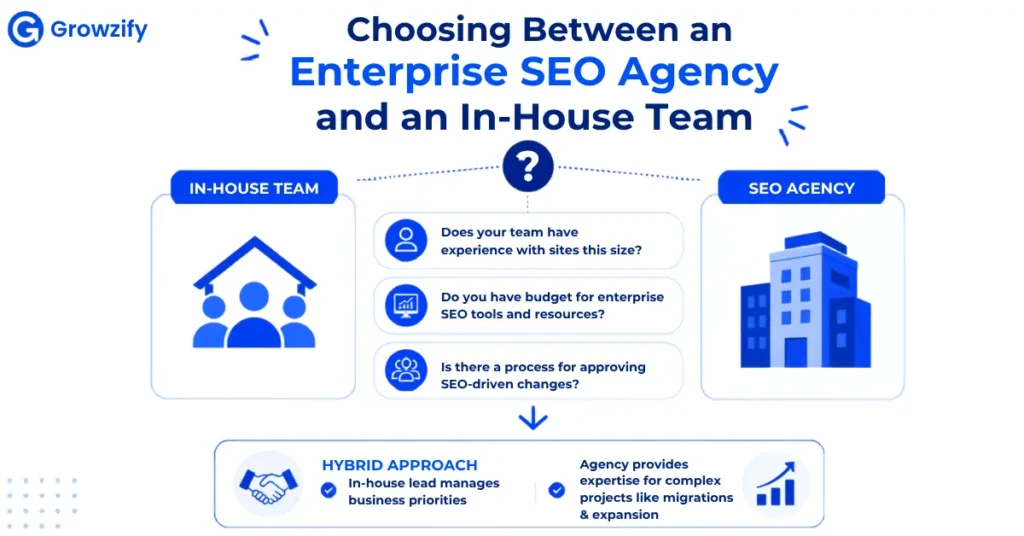
Choosing Between an Enterprise SEO Agency and an In-House Team
Businesses evaluating enterprise SEO services usually face this decision at some point: build an internal team, hire an outside agency, or blend both. A few questions clarify the choice.
- Does the current team have experience with sites this size, or would there be a learning curve that costs months of visibility?
- Is there budget for an enterprise SEO platform capable of crawling and monitoring at scale, and someone to manage it?
- Do stakeholders across departments already have a process for approving SEO-driven changes, or would that need to be built first?
Many large organizations use a hybrid approach to enterprise SEO. An in-house SEO lead manages business priorities, while an enterprise SEO agency provides specialized expertise for complex projects such as website migrations and international expansion.
When Is It Time to Move to Enterprise SEO? How Growzify Helps
Businesses rarely outgrow traditional SEO overnight. Growth happens gradually as websites expand, new markets are added, and more teams contribute to the site. Eventually, managing SEO without documented processes and scalable systems becomes increasingly difficult.
Common signs that it is time to adopt enterprise SEO include:
- Your website has grown beyond what one person can manage effectively.
- Multiple teams or regions publish content without consistent SEO standards.
- A single technical issue could affect thousands of pages instead of just a few.
At this stage, enterprise SEO becomes essential for maintaining website performance and supporting long-term growth. Growzify helps businesses build scalable SEO strategies, improve technical performance, and create processes that keep large websites organized, searchable, and ready for continued expansion.
Frequently Asked Questions
What is the main difference between traditional SEO and enterprise SEO?
Traditional SEO fits small and mid-sized websites with a limited set of keywords and a local or niche audience. Enterprise SEO manages large-scale websites with thousands of pages, multiple markets, and higher revenue stakes. The core difference is scale, technical complexity, and how many people are involved in decisions.
Who actually needs enterprise SEO services?
Organizations with large, complex websites need them: global ecommerce brands, SaaS platforms, and multinational corporations. If a site spans thousands of pages or the business operates across multiple markets, enterprise-level strategy and tooling become necessary to stay competitive.
Is traditional SEO still effective for small businesses?
Yes. Clean site structure, local visibility, and consistent content updates continue to bring in qualified traffic for small businesses without the overhead of enterprise-level systems.
Why is technical SEO harder at the enterprise level?
Large sites deal with crawl budget limits, JavaScript rendering issues, international hreflang setups, and the risk of a single error affecting thousands of URLs at once. Traditional sites rarely encounter these issues, which is why enterprises need dedicated technical SEOs and enterprise SEO platforms built for that scale.
How do enterprise SEO companies measure success differently?
Small businesses typically track rankings, traffic, and leads. Enterprises connect SEO performance to revenue, conversions, and market share, often through business intelligence integrations that give executives visibility into how organic search contributes to the bottom line.
Can a business outgrow traditional SEO and need enterprise SEO?
Yes. As your business grows, your website becomes larger and more complex. Adding more pages, expanding into new markets, or launching new products often makes traditional SEO harder to manage. At that stage, switching to enterprise SEO helps you scale with better processes, automation, and collaboration across teams.
Do enterprises still need local SEO?
Often, yes, just at a larger scale. Enterprises with multiple physical locations still need consistent local listings and geo-targeted pages, even while managing the broader complexity of a global enterprise SEO strategy.

Chitranshu SharmaA growth strategist, digital marketing consultant, and the founder of Growzify, a performance-driven agency helping brands dominate search, shape perception, and build sustainable online visibility. With 8+ years of hands-on experience in Enterprise SEO, Online Reputation Management (ORM), and AI-led traffic generation, Chitranshu has helped startups, public figures, SaaS companies, and cannabis brands outrank competitors — ethically and at scale.
Explore More Articles
How to Find and Compare Local SEO Outsourcing Providers
How to Find and Compare Local SEO Outsourcing Providers Finding a local SEO outsourcing provider...
October 13, 2026Outsourcing

Inside a White Label SEO Campaign: How the Work Gets Done
Inside a White Label SEO Campaign: How the Work Gets Done Clients see a single...
October 13, 2026White Label

How to Vet an SEO Outsourcing Provider Before You Sign a Contract
How to Vet an SEO Outsourcing Provider Before You Sign a Contract A polished proposal...
October 9, 2026Outsourcing

Multilingual SEO Best Practices: Optimize Your Multi-Language Website
Multilingual SEO Best Practices: Optimize Your Multi-Language Website Translating a page and localizing it for...
October 7, 2026SEO
What Makes In-House Enterprise SEO Work Different Day-to-Day?
What Makes In-House Enterprise SEO Work Different Day-to-Day? On a small site, deciding to fix...
October 7, 2026Enterprise

How Core Algorithm Updates Impact Large Sites Differently Than Small Ones
How Core Algorithm Updates Impact Large Sites Differently Than Small Ones A large enterprise site...
October 7, 2026Enterprise
When Should You Outsource SEO? 11 Signs It Makes Sense
When Should You Outsource SEO? 11 Signs It Makes Sense Outsourcing SEO does not necessarily...
September 26, 2026Outsourcing