


Advanced Enterprise SEO: How Big Brands Grow Search at Scale
Advanced enterprise SEO empowers large brands to scale organic growth through technical optimization, content strategy, automation, and data-driven decision-making, resulting in stronger search visibility, higher rankings, and sustainable long-term business success.

Written byChitranshu Sharma
June 16, 2025
- Home
- Blog
- SEO
- Enterprise
- Advanced Enterprise SEO
Quick Nav
Advanced Enterprise SEO is the process of optimizing large websites with thousands of pages, multiple teams, or operations across different markets. It focuses on scalable technical SEO, content governance, site architecture, and automation instead of individual page updates.
Big brands use advanced enterprise SEO to improve organic visibility, maintain consistent search performance, and support long-term business growth. This approach helps websites scale efficiently while driving sustainable traffic, leads, and revenue.
Enterprise SEO Servicesare the strategy, technical systems, and governance used to grow organic search for large websites. This usually means sites with 10,000 or more pages, multiple teams, or operations across several markets. At this scale, single-page fixes stop working. You need architecture, automation, and cross-team processes instead of individual tactics.
Why Enterprise SEO Requires a Scalable Strategy
A small site has one team and a handful of pages. An enterprise site has thousands of pages, several CMS platforms, and teams that rarely talk to each other. One bad template update can hit fifty thousand pages instead of five. That is why enterprise SEO needs systems, not one-off tactics.
The complexity usually comes from a mix of:
- Multiple subdomains or business units publishing independently
- More than one CMS or a fully custom stack
- Engineering, product, and marketing teams shipping changes on separate schedules
- Operations across several countries, languages, or currencies
Do You Need Enterprise SEO Services?
Enterprise SEO isn’t necessary for every business. However, if your website has grown in size, complexity, or geographic reach, traditional SEO methods may no longer deliver consistent results.
Use the checklist below to determine whether your business would benefit from Enterprise SEO Services.
- More than 10,000 indexable pages
- Multiple business units or brands publishing content on the same domain
- Operations in three or more countries or languages
- SEO decisions that get stuck between teams with no clear owner
- A CMS that multiple engineering teams can push changes to
If two or more of these are true, standard SEO tactics will not hold up. You need a system built for scale.
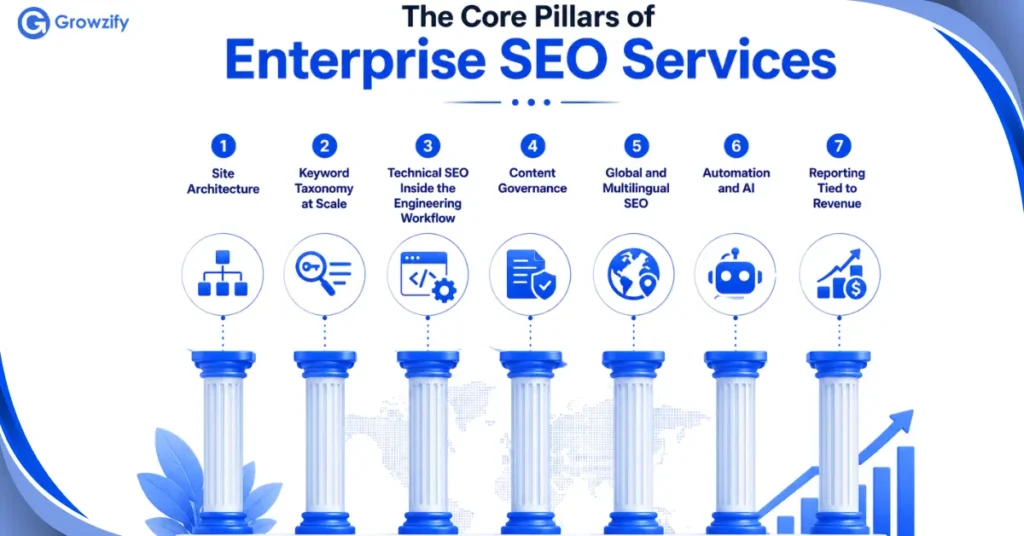
The Core Pillars of Enterprise SEO Services
Each pillar below solves a specific failure mode at scale. Skip one, and the others start working against each other.
Site Architecture
Architecture is where most large sites lose traffic first, and it often goes unnoticed for months. A messy folder structure confuses search engines about what to prioritize.
- Structure folders the way people search, not the way teams are organized internally
- Keep priority pages within two or three clicks of the homepage
- Use one consistent URL format across every team that publishes
- Automate sitemap updates instead of maintaining them by hand
Keyword Taxonomy at Scale
Enterprise sites deal with thousands of keywords, not twenty. Managing that manually leads to pages competing with each other for the same search terms.
- Group keywords into clusters tied to product lines or user journeys
- Map every cluster to one owned URL before content gets written
- Pull real search language from support tickets and sales calls, not just keyword tools
- Do not ignore branded search terms. They often convert the best and get overlooked
Technical SEO Inside the Engineering Workflow
Technical SEOat this scale means being part of engineering planning, not auditing after a release ships.
- Watch for canonical conflicts on similar or duplicate pages
- Audit hreflang tags regularly. They break more often than any other technical element
- Check that JavaScript-rendered pages are actually reaching the index
- Confirm noindex and disallow rules are not applied too broadly during redesigns
- Monitor Core Web Vitals and mobile performance, since both affect rankings and conversion
Content Governance
Large sites often have blog, product, support, and legal teams publishing in parallel with no shared visibility. That creates pages that compete instead of supporting each other.
- Audit what is ranking, what is not, and why
- Build content briefs from live search results, not internal assumptions
- Put aging pages on a scheduled refresh cycle
- Group related content into hubs to consolidate topical authority
Global and Multilingual SEO
Multi-market operations add language and behaviour differences on top of everything above.
- Audit hreflang tags on a fixed schedule, not just at launch
- Avoid direct translation. Local intent matters more than literal wording
- Choose a domain structure (subfolders, subdomains, or ccTLDs) deliberately, not by default
Automation and AI
Manually managing thousands of SEO tasks is not realistic at this scale.
- Automate detection of broken links, crawl errors, and content decay
- Use AI to classify keyword intent and spot content gaps across large libraries
- Keep judgment calls, like what to prioritize or sunset, with a person
Reporting Tied to Revenue
Traffic numbers alone rarely keep leadership invested. Reporting needs to connect to outcomes the business already tracks.
- Revenue or qualified lead contribution by page cluster
- Reduced paid search spend attributable to organic growth
- Conversion rate improvement by page template
Traditional SEO vs. Enterprise SEO Services
Factor | Traditional SEO | Enterprise SEO Services |
Site size | Dozens to low hundreds of pages | Thousands to millions of pages |
Ownership | One person or team | Marketing, engineering, product, and regional teams |
Technical work | Occasional audits | Continuous monitoring inside release cycles |
Risk if something breaks | One page is affected | Thousands of pages can be affected at once |
Reporting focus | Traffic and rankings | Revenue, pipeline, and paid search offset |
Governance | Informal | Documented rules, QA gates, and one clear owner |
Growzify runs a free enterprise SEO audit that maps your site against each of these factors.
Costs, Timelines, and ROI
- Cost:Enterprise SEO engagements typically range from the low five figures to six figures monthly, depending on the number of markets and the state of the existing site
- Timeline:Most brands see measurable traction in 3 to 6 months, usually after major crawl and indexation issues are fixed. Full program maturity takes closer to 9 to 12 months
- ROI:The strongest signals are reduced paid search spend, higher-converting organic traffic, and shorter sales cycles, not keyword rank alone
Common Enterprise SEO Mistakes
- Leaving thin or duplicate pages indexed, which quietly wastes crawl budget
- Tracking rankings without tying them to revenue or lead quality
- Letting legal, dev, or brand teams delay fixes for months with no deadline
- Growing traffic without a clear path to conversion
Enterprise SEO Checklist
- Site architecture is reviewed every quarter
- Every keyword cluster is mapped to one owned URL
- SEO checks built into the engineering release cycle
- Hreflang and international setup audited on a fixed schedule
- Reporting tied to revenue, not just traffic
- Automation handling detection, with humans making the calls
How Growzify Runs Enterprise SEO Services
Growzify builds enterprise SEO around the same pillars covered above: architecture, keyword taxonomy, technical workflow integration, and reporting tied to revenue. Every engagement starts with an architecture and technical audit, followed by a governance setup, before any content work begins.
If you are managing search for a large site, a multi-brand portfolio, or an expansion into new markets, see howGrowzify’s Enterprise SEO Serviceswork, or book a free audit to see where your site stands today.
Frequently Asked Questions
How is enterprise SEO different from regular SEO?
Enterprise SEO deals with larger sites, more stakeholders, and more technical debt. It relies on systems and governance instead of individual page fixes.
How long does enterprise SEO take to show results?
Most brands see measurable traction within 3 to 6 months. Full program maturity usually takes 9 to 12 months.
What does enterprise SEO typically cost?
Engagements usually range from the low five figures to six figures monthly, depending on the number of markets and the current state of the site.
How do you scale technical SEO fixes across thousands of pages?
Through templates, automation, and pre-approved components. Manual, page-by-page fixes do not scale at this size.
Should this be handled in-house or by an agency?
Either can work. What matters is direct access to engineering sprints and product roadmaps, not just publishing access to the CMS.
Is enterprise SEO the same as technical SEO?
No. Technical SEO is one part of it. Enterprise SEO also covers keyword taxonomy, content governance, global strategy, and revenue reporting.
What is included in Growzify’s Enterprise SEO Services?
A dedicated strategist, technical audits, content planning at scale, backlink acquisition, and support for multilingual and regional SEO.
How is enterprise SEO different from a typical SEO agency?
The focus is on building systems, not one-off fixes, and working directly with engineering and product teams from day one.
Can your enterprise SEO team work directly with our developers?
Yes. Growzify integrates with your existing tools, such as Slack, Notion, or Jira, to keep implementation collaborative.
How is enterprise SEO success measured?
Traffic growth, indexed page quality, conversion improvement, and KPIs tied to business goals, not vanity metrics.
What is the biggest risk of skipping SEO governance in enterprise SEO?
Silent regressions. Without QA gates, one release can suppress indexation across thousands of pages before anyone notices.
Does AI search change enterprise SEO strategy?
It raises the bar on clarity and structure. Clean architecture and well-organized content are easier for AI systems to parse and cite, but the fundamentals stay the same.
Ready to see where your site stands?Growzify’s free enterprise SEO auditshows exactly which of these pillars needs fixing first.

Chitranshu SharmaA growth strategist, digital marketing consultant, and the founder of Growzify, a performance-driven agency helping brands dominate search, shape perception, and build sustainable online visibility. With 8+ years of hands-on experience in Enterprise SEO, Online Reputation Management (ORM), and AI-led traffic generation, Chitranshu has helped startups, public figures, SaaS companies, and cannabis brands outrank competitors — ethically and at scale.
Explore More Articles
How to Find and Compare Local SEO Outsourcing Providers
How to Find and Compare Local SEO Outsourcing Providers Finding a local SEO outsourcing provider...
October 13, 2026Outsourcing
Inside a White Label SEO Campaign: How the Work Gets Done
Inside a White Label SEO Campaign: How the Work Gets Done Clients see a single...
October 13, 2026White Label

How to Vet an SEO Outsourcing Provider Before You Sign a Contract
How to Vet an SEO Outsourcing Provider Before You Sign a Contract A polished proposal...
October 9, 2026Outsourcing
Multilingual SEO Best Practices: Optimize Your Multi-Language Website
Multilingual SEO Best Practices: Optimize Your Multi-Language Website Translating a page and localizing it for...
October 7, 2026SEO
What Makes In-House Enterprise SEO Work Different Day-to-Day?
What Makes In-House Enterprise SEO Work Different Day-to-Day? On a small site, deciding to fix...
October 7, 2026Enterprise
How Core Algorithm Updates Impact Large Sites Differently Than Small Ones
How Core Algorithm Updates Impact Large Sites Differently Than Small Ones A large enterprise site...
October 7, 2026Enterprise
When Should You Outsource SEO? 11 Signs It Makes Sense
When Should You Outsource SEO? 11 Signs It Makes Sense Outsourcing SEO does not necessarily...
September 26, 2026Outsourcing