What is Agentic SEO Workflow and How Does It Help in AI SEO Automation?
What is Agentic SEO Workflow and How Does It Help...
Read More →
AI search has given SEO teams more to check, monitor, and report on. The practical question is whether the recurring parts of that work can be handed to an AI system with a documented method, connected data sources, and clear limits, so that it follows a consistent method while adapting its analysis within defined limits.

An agentic SEO workflow uses an AI system to pursue an SEO objective by selecting investigative steps or tools within defined constraints. It can retrieve data, inspect findings, and produce recommendations, while predefined rules and tool permissions limit what it may do. Reusable instructions and structured outputs make the work easier to evaluate, but do not alone make it agentic.
For AI SEO automation, this makes recurring analysis, including the checks behind visibility in AI-powered search, easier to standardize, review, and refine. The appropriate level of autonomy depends on the task, data quality, and operational risk.
Methodology:This guide draws on Anthropic’s published guidance on building agents (used here for its architectural distinction between workflows and agents, since the article is dated December 2024 and notes that much of its tooling landscape has changed), the Model Context Protocol documentation, Anthropic’s documentation for Claude Projects and Agent Skills, and Google’s documentation on AI features, spam policies,Google and AI-generated content, the Search Console API, Search Console bulk data export, and Search Console’s generative AI performance reports. “Agentic SEO” is a practitioner term, not a formal standard, so the four-layer operating model, guardrails, workflow list, and measurement approach are practitioner judgment.
An agentic SEO workflow hands one defined SEO objective to an AI system and lets it select investigative steps or tools within defined constraints. The job might be diagnosing pages that lost traffic, triaging a site audit, or checking a site after a release.
What makes a setup agentic is that the model directs part of its own process. What makes it dependable for recurring SEO work is the structure around it. Three features support that reliability, although none of them makes a system agentic on its own:
“Agentic” comes from the idea of an AI agent. Anthropic’s guidance onbuilding effective agentsdescribes agents as systems where “LLMs dynamically direct their own processes and tool usage,” and contrasts them with workflows, where “LLMs and tools are orchestrated through predefined code paths.” That article was published in December 2024 and notes that much of its tooling landscape has changed, so it is cited here for the architectural distinction, not for current product setup.
In practice, many useful SEO setups sit between those two ends. In this guide’s recommended approach, the overall objective, constraints, and evaluation rules are documented, while the agent has limited flexibility to select tools or investigate findings. More autonomous systems may also adapt their sequence of steps.
Reusable instructions, connected data, and standardized outputs make agent behavior easier to review. They do not, alone, turn a predefined workflow into an agent.

These three approaches are often blended in conversation. The clearest difference is who decides what happens next.
| Workflow automation | AI-assisted SEO | Agentic SEO workflow | |
| Who determines the steps | Predefined code or rules determine the execution path, potentially including LLM steps | The person, in each conversation | The team defines objectives and constraints; the model selects some investigative steps or tools within those boundaries |
| Where data comes from | Fixed integrations | User-provided files, prompts, or connected sources | Connected tools or staged data the agent retrieves |
| Handling unexpected input | Handles predefined exceptions; escalates unknown cases | Depends on the prompt | Follows a documented rule or flags it for a person |
| Consistency run to run | High, but rigid | Varies with phrasing | Potentially consistent with validation; outputs may still vary |
| Typical fit | High-volume, unchanging checks | Exploration and one-off questions | Recurring analysis that needs judgment |
The table is a practitioner comparison, not an industry standard. The boundaries blur in real tools.
The point worth keeping: a task can vary between runs and still benefit from stable constraints and evaluation rules. Automation becomes harder to justify when neither the objective nor the quality criteria can be defined clearly. At the other end, a task that is simple and identical every time, such as checking the status code of a long URL list, is usually better handled by a plain script.
Anthropic’s guidance makes a related point, recommending “finding the simplest solution possible, and only increasing complexity when needed.” It notes that agentic systems often trade latency and cost for better task performance.
This guide uses a four-layer operating model, a practitioner framework and not an industry standard. A workflow holds up better when the work is split into layers, each with one job. When something goes wrong, the team knows which layer to fix instead of rewriting one long prompt.
If the prompt carries everything, it becomes long and fragile. If the first three layers carry the weight, the prompt can stay short.
These layers map onto features in current AI tools. Claude, for example, offers Projects for context, Skills for method, and connectors built on the Model Context Protocol for data. Other platforms use different names for similar ideas.
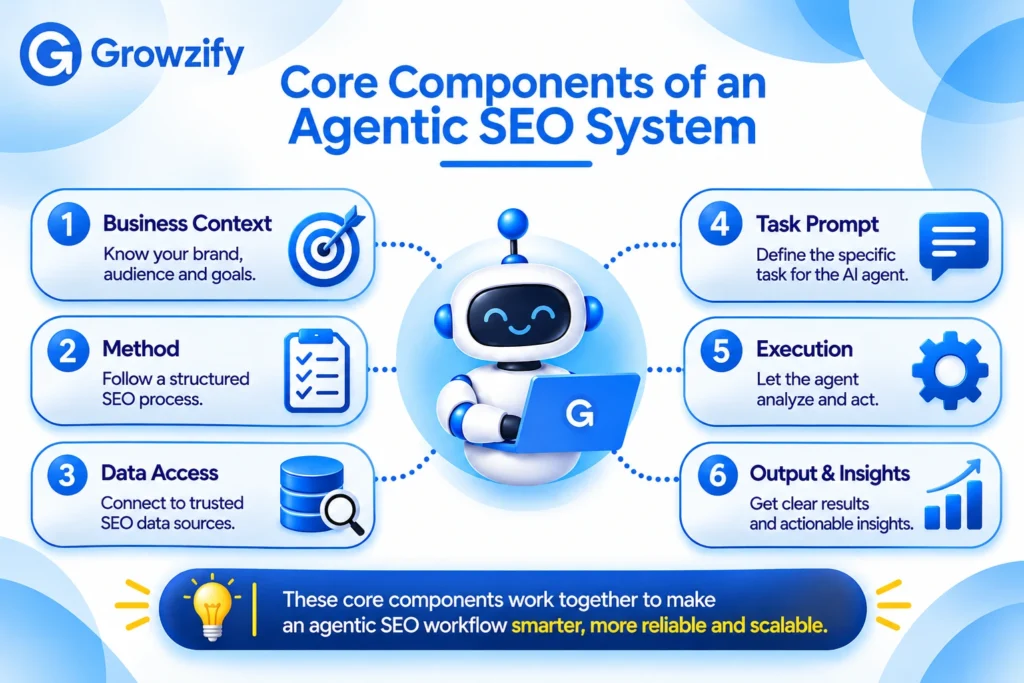
In this guide, AI SEO automation covers two related things: using AI agents to carry out recurring SEO tasks, and applying those agents to the recurring checks behind AI SEO, the work of improving visibility in AI-powered search such as AI Overviews, AI Mode, and AI assistants.
The benefits come from structure, not from the AI itself. Used well, an agentic workflow can help in these ways.
It standardizes recurring analysis.A written method specifies the same checks each time, including the ones someone might forget to request.
It retrieves the latest data available.Direct connections let an agent retrieve the latest data available from the source, although reporting delays, API limits, and data refresh schedules still apply. Google’s Search Analytics API guide notes that data is typically available after two to three days.
It makes work auditable.Each finding can carry its evidence, so a reviewer can see why the agent concluded and challenge it.
It frees specialists for judgment.Pulling, joining, and sorting data is repeatable. Deciding what the business should do about it is not.
It supports controlled improvement.Versioned changes to the method can be tested against earlier outputs before being adopted, which is harder to do with prompts typed from scratch.
These are structural advantages. The size of the benefit depends on the task, the data quality, and how carefully the method is written, so no general figure applies.
Automation changes how the work is done. It does not change what Google evaluates. Three points from Google’s documentation set the boundaries.
Optimizing for AI features needs no special tactics.Google’s page onAI features and your websitesays there are no additional requirements to appear in AI Overviews or AI Mode, nor other special optimizations necessary. It points back to foundational practices such as allowing crawling, providing a good page experience, and making sure a page is indexed and eligible to show with a snippet.
The same page says there is no need for new AI text files, machine-readable files, or special schema.org markup. An agentic workflow is therefore best aimed at checking and maintaining those fundamentals, not at chasing a separate set of AI tricks. Growzify’s guide toranking in Google AI Overviews by matching search intentcovers the intent-matching side of this in more depth.
Mass-produced pages are a spam risk.Google’sspam policiesdefine scaled content abuse as many pages generated for the primary purpose of manipulating search rankings instead of helping users, “no matter how it’s created.” One listed example is using generative AI tools to generate many pages without adding value for users.
AI output needs human review.Google’s page on generative AI content says generative models predict likely sequences of words rather than retrieving facts, and calls it critical to manually fact-check and review AI-generated content before publishing.
The practical takeaway: use agentic workflows mainly for analysis, monitoring, and preparation. Treat any step that publishes content as one that needs a person’s review.
Four building blocks are enough to start. The specific products are interchangeable.
Start small. One connection, one method, and one task is enough to judge whether the approach pays off for a given team.
Context contains relatively stable business information that is reused between runs and updated when circumstances change. In Claude, Projects can hold it. Anthropic’shelp documentation on projectsdescribes them as “self-contained workspaces with their own chat histories and knowledge bases,” and says users can set project instructions to tailor responses. Projects are available on all plans, including free accounts, which are limited to five.
Useful context documents for SEO work include:
Keep project documents focused, current, and well organized so the AI can retrieve relevant context efficiently. How much material is loaded or retrieved depends on the platform and its knowledge-handling features. Mark anything unknown as “to confirm” instead of filling the gap with plausible detail. An agent given guesses will treat them as facts.
A skill is a written procedure that the AI loads when a task matches it. Anthropic’sAgent Skills documentationdescribes them as reusable, filesystem-based resources, and says that unlike prompts, they load on demand, so the same guidance does not need repeating across conversations.
The structure is simple:
The documentation describes progressive disclosure: only the name and description sit in context until a skill is triggered, then the body loads, then bundled files load only when referenced.
Here is a shortened example for an SEO task. It is illustrative, not a tested production skill. Any required permissions, tool dependencies, and platform-specific metadata should be checked before use, and tool permissions must be configured separately from the skill text.
—
name: content-decline-check
description: >
Analyze meaningful organic traffic declines.
Use when asked to diagnose a section or URL set.
—
# Content Decline Check
## Inputs to confirm
– Domain or section
– Comparison windows
– Minimum meaningful drop
## Steps
1. Retrieve Search Console performance data.
2. Identify URLs meeting the decline threshold.
3. Inspect available technical evidence.
4. Compare query-level visibility and demand signals.
5. Classify confirmed findings and hypotheses separately.
## Output
URL | Clicks lost | Possible cause | Evidence | Action | Confidence
## Restrictions
– Do not edit, redirect, delete, or publish.
– Do not invent unavailable data.
Three cautions apply. First, instructions in a skill guide behavior; they do not enforce permissions. A line saying “do not publish” is not an access control. Second, the documentation says skills should come from trusted sources, because a malicious skill can direct Claude to call tools or run code in ways that do not match its stated purpose. Skills from outside the team should be audited before use. Third, availability differs by surface. Custom skills in claude.ai are available on certain paid plans with code execution enabled, while Claude Code reads skills from its own skills folders.
The data layer is what lets the agent retrieve evidence. TheModel Context Protocolis described by its documentation as an open-source standard for connecting AI applications to external systems, including data sources, tools, and workflows. Its analogy is a USB-C port for AI applications. With an appropriate MCP server or connector and authorized access, an agent can query supported sources such as Search Console. MCP itself does not supply the underlying data or grant access.
For SEO, useful connections include:
Search Console data comes with limits that an agent cannot work around.Google’s search Analytics API guideshows paginated requests of up to 25,000 rows per response, and documents a maximum of 50K rows of data per day per search type. The guide also warns that when results are grouped by page and/or query, the system may drop some data.
Pagination helps retrieve the available rows but cannot bypass that ceiling. For larger sites that need more complete performance datasets, Search Console’s bulk data export to BigQuery is a separate option. Google’sbulk export overviewdescribes a daily export of performance data, and itssetup pagesays the export does not include data from before setup, pointing to the Search Console API or the reports for earlier history. Anonymized queries are handled separately from other rows, so check the table documentation before building a workflow on it.
Confirm access separately for each dataset. A report being available in Search Console does not establish that a particular API or connector exposes it.Google’s generative AI performance report, for example, offers an export button to download chart and table data, but that does not establish that a given connector can retrieve the dataset. Where direct retrieval is unavailable, use an authorized export and document the manual dependency.
Treat any connector like installed software. Check who built it, what it can read, and whether it can also write. Keep production connections read-only until a workflow has earned more access.
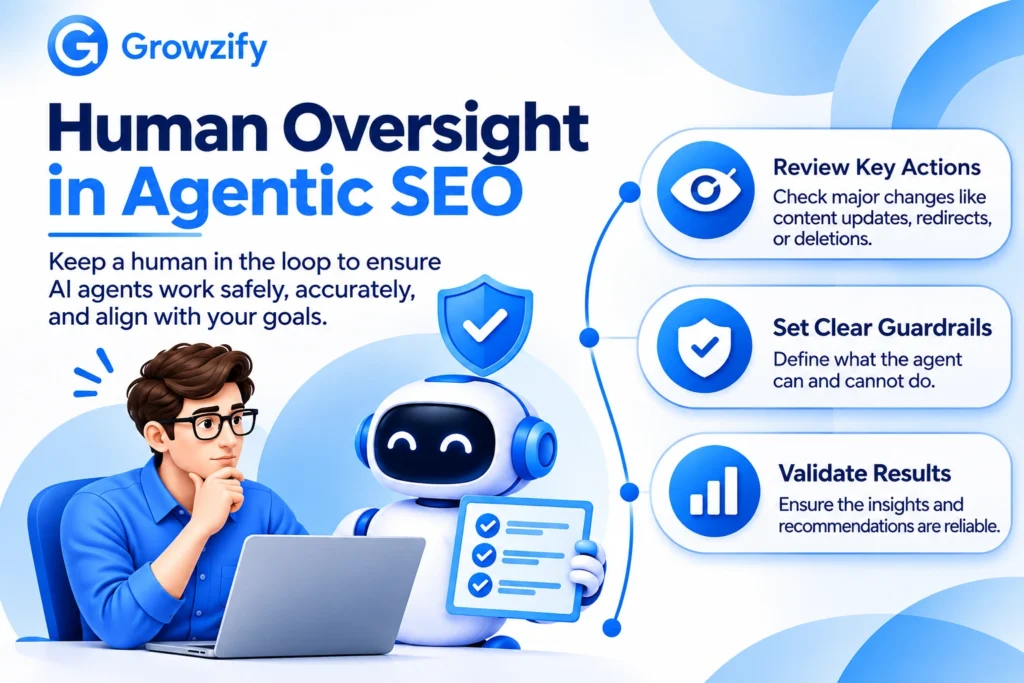
Autonomy is a risk to manage, not a goal. Anthropic’s guidance notes that autonomous agents bring higher costs and “the potential for compounding errors,” and recommends extensive testing in sandboxed environments along with appropriate guardrails. It also describes agents pausing for human feedback at checkpoints or when they hit blockers.
Rules that translate well to SEO work:
Enforce read/write permissions, approved destinations, and execution limits in the tools or application layer. Written instructions guide behavior but should not be the only control preventing unauthorized actions.
Skills that fetch external web content carry an added risk. Anthropic’s documentation warns that fetched content might contain malicious instructions, so a workflow that reads outside pages should treat that content as data, not as commands.
| Workflow | What the agent does | What a person decides |
| Content decline diagnosis | Finds pages that lost clicks and proposes likely causes for review | Which pages get rewritten, fixed, or left alone |
| Technical audit triage | Groups audit issues by root cause and checks them against traffic | Which fixes enter the sprint |
| Competitor movement review | Isolates pages and keywords behind a competitor’s change | Whether the change is relevant enough to respond to |
| Search opportunity briefs | Checks existing coverage and drafts a brief | Whether to create, update, or skip |
| Internal linking review | Finds relevant source passages for priority pages | Which links to add |
| Content portfolio review | Classifies URLs as keep, update, consolidate, redirect, or investigate | Final calls on removals and merges |
| AI citation gap mapping | Groups prompts and cited sources, finds outreach candidates | Which sources are worth pursuing |
| Release regression check | Compares pre- and post-release states against approved changes | Which differences are bugs |
AI SEO work commonly combines answer engine optimization, generative engine optimization, entity work, structured data, technical SEO, and topical authority. Much of it is recurring checking and monitoring, which is where a written method helps.
Growzify’s comparison ofAI SEO and traditional SEOmakes the case that AI SEO is not a rival discipline and sits on top of strong fundamentals. That is also the right frame for automation: the workflow supports the fundamentals and adds AI-specific monitoring on top.
| Recurring AI SEO task | What the workflow does | What a person decides |
| Eligibility check for priority pages | Confirms pages are crawlable, indexed, and eligible to show with a snippet | Which blocked or non-indexed pages are intentional |
| Content and markup match | Compares structured data with the visible page text and flags mismatches | Which mismatches to fix first |
| Google AI-search visibility monitoring | Reviews Search Console’s generative AI performance report for impressions, appearing pages, countries, devices, and changes over time; compares them with broader Search performance | Which visibility changes warrant investigation and whether content or technical improvements are justified |
| Prompt and citation sampling | Runs a fixed set of prompts on chosen AI tools on a schedule and records which sources are cited and whether the brand appears | Which gaps justify new content, digital PR, or outreach |
| Entity and brand consistency review | Compares how the brand and key facts are described across owned pages and major profiles | Which inconsistencies to correct |
| Content refresh queue | Flags priority pages with outdated facts, thin answers, or missing coverage | Which pages are refreshed, and who verifies the facts |
Google introduced dedicatedgenerative AI performance reports in Search Console in June 2026, and says they reached all websites worldwide by August 31, 2026.
The reports give views of impressions in generative AI features such as AI Overviews and AI Mode, with breakdowns by page, country, date, and, for Search, device. Google’s Help page describes impressions only, with no clicks or queries, and notes that the report may not appear for a site without enough generative AI impressions. The data also stays part of broader Search Console performance reporting.
Agencies should distinguish this first-party reporting from third-party prompt sampling. Prompt sampling provides directional observations, not a complete measurement of AI-search visibility, because outputs can vary between runs and tools. Recording the date, the tool, and the exact prompt wording keeps sampled results comparable.
Structured data checks are part of maintaining accuratetechnical SEO, not a special eligibility requirement for Google’s AI features.
Automation also cannot guarantee inclusion in AI answers. Google’s guidance, covered above, points to foundational practices and not to special tactics, so the gains come from keeping strong pages in good condition.
This example is illustrative. “Northline Outdoor” is an invented site, and the numbers are made up to show the flow.
Setup:The project contains the site’s priorities and approved change history. The agent has read-only access to Search Console performance data, a current technical crawl or inspection source, and a release or redirect log. Where reliable demand data is unavailable, it must label demand-related explanations as hypotheses rather than confirmed causes. Thecontent-decline-checkskill is loaded.
Prompt:“Run the content decline check on /guides/ comparing the last 90 days with the same period last year. Minimum drop: 30% and 100 clicks.”
What the agent does:
Illustrative output:
| URL | Clicks lost | Classification | Evidence | Suggested action | Confidence |
| /guides/tent-sizing/ | 230 | Planned redirect | Current redirect matches the approved consolidation record | None for the redirect itself | High |
| /guides/trail-boots/ | 140 | Suspected indexing issue | Current inspection found a noindex directive; timing and impact not yet confirmed | Confirm when the directive was added and whether it was intended | Medium |
| /guides/rain-shells/ | 120 | Possible ranking loss | Average position worsened; query mix and demand not yet checked | Investigate query mix and demand before choosing a refresh | Low |
Two cautions apply to this kind of output. A currentnoindexdirective alone does not prove it caused all of the observed traffic loss. A recorded redirect does not prove the underlying content decision was correct.
What a person does next:confirm the timing of thenoindexchange with a developer, check query-level and demand data for the third page, and decide whether the consolidation delivered what was intended. The agent narrowed the list and sorted the causes into confirmed findings and hypotheses. The decisions stay with the team.
A workflow that runs is not the same as one that works. Check it the way any analysis would be checked.
Time saved is worth recording, but only after quality holds up. A fast wrong answer costs more than a slow right one.
This approach adds setup effort, so it is not right everywhere.
It tends to fit when:
It tends not to fit when:
Missing data deserves special attention. When conversion data is missing, the agent should flag the gap and avoid making unsupported claims about results. Fix the tracking before relying on automated conversion analysis.
This is an illustration, not a real client case. “Brightline Studio” is a fictional design agency adding SEO for a local dental clinic through a white label partner.
During week one, the account manager checks the Business Profile. The profile’s primary owner is the web company that built the clinic’s old site.
Because the agency’s onboarding checklist asks who owns each account, this surfaces early. The workflow runs like this:
Meanwhile, the provider takes a baseline and finds that the clinic’s Search Console property has only one verified owner, a former employee.
Adding another delegated owner wouldn’t solve that, because delegated owners depend on a verified owner. Instead, the clinic verifies ownership through a method it controls, such as a DNS record at a registrar the clinic controls. It then reviews the former employee’s verification tokens and access, so it no longer depends on an ex-employee.
With access properly secured, the agency can manage SEO activities more reliably, monitor thevisibility in AI search overviews and LLMs, track search performance, and maintain accurate business information.
It is a defined SEO objective pursued by an AI system that selects investigative steps or tools within set constraints, retrieves data, and analyzes findings. For recurring work, a written method and a standard output format make it easier to evaluate, and tool permissions and human approval limit what it may do to the site or outside the team.
ChatGPT or Claude can support either manual assistance or agentic execution, depending on the setup. The distinction is whether the user directs each step or the system selects investigative steps and tools within an authorized objective. Separating context, method, and data access makes the second mode easier to repeat and review.
No. It handles repeatable data gathering and first-pass analysis. Specialists decide priorities, judge trade-offs, and approve changes.
It standardizes recurring analysis, draws it from connected data sources, and records the evidence behind each finding. That makes automated SEO work easier to review and improve.
For Google’s AI features, Google says there are no additional requirements to appear in AI Overviews or AI Mode, nor are other special optimizations necessary. Standard SEO fundamentals still apply, so an agentic workflow is useful for keeping those fundamentals checked.
It can help keep the fundamentals checked and track visibility signals on a schedule, but it cannot guarantee inclusion in AI Overviews, AI Mode, or other AI answers. Google says no special optimizations are required for its AI features, so any gain on Google surfaces comes from maintaining strong, accurate pages, not from automation alone.
Google’s guidance does not describe AI content as against the guidelines in general. It warns that using generative AI to produce many pages without adding value may violate its policy on scaled content abuse, and it says to fact-check and review AI-generated content before publishing.
The Model Context Protocol is an open-source standard for connecting AI applications to external systems such as data sources and tools. With an appropriate MCP server or connector and authorized access, an agent can query supported sources such as Search Console. MCP itself does not supply the underlying data or grant access.
No. It can use direct APIs, other integrations, or staged files. MCP is one way to standardize connections between an AI application and external tools or data sources.
Publishing, redirecting, deleting, editing code, merging changes, and sending external messages. Production tools should remain read-only until a workflow has earned more access.
Pick one that recurs, has a clear method, and ends in a reviewable output. Content decline diagnosis and technical audit triage are common starting points because the data is usually already available.
If your brand wants to be found and cited in AI-powered search, Growzify’sAI SEO servicesteam can help assess where the brand stands today and which recurring tasks suit automation and which should stay hands-on.

Chitranshu SharmaA growth strategist, digital marketing consultant, and the founder of Growzify, a performance-driven agency helping brands dominate search, shape perception, and build sustainable online visibility. With 8+ years of hands-on experience in Enterprise SEO, Online Reputation Management (ORM), and AI-led traffic generation, Chitranshu has helped startups, public figures, SaaS companies, and cannabis brands outrank competitors — ethically and at scale.

At Growzify, we are dedicated to helping your business achieve its goals. Are you Ready to take the next step?
What is Private Label SEO? How is it Different From White Label SEO? Ask five...

White Label SEO Dashboard: 10 Best Tools for Agencies To Create It A client doesn’t...
The Complete Guide to White Label SEO Onboarding for Agencies and Resellers A lot of...
What is White Label SEO Reporting: Tools, Metrics, and Best Practices A report can look...
How SEO Outsourcing for Startups Helps in Driving Organic Growth A startup rarely has enough...
How Much Does SEO Outsourcing Cost in 2026? Nobody can give you one honest price...
AI SEO Best Practices to Boost Visibility Across LLMs Large language models do not all...
7 AI SEO Content Optimization Strategies to Improve Visibility on AI Search Platforms AI-powered search...
Call Now






Growzify digital team is very effective, and easy to work with. Very strong communication and always up for suggestions. Saw 300% growth in web traffic 170% growth in revenue through Facebook ad’s & Amazon. I recommended them to my fellows and they turned their online business into a money making machine.