How SEO Outsourcing for Startups Helps in Driving Organic Growth
How SEO Outsourcing for Startups Helps in Driving Organic Growth...
Read More →
Nobody can give you one honest price for SEO outsourcing. But anyone can give you an honest range, and tell you what’s inside it.

SEO outsourcing cost is what you pay an outside agency, freelancer, consultant, or partner to do SEO work for you, instead of doing it with your own team. There is no verified single 2026 market rate. The broadest transparent provider-pricing benchmark we could verify is Ahrefs’ August 2024 survey of 439 SEO providers, which estimated monthly retainers of roughly $1,350 for freelancers, $3,200 for agencies, and $3,250 for consultants. Those figures were calculated from pricing bands, and they are 2024 reference points, not 2026 quotes. The more useful comparison is scope, capacity, seniority, exclusions, and total operating cost.
Methodology:This guide draws on Ahrefs’ SEO pricing survey (439 providers, updated August 2024), U.S. Bureau of Labor Statistics data on wages and employer compensation costs, and Google Search Central’s guidance on hiring an SEO and on generative AI features, alongside patterns Growzify sees when businesses and agencies buy SEO. The Ahrefs survey is self-reported by providers, its author notes that data was thin for some regions, and its provider-type averages assume each respondent charges the upper end of their selected pricing band.
Here are roundedAhrefs surveyestimates side by side.
| Provider type | Approx. monthly retainer | Approx. hourly rate | Approx. project fee* |
| Freelancer | ~$1,350 | ~$72 | ~$2,350 |
| Agency | ~$3,200 | ~$99 | ~$9,500 |
| Consultant | ~$3,250 | ~$171 | ~$8,700 |
| All providers | ~$2,900 | Not shown | Not shown |
Derived project estimates. Ahrefs labels this subsection “/month” even though it describes per-project fees, so use these figures cautiously.
I rounded the figures because Ahrefs calculated them from respondents’ pricing ranges, assuming each provider charges the upper end of its selected range. Ahrefs’ unrounded values are $1,348.63, $3,209, and $3,250 for monthly retainers, and $71.59, $98.90, and $171.18 for hourly rates. They’re directional benchmarks, not exact average invoices.
Ahrefs surveyed SEO service providers generally, not SEO outsourcing engagements specifically. We use it here because freelancers, agencies, and consultants are common outsourcing options, but the figures should be read as external-provider pricing benchmarks, not an outsourcing-specific market rate.
A few more cautions apply:
Ahrefs also reported the most popular ranges for two models:
Those ranges are lower than the calculated averages. That difference shows why a single number can be misleading. Use the ranges to see how responses were spread out, and the averages as a separate reference point. Neither is a recommended budget or a pricing ceiling.
Ahrefs also noted that SEOs based in India charged significantly less, and those in the U.S. and Canada charged substantially more. It warned that it had little data for some regions.

SEO outsourcing means paying someone outside your company to handle some or all of your SEO. The work usually falls into a few areas:
Prices differ mostly because the scope differs. “SEO included” can mean a monthly report and a few edits, or a full team producing content and building links. Always ask for the scope in writing.
Freelancers often suit focused work, like an audit, a keyword plan, or some content. Ahrefs estimated roughly $1,350 a month on retainer and about $72 an hour for freelancers.
A freelancer may specialize in one or two areas rather than offering the breadth of a multi-person team. So check which skills are included and which would need other specialists. You may also manage the relationship yourself.
Many consultants focus mainly on strategy and advice, although delivery models vary. Ahrefs estimated roughly $3,250 a month and about $171 an hour for consultants. That’s the highest hourly estimate in the survey.
A consultant can be a good fit if you have a team that can carry out the plan. If you don’t, ask whether delivery is included or whether you’d need a second provider.
Agencies can provide access to several specialists, such as strategists, writers, technical SEOs, and account managers. Ahrefs estimated roughly $3,200 a month and about $99 an hour.
Pricing may reflect team structure, scope, experience, overhead, and the level of service included. So ask who is assigned to your account and what they’ll actually do.
A white-label partner does SEO work that an agency sells to its own clients under the agency’s brand. Pricing here works differently. White-label arrangements commonly use wholesale or partner pricing, with the agency building fulfillment cost into its own client pricing and margin model.
That’s a separate topic from this guide. Growzify’swhite label SEO pricing guidecovers wholesale tiers and agency margins in detail.
Ahrefs’ survey measured three widely used models. It found that 78.2% of providers offered monthly retainers, 48.9% offered per-project pricing, and 34.8% offered hourly pricing. Those shares add up to more than 100%, because many providers offer more than one model.
Some providers also offer performance-based arrangements. That model isn’t quantified in the survey figures used here.
| Model | Best for | Watch out for |
| Monthly retainer | Ongoing scope, recurring execution, monitoring, and iteration | Vague scope that lets hours drift |
| Hourly | Short advice or small fixes | Costs that climb without a cap |
| Project fee | Audits, migrations, one-off builds | Unclear what happens after delivery |
| Performance-based | Shared risk on agreed outcomes | Unclear definitions and outside factors |
A retainer buys an agreed scope of ongoing work. It doesn’t buy a guaranteed growth rate.
Be careful with performance-based deals. Rankings can change for reasons no provider controls.Google’s guidance on hiring an SEOsays no one can guarantee a #1 ranking, and warns about SEOs who claim to.
If you consider a performance-based deal, the agreement should define:
Performance pricing transfers part of the commercial risk. It doesn’t make attribution or causation any easier.
Two businesses can get very different quotes from the same provider. Here are the main reasons.
This is Growzify’s practitioner list. It matches what Ahrefs describes about regional differences, but the choice and order of factors is our judgment.
Page count affects complexity, but it doesn’t determine required monthly hours on its own. Architecture, current technical state, release velocity, content needs, markets, implementation authority, and business goals can matter as much or more. A 5,000-page store in good technical shape may need less ongoing effort than a 200-page site in the middle of a migration or recovery.
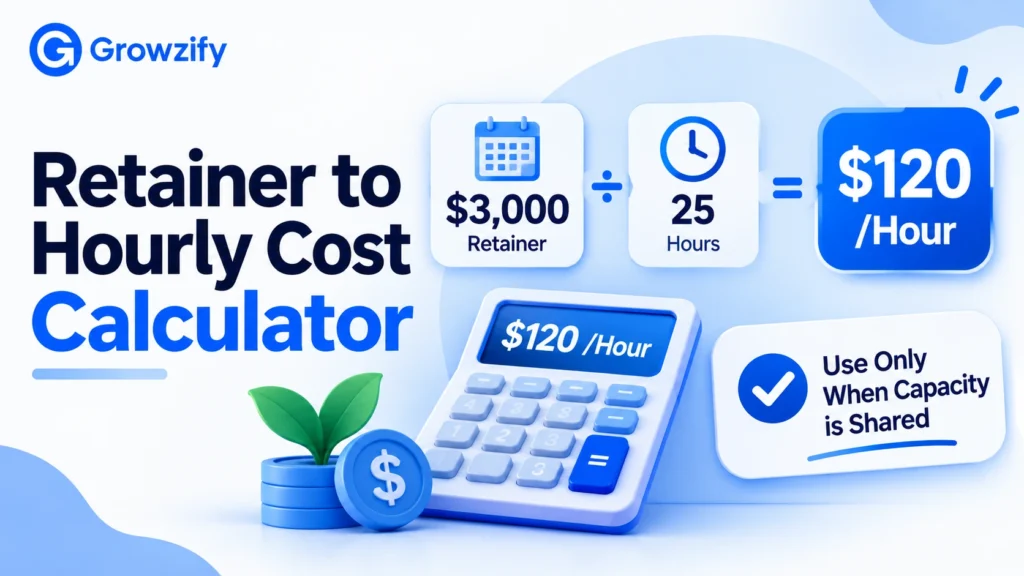
It can help to convert a quote into an implied hourly cost, but only when the provider discloses the capacity.
If a provider tells you a $3,000 retainer includes about 25 hours of delivery, you can calculate an implied blended cost of $120 an hour. That helps compare capacity across proposals.
Don’t infer hours by dividing a market-level retainer benchmark by a separate market-level hourly benchmark. The two figures came from different respondents, scopes, seniority mixes, and cost structures, so the result isn’t a reliable estimate of what any provider will actually spend on your account. Retainers can also cover tools, management, overhead, fixed deliverables, and different levels of specialist time.
Cost isn’t the only reason to outsource. But many people want to know how it compares with hiring someone.
TheU.S. Bureau of Labor Statisticsreports a median annual wage of $78,760 for market research analysts, as of May 2025. That’s the closest official category we found, not an SEO-specific one, so treat it as a broad proxy.
Salary isn’t the full cost of an employee. The BLS reports that benefits made up 30.0% of employer compensation costs for private industry workers in June 2026, in itsemployer cost release.
Applying that all-private-industry 70/30 split purely as an illustration would turn a $78,760 wage into about $112,500 of annual compensation, or about $9,400 a month. This is an illustrative compensation proxy, not an SEO-hire market cost. The occupation and benefits datasets cover different populations, and actual benefits vary substantially by employer and role.
Tools, recruiting, training, and internal management can sit outside that figure.
A full-time employee buys dedicated capacity, institutional context, and internal availability. A provider may buy fractional access to several specialties, variable capacity, and external process and infrastructure. Neither is automatically cheaper, because they buy different things. Comparing a monthly retainer to a monthly salary figure and calling the difference “savings” ignores that.
Many providers now list “AI search,” “AEO,” or “GEO” as a separate line item. Before you pay for it, find out what it covers.
Google’s guide to optimizing for generative AI featuressays its generative AI features are rooted in its core Search ranking and quality systems. It also says you don’t need new machine-readable files, AI text files, or special schema markup to appear in Google Search.
Google’s guidance on hiring an SEO now also tells site owners to check whether a provider’s AEO or GEO advice is aligned with Google’s official guidance for generative AI features. A separate AI-search fee should therefore map to identifiable incremental work, not rebrand ordinary SEO tasks.
This split is Growzify practitioner judgment:
| Potentially incremental work | Often already part of SEO |
| Search generative-AI eligibility audit | Crawlability and indexing |
| Search Console generative-AI reporting | Internal linking |
| External AI crawler policy | Content quality and ordinary optimization |
| Prompt-set monitoring across relevant platforms | Technical structure |
| Brand-representation testing | Structured data |
| Commerce or local data improvements where they apply |
Ask yourself: am I paying for new work, or a new label?
If the package includes “AI visibility reporting,” ask what it measures. Google’s Search Console now offers a dedicated generative-AI performance report, rolled out worldwide as of August 31, 2026. Ask whether the reporting includes official Google generative-AI impressions, external-assistant referral traffic, and third-party or prompt-set measurements, and whether the provider keeps them separate.
Be careful if the proposal sells a special file or a secret markup as the main deliverable. Ask these questions:
In Growzify’s view, AI-visibility work often builds on the same foundation as regular SEO. That means it may be a modest add-on for a site that’s already in good shape, and a bigger job for a site that isn’t. This is a practitioner opinion, not a pricing rule.
Two SEO proposals with the same monthly fee can represent very different purchases. One may include strategy, content, and technical implementation. Another may include recommendations only, with developer work billed separately. A monthly price alone can’t tell you which you’re buying.
Growzify’s quote-comparison framework runs in this order:Benchmark → Scope → Capacity → Seniority → Exclusions → Internal Cost → Risk → Measurement.
Here are the items to ask for in writing:
| Item to ask for | Why it matters |
| Written scope of work and exclusions | Shows what “SEO” means in this deal and what costs extra |
| Who does the work, and their seniority mix | Senior strategy and junior execution cost different amounts |
| Deliverables, definition of done, and purpose | Four articles or twenty links don’t automatically equal useful progress |
| Hours or capacity | Helps you judge what the price covers |
| Implementation responsibility | Shows who makes the changes and who pays for developer time |
| QA and revision policy | Shows what happens when work needs fixing |
| Subcontractors and pass-through costs | Shows who else touches the work and what costs are added |
| Reporting | Should link work to results you care about |
| Access and ownership | You should own your accounts and content |
| Contract terms | Minimum term, cancellation, setup fees, renewals |
Compare total effective cost, not only the invoice. That’s the provider fee plus required add-ons, pass-through costs, and the internal review and implementation time your team must supply. Content production outside the retainer, developer work, digital PR placement costs, SEO software, subject-matter review, design, and translation can all sit outside the monthly fee.
Here’s an illustration, with no benchmark behind it. Provider A charges $2,000 a month but needs 25 hours of your team’s time. Provider B charges $3,500 and needs 5 hours. The cheaper invoice isn’t necessarily the lower total operating cost.
Google adds practical advice here. It suggests checking an SEO’s business references and asking for explanations if something is unclear. It also warns that if an SEO creates deceptive or misleading content on your behalf, your site could be removed entirely from Google’s index.
For preparing access, goals, and handoff details, Growzify’sSEO outsourcing checklistwalks through each step.
Low prices aren’t automatically bad. A lean provider with efficient processes can charge less. The risk is in what gets cut.
Questions to ask when a quote is far below others:
Poor work can create rework costs in addition to the original spend. That can mean rewritten content, technical remediation, link cleanup, and tracking fixes, all of which add to your total.
Start with the goal, not with a number.
Growzify’s guide onmanaging outsourced SEO for long-term resultscovers how to review progress once the work starts.
There is no verified single 2026 market rate for SEO outsourcing. The broadest transparent provider benchmark used in this guide is Ahrefs’ August 2024 survey of 439 SEO providers. It estimated monthly retainers of roughly $1,350 for freelancers, $3,200 for agencies, and $3,250 for consultants, but those figures were calculated from pricing bands and should be treated as directional reference points, not current 2026 quotes. The more useful comparison is scope, capacity, seniority, exclusions, and total operating cost.
It means the total you pay an outside provider to handle SEO work. That can be a monthly retainer, an hourly rate, a one-time project fee, or an agreed performance deal.
It depends on the scope and expertise you need. An employee’s cost includes more than salary, since the BLS reported that benefits were 30.0% of employer compensation costs for private industry in June 2026. Outsourcing may give you access to specialist capacity without a full-time hire. Because the two models provide different amounts of time, expertise, and control, compare total cost against the work you actually need.
Hourly pricing charges for the time used and suits short tasks. A retainer is a fixed monthly fee for an agreed scope and suits ongoing work. Don’t convert a retainer into hours using market benchmarks. Ask the provider what the retainer actually includes and whether it defines capacity.
Providers differ in team size, seniority, and location, and the scope of work can be very different. Competition and site size also change the workload. Always compare what’s included, what’s excluded, and what your own team must supply.
Yes. Audits, migrations, and strategies are often priced as projects. In Ahrefs’ survey, the most popular per-project range was $2,501 to $5,000. Ask what follow-up and implementation are included.
Not necessarily, but ask what’s cut. Check hours, who does the work, how links are found, and what happens if work needs to be redone. Google also warns that deceptive content or spam tactics can lower rankings or remove pages from results.
If you’re an agency that wants reliable SEO delivery without building a larger in-house team, Growzify’swhite label SEO servicesteam can walk through scope and pricing for your situation.

Chitranshu SharmaA growth strategist, digital marketing consultant, and the founder of Growzify, a performance-driven agency helping brands dominate search, shape perception, and build sustainable online visibility. With 8+ years of hands-on experience in Enterprise SEO, Online Reputation Management (ORM), and AI-led traffic generation, Chitranshu has helped startups, public figures, SaaS companies, and cannabis brands outrank competitors — ethically and at scale.

At Growzify, we are dedicated to helping your business achieve its goals. Are you Ready to take the next step?

How SEO Outsourcing for Startups Helps in Driving Organic Growth A startup rarely has enough...

AI SEO Best Practices to Boost Visibility Across LLMs Large language models do not all...

7 AI SEO Content Optimization Strategies to Improve Visibility on AI Search Platforms AI-powered search...

How to Outsource SEO Without Losing Your Rankings Rankings don’t vanish because someone else is...

AI SEO vs Traditional SEO: The Comparison Guide Most “versus” articles frame two rival camps....

How to Rank Ecommerce Sites: Strategies That Actually Work Home Blog SEO How to Rank...

What is AI SEO? How Can Businesses Optimize Their Content for AI Searches A page...

7 White Label SEO Practices That Support Client Retention and Agency Growth White-label SEO helps...
Call Now






Growzify digital team is very effective, and easy to work with. Very strong communication and always up for suggestions. Saw 300% growth in web traffic 170% growth in revenue through Facebook ad’s & Amazon. I recommended them to my fellows and they turned their online business into a money making machine.