How to Manage SEO Outsourcing Across Multiple Teams
How to Manage SEO Outsourcing Across Multiple Teams A single-owner...
Read More →
Finding a local SEO outsourcing provider is only half the task. Comparing candidates against the same fixed criteria, instead of judging each pitch in isolation, is what actually prevents a costly mismatch six months into the contract. Risk should be gated out first, not averaged away by a strong score somewhere else.

Comparing local SEO outsourcing providers means running every candidate through the same two-stage process: first eliminating anyone who fails a non-negotiable policy or eligibility check, then comparing the remaining candidates on local-specific capability. Google’s own guidance ties local ranking to relevance, distance, and prominence specifically, and a provider can genuinely work on relevance and prominence, accurate Business Profile information, reviews, and supporting website content, but distance depends on the actual relationship between the business and the searcher and isn’t something any provider can simply optimize away.
Methodology:This guide draws on Google’s own documentation on local ranking factors, Business Profile eligibility, and evaluating an SEO provider, Google’s Business Profile content policy on review incentives, and the FTC’s 2024 federal rule governing consumer reviews and testimonials. Statements attributed to Growzify are practitioner observations from local SEO engagements, not universal guarantees, and the comparison scenario later in this article is an illustrative composite, not a specific client case.
Google’s own guidance states that local results are mainly based on relevance, distance, and prominence. Google says complete and detailed business information helps it understand a business and match the profile to relevant searches, and that more reviews and positive ratings can help local ranking. That’s a meaningfully different set of factors than what drives general organic rankings, and it’s why local SEO deserves its own evaluation checklist rather than borrowing one built for content SEO.
A provider with strong national content SEO experience may have never actually managed a Google Business Profile, built local citations, or run a review-acquisition process. That’s not a disqualifier by itself, but it’s a reason to ask the question directly rather than assume local competence follows from general SEO competence.
This is also why comparing providers on price alone tends to backfire. Two providers can quote similar monthly rates while one includes ongoing Google Business Profile management and business-information cleanup and the other includes neither.
Businesses with multiple physical locations add another layer to this. A provider handling five eligible business locations needs a repeatable process for keeping each one’s profile, listings, and reviews consistent, rather than manually redoing the same steps five separate times with room for drift between locations. Growzify’s guide tomulti-location SEO for enterprise businessesexplains how centralized processes help maintain local visibility and data consistency across branches.

Not every criterion should be averaged into one overall score.
Stage 1: the eligibility gate.First remove providers that fail a non-negotiable check, Business Profile eligibility, review-policy compliance, ranking guarantees, methodology transparency, account ownership, or manipulative location and link tactics. A provider proposing fake locations or prohibited review practices shouldn’t stay in contention just because its reporting or pricing scores well elsewhere. A policy failure is a disqualifier, not a deduction to offset against a strong score somewhere else.
Stage 2: comparative fit.Compare only the providers that clear the gate, on local-search capability, website and Business Profile execution, measurement, multi-location process where relevant, communication, and commercial terms.
Measurement deserves particular attention because local visibility is geographic. A business doesn’t have one universal “Maps ranking”; visibility should be evaluated asquery × location, not a single number. If a provider uses geo-grid or rank-tracking data, ask which queries, locations, radius, and comparison periods are actually being measured, and use those visibility numbers alongside real business outcomes, qualified calls, bookings, forms, or revenue where those can genuinely be tracked, rather than treating profile interactions as proof of business outcomes on their own.
A few sourcing paths are worth trying before narrowing to a shortlist. Where you found a provider is a sourcing signal, not proof of quality; a referral, a chamber membership, a directory listing, or a provider that ranks well for its own marketing all say something about visibility or reputation, but none of them substitute for the comparison process itself.
Industry referrals.Other business owners in your industry, even in different cities, may know which providers have worked with a business like yours before. A referral is one useful signal worth following up on directly, not a substitute for the comparison process itself.
Local business associations and chambers of commerce.These groups can be a useful place to find potential providers or request an introduction. Membership in an association isn’t proof of SEO competence on its own, so treat it as a sourcing channel rather than a vetting step.
Specialized local SEO agencies versus full-service agencies.Some providers focus exclusively on local and Google Business Profile work. Others offer it as one line item inside a broader digital marketing package. Neither structure is automatically better, but it’s worth knowing which one you’re evaluating, since a specialist may go deeper on local-specific tactics while a full-service agency may better integrate local work with a wider marketing plan.
White-label local SEO providers, for agencies specifically.If you’re an agency that wants to offer local SEO to your own clients without hiring and training an in-house local SEO team, a white-label local SEO partner delivers the work under your brand while you keep the client relationship, an option covered further down for agencies weighing that path. Agencies serving franchise businesses may also want to assess providers with experience infranchise SEO, where local visibility must be coordinated across multiple locations.
Whichever channel surfaces a candidate, run every one of them through the same eligibility gate and comparison criteria below rather than treating the sourcing channel itself as evidence of quality.

A provider failing any of these should generally be removed from consideration regardless of how strong the rest of their pitch is.
| Criterion | What to look for |
| Business Profile eligibility compliance | No fake locations, virtual-office shortcuts, or duplicate profiles created purely to expand map coverage; Google’s own eligibility rules require a location to be genuinely staffed and customer-facing, or the service-area model used correctly |
| Review policy compliance | No incentives offered in exchange for Google reviews, no compensation conditioned on positive sentiment, and no selective solicitation that only asks satisfied customers |
| No ranking or geographic-coverage guarantees | No promise of a specific map pack position, and no claim that one eligible location can be made to rank consistently across an entire city or distant service area through profile settings alone |
| Transparent methodology | A clear, specific explanation of what they actually do, not a proprietary process they won’t describe |
| Access and ownership terms | Read-only access during evaluation, broader access tied to a signed, scoped agreement, and the business retains ownership of its own Business Profile regardless of how the relationship ends |
| No manipulative link or location tactics | No spammy link schemes, and no strategy built around large numbers of near-duplicate location pages created mainly to capture search queries rather than serve a genuinely distinct location or service area |
Once a candidate clears the gate above, compare it against the others on the following.
| Criterion | What to look for | Why it matters |
| Google Business Profile management | Accurate categories, services, hours, attributes, and photos, with a documented process for keeping information current | Complete, detailed profile information helps Google match the business to relevant local searches |
| Proximity and distance realism | The provider explains where distance genuinely constrains visibility rather than promising to override it with service-area settings or profile tricks | Distance is part of Google’s own documented local-ranking framework, not something a provider controls |
| Website and local-page capability | The provider can diagnose and improve the organic pages that support local discovery, not just the Business Profile in isolation | Local SEO depends on more than the profile; crawlability, on-page relevance, and genuinely useful location pages still matter |
| Business information consistency | A documented process for finding and correcting outdated or duplicate listings across directories and platforms | Consistent business details reduce conflicting information and help customers reach the right listing |
| Review management approach | A compliant process for requesting genuine reviews consistently, regardless of expected sentiment, and responding to all of them | Review count and positive ratings are associated with local prominence in Google’s own guidance |
| Local content and on-page work | Location-specific pages that provide genuine, distinct value rather than the same template with a city name swapped in | Large sets of near-duplicate geographic pages built mainly to capture search queries can raise doorway or scaled-content concerns |
| Multi-location process, where relevant | A repeatable, documented workflow for managing category, name, hours, and ownership consistency across locations, with clear QA and an escalation path if a profile is suspended or flagged | Manual, one-off handling of each location tends to drift and create inconsistencies as location count grows |
| Reporting and measurement | Query × location visibility data alongside the business’s actual conversion points, reported as separate categories rather than one blended score | Profile interactions and confirmed business outcomes are different things and shouldn’t be presented as interchangeable |
| Pricing and contract terms | Clear scope for what’s included at the quoted price, and reasonable flexibility to exit if the relationship isn’t working | Long lock-in contracts increase the cost of a bad initial choice |
Use both tables as a scorecard during vetting calls. Ask every candidate the same questions in the same order, and write down their actual answers rather than relying on memory afterward.
A few warning signs are specific enough to local SEO that they’re worth naming directly.
Guaranteed map pack rankings.Google’s own guidance on evaluating an SEO providerstates plainly that no one can guarantee a specific ranking position. A provider promising a guaranteed top-three map pack spot is making a claim Google itself says no one can back.
Guaranteed geographic coverage.Be cautious if a provider claims it can make one eligible location rank consistently across an entire city or a distant service area simply by adjusting profile settings. Distance is part of how Google determines local relevance, and local visibility genuinely varies by both the specific query and the searcher’s location.
Fake or ineligible locations.Google’s own eligibility guidelines require a shared or co-working office to be staffed and customer-facing during business hours to qualify, and set separate rules for service-area businesses without a public storefront. A provider suggesting virtual offices, rented mailboxes, or duplicate listings to expand map presence is proposing something that puts the business’s actual eligibility at risk.
Incentivized reviews specifically on Google.Google’s own Business Profile content policy prohibits offering payment, discounts, or free goods or services in exchange for posting, revising, or removing a review. This is a stricter standard than general review law: it applies regardless of whether the incentive is conditioned on sentiment, and content posted because of an incentive can be removed as rating manipulation.
Fabricated reviews, sentiment-conditioned incentives, or review gating.TheFTC’s 2024 federal rule on consumer reviews and testimonialsprohibits fake and fabricated reviews outright, and separately prohibits compensation or incentives conditioned, explicitly or implicitly, on a review expressing a particular sentiment; the FTC has clarified that a neutral incentive offered regardless of sentiment isn’t categorically prohibited by that specific rule, though other disclosure and deception rules can still apply.
Google’s policy governs what’s allowed on Google specifically, while the FTC rule governs deceptive review practices more broadly and can create exposure for the business regardless of platform.
Also worth screening for: a provider that only requests reviews from customers it expects to be satisfied, or steers unhappy customers away from public review channels, since that pattern raises the same underlying concern even without an explicit incentive attached.
Mass, low-relevance directory submissions.A provider focused mainly on citation volume should be able to explain which directories are actually relevant to the business, how duplicate or inaccurate listings get handled, and what quality-control process is in place. A large number of submissions isn’t inherently more valuable than a smaller set of accurate, relevant ones.
Secrecy about methodology.A provider unwilling to explain in plain language what they’re actually doing each month is harder to hold accountable later. This doesn’t mean every tactic needs to be disclosed in granular detail, but the general approach should be explainable without evasiveness.
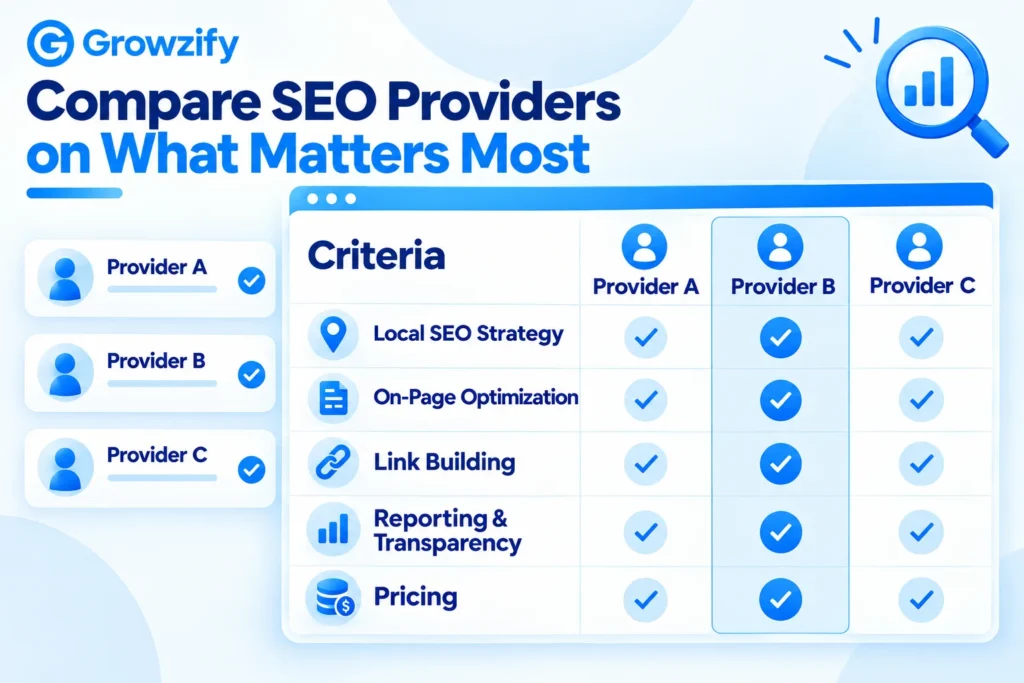
Apply the eligibility gate first, then fill out the comparative table for every candidate that clears it, using their actual answers, not their marketing copy. Seeing several providers on one page, scored against the same rows, makes gaps far easier to spot than reading separate proposals days apart.
Give every shortlisted provider the same written questions and scope assumptions rather than relying on however their sales conversation happens to unfold. Standardizing what you ask for makes the answers genuinely comparable, even when providers are at different points in their own sales process.
This same discipline, applying one consistent standard rather than judging each deliverable in isolation, is the same principle behind an internal quality control process. Growzify’swhite label SEO quality control checklistwalks through how a similar structured review applies once work is already underway, which is useful context for what ongoing accountability with a provider should look like after signing.
A short, direct list is more useful on a call than a long one you won’t get through.
Specific answers give you something concrete to compare and verify. Vague marketing language doesn’t, regardless of how confident it sounds.
The right outsourcing structure depends on who’s actually asking the question.
A local business hiring for itselfis typically looking for a direct working relationship: one point of contact, direct reporting, and a provider who understands that specific business and its service area.
An agency that wants to offer local SEO to its own clientsfaces a different question: build an in-house local SEO capability, or partner with a white-label provider who delivers the work under the agency’s brand.Growzify’s guide to how white label SEO actually workscovers the mechanics of that arrangement in more depth, including how client-facing branding and reporting stay consistent even though a separate team executes the work behind the scenes.
Neither path is inherently better. The right choice depends on whether you’re the end client or the party reselling the service to one.
The following is an illustrative, hypothetical scenario built to show how the comparison process plays out, not a specific named client or business.
Consider a regional dental practice with three locations, evaluating three local SEO providers after growing frustrated with inconsistent results from a previous freelancer. Using the two-stage process above, the practice ran each candidate through the eligibility gate first, then compared the survivors.
Provider A quoted the lowest monthly price but couldn’t describe a specific process for maintaining business listing accuracy beyond “we submit to directories,” and had no sample report to share.
Provider B was more expensive and included ongoing Google Business Profile management, a documented listing-accuracy process, and a review-request process that asked genuine customers for feedback consistently without offering any incentive tied to a Google review or conditioning the request on sentiment, with a sample report that separated visibility data by location from the specific actions that mattered to the practice.
Provider C fell in between on price but couldn’t clearly explain its review-request, response, or escalation methodology well enough to verify how it actually worked, which kept a real compliance question open.
The practice selected Provider B, not because of price, but because it was the only candidate that passed every non-negotiable criterion and could answer the comparative questions with specifics rather than general reassurance. The decision replaced a guess with an actual comparison.
How is local SEO outsourcing different from general SEO outsourcing?
Local SEO involves geographic and Business Profile factors that don’t apply in the same way to ordinary organic results, particularly relevance, distance, prominence, profile eligibility, reviews, and location-specific search behavior. A provider strong in one area isn’t automatically strong in the other, so it’s worth confirming local-specific experience directly rather than assuming it.
How should you compare local SEO providers?
First, eliminate any provider that fails a non-negotiable check: policy compliance, eligibility, ranking guarantees, or methodology transparency. Then compare the remaining candidates on local-specific capability: Business Profile management, website and local-page work, review practices, multi-location process where relevant, query-and-location measurement, reporting, communication, and commercial terms.
What are the biggest local SEO provider red flags?
Guaranteed map pack positions or guaranteed geographic coverage, fake or ineligible business locations, incentivized or selectively solicited Google reviews, manipulative links or doorway-style location pages, vague or secretive methodology, unnecessary ownership of the business’s own profile, and reporting built around one generic ranking number without specifying the query and location behind it.
How many providers should I compare before deciding?
There’s no universal number. Compare enough qualified candidates to establish a meaningful difference in scope, methodology, pricing, reporting, and contract terms, which for many businesses means two or three, though a more formal procurement process may involve more.
Is a cheaper local SEO provider automatically a worse choice?
Not automatically, but a lower price is a reason to check what’s actually included rather than assume it. A cheaper quote that excludes Google Business Profile management or listing-accuracy work isn’t necessarily a bargain if those tasks then fall to someone else internally.
What’s a reasonable timeframe to expect results from local SEO?
Timeframes vary by competition, current visibility, and how much foundational work already exists. A provider should be able to describe a rough, staged timeline rather than a guaranteed date, sinceno provider can guarantee a specific ranking outcome.
Should I ask for references, or are online reviews of the provider enough?
Both are useful, but a direct reference conversation can surface details a public review won’t, such as how the provider handled a slow month or a disagreement over scope. Ask for reference conversations where confidentiality allows, ideally from businesses with comparable scope, and keep in mind that provider-supplied references may still be selectively chosen, so treat them as one part of the comparison rather than standalone proof.
Can an agency use a white-label local SEO provider under its own brand?
Yes. A white-label arrangement lets an agency offer local SEO to its own clients while a specialized provider executes the work behind the scenes, with reporting and communication delivered under the agency’s own branding rather than the provider’s.
What should be in a local SEO provider’s monthly report?
That depends on how the business actually converts, but it should keep visibility data and business outcomes separate rather than blending them into one score. A useful report generally includes Business Profile visibility, query-and-location measurements where geo-tracking is used, and whichever specific actions matter most, calls, form submissions, direction requests, or reviews, plus a summary of the optimization work completed that month. A report built entirely around generic website traffic, or one universal “Maps ranking,” doesn’t say much about local pack performance.
Does a multi-location business need a different comparison approach?
The same scorecard still applies, but it’s worth asking each provider specifically how they manage consistency across locations, including category, hours, and ownership data, and what happens if a specific profile gets suspended or flagged, rather than assuming a process built for one location scales cleanly to several. A provider without a repeatable, location-by-location workflow may unintentionally let smaller locations fall behind.
The providers who look most similar in a pitch often turn out to be quite different once run through the same eligibility gate and comparative scorecard: policy compliance, Business Profile practices, review management, measurement, and contract terms. A standardized, two-stage comparison reduces the chance that the strongest sales presentation, rather than the strongest fit, ends up deciding the outcome.
If you’re a local business comparing providers to handle your own search visibility, Growzify’sSEO outsourcingteam can walk through what’s included at each level and how fulfillment and reporting would work for your specific situation. If you’re an agency evaluating a local SEO fulfillment partner to deliver under your own brand, Growzify’swhite label SEO servicesteam can cover that structure specifically.

At Growzify, we are dedicated to helping your business achieve its goals. Are you Ready to take the next step?

How to Manage SEO Outsourcing Across Multiple Teams A single-owner outsourcing model works fine until...
Inside a White Label SEO Campaign: How the Work Gets Done Clients see a single...

How to Vet an SEO Outsourcing Provider Before You Sign a Contract A polished proposal...

Multilingual SEO Best Practices: Optimize Your Multi-Language Website Translating a page and localizing it for...
What Makes In-House Enterprise SEO Work Different Day-to-Day? On a small site, deciding to fix...

How Core Algorithm Updates Impact Large Sites Differently Than Small Ones A large enterprise site...
When Should You Outsource SEO? 11 Signs It Makes Sense Outsourcing SEO does not necessarily...

SEO Outsourcing Checklist: What to Prepare Before You Hand Off Your SEO SEO handoffs can...
Call Now






Growzify digital team is very effective, and easy to work with. Very strong communication and always up for suggestions. Saw 300% growth in web traffic 170% growth in revenue through Facebook ad’s & Amazon. I recommended them to my fellows and they turned their online business into a money making machine.