



Law Firm SEO Pricing Breakdown in 2026
Law firm SEO pricing in 2026 varies based on competition, location, practice areas, and campaign scope. This guide explains common SEO pricing models, average costs, included services, and the factors that influence investment levels. Also learn how to evaluate SEO proposals, avoid common pricing mistakes, and determine the right budget to increase leads.

Written byChitranshu Sharma
June 25, 2026
Quick Nav
More law firms are putting real money behind SEO this year, and for good reason. Referrals only go so far, and paid ads stop working the moment you stop paying for them. Organic search keeps producing leads long after the work is done.
But there is a problem. Ask five agencies what law firm SEO costs, and you will get five different answers, often with little explanation behind the number. That makes it hard for a managing partner or marketing director to know if a quote is fair or if they are being overcharged for very little work.
Let’s understand what actually drives law firm SEO pricing in 2026, what you should expect to get for your money, and how to tell the difference between a real investment and an expensive guess.
What Does Law Firm SEO Cost in 2026?
Law firm SEO typically costs between $1,500 and $10,000 per month, depending on market competition, firm size, and the scope of work involved. Most independent firms fall somewhere between $2,000 and $5,000 monthly for a comprehensive campaign.
Low-cost SEO, generally anything under $1,000 a month, usually means automated reporting, minimal content work, and very little hands-on strategy.
It can work for a solo attorney in a small, low-competition town, but it rarely moves the needle in any city with real legal competition.
Mid-range SEO, typically $2,000 to $5,000 a month, includes ongoing content creation, technical fixes, local SEO management, and regular link building. This is where most law firms land, and it is usually enough to compete seriously in a mid-sized market.
Premium SEO, often $5,000 to $10,000 or more per month, is built for firms competing in major metro areas or running multi-location campaigns. It includes deeper content production, more aggressive link building, advanced technical work, and dedicated strategy time.
Price alone does not tell you much. What matters is what is actually being done for that price, which is where most law firms get confused.
Factors That Influence Law Firm SEO Pricing
Practice Area Competition
Personal injury and criminal defense are some of the most competitive practice areas in SEO, often requiring significantly more investment than estate planning or family law in the same city. The harder the keywords are to rank for, the more time and resources it takes to get there.
Geographic Market
A solo attorney in a small city might compete with five other firms online. A personal injury firm in Los Angeles or Chicago might compete with fifty. Larger, denser markets almost always require bigger budgets to see meaningful movement.
Current Website Condition
A firm starting from a modern, well-built website pays less upfront than one starting from an outdated site full of technical problems. Fixing years of neglected technical SEO takes real time before any content or link-building work can even be effective.
Content Requirements
A firm with three practice areas and one office needs far less content than a firm with eight practice areas across five locations. Content volume and complexity scale pricing directly.
Technical SEO Needs
Sites with major speed issues, broken structure, or missing schema markup require upfront technical work before growth becomes possible. This adds cost early in a campaign, often in the first one to three months.
Link Building Requirements
Earning authoritative backlinks from legal directories, local press, and industry sources takes time and outreach effort. More competitive practice areas typically need a stronger backlink profile, which increases the ongoing investment required.
Local SEO Requirements
Local SEO for lawyers, including Google Business Profile management, citation building, and review generation, adds a recurring cost layer, especially for firms competing hard in local map rankings.
Multi-Location Law Firms
Each additional office location adds its own local SEO requirements, often including a dedicated location page, its own Google Business Profile, and individualized citation management. Multi-location firms should expect pricing to scale with each new market.
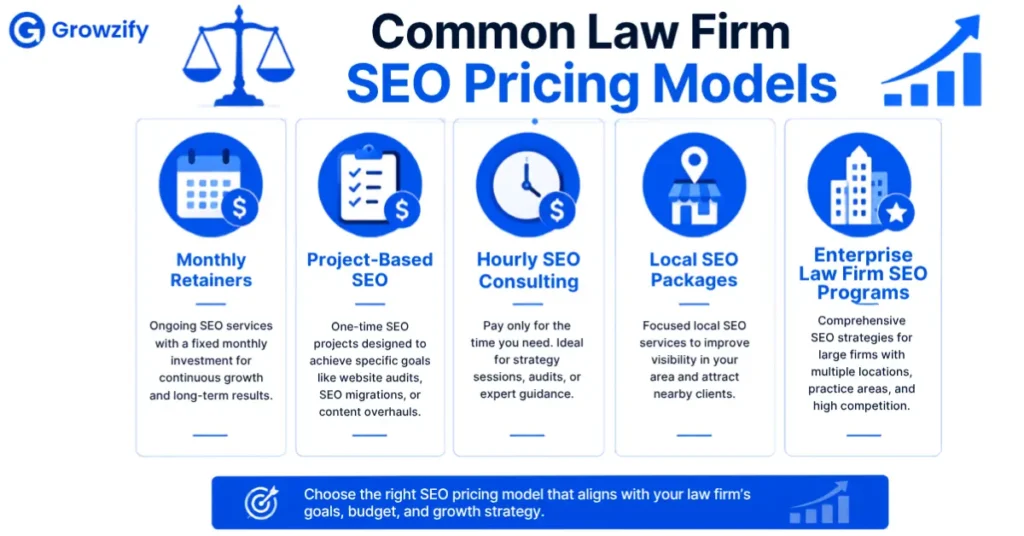
Common Law Firm SEO Pricing Models
Monthly Retainers
The most common model for law firm SEO. A firm pays a consistent monthly fee for ongoing work, including content, technical SEO, local SEO, and reporting. This model suits firms looking for steady, long-term growth.
Project-Based SEO
Some agencies offer a fixed scope project, such as a technical audit or a website migration, billed as a one-time fee. This works well for specific, defined problems, but does not replace ongoing optimization.
Hourly SEO Consulting
Fewer firms hire SEO consultants by the hour for strategy guidance or specific troubleshooting. This can be useful for firms with in-house marketing teams that need expert input rather than full execution.
Local SEO Packages
Some agencies offer standalone local SEO packages focused specifically on Google Business Profile optimization and citation management. These tend to be lower cost but narrower in scope than a full SEO campaign.
Enterprise Law Firm SEO Programs
Large, multi-location firms or legal networks often need custom enterprise pricing that accounts for dozens of locations, extensive content needs, and dedicated account management.
What Is Typically Included in a Law Firm SEO Package?
Asolid law firm SEO packageshould include the following core components:
- Keyword research identifies the specific terms potential clients use, including practice area searches and location-based phrases.
- Competitor analysis shows where competing firms are ranking and where the real opportunities exist.
- Technical SEO addresses site speed, mobile usability, crawlability, and structured data.
- Content strategy maps out what pages and topics need to be created or improved over time.
- Content creation produces the actual practice area pages, location pages, and supporting articles.
- On-page optimization fine-tunes titles, headers, and page structure for both search engines and readers.
- Local SEO manages citations, NAP consistency, and location-based visibility.
- Google Business Profile optimization keeps your listing accurate, complete, and actively managed.
- Link building earns backlinks from credible legal and local sources.
- Reporting and analytics track rankings, traffic, and most importantly, leads generated from organic search.
If a proposal is missing several of these, ask why before signing anything.
Why Cheap SEO Can Cost More in the Long Run
Low-cost SEO often looks appealing until you see what it actually delivers. Many cheap providers rely on thin, templated content copied across multiple law firm clients with minor changes. That kind of content rarely ranks and can actually hurt a site’s credibility with search engines.
Some low-cost providers also use outdated link-building tactics, including buying links from low-quality directories or link farms. This creates real risk. Google can penalize a site for unnatural backlinks, sometimes erasing months or years of progress in the process.
Sustainable SEO strategies take more time and more skill to execute correctly. A cheap provider cutting corners on technical SEO, content quality, or link building is not actually saving you money.
They are usually deferring the cost to a future cleanup project that costs more than doing it right the first time.
How to Evaluate the Value of an SEO Investment
The most useful metrics for law firms go beyond rankings and traffic numbers.
Lead qualitymatters more than lead volume. Ten qualified consultation requests are worth more than two hundred visitors who never call.
Cost per qualified leadhelps you understand the real return on your SEO spend. If your monthly retainer is $3,000 and it produces fifteen qualified leads, that is $200 per lead, which you can then compare against other marketing channels.
Conversion tracking, including calls and form submissions, shows whether your website is actually doing its job once visitors arrive.
Long-term ROIconsiderations matter because SEO compounds. A page built in month three might still be generating leads in month twenty-four without any additional spend on that specific page.
Signs a Law Firm Needs a Higher SEO Budget
Some signs suggest a firm should be investing more, not less, in SEO.
- Expanding practice areas means more content and keyword research is needed to build authority in each new area.
- Operating in multiple locations multiplies local SEO requirements across every market served.
- Competing in a saturated legal market, such as personal injury in a major city, requires significantly more investment to keep pace with well-funded competitors.
- Aggressive growth goals, such as doubling consultation requests within a year, typically require a faster, more resource-intensive SEO approach than a firm simply trying to maintain its current position.
How Long Does It Take to See Results from Law Firm SEO?
Most law firms start seeing early movement within 60 to 90 days, particularly in local search visibility and Google Business Profile performance.
Noticeable growth in organic traffic and rankings for moderately competitive keywords usually shows up within four to six months of consistent work.
Ranking for highly competitive practice area terms in larger markets can take six months to a year or longer, depending on the strength of existing competitors.
Several factors affect this timeline, including the website’s starting condition, the level of competition in your specific market, and how consistently the SEO work is executed month over month.
The biggest benefit of law firm SEO shows up over time. Unlike paid ads, the pages and rankings built in year one continue producing leads well into year two and beyond, often with a lower cost per lead the longer the campaign runs.
How to Choose the Right Law Firm SEO Partner
Ask specific questions before signing any contract. What results have they produced for other law firms? How do they measure success beyond rankings? What does a typical month of work actually include?
Watch for red flags. Guaranteed rankings, suspiciously low pricing, vague reporting, and an unwillingness to explain their process are all warning signs worth taking seriously.
The biggest difference between legal SEO specialists and general SEO providers comes down to context.
A specialist understands how legal searches work, how to write content that meets Google’s higher trust standards for legal topics, and how to navigate the specific local search dynamics that drive most attorney-client inquiries.
A generalist agency may know SEO broadly but lacks that legal-specific experience, which often shows up in thin practice area content or weak local strategy.
Why Many Law Firms Choose Growzify
Growzify works specifically within the legal industry, which shapes every part of how campaigns are built. Strategies are designed around how potential clients actually search for attorneys, not adapted from templates built for unrelated industries.
Every campaign is customized based on the firm’s practice areas, location, and competition, rather than applying a standard package regardless of fit.
Reporting stays transparent throughout the relationship, with clear visibility into what work is being done and what results it is producing each month.
The focus stays on qualified leads and long-term growth rather than short-term ranking spikes that fade once active work slows down. That approach reflects how law firm SEO actually works best, as a sustained investment rather than a quick campaign.
Making the Right Law Firm SEO Investment in 2026
Law firm SEO pricing in 2026 depends on real, identifiable factors: your practice areas, your market, your website’s starting condition, and how aggressively you want to grow.
There is no single right number, but there is a clear difference between a price that reflects real strategic work and a price that reflects cutting corners.
Before committing to any SEO investment, understand exactly what you are paying for. Ask about content, technical work, local SEO, and link building specifically. Track leads, not just traffic.
And remember that the cheapest option is rarely the most cost-effective one once you factor in the time and money needed to fix a poorly executed campaign later.
Frequently Asked Questions
How much does law firm SEO cost per month?
Most law firms pay between $1,500 and $10,000 per month for SEO, with the majority landing between $2,000 and $5,000. The exact cost depends on practice area competition, market size, current website condition, and how many locations need to be optimized. Solo attorneys in smaller markets typically pay less than multi-location firms competing in major cities.
Is SEO worth it for small law firms?
Yes, SEO is worth it for small law firms, particularly because it produces leads without the ongoing cost of paid advertising. A small firm in a less competitive market can often see strong results with a modest, consistent monthly investment. The key is matching the budget and strategy to the firm’s actual market, rather than overspending on a campaign sized for a much larger competitor.
How long does SEO take for lawyers?
Most law firms see early improvements in local visibility within 60 to 90 days. Meaningful organic traffic growth for moderately competitive terms typically takes four to six months. Ranking for highly competitive practice areas in larger markets can take six months to a year or more, depending on the strength of existing competition.
What affects law firm SEO pricing the most?
Practice area competition and geographic market tend to have the biggest impact on pricing. A personal injury firm in a major city will almost always cost more to support than an estate planning firm in a smaller town, simply because the level of competition and the work required to compete are so different. Website condition and the number of locations also play a significant role.
Why choose Growzify for law firm SEO?
Growzify focuses specifically on legal industry SEO, building customized strategies around each firm’s practice areas, location, and competitive landscape rather than applying a generic package. Transparent reporting and a focus on qualified leads, not just rankings, help firms understand exactly what their investment is producing and why it matters for long-term growth.

Chitranshu SharmaA growth strategist, digital marketing consultant, and the founder of Growzify, a performance-driven agency helping brands dominate search, shape perception, and build sustainable online visibility. With 8+ years of hands-on experience in Enterprise SEO, Online Reputation Management (ORM), and AI-led traffic generation, Chitranshu has helped startups, public figures, SaaS companies, and cannabis brands outrank competitors — ethically and at scale.
Explore More Articles

How to Find and Compare Local SEO Outsourcing Providers
How to Find and Compare Local SEO Outsourcing Providers Finding a local SEO outsourcing provider...
October 13, 2026Outsourcing

Inside a White Label SEO Campaign: How the Work Gets Done
Inside a White Label SEO Campaign: How the Work Gets Done Clients see a single...
October 13, 2026White Label

How to Vet an SEO Outsourcing Provider Before You Sign a Contract
How to Vet an SEO Outsourcing Provider Before You Sign a Contract A polished proposal...
October 9, 2026Outsourcing

Multilingual SEO Best Practices: Optimize Your Multi-Language Website
Multilingual SEO Best Practices: Optimize Your Multi-Language Website Translating a page and localizing it for...
October 7, 2026SEO

What Makes In-House Enterprise SEO Work Different Day-to-Day?
What Makes In-House Enterprise SEO Work Different Day-to-Day? On a small site, deciding to fix...
October 7, 2026Enterprise

How Core Algorithm Updates Impact Large Sites Differently Than Small Ones
How Core Algorithm Updates Impact Large Sites Differently Than Small Ones A large enterprise site...
October 7, 2026Enterprise
When Should You Outsource SEO? 11 Signs It Makes Sense
When Should You Outsource SEO? 11 Signs It Makes Sense Outsourcing SEO does not necessarily...
September 26, 2026Outsourcing