



Why AI Search Favors Some Law Firm Websites Over Others and How to Get Cited
AI search engines cite law firm websites that demonstrate strong authority, trust, and expertise. The right SEO and content strategy can improve visibility and increase AI citations.

Written byChitranshu Sharma
June 18, 2026
Quick Nav
AI search favors law firm websites that demonstrate clear authority, structured expertise, verifiable trustworthiness, and precise topical relevance. These systems do not simply rank pages the way traditional search engines do.
They evaluate which firms appear most credible, most knowledgeable, and most useful for a specific legal query, and then recommend those firms with confidence.
The firms that get recommended repeatedly are not always the largest. They are not always the oldest. They are the ones whose digital presence has been built in a way that AI systems can read, interpret, and trust.
That distinction isreshaping Law Firm SEOin ways that most legal marketing strategies have not yet caught up with.
If your firm has strong traditional SEO but limited AI search visibility, the gap is real, and it is growing. Prospective clients are asking ChatGPT, Perplexity, Gemini, and other AI platforms for legal guidance every day. The firms that appear in those answers are quietly capturing client attention at the very top of the decision-making process.
How AI Search Systems Evaluate and Recommend Law Firm Websites
Traditional search engines return a list of results based on keywords, backlinks, and technical factors. Users then choose which link to click. The search engine does not make a recommendation. It provides options.
AI search works differently. When someone asks ChatGPT, “What should I look for in a personal injury lawyer?” or asks Perplexity, “How do I find a good immigration attorney in Houston?” the AI does not show a list of links.
It synthesizes an answer and names specific sources, firms, or professionals that its training data and retrieval systems associate with credibility on that topic.
This is a fundamental shift. The AI is making a recommendation on behalf of the user. That means the firms it names are receiving an implicit endorsement. And the firms it does not name are simply absent from that conversation.
The selection process is not random. AI systems apply a layered evaluation of authority, relevance, trust, and clarity. Firms that meet those criteria consistently earn a recommendation.
Firms that do not are filtered out before the answer is ever generated. Understanding that the filter is the starting point for any seriousLaw Firm SEO strategyin the current landscape.
Authority Is the First Filter AI Uses
Before an AI system considers recommending a law firm, it must first identify the firm as an authority on the subject being queried.
Authority in AI terms is not about reputation in the traditional sense. It is about the depth and coherence of knowledge a firm has demonstrated across its digital presence.
Topical authorityis the most important dimension. A law firm that publishes comprehensive, interconnected content across a specific practice area signals to AI systems that it understands that subject deeply.
A personal injury firm that has covered negligence standards, case timelines, and jurisdiction-specific procedures in separate, well-structured pieces holds genuine topical authority on personal injury law.
A firm that has one landing page covering all of those subjects in 400 words holds almost none. The difference is not cosmetic.
AI systems are trained on enormous volumes truly understand a subject and one that is simply present on the web.
Practice area specializationamplifies authority signals. A firm that focuses its content on two or three core practice areas builds faster and deeper authority than a firm that spreads thin coverage across ten practice areas.
Depth is what AI systems recognize. Breadth without depth is invisible. Authority also compounds over time.
A firm that has been consistently publishing expert legal content for several years has built a depth of digital authority that a firm publishing for six months cannot easily replicate.
This creates a real and growing advantage for law firms that start building authority-focused content strategies now rather than waiting.
The Role of Entity Recognition in Law Firm SEO
One of the least understood aspects of AI search visibility is entity recognition, and it may be one of the most important.
An entity, in the context of AI and search systems, is a clearly defined real-world thing. A law firm is an entity. An attorney is an entity.
A practice area is an entity. AI systems work best when they can clearly identify, verify, and connect entities to each other in a coherent way.
When a prospective client asks an AI system about a law firm or a type of attorney, the system searches its training data and retrieval systems for clearly defined entities that match the query.
Firms that exist as well-defined, consistently documented entities are far more likely to be surfaced than firms that are ambiguous, inconsistently referenced, or poorly documented.
What entity clarity looks like in practice:
Your firm’s name should be identical across every platform where it appears. The website, Google Business Profile, Avvo, Martindale-Hubbell, state bar directory, LinkedIn, and every other platform should use the same name, address, and phone number.
Variations in even minor details, like abbreviating “and” to an ampersand on one platform but spelling it out on another, create ambiguity that reduces AI recognition.
Your attorneys should each have clearly documented professional identities. Attorney profiles on your website should link to and align with their bar association listings, LinkedIn profiles, Avvo profiles, and any publications or speaking engagements.
An attorney who appears as a clearly documented expert in specific legal topics is far more citable by AI systems than one who has a photo and a brief bio on the firm’s about page.
Your firm’s practice areas should be explicitly and consistently connected to your entity. When AI systems encounter your firm’s name across multiple sources, they should be seeing the same practice area associations every time.
Inconsistency here creates uncertainty that reduces recommendation confidence. Knowledge graph recognition extends this entity clarity further. Firms that appear in Google’s Knowledge Graph have achieved a level of entity verification that signals high credibility to AI systems.
Getting there requires consistent entity documentation, meaningful external references, and a well-structured website that clearly communicates what the firm is and does.
Why Content Depth Beats Content Volume
Publishing more pages does not build authority. Publishing better pages does. This is a distinction that many Law Firm SEO strategies get wrong.
The instinct is to publish frequently, to add more pages, to cover more keywords. But AI systems are not counting pages. They are evaluating whether the content on those pages genuinely advances understanding of the subject.
A tale of two law firm websites:
Firm A has 80 pages on its website. Each practice area has a landing page. There is a blog with 50 posts, most of them 400 to 600 words, covering general legal topics with basic information.
Each page is optimized for a different keyword. The content is technically correct but provides no insight beyond what any client could find in a five-minute Google search.
Firm B has 40 pages on its website. Each practice area has a hub page supported by five to eight detailed supporting articles that cover specific aspects of that area of law.
The blog posts are 1,000 to 2,000 words and answer specific, nuanced questions that actual clients ask. The content is reviewed by attorneys and reflects genuine legal expertise.
Firm B holds significantly more AI authority despite having half the page count. AI systems have been trained on enough content to recognize the difference between a page that truly answers a question and a page that simply mentions the keywords associated with a question.
Practice area content clustersare the structural framework that supports depth. A hub page on personal injury law sits at the center. Supporting articles branch out to cover every major sub-topic within that practice area.
Each supporting article links back to the hub. The hub links to each supporting article. The result is a content structure that clearly communicates to AI systems that this firm has comprehensive knowledge of personal injury law, not just a surface-level understanding.
User intent coverageis the strategic layer on top of content depth. Every piece of content should be designed to answer a real question that a real prospective client is asking at a specific stage of their legal journey.
Pre-consultation questions, process questions, cost questions, outcome questions, and timeline questions all represent intent categories that comprehensive legal content should cover.
Firms that map their content to the full range of client intent questions build the kind of resource that AI systems return to repeatedly when answering legal queries.
Trust Signals That Influence AI Recommendations
AI systems do not recommend firms that they cannot verify as trustworthy. This is especially true in legal content, which falls under the YMYL (Your Money or Your Life) category.
These are subjects where bad information has real consequences for real people, and AI systems are trained to be more cautious and more demanding about source quality in these areas.
Trust is built through signals that AI systems can find, verify, and cross-reference.
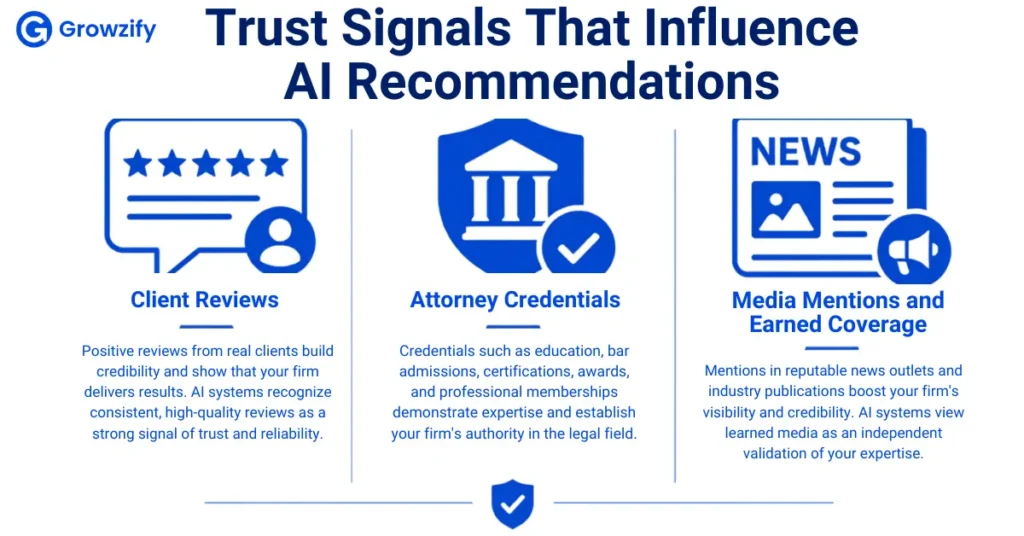
Client reviewsare among the most visible trust signals available to law firms. Reviews on Google, Avvo, Martindale-Hubbell, and other legal platforms create a documented record of client satisfaction.
Detailed reviews that describe specific experiences, mention attorney names, and reference successful outcomes are more valuable than generic five-star ratings. AI systems incorporate this data into a firm’s reputation profile.
Attorney credentialscommunicate professional legitimacy. Bar admissions, law school affiliations, years of practice, and professional recognitions should all be clearly visible on attorney profile pages and consistent across external platforms.
An attorney whose credentials can be verified by multiple independent sources is a far more trustworthy source than one whose background is described only on the firm’s own website.
Media mentions and earned coveragecarry disproportionate weight in AI trust evaluation. A law firm that has been quoted in a local news article, featured in a legal publication, or cited in a bar association newsletter has received external validation from a source the AI system already treats as credible.
These mentions function as implicit endorsements that reinforce the firm’s authority and trustworthiness.
Website Structure and Content Organization
AI systems learn what a law firm does, where it operates, and how expert it is by processing the firm’s website. How that website is structured determines how accurately and completely AI systems can extract that information.
A disorganized website with poor navigation, broken internal links, overlapping content, and unclear topic relationships creates confusion for AI parsing. The result is an incomplete or inaccurate representation of the firm in AI training data.
A well-organized website communicates its content clearly and creates explicit relationships between topics.
Content hierarchyshould reflect the firm’s practice areas and expertise. The homepage establishes the firm’s identity and top-level practice areas. Practice area hub pages sit one level below and establish comprehensive coverage of each area.
Supporting content sits below each hub and provides detailed answers to specific questions within each practice area. This hierarchy tells AI systems exactly what the firm specializes in and how deeply it covers each topic.
Internal linkingis the connective tissue of this structure. Links from hub pages to supporting articles and back again create a web of topic relationships that AI systems can follow and interpret.
When every piece of content is connected to related content through relevant internal links, the firm’s topical authority becomes structural rather than incidental.
Navigation clarityaffects both user experience and AI parsability. A firm whose navigation clearly separates practice areas, attorney profiles, client resources, and contact information gives AI systems a clean map of the site’s content.
A firm with a confusing or cluttered navigation structure forces AI systems to guess at content relationships, which reduces the confidence of any subsequent citation or recommendation.
Schema markuptranslates this structure into machine-readable code. Legal Service schema explicitly tells search and AI systems that the firm provides legal services in specific areas.
Attorney schema documents individual attorneys with credentials and specializations. The FAQ Page schema marks up question-and-answer content for direct AI extraction. Local Business schema anchors the firm’s identity to its geographic location.
Without a schema, AI systems must infer all of this information from unstructured text. With a schema, the information is provided directly in a format designed for machine reading. The difference in AI parsability is significant.
Local SEO and AI Search Visibility
For most law firms, clients come from a specific geographic area. AI systems increasingly incorporate geographic relevance into their legal recommendations, particularly for queries that include location or imply local intent.
Local SEO remains one of the most powerful levers available to law firms, and its importance in AI search is growing rather than diminishing.
Google Business Profileis the most visible local signal available to any law firm. A complete, accurate, and actively maintained profile with consistent business information, a comprehensive service description, and regular posts signals active local relevance.
Local citation consistencyreinforces entity recognition for location-specific queries. When a firm’s name, address, and phone number are identical across every local and legal directory, AI systems can confidently associate that firm with its geographic location. Inconsistencies, even small ones, reduce that confidence.
Location-specific contentstrengthens geographic authority in AI training data. Content that references local court procedures, state-specific legal standards, local jurisdiction nuances, and community-relevant legal topics signals geographic expertise.
A Texas personal injury firm that publishes content on Texas comparative fault laws is more geographically credible in AI systems than one that publishes generic injury law content that could apply anywhere.
Local community recognitionbuilds geographic trust signals beyond directories. Coverage in local news publications, mentions on local bar association platforms, speaking engagements at community events, and participation in regional legal associations all contribute to a firm’s local authority profile.
Firms that treat local SEO as a foundation rather than an afterthought build geographic authority that AI systems recognize and reward in location-specific recommendations.
The Relationship Between Traditional SEO and AI Search
Traditional SEO and AI search visibility are not opposites. They share a common foundation, but they diverge at the level of depth and quality required.
Signal | Traditional SEO Weight | AI Search Weight |
Keyword optimization | High | Moderate |
Backlink quantity | High | Moderate |
Content depth | Moderate | Very High |
Entity recognition | Low | Very High |
Author credentials | Low | High |
Topical authority | Moderate | Very High |
Schema markup | Moderate | High |
Trust signals | Moderate | High |
Content recency | Moderate | High |
Local citation consistency | High | High |
Traditional SEO focuses heavily on technical optimization, keyword placement, and backlink acquisition. These signals still matter for Google rankings, and Google rankings still feed the data pipeline that influences AI systems.
The firms that will perform best in the coming years are those that treat traditional SEO as the foundation and layer AI-specific authority signals on top of it.
That means technical excellence, content depth, entity clarity, trust signal development, and a long-term commitment to topical authority rather than short-term keyword targeting.
How Law Firms Can Increase Their Chances of Being Recommended by AI
Understanding the problem is one thing. Building toward the solution requires a structured, prioritized approach.
Start with a content audit.Before adding new content, assess what exists. Identify thin pages, outdated information, missing author attribution, and practice areas with no supporting content cluster.
The audit creates a clear picture of the gap between where the firm is and where it needs to be for AI visibility.
Build content clusters around each core practice area.Identify the primary practice areas the firm wants to own. Build a hub page for each one. Develop five to ten supporting articles that cover specific sub-topics within each practice area.
Connect them through internal linking. This structure should be the central content investment priority.
Strengthen entity documentation.Audit every platform where the firm or its attorneys appear. Ensure complete consistency in name, address, phone number, and practice area descriptions.
Create or complete profiles on major legal directories. Update attorney profiles on the website to include bar admission details, law school, years of practice, and verifiable credentials.
Implement schema markup.At a minimum, implement LegalService, Attorney, FAQPage, and LocalBusiness schema across the website. This step alone significantly improves AI parsability and should be treated as a technical priority.
Develop a review generation process.Encourage satisfied clients to leave detailed reviews on Google and legal platforms. Make it easy by sending follow-up emails with direct links. A consistent flow of specific, meaningful reviews builds the trust profile that AI systems rely on.
Pursue earned citations from authoritative sources.Identify legal publications, local news outlets, bar association platforms, and relevant community organizations where the firm could earn mentions or coverage. Develop relationships and content strategies that facilitate those placements over time.
Audit and update existing content regularly.Establish a content review cycle that ensures all practice area content reflects current legal standards and procedures. Content that is accurate and current holds its authority. Content that becomes outdated loses its relevance.
Add FAQ sections to all major pages.FAQ content using the FAQ Page schema format is among the most extractable content for AI systems. Every practice area page, every major blog post, and every attorney profile page should include structured question-and-answer content addressing the most common questions in that area.
How Growzify Helps Law Firms Build AI Search Visibility
Growzify Digital is a legal SEO agency that specializes in building the type of digital authority that AI search systems require.
The approach at Growzify begins with a diagnostic audit that evaluates a firm’s current content architecture, entity documentation, technical SEO health, trust signal profile, and local visibility.
This audit identifies the specific gaps preventing AI recognition and produces a prioritized roadmap tailored to the firm’s practice areas, markets, and competitive positioning.
AI-focused content strategyis at the center of the Growzify methodology. The content team produces legal content that meets two simultaneous standards. It answers real questions from real prospective clients, and it is structured in a way that AI systems can extract, interpret, and cite with confidence.
Every piece is attorney-reviewed, formatted with appropriate schema markup, and integrated into a coherent content cluster rather than published as an isolated page.
Entity-based optimizationis treated as a distinct workstream. Growzify audits all external platforms, legal directories, and citation sources to identify inconsistencies and gaps.
Corrections are made systematically, and new entity documentation is developed across all platforms relevant to the firm’s market and practice areas. The goal is a firm identity that AI systems can recognize, verify, and consistently associate with its specific areas of legal expertise.
Authority-building frameworksat Growzify include targeted link acquisition from legal publications and relevant local media, earned citation strategies, and structured approaches to building the external validation signals that AI systems treat as trust indicators.
This is long-term work that compounds over time, and Growzify structures it as an ongoing investment rather than a one-time project.
Local SEO enhancementsaddress the geographic authority signals that drive AI visibility for location-specific legal queries. Growzify manages Google Business Profile optimization, local citation audits, location-specific content development, and review generation strategies that build the geographic authority AI systems rely on when answering local legal questions.
Long-term visibility planningensures that the firm’s AI search authority grows with every content investment, every citation earned, and every trust signal strengthened.
Growzify positions AI search visibility as a compounding asset, not a campaign. The firms that work with Growzify are building toward a point where AI systems recommend them automatically because their authority signals are too strong to ignore.
Frequently Asked Questions
Why does AI recommend some law firms more often than others?
AI systems recommend law firmsthat have clearly demonstrated expertise, verifiable credibility, and comprehensive coverage of the legal topics relevant to the user’s query. Firms that appear repeatedly are those whose content directly answers the questions being asked, whose digital presence is consistent and well-documented across multiple trusted platforms.
Can smaller law firms compete with larger firms in AI search?
Yes, and in many cases, smaller firms have a structural advantage they are not using. A solo practitioner or small firm that focuses its Law Firm SEO strategy on one or two practice areas and builds deep, expert-level content around those areas can achieve higher AI authority in those specific areas than a large full-service firm that spreads thin content across twenty practice areas.
What are the biggest Law Firm SEO mistakes that reduce AI visibility?
The most damaging mistakes are consistent patterns rather than single errors. Publishing thin, generic content that provides no unique legal insight is the most widespread problem. Missing attorney attribution on legal content removes a critical trust signal. Inconsistent business information across directories and platforms breaks entity recognition. Failing to implement schema markup forces AI systems to guess at content relationships rather than reading them directly.
How long does it take to build authority for AI search?
Building meaningful AI search authority typically takes six to twelve months of consistent, structured effort for firms starting from a limited baseline. Firms with existing domain authority and some content depth often see measurable improvement in AI visibility within three to six months of implementing targeted authority and content strategies.
How does Growzify help law firms improve their visibility in AI search specifically?
Growzify builds Law Firm SEO strategies designed specifically for the signals that drive AI search visibility. The process starts with a comprehensive audit that identifies the exact gaps in a firm’s content depth, entity documentation, technical structure, trust signals, and local authority. From that audit, Growzify develops a firm-specific roadmap covering content cluster development, schema implementation, entity optimization across all platforms, authority building through targeted citations and earned media, and local SEO enhancements tailored to the firm’s geographic markets.

Chitranshu SharmaA growth strategist, digital marketing consultant, and the founder of Growzify, a performance-driven agency helping brands dominate search, shape perception, and build sustainable online visibility. With 8+ years of hands-on experience in Enterprise SEO, Online Reputation Management (ORM), and AI-led traffic generation, Chitranshu has helped startups, public figures, SaaS companies, and cannabis brands outrank competitors — ethically and at scale.
Explore More Articles

How to Find and Compare Local SEO Outsourcing Providers
How to Find and Compare Local SEO Outsourcing Providers Finding a local SEO outsourcing provider...
October 13, 2026Outsourcing

Inside a White Label SEO Campaign: How the Work Gets Done
Inside a White Label SEO Campaign: How the Work Gets Done Clients see a single...
October 13, 2026White Label

How to Vet an SEO Outsourcing Provider Before You Sign a Contract
How to Vet an SEO Outsourcing Provider Before You Sign a Contract A polished proposal...
October 9, 2026Outsourcing

Multilingual SEO Best Practices: Optimize Your Multi-Language Website
Multilingual SEO Best Practices: Optimize Your Multi-Language Website Translating a page and localizing it for...
October 7, 2026SEO

What Makes In-House Enterprise SEO Work Different Day-to-Day?
What Makes In-House Enterprise SEO Work Different Day-to-Day? On a small site, deciding to fix...
October 7, 2026Enterprise

How Core Algorithm Updates Impact Large Sites Differently Than Small Ones
How Core Algorithm Updates Impact Large Sites Differently Than Small Ones A large enterprise site...
October 7, 2026Enterprise

When Should You Outsource SEO? 11 Signs It Makes Sense
When Should You Outsource SEO? 11 Signs It Makes Sense Outsourcing SEO does not necessarily...
September 26, 2026Outsourcing