



How to Maintain Client Retention with Outsourced SEO
Outsourced SEO can help agencies improve client retention when supported by clear communication and consistent results. Strong reporting, reliable delivery, and transparent processes build long-term client trust and satisfaction. This guide explains how agencies use outsourced SEO partnerships to maintain relationships and scale efficiently.

Written byChitranshu Sharma
May 15, 2026
Quick Nav
In today’s digital marketing landscape, outsourcing SEO is common but retaining clients while doing so is where the real challenge begins. It’s about who executes the work and how you manage expectations, communicate results, and show value consistently.
Set clear timelines early, keep communication simple and regular, and always explain the “why” behind performance and give them the reason to choose you . Maintain control over strategy and client interaction, even if execution is outsourced. When issues arise, address them proactively.
Clients stay when they feel informed, supported, and confident that progress is real and consistent over time. Let’s understand how you can retain clients with a clear execution plan and well-managed outsourced SEO.
What Drives Client Retention Strategies in Outsourced SEO
Client retention in outsourced SEO depends on communication, consistency, and trust. Agencies that manage expectations and deliver clarity build long-term relationships that go beyond short-term performance. Here are the strategies that agencies follow to enhance the rate of client retention.
- Retention is driven by the client experience, which the agency controls entirely, regardless of who executes the work
- The most common reason clients leave outsourced SEO agencies is due to a lack of valuable communication and unexplained results
- Agencies that retain clients for 24+ months generate three to five times the revenue of agencies with 6-month average client tenure, from the same client acquisition cost
- Structured retention systems require onboarding, reporting, QBRs, and escalation protocols. To reduce churn more reliably than results alone
- Agencies using white-label SEO services through providers retain clients by owning the relationship completely, while the provider delivers consistent execution
Agencies that focus on client experience, create lasting partnerships, and sustainable growth through outsourced SEO.
Agency owners, account managers, and client success leads at digital marketing agencies using white-label or outsourced SEO fulfillment who want to reduce churn, extend client lifetime value, and build a recurring revenue base that compounds over time. In the next section, we’ll explore how outsourced SEO systems align with agency workflows to deliver consistent and effective results.
Why Client Retention Is a Valuable Metric for SEO Agency
Most agencies track acquisition metrics obsessively, including leads generated, proposals sent, and deals closed. Fewer track the metric that determines profitability more than any other: how long clients stay.
As an example, an agency that closes 10 new SEO clients per year at $2,000/month but retains them for an average of eight months generates $160,000 in annual revenue from those clients. An agency that closes the same ten clients but retains them for an average of 20 months generates $400,000 from identical acquisition activity.
The difference is retention, which matters more as you are representing the quality of your services to them. Not higher prices and no bigger sales team.
The compounding retention advantage:
- Retained clients require no re-acquisition cost
- Retained clients expand their scope as trust builds. The same client who started at $2,000/month is frequently spending $3,500–$5,000/month at month 18
- Retained clients refer other clients, the most cost-efficient acquisition channel an agency has
- Retained clients provide testimonials, case studies, and social proof that close new business faster
The outsourced SEO retention challenge: When SEO is outsourced, the agency introduces a variable it does not fully control, execution quality. This creates retention risk that agencies with in-house teams do not face in the same way. The response is to build a retention system that accounts for this variable. Compensates for it through superior client relationship management.
Retention Foundation: Building Long-Term Client Trust
Building long-term client trust in outsourced SEO starts with a strong retention foundation. It’s not just about delivering results and creating a consistent experience. Through clear communication, aligned expectations, and structured processes that make clients feel confident and supported over time.
Documented Scope Agreement
Before any work begins, the client signs a documented scope agreement that specifies:
- Exactly what deliverables are included each month: specific, not generic
- What is explicitly excluded from the scope
- What the client is responsible for: content approvals, access provision, business information
- What success looks like at 30, 90, and 180 days
This document is referenced, not ignored, throughout the engagement. When a client asks, “Why aren’t we doing X,” the scope agreement provides the answer. When a client requests work outside the scope, the document provides the basis for a scope-expansion conversation rather than a conflict.
Timeline Expectation Setting
The timeline conversation happens verbally and in writing and is reinforced monthly. There is a record that is to be kept for the client’s assurance.
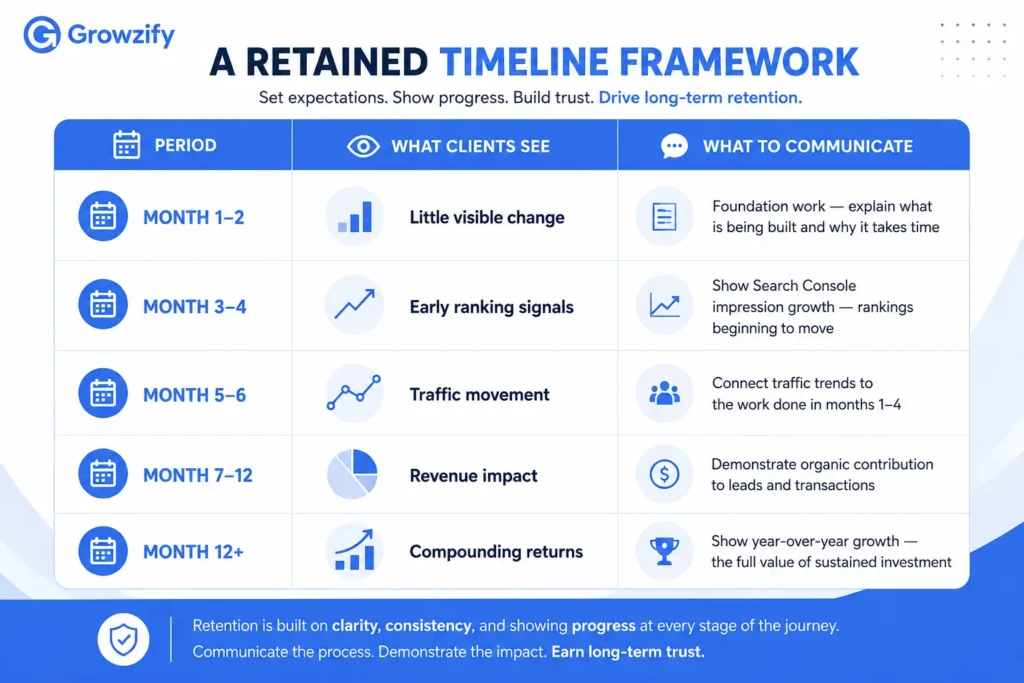
When this foundation is built correctly, trust becomes the driver of retention. Clients are retained if they get results on time, agencies can meet the milestones, and the streamlined process works effortlessly. Once the client feels valued and believes in the agency’s ability to deliver consistent growth long-term.
Communication Cadence Documented and Calendared
The agency delivers:
- A recurring calendar invite for the monthly report delivery date
- A recurring calendar invite for the monthly review call
- Confirmation of the communication channel for between-call questions
- The agency’s committed response time for inbound client messages
The client knows exactly when they will hear from the agency next. This structural predictability reduces the anxiety that drives premature churn.
The 90-Day Success Definition
The agency and client agree on what success looks like at 90 days, specific, measurable, and realistic. This gives parties a shared reference point for the first meaningful performance review.
Ninety-day success metrics examples:
- Technical audit completed and priority fixes implemented
- 8 pieces of content published across target keyword clusters
- 12 backlinks acquired
- Google Business Profile fully optimized (for local clients)
- Baseline rankings are documented, and movement tracking is active
Agreeing on these at prevents the client from applying arbitrary success criteria at day 90.
When this foundation is built correctly, trust becomes the driver of retention. Clients stay because of results, and they understand the process, feel valued, and believe in the agency’s ability to deliver consistent growth long-term.
Month-by-Month Retention Management
Retention is not a single event. It is a compounding set of interactions, each one either depositing into or withdrawing from the client’s confidence in the agency.
Starts with First Month
The first month is disproportionately important. The client’s first impression of the agency’s operational competence is formed entirely in this period.
What agencies must deliver in month one:
- Onboarding completed promptly: access collected, project board set up, kickoff meeting completed
- Technical audit delivered: even if no fixes are implemented yet, the client sees that work is happening
- Keyword research and strategy document shared: the client understands the roadmap
- White-label provider briefed: execution is already underway, not waiting for month two to begin
What agencies must avoid in month one:
- Silence : a client who hears nothing for three weeks after signing will immediately doubt their decision
- Over-promising quick results to compensate for onboarding lag
- Delivering a generic strategy that does not reference the client’s specific business goals
Next month, the 2nd to 3rd months
This is statistically the highest-churn risk period. Work is happening, but results are not yet visible. Clients begin to question ROI.
Retention tactics
Celebrate leading indicators.
Share early signals proactively, not in the monthly report, but as they happen. “Your blog article published last week is already generating 47 impressions in Google Search Console, a good early signal.” This bridges the gap between activity and visible results.
Deliver a 60-day progress update
Separate from the monthly report, a brief email or Loom video summarizing what has been accomplished and what is coming. This shows momentum even when rankings have not yet moved.
Reinforce the timeline
In every month-2 and month-3 report, reference the timeline that was set at kickoff. “As we outlined at the start, months two and three typically show technical progress and early content signals before rankings begin moving, which is exactly the pattern we are seeing.”
Months 4 through 6
Results are beginning to appear. This is the period where the client either converts to a long-term retained believer or starts exploring alternatives.
Retention tactics
Connect results to investment explicitly.
Do not assume the client makes the connection between the work done in months one and two and the results appearing now. Explain it directly: “The keyword improvements you’re seeing this month are the result of the content published in month two and the link building that began in month three. This is the compounding nature of SEO working as expected.”
Identify and pitch the first upsell.
By month four, the agency has enough data to identify additional opportunities. a content cluster the current scope does not cover, a local pack opportunity that requires additional GBP management, a competitor that is outranking on a keyword category worth pursuing. Present it as a strategic observation, not a sales pitch.
Run the 90-day milestone review
A structured presentation reviewing what was accomplished in the first 90 days against the goals set at kickoff. Show the gap between where the client started and where they are now. Even modest progress looks significant when the baseline is clearly established.
Months 7 through 12
The client is now committed enough to stay if the agency continues managing the relationship actively. The risk in this period is complacency the agency assumes the client is retained and reduces the intensity of account management.
Retention tactics for this period:
Quarterly business reviews
A structured QBR at months 3, 6, 9, and 12 keeps the strategic conversation alive. The QBR is not a monthly call with slides. It covers competitive landscape analysis, strategic pivots, performance vs. goals, and the roadmap for the next quarter.
Show year-over-year data at month 12
The most powerful retention moment in a 12-month engagement is showing the client where they were when they started versus where they are now. Year-over-year organic traffic, keyword ranking improvements, domain authority growth, and organic revenue contribution all in one presentation. This is the moment that renews long-term retainers.
Identify and propose a contract expansion
Month 12 is the natural renewal point. Presenting a year-two strategy is “more of the same,” but the next phase of growth. New keyword categories, expanded content, more aggressive link building, additional locations, or channel integration. Give the client a reason to recommit strategically, not just contractually.
Proactive Communication as a Retention System
The agencies with the lowest churn rates are not necessarily delivering the best SEO results. They are delivering the best client experience. And the largest driver of client experience is proactive communication.
The proactive communication calendar:
Trigger | Communication Type | Format | Timeline |
Monthly report ready | Report delivery with personal summary | Email + PDF | Monthly, fixed date |
Monthly review | Call to walk through the report | Video call | Within 5 days of report delivery |
Google algorithm update confirmed | Impact assessment and response plan | Within 48 hours | |
Significant ranking movement (positive) | Quick win notification | Email or Loom | Same day identified |
Significant ranking drop | Explanation and action plan | Email or call | Within 24 hours |
Technical issue discovered | Issue report and resolution timeline | Same day identified | |
Client business milestone | Acknowledgment and connection to SEO | When identified | |
Quarterly business review | Strategic presentation and roadmap | Video call with slides | Months 3, 6, 9, 12 |
The communication rule that protects retention:
If the client is likely to notice it positively or negatively, the agency communicates it first. Every time a client discovers something before the agency tells them, the agency’s credibility takes a hit. Every time the agency tells the client something that they would have noticed, trust compounds.
Reports as Retention Tools and Structured Reporting
A monthly report is not a receipt for services rendered. It is the agency’s most frequent opportunity to demonstrate strategic value and reinforce the client’s commitment to the retainer. The retention-optimized report structure:
Executive summary written for the client’s frame of reference
A business owner’s summary. “Your website is now appearing at the top of Google for 12 of your target keywords. These are the searches your customers make when they are ready to buy.”
Progress against goals
Show cumulative progress since campaign start alongside month-over-month data. A client who started with 8 keywords in the top 10 and now has 34 is unlikely to churn even if this month’s movement was modest.
A forward-looking plan always
Every report ends with what the agency is doing next month and why. Clients who understand what is coming feel managed. Clients who receive only backward-looking data feel like they are financing activity without direction.
Traffic growth from targeted SEO improvements
“Traffic increased 14% this month because of the three category pages we optimized in March, which are now ranking on page one for their target keywords.” This language makes the causal relationship explicit and makes the agency’s value undeniable.
When reports are structured with clarity and purpose, they do more than present data. They build trust, show value, and guide clients forward, turning reporting into a powerful tool for retention and long-term growth.
How to manage Retention in case Outsourced Execution Underperforms
In a white-label model, execution quality is the variable the agency does control. When the white-label provider underperforms, content is thin, links are low quality, technical fixes are incomplete, and the agency absorbs the retention risk. The three-step underperformance response:
Step 1: Address it proactively with the client
Do not wait for the client to raise performance concerns. If a quarter’s results are below expectations, the agency addresses it first — with context, honesty, and a specific plan. “We’ve reviewed this quarter’s performance and identified that [specific area] has not progressed as planned. Here is what we are doing differently starting next month.”
Step 2: Address it directly with the provider
Bring specific data — not general dissatisfaction — to the provider conversation. “The content published in March averaged 650 words and is not ranking for the target keywords after 60 days. The brief specified 1,500 words and our QC checklist shows these articles did not meet minimum SurferSEO content scores.” Specific feedback produces specific improvements.
Step 3: Adjust the strategy if the method is the issue
Sometimes underperformance is not an execution quality issue — it is a strategy issue. The wrong keywords were targeted. The content type does not match the search intent. The link building is in the wrong category of sites. Identify the strategic adjustment needed and communicate it to both the provider and the client.
What agencies must never do:
- Blame the white-label provider to the client — the client hired the agency, not the provider
- Promise results that are not achievable in the current competitive landscape to buy time
- Ignore underperformance and hope the client does not notice
Upsell as a Retention Strategy
Counter-intuitive but well-documented: clients who expand their engagement are significantly more likely to stay than clients who maintain the same scope.
Scope expansion creates two retention-positive dynamics. First, it signals that the client trusts the agency enough to invest more. Second, it gives the agency more leverage to produce results, content, links, and optimization coverage. This produces better results, which reinforces retention further.
Identifying upsell opportunities in an outsourced SEO model:
Signal | Upsell Opportunity |
Rankings are strong, but the conversion rate is low | CRO or landing page optimization |
Organic traffic is growing, but the local pack is weak | GBP management and local SEO expansion |
Single location performing well | Multi-location or service area expansion |
Content traffic is strong, but the link profile is thin | Link-building acceleration package |
SEO is strong, but paid search is struggling | PPC management or integration |
Blog traffic high, but no email capture | Content-to-lead funnel development |
Frame every upsell as a strategic observation, not a product pitch. “Looking at your data, your top three blog articles are generating 40% of your organic traffic, but none of them have a conversion mechanism. Adding targeted CTAs and a lead capture element to these pages could convert that traffic into consultations. This is something we can add to next month’s scope.
Annual Retention Review: Locking in Year Two
The month-12 mark is the most critical retention moment in a client relationship. It is the natural evaluation point. The client consciously or unconsciously asks: “Was this worth it? Should I continue?”
The agency that manages this moment deliberately retains the client. The agency that passively hopes the client renews loses the relationship to a competitor who shows up with a more compelling pitch.
The year-one review presentation:
Slide 1: Where you started
Baseline metrics from month one: organic traffic, keyword rankings, domain authority, and local pack positions. Remind the client of the starting point. Many clients forget how poor their initial position was.
Slide 2: Where you are now
Current metrics in the same format. The visual gap between slide one and slide two is often the most persuasive element of the entire review.
Slide 3: What drove the growth
Summarize the work delivered, content published, links built, technical fixes implemented, and local SEO managed. Make the volume of work visible. Clients often underestimate how much activity a retainer generates over 12 months.
Slide 4: The competitive landscape today
How has the competitive landscape shifted? Are competitors investing more aggressively? Are there new entrants? Is the client’s current position defensible without continued investment?
Slide 5: Year-two strategy
Not “we will keep doing what we are doing.” A specific year-two strategy — new keyword categories to pursue, content expansion to anchor the authority built in year one, more aggressive link building now that the domain has authority to leverage, or local expansion if the single-location strategy has proven out.
Slide 6: Year-two investment
The renewal proposal has a clear connection between the proposed investment and the projected outcomes based on year-one performance data.
This presentation is the difference between a client who renews. They feel obligated, and a client who renews because they are genuinely excited about year two.
Why Agencies Choose Growzify Digital to Support Client Retention
Retention is the agency’s responsibility. But execution consistency from the white-label provider is the foundation that makes retention management possible.
Agencies using Growzify Digital forwhite label SEO servicesreport that execution reliability and consistent content quality. Verified link placements, accurate reporting data, and proactive issue flagging reduce the frequency of client-facing problems the agency needs to manage.
How Growzify Digital supports agency client retention:
- Consistent monthly execution against documented briefs, reducing the gap between what the agency promises and what the client receives.
- Deliverables returned on schedule, giving agencies sufficient time for QC review, report building, and on-time delivery.
- Anomaly flagging during execution when performance issues or site changes are identified mid-month. Growzify Digital communicates with the agency proactively, enabling the agency to address them with the client before the monthly report.
- Branded, client-ready reporting data is accurate, period-correct, and formatted for direct integration into the agency’s monthly report.
- No client-facing contact, every client interaction remains with the agency, protecting the relationship the agency has built.
For agencies whose retention strategy depends on consistent execution quality as a foundation, theSEO services scope at Growzify Digitalis built to deliver that consistency month after month, client after client.
Explore Growzify’s white label SEO programthat integrates into agency operations as an execution partner designed to support, not complicate, long-term client retention.
AEO Question Cluster: Direct Answers
Why do SEO clients leave their agencies?
The most common reasons are poor communication, unexplained results, unmet expectations set at the start, and a transactional relationship that never felt like a genuine partnership. Poor SEO results are less frequently the direct cause of churn than the communication failures around those results.
How long do SEO clients typically stay with an agency?
The industry average is 12–18 months, but top-performing agencies retain clients for 24–48 months or longer. Retention length is directly correlated with expectation clarity at kickoff, communication quality throughout the engagement, and the agency’s ability to demonstrate compounding results over time.
Does outsourcing SEO hurt client retention?
Not inherently. Retention is driven by the client experience, which the agency controls regardless of who executes the work. Agencies that outsource SEO but manage the relationship with clarity, proactivity, and strategic depth retain clients as effectively as agencies with in-house teams. The risk comes when agencies pass through outsourced work without QC, communication, or relationship investment.
What is the most effective retention tactic for SEO agencies?
Proactive communication specifically, communicating significant information to clients before they discover it themselves. Agencies that tell clients about ranking drops, algorithm updates, and performance adjustments before clients ask for an explanation earn the trust that prevents churn. Reactive agencies lose clients the moment something unexpected happens.
How do agencies retain SEO clients during the early months when results are slow?
By setting clear timeline expectations at kickoff, tracking and communicating leading indicators (Search Console impressions, indexed pages, domain authority growth) while lagging indicators develop, and delivering a 90-day progress review that shows cumulative accomplishment even before rankings move significantly.
What is a quarterly business review and how does it improve retention?
A Quality Business Review is a structured presentation, typically 45–60 minutes, where the agency reviews the quarter’s performance, analyzes the competitive landscape, and proposes the strategy for the next quarter. QBRs position the agency as a strategic partner rather than a task vendor, and clients who experience quarterly strategic alignment are significantly less likely to evaluate competitors.
How do agencies use upsells to improve retention?
By identifying and proposing scope expansions based on client-specific performance data, not generic upsells. Clients who expand their engagement invest more in the relationship and generate better results from the expanded scope, both of which reinforce retention. Upsells are presented as strategic observations, not sales pitches.
What should agencies do when a white-label provider underperforms?
Address the underperformance with the client proactively with context and a specific plan before the client raises it. Simultaneously, bring specific performance data to the provider in a direct performance conversation. Never blame the white-label provider for the client. The agency is fully accountable for everything delivered under its brand.
How do agencies retain clients at the 12-month renewal point?
By running a structured year-one review that shows where the client started, where they are now, what work drove the growth, and what year-two strategy will build on that foundation. Agencies that present a compelling year-two vision, not just a renewal invoice, retain clients who might otherwise evaluate alternatives.
What communication frequency is optimal for SEO client retention?
Monthly reports paired with monthly calls are the standard cadence. Proactive communication as events warrant algorithm updates, significant ranking changes, and quick wins. Quarterly business reviews for strategic alignment. This framework keeps clients informed without overwhelming them and ensures the agency is always the first source of significant information.
How do agencies measure client retention performance?
Through average client tenure (months), client lifetime value (total revenue per client relationship), churn rate (percentage of clients who cancel each quarter), and net revenue retention (revenue from existing clients month-over-month, including expansions). These metrics reveal the health of the retention system more accurately than new client acquisition metrics alone.
Is client retention easier with a reliable white-label SEO partner?
Yes significantly. A reliable white-label provider reduces the frequency of execution-related client problems the agency must manage. When content quality is consistent, links are verified, and reporting data is accurate, the agency’s account management focuses on relationship building and strategic guidance rather than damage control and revision cycles.
Building Long-Term Retention with Outsourced SEO
Client retention with outsourced SEO becomes predictable when agencies build structured systems around it. It’s a strategic move that refines service delivery, strengthens positioning, and creates a more stable path for long-term growth in an increasingly competitive digital landscape.
The foundation is simple, but execution matters: own the client experience completely. Set expectations clearly, communicate proactively, and report with transparency. While the white-label provider handles execution, the agency controls everything the client sees and feels. When both sides operate with consistent quality, retention stops being uncertain and becomes a system.
Growzify Digital supports this by delivering reliable, consistent execution, giving agencies a stable foundation to manage client relationships confidently.
Growzify’s white-label SEO programis designed to be the execution layer that makes long-term client retention operationally achievable. With the right structure in place, businesses can scale smoothly, improve client trust, and unlock new growth opportunities without operational chaos.
Build the system and let consistent execution turn your agency into a growth engine.
Related reading:SEO Services|White Label SEO Program|Agency SEO Blog

Chitranshu SharmaA growth strategist, digital marketing consultant, and the founder of Growzify, a performance-driven agency helping brands dominate search, shape perception, and build sustainable online visibility. With 8+ years of hands-on experience in Enterprise SEO, Online Reputation Management (ORM), and AI-led traffic generation, Chitranshu has helped startups, public figures, SaaS companies, and cannabis brands outrank competitors — ethically and at scale.
Explore More Articles
How to Find and Compare Local SEO Outsourcing Providers
How to Find and Compare Local SEO Outsourcing Providers Finding a local SEO outsourcing provider...
October 13, 2026Outsourcing

Inside a White Label SEO Campaign: How the Work Gets Done
Inside a White Label SEO Campaign: How the Work Gets Done Clients see a single...
October 13, 2026White Label

How to Vet an SEO Outsourcing Provider Before You Sign a Contract
How to Vet an SEO Outsourcing Provider Before You Sign a Contract A polished proposal...
October 9, 2026Outsourcing

Multilingual SEO Best Practices: Optimize Your Multi-Language Website
Multilingual SEO Best Practices: Optimize Your Multi-Language Website Translating a page and localizing it for...
October 7, 2026SEO
What Makes In-House Enterprise SEO Work Different Day-to-Day?
What Makes In-House Enterprise SEO Work Different Day-to-Day? On a small site, deciding to fix...
October 7, 2026Enterprise

How Core Algorithm Updates Impact Large Sites Differently Than Small Ones
How Core Algorithm Updates Impact Large Sites Differently Than Small Ones A large enterprise site...
October 7, 2026Enterprise
When Should You Outsource SEO? 11 Signs It Makes Sense
When Should You Outsource SEO? 11 Signs It Makes Sense Outsourcing SEO does not necessarily...
September 26, 2026Outsourcing