



Why Your GBP Is Not Ranking (And How to Fix It)
Many Google Business Profiles fail to rank due to weak optimization, inconsistent information, low engagement, or poor local SEO signals. This guide explains the common reasons behind low GBP visibility and practical ways to improve rankings. Learn how reviews, categories, content, citations, and proximity affect local search performance.

Written byChitranshu Sharma
May 14, 2026
Quick Nav
A Google Business Profile fails to rank in the Local Pack when one or more of Google’s three core local ranking signals, relevance, distance, and prominence. Common causes include incorrect or broad primary categories, incomplete profile fields, NAP inconsistencies across directories, and insufficient local authority signals.
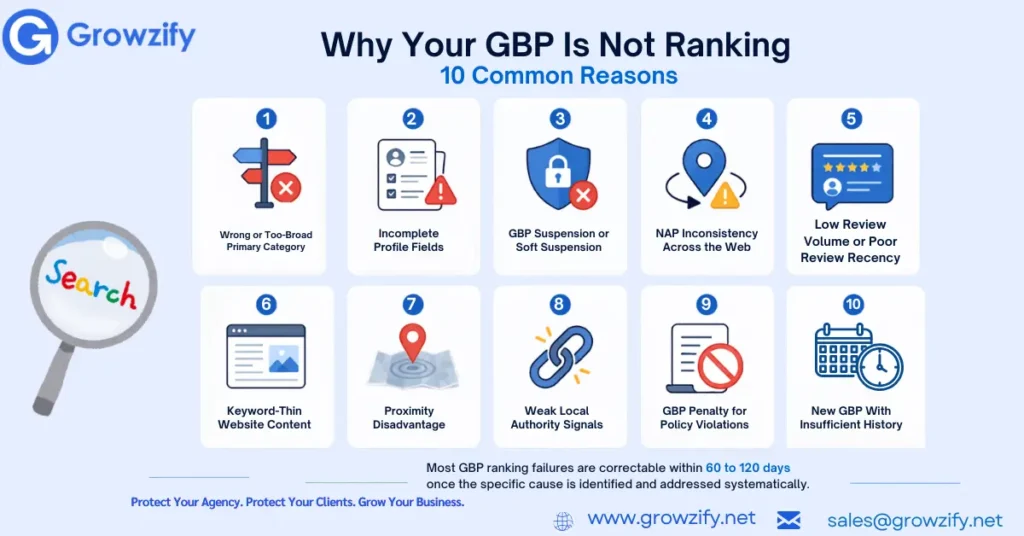
Most GBP ranking failures are correctable within 60 to 120 days once the specific cause is identified and addressed systematically.
- An incorrect primary category is the single most common cause of GBP ranking failure for core service keywords
- A suspended or soft-suspended GBP will not appear in any Local Pack results, regardless of other optimization
- NAP inconsistencies across directories reduce Google’s confidence in the business’s legitimacy and suppress rankings
- Low review count and poor review recency signal weak prominence, a primary Local Pack ranking factor
- A website with thin or no location-specific content fails to reinforce the geographic relevance GBP needs to rank
Who it is for:Business owners, local SEO practitioners, and agency strategists troubleshooting why a Google Business Profile is not appearing in Local Pack results or ranking lower than expected for target keywords.
The Frustration of an Invisible GBP
You claimed the profile. You filled in the hours and the phone number. You uploaded a few photos. You verified the business. And then, nothing. Competitors you know are inferior appear in the top three Local Pack positions, while your profile sits somewhere on page two of Google Maps results.
This is one of the most common and most frustrating situations in local SEO. The business exists, the profile exists, and the service exists, but Google is not connecting any of them to local searchers.
The good news:
GBP ranking failures almost always have diagnosable, correctable causes. Unlike traditional SEO, fixing a GBP ranking problem often produces measurable improvement within thirty to ninety days of addressing the root cause.
The challenge is identifying which cause, or more often, which combination of causes, is suppressing the listing.
AtGrowzify Digital, our local SEOaudits resolve GBP ranking problems across dozens of verticals annually. The failure patterns repeat with remarkable consistency regardless of business type or market size.
Understanding Why Google Ranks GBPs the Way It Does
Before diagnosing specific failure points, it helps to understand the three factors Google explicitly states govern Local Pack rankings:
Relevance
How well the GBP matches what the user searched for. A business categorized as a “General Contractor” is less relevant to a search for “bathroom remodeling” than a business categorized specifically as a “Bathroom Remodeler.”
Distance
How far the business is from the searcher or the location specified in the query. Google factors in the user’s physical location at search time, the business’s declared address or service area, and the density of competitors within the same radius.
Prominence
How well-known and trusted the business is, based on links, citations, reviews, and overall web presence. A business with 200 reviews, consistent citations across directories, and a strong website typically outranks a business with 12 reviews and no off-site presence.
Every specific GBP ranking failure maps back to one of these three factors. The diagnostic process is a matter of identifying which factor, or factors, are underperforming and why.
Reason One: Wrong or Too-Broad Primary Category
The Diagnosis
Search Google Maps for the primary service keyword the business should rank for, “electrician [city],” “family dentist [city],” “Italian restaurant [city].” Click on the top three Local Pack listings and view each competitor’s profile. Note their primary categories.
A roofing company using “Construction Company” as its primary category when competitors use “Roofing Contractor” is structurally disadvantaged for every roofing-related local search.
The Fix
Change the primary category to the most specific, accurate description of the business’s core service. In the GBP dashboard, navigate to Edit Profile → Business Information → Category.
The change takes effect within 24 to 72 hours in most cases. However, category changes can temporarily affect ranking while Google recalibrates. Expect two to four weeks of fluctuation before the ranking impact of the new category stabilizes.
Add secondary categories for every additional service offered. If the primary category change is correct and secondary categories are complete, relevance will improve for the full range of keywords the business should target.
Reason Two: Incomplete Profile Fields
The Diagnosis
Google treats GBP completeness as a signal of business reliability. A profile with missing fields, no business description, signals passive management, and provides fewer data points for Google to match against search queries.
Audit the profile by viewing it as a customer would, searching the business name in Google Maps, and examining the Knowledge Panel.
Check for:
- Missing or minimal business description
- No services listed
- The attributes section is empty or incomplete
- Fewer than 20 photos
- No products listed (for relevant business types)
- Appointment links not configured (for appointment-based businesses)
Compare the profile completeness to the top three Local Pack competitors. If their profiles have significantly more content in any of these areas, that gap is contributing to a relevance and prominence deficit.
The Fix
Systematically complete every available profile section in priority order:
- Business description: 750 characters, service keywords included naturally, call to action at the end
- Services: Every service the business offers, with names and descriptions
- Attributes: Every accurate attribute from the available list for the business category
- Photos: Minimum 20 to start, with a plan to add monthly
- Products: For applicable business types
- Booking and appointment links: For appointment-based businesses
Profile completion improvements typically begin affecting rankings within 30 to 60 days. Completeness is a baseline signal; it does not overcome weak prominence signals, but its absence will cap how high the profile can rank, regardless of other optimization.
Reason Three: GBP Suspension or Soft Suspension
The Diagnosis
A suspended GBP does not appear in Google Maps or the Local Pack under any circumstances. The profile exists but is effectively invisible until the suspension is resolved.
Suspensions come in two types:
Hard Suspension
The profile is explicitly removed from Google’s index. The business owner receives a notification in the GBP dashboard. The profile cannot be found by searching the business name on Google Maps.
Soft Suspension
The profile appears to be active in the GBP dashboard, but does not appear in Local Pack results or Google Maps searches. There is no explicit notification. This is the harder diagnosis because the business owner may be unaware that the profile has been suppressed.
Common causes of suspension:
- Keyword stuffing in the business name
- Using a virtual office address, P.O. box, or shared coworking space as a business address without meeting Google’s requirements
- Address inconsistency: the GBP address does not match a verifiable physical location
- Multiple GBP profiles for the same business at the same address
- Violation of Google’s guidelines for represented categories (some service types have stricter requirements)
- Profile was previously suspended and re-created rather than reinstated
To check for soft suspension: log out of Google or use a private browser window. Search the exact business name and address in Google Maps. If the profile does not appear in Maps for a direct business name search, soft suspension is likely.
The Fix
For hard suspension: file a reinstatement request through the GBP support portal. The request requires documentation proving the business is legitimate and operates at the claimed address, such as utility bills, lease agreements, business licenses, or photos of the business exterior with visible signage and address numbers.
For soft suspension, the same reinstatement request process applies, though diagnosis is more complex because the cause is not always communicated by Google.
Prevention measures after reinstatement:
- Remove any keyword additions from the business name
- Ensure the listed address is a genuine, verifiable physical location
- Remove any duplicate GBP listings
- Confirm the profile complies with category-specific guidelines
Reinstatement timelines vary from days to weeks, depending on the documentation quality and Google’s review queue volume. Businesses that receive repeated suspensions may face extended review periods.
Reason Four: NAP Inconsistency Across the Web
The Diagnosis
Google cross-references the business’s Name, Address, and Phone number across hundreds of data sources to verify legitimacy. When that information is inconsistent, Google’s confidence in the business declines, and Local Pack rankings are suppressed.
Common sources of NAP inconsistency:
- A previous address that was never updated in older directory listings after a business moved
- A phone number that changed but was only updated on the website and GBP, not in secondary directories
- The business name appearing with and without “LLC,” “Inc.,” or common abbreviations
- Suite numbers that appear in some listings but not others
- Old tracking numbers are left in directories from a discontinued campaign
Run a citation audit using BrightLocal, Whitespark, or Semrush’s listing management tool. These tools scan hundreds of directories and flag any listing where the NAP data differs from the business’s master NAP.
The Fix
Establish a master NAP record, the exact business name, address (including suite number if applicable), and phone number that will be used consistently across every directory and the website.
Correct inconsistencies in priority order:
- Google Business Profile (primary source)
- Bing Places
- Apple Maps
- Yelp
- Facebook Business Page
- Top industry-specific directories
- Data aggregators (Neustar Localeze, Data Axle, Foursquare), correcting aggregators propagate fixes to hundreds of secondary directories automatically
For directories that do not allow direct edits, use the claim function, contact the directory’s support team, or use a data aggregator submission service that pushes corrected data directly to the directory’s source.
Full NAP consistency restoration across all directories typically takes 60 to 90 days for corrections to propagate. Ranking improvement begins as Google re-crawls corrected listings and updates its confidence signals.
Reason Five: Low Review Volume or Poor Review Recency
The Diagnosis
Reviews are a primary prominence signal. A business with 12 reviews competes poorly against a business with 180 reviews in the same Local Pack.
Beyond total count, a business that received 150 reviews over the past three years but has received none in the past six months signals declining customer activity to Google’s algorithm.
Audit the review profiles of every business appearing above the target GBP in Local Pack results for core keywords:
- How many total reviews do they have?
- What is their average star rating?
- When was their most recent review?
- Are they actively responding to reviews?
If competitors have significantly more reviews, higher ratings, or more recent review activity, review signals indicate a ranking gap.
The Fix
Implement a systematic review generation process. This is covered in detail in the GBP optimization guide, but for a business actively trying to recover ranking from a review deficit, the priority is velocity and recency, not just total count.
Key steps for review recovery:
- Create a direct review link and distribute it immediately through every customer-facing channel
- Train staff to request reviews at the point of service
- Set up automated SMS or email follow-up for all recent customers
- If the business has a customer list or email database, send a direct review request to past customers who had positive experiences
A business that generates 10 to 20 genuine reviews per month will begin recovering Local Pack position within 60 to 90 days in most competitive markets.
Do not attempt to accelerate this with purchased or fake reviews; Google’s spam detection systems are increasingly sophisticated, and the penalties for review fraud include profile suspension.
Review responses are a secondary signal. Respond to all existing reviews immediately. Google can detect review engagement patterns and a profile where the owner actively participates in the review ecosystem.
Reason Six: Keyword-Thin Website Content
The Diagnosis
The GBP and the website are interdependent ranking systems. Google uses website content to reinforce and validate what the GBP claims about the business’s services, location, and relevance.
A GBP listing for a landscaping company that links to a website with no mentions of the specific cities served, no detailed service pages, and no location-specific content gives Google less confidence to rank.
Check the business website for:
- Does the homepage include the city name and primary service keyword in H1 or H2 headings?
- Are there dedicated service pages for each primary service offered?
- Is there a location or contact page with the full NAP matching the GBP?
- Is the business name, city, and phone number in the website footer?
- Are there location-specific pages for all service areas?
- Does the website have LocalBusiness schema markup with address and geo coordinates?
If any of these are missing or thin, the website is failing to reinforce the GBP’s relevance signals.
The Fix
Address website content issues in the following sequence:
Homepage optimization:Include the primary keyword and city name in the H1 tag or the first paragraph of content. Add the full NAP to the footer. Ensure the meta title includes the primary service and city.
Service pages:Create or expand individual service pages with 500 to 1,000 words of specific content for each primary service. Include the city and surrounding service areas naturally within the content.
Location pages:For each city or service area the business covers, create a dedicated page with original content describing the specific services available in that area, local context, and geo-specific information.
Schema markup:Implement LocalBusiness schema on the homepage and contact page with full NAP data, geo coordinates, business hours, and service area. Use Google’s Rich Results Test to verify the markup is correctly implemented.
Contact page:Ensure the contact page includes the full address matching the GBP exactly, an embedded Google Map, and the primary phone number.
Website content improvements typically take 30 to 60 days to be re-crawled and factored into GBP ranking signals.
Reason Seven: Proximity Disadvantage
The Diagnosis
Distance is one of Google’s three core local ranking factors and the one business owners have the least control over. Google heavily weights the distance between the business’s physical location and the searcher’s location when determining Local Pack results.
A plumbing company located in the northern suburb of a city will naturally rank better for searches originating from that suburb than for searches from the city center or southern suburbs.
This is not a flaw in the algorithm; it is intentional. Google wants to surface businesses that are genuinely convenient for the searcher.
The challenge: many businesses are located at the geographic edge of their target market, or their physical address is less central than their actual service territory.
A contractor whose shop is in one suburb but who actively serves an entire metro area will struggle to rank in the Local Pack for city-center searches regardless of how well everything else is optimized.
Signs proximity is the primary ranking issue:
- The GBP ranks well for searches near the business address but poorly for searches in other parts of the target market
- Ranking position varies dramatically when the same query is searched from different locations in the city
- Competitors outranking the business are physically located closer to the city center or population-dense areas
The Fix
Proximity cannot be overcome entirely, but several tactics reduce its limiting effect:
Service area configuration:Ensure the GBP service area is configured to explicitly include all geographic territories the business covers. This does not override proximity weighting but signals to Google the full scope of the business’s relevance.
Location page content:Create location-specific pages on the website for each city or neighborhood in the service area. Strong location pages with genuine content help the website rank in traditional organic results for those areas.
Citation building in target cities:Build citations in city-specific directories, local chambers of commerce, and neighborhood business associations in the target areas. This reinforces local relevance signals beyond the business’s physical address.
For severe proximity disadvantage:Some businesses open secondary locations or register legitimate virtual offices with physical staff presence to establish a second GBP closer to the target market.
Reason Eight: Weak Local Authority Signals
The Diagnosis
Prominence, the third core Local Pack ranking factor, is built through the overall strength of a business’s web presence. This includes:
- The number and quality of websites linking to the business
- The consistency and breadth of directory citations
- The volume of branded searches for the business
- Overall domain authority of the linked website
- Social proof signals (review platforms beyond Google)
A business with a clean GBP, a good website, consistent NAP, and strong reviews can still fail to rank in competitive markets. Check competitor backlink profiles using Ahrefs, Moz, or Semrush.
If top-ranking competitors have dozens of local links, from city newspapers, regional business publications, and the target business has few or none, the local authority is the ranking gap.
The Fix
Local link building is the highest-effort, highest-impact solution for authority-based ranking gaps. Tactics that generate genuine local links:
- Chamber of Commerce and business association membership. Most chambers provide a directory listing with a backlink
- Local press coverage, Pitch local news outlets with genuinely newsworthy angles: business anniversary, community initiative, expert commentary on local issues
- Sponsoring local events, Community events, school fundraisers, and sports teams often list sponsors with backlinks
- Local business partnerships, Reciprocal mentions, and links with complementary, non-competing local businesses
- Guest content for local publications, Offer expertise to local blogs, community websites, or regional industry publications
- Charity involvement, Local nonprofits frequently acknowledge donors and volunteers with website mentions
Local link building is a sustained effort, not a one-time campaign. Building two to four quality local links per month consistently over six months is more valuable and more sustainable than attempting to acquire 50 links in a single push.
Reason Nine: GBP has a Penalty for Policy Violations
The Diagnosis
Google’s quality guidelines for GBP are specific, and violations, even unintentional ones, can suppress rankings without producing an explicit suspension notification.
Common policy violations that cause ranking suppression without full suspension:
- Business name contains keywords beyond the actual business name
- Address is a virtual office, UPS Store, or residential address listed as a commercial location for a business that has no physical presence
- Multiple GBP profiles exist for the same business at the same address (Google detects and suppresses duplicate signals)
- The GBP category does not match the actual primary business activity
- The profile was reported by users or competitors for guideline violations
To identify a potential guideline penalty, check the GBP dashboard for any policy notifications. Search Google Maps for the business name and address in a private browser.
If the profile appears in a direct name search but consistently ranks at position 15 or lower for core service keywords despite solid optimization, a penalty signal may be suppressing rankings.
The Fix
Audit the profile against Google’s GBP guidelines:
- Verify the business name contains no keyword additions beyond the real name
- Confirm the address is a genuine, verifiable physical business location
- Search Google Maps for the business address to identify and merge or remove any duplicate listings
- Review all user-suggested edits that may have been applied without the owner’s knowledge
- Ensure the primary category accurately represents the business’s main activity
For duplicate listings: request a merge through the GBP support portal. Merging rather than deleting preserves the review history and citation signals of both profiles rather than discarding them.
Reason Ten: New GBP With Insufficient History
The Diagnosis
A newly created or recently claimed GBP has no ranking history. Google’s local algorithm gives weight to establishment signals, such as how long the business has been open, the age of reviews, and the tenure of citations across directories.
A GBP created three months ago competes against businesses that have been accumulating local signals for three to five years. This is not a permanent disadvantage, but it is a realistic explanation for why a new listing fails to rank immediately, even with full optimization.
Signs new GBP age is a primary factor:
- The GBP was created or claimed recently (within six months)
- The business itself is newly established rather than recently digitized
- Competitors ranking above it have GBP listings with review dates going back two or more years
The Fix
There is no shortcut to GBP age. However, the rate at which a new GBP accumulates trust signals determines how quickly it earns competitive ranking positions. Priority actions for new profiles:
- Complete the profile fully on day one; do not give Google a reason to distrust the listing
- Generate reviews as quickly as possible through active customer outreach
- Build foundational citations immediately across top-tier directories
- Publish posts consistently from the first week, establishing an active management signal from the beginning
- Build local links early, even two or three quality local links in the first 90 days, accelerate authority accumulation
Most well-optimized new GBPs begin achieving meaningful Local Pack visibility within 90 to 150 days in moderately competitive markets.
The GBP Ranking Diagnostic Sequence
When a GBP is not ranking, work through this diagnostic sequence before implementing any fixes. Treating symptoms without identifying the root cause wastes time and may mask the actual problem.
Step 1: Confirm the profile is live and verified
Search the business name and address in Google Maps using a private browser. Confirm the profile appears. If it does not appear at all, suspension is the primary issue.
Step 2: Check for guideline violations
Review the business name for keyword stuffing. Verify the address is a legitimate physical location. Check for duplicate profiles.
Step 3: Run a NAP audit
Use a citation audit tool to identify inconsistencies across directories. Flag the most significant discrepancies.
Step 4: Audit the profile for completeness
Score the profile against every available field. Identify which sections are incomplete or missing.
Step 5: Audit reviews
Count total reviews, note average rating, and identify the most recent review date. Compare against the top three Local Pack competitors for core keywords.
Step 6: Audit the website
Check the homepage for NAP, primary keyword, and city name in the heading structure. Verify LocalBusiness schema. Identify missing location pages or thin service content.
Step 7: Check the local authority
Run a backlink audit and compare link profiles against top-ranking competitors. Identify the local link gap.
Step 8: Assess proximity
Test ranking positions for the same query from multiple geographic points within the target market using a local rank tracker. Determine whether low rankings are consistent or location-specific.
Step 9: Prioritize fixes by impact
Address suspension, guideline violations, and NAP inconsistencies first. Then profile completeness, then reviews, then website content, then local links. This sequence reflects the order in which fixes produce the fastest measurable ranking improvement.
Growzify Digital: Diagnosing and Fixing GBP Ranking Problems at Scale
For agencies managing multiple local SEO clients, GBP ranking issues are one of the most common challenges. A structured diagnostic process is often what separates agencies that solve problems from those that only generate reports.
Growzify Digital provides GBP audits designed to identify the exact factors limiting Local Pack rankings. Each audit includes a prioritized action plan and a realistic improvement timeline. The focus is on fixing root causes, not giving generic “optimize your GBP” advice.
For agencies that want to offer local SEO and GBP management without building an in-house specialist team. The white-label SEO program from Growzify Digital provides the diagnostic and execution support needed to manage GBP ranking issues under the agency’s own brand.
Ranking Failures are Diagnostic Problems
A GBP that is not ranking is not a broken asset, it is an asset with an undiagnosed problem. Every failure pattern described in this guide has a specific cause, a specific fix, and a realistic timeline for ranking improvement.
Work through the diagnostic sequence methodically. Address the highest-impact issues first. Maintain the fixes consistently.
A GBP that is not ranking today, with the right diagnosis and the right corrective actions, can be a consistent Local Pack presence within three to four months.
The visibility is there. The demand exists. The process for connecting the two is what this guide is for.
FAQs
Why is my Google Business Profile not showing up in the Local Pack?
The most common causes are an incorrect primary category, incomplete profile fields, a suspension, NAP inconsistencies across directories, low review volume, a website with no location-specific content, or proximity disadvantage.
How do I know if my GBP is suspended?
Log out of Google and search your business name and address in Google Maps. If the profile does not appear in a direct name search, it may be hard-suspended. If it appears in a name search but does not rank for service keywords, soft suspension is possible.
Why does my GBP rank in some areas but not others?
Geographic ranking variation is primarily caused by proximity weighting in Google’s local algorithm. A business located in one part of a city will naturally rank better for searches originating near that location than for searches from other areas.
Does NAP inconsistency cause GBP ranking drops?
Yes. Google cross-references business Name, Address, and Phone number across hundreds of data sources. Inconsistent NAP data reduces Google’s confidence in the business’s legitimacy, which suppresses Local Pack rankings. A citation audit using tools like BrightLocal or Whitespark identifies all inconsistent listings.
How many reviews do I need to rank in the Local Pack?
There is no fixed threshold, but review count and recency are prominent signals compared against competitors. If top-ranking competitors have 100 to 200 reviews and the target GBP has 15, review volume is a ranking gap. Implement a systematic review generation process to close the gap.
Can a new GBP rank quickly in the Local Pack?
A newly created GBP lacks the historical trust signals of established competitors. With full profile optimization, most new profiles begin achieving meaningful Local Pack visibility within 90 to 150 days in moderately competitive markets. Highly competitive markets may require longer.

Chitranshu SharmaA growth strategist, digital marketing consultant, and the founder of Growzify, a performance-driven agency helping brands dominate search, shape perception, and build sustainable online visibility. With 8+ years of hands-on experience in Enterprise SEO, Online Reputation Management (ORM), and AI-led traffic generation, Chitranshu has helped startups, public figures, SaaS companies, and cannabis brands outrank competitors — ethically and at scale.
Explore More Articles
How to Find and Compare Local SEO Outsourcing Providers
How to Find and Compare Local SEO Outsourcing Providers Finding a local SEO outsourcing provider...
October 13, 2026Outsourcing
Inside a White Label SEO Campaign: How the Work Gets Done
Inside a White Label SEO Campaign: How the Work Gets Done Clients see a single...
October 13, 2026White Label

How to Vet an SEO Outsourcing Provider Before You Sign a Contract
How to Vet an SEO Outsourcing Provider Before You Sign a Contract A polished proposal...
October 9, 2026Outsourcing

Multilingual SEO Best Practices: Optimize Your Multi-Language Website
Multilingual SEO Best Practices: Optimize Your Multi-Language Website Translating a page and localizing it for...
October 7, 2026SEO
What Makes In-House Enterprise SEO Work Different Day-to-Day?
What Makes In-House Enterprise SEO Work Different Day-to-Day? On a small site, deciding to fix...
October 7, 2026Enterprise

How Core Algorithm Updates Impact Large Sites Differently Than Small Ones
How Core Algorithm Updates Impact Large Sites Differently Than Small Ones A large enterprise site...
October 7, 2026Enterprise
When Should You Outsource SEO? 11 Signs It Makes Sense
When Should You Outsource SEO? 11 Signs It Makes Sense Outsourcing SEO does not necessarily...
September 26, 2026Outsourcing