


How to Choose the Best SEO Company for Your Law Firm
Choosing the right SEO company can significantly impact a law firm’s online visibility and lead generation. This guide explains what law firms should evaluate, including legal SEO experience, reporting, strategy, and transparency. Learn how to identify an SEO partner that delivers sustainable growth and qualified client inquiries.

Written byChitranshu Sharma
May 19, 2026
Quick Nav
Every day, potential clients search Google for legal help in their area. If your law firm is not visible in those results, competitors are likely getting those calls first. They typed “personal injury lawyer near me” into Google 40 seconds ago. If your firm isn’t in the top three results, they already called your competitor.
“Choosing the best SEO company for your law firm means partnering with experts who deliver qualified leads through proven legal SEO strategies and transparent results.”
That’s not a hypothetical. It’s the daily reality of legal marketing in 2026. The legal vertical is among the most aggressively competitive SEO markets in existence.
A single keyword like “car accident attorney Chicago” can carry a keyword difficulty score above 80 and a paid CPC exceeding $180.
Firms spending $15,000/month on Google Ads are bidding against you, and losing to firms that invested in organic SEO two years earlier.
The firms winning on page one aren’t just spending more. They’re working with the right SEO company for law firms.
But most attorneys have no framework for evaluating SEO agencies. They get sold on rankings promises, sign 12-month contracts, and see no new cases six months later.
What Is Law Firm SEO?
Law firm SEO is the process of optimizing a law firm’s website, content, and online authority so it ranks in Google search results when potential clients search for legal services.
It operates across four interconnected layers:
Technical SEO
Site speed, mobile usability, Core Web Vitals, schema markup, crawlability
Content strategy
Practice-area pages, local landing pages, FAQ content, legal blog articles
Authority building
Earning links from legal directories, bar associations, local media, and legal publications
Local SEO
Google Business Profile optimization, local citations, review management, Google Maps rankings
When all four layers work together, your firm appears when high-intent searches happen, not just as a result, but as the credible, trusted answer a potential client chooses to call.
Why SEO Matters More for Law Firms Than Almost Any Other Industry
96% of people seeking legal advice use a search engine first (American Bar Association research). That means your website is your first impression for nearly every potential client, before they ever see your office, speak to your staff, or read a review.
Here’s what makes legal SEO uniquely high-stakes:
- Search intent = case intent.Someone searching “wrongful termination lawyer” isn’t browsing. They have a problem that costs them money. They need help now.
- Unlike paid ads, organic rankings continue generating leads over time.A page-one ranking earned today generates leads for years. Paid ads stop the moment the budget stops.
- Local pack placement is winner-take-most.The top three Google Maps results for a legal query capture the majority of calls. Position four gets almost nothing.
- Trust is established before contact.Ranking on page one signals authority. Ranking at position eight signals uncertainty.
- Practice-area keywords carry real dollar values.Personal injury, mass tort, and criminal defense keywords regularly exceed $100 CPC, making organic rankings worth thousands per month in equivalent ad spend.
Law firm SEO servicesaren’t optional infrastructure. For firms in competitive markets, they’re the primary growth lever.
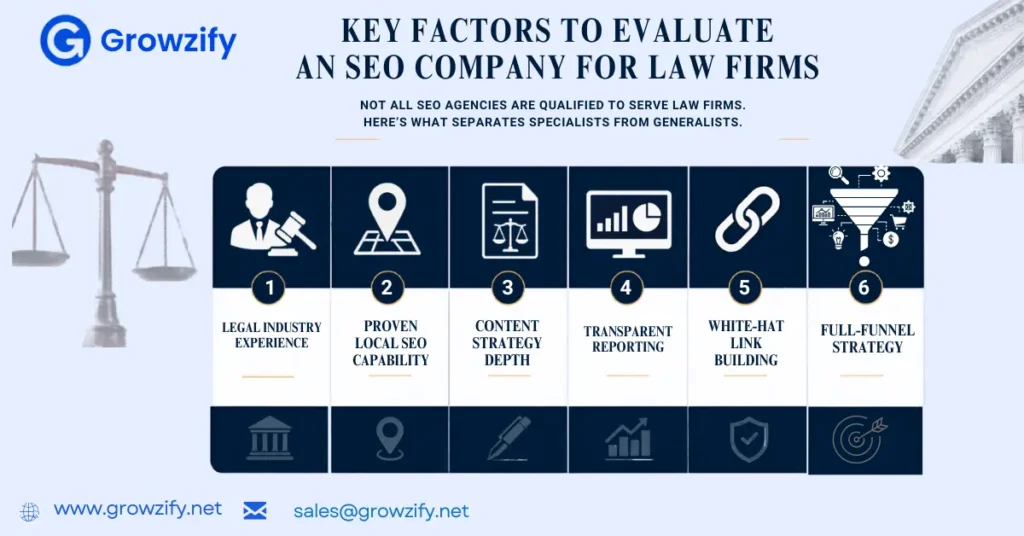
Key Factors to Evaluate an SEO Company for Law Firms
Not all SEO agencies are qualified to serve law firms. Most will hurt your rankings before they help them. Here’s the evaluation framework that separates specialists from generalists.
1. Demonstrated Legal SEO Experience
Ask directly: which law firms have they ranked, in which practice areas, and in which markets? Legal SEO involves challenges most agencies never handle, including YMYL standards, E-E-A-T signals, and legal advertising compliance.
An agency that ranks e-commerce stores or SaaS companies does not understand why a personal injury firm in a mid-size city needs 18 separate geo-targeted landing pages. Insist on legal-specific case studies.
2. Documented Local SEO Methodology
Over 70% of legal searches have local intent. Your agency must have a repeatable, proven process for:
- Google Business Profile optimization (categories, service areas, Q&A, posts)
- Local citation building and consistency across legal directories (Avvo, Justia, FindLaw, Martindale)
- Review acquisition systems that comply with bar rules
- Geo-targeted service pages optimized for city + practice area queries
Ask them to walk you through exactly what they do in month one for local SEO. Vague answers are red flags.
3. Legal Content Strategy Depth
Thin content doesn’t survive Google’s Helpful Content updates. A properly executed law firm content strategy includes:
- Practice-area hub pages (deep, comprehensive, schema-marked)
- City + practice area landing pages (“car accident lawyer in [city]”)
- Attorney bio pages optimized for credibility and local search
- FAQ content capturing how potential clients actually phrase legal questions
- Blog content targeting informational queries that build topical authority
Ask to see samples of legal content they’ve produced. Review the depth, the citations, and whether it reads like it was written by someone who understands the law, or someone who writes for every industry.
4. Technical SEO Competency
Before content or links can perform, the technical foundation must be solid. A qualified legal SEO agency will audit and address:
- Core Web Vitals (especially LCP and CLS on mobile)
- Crawl errors and indexation issues
- Internal linking structure across practice-area pages
- Schema markup implementation (LocalBusiness, LegalService, Attorney, FAQ)
- Redirect chains from old pages, acquisitions, or redesigns
These technical improvements help Google crawl, understand, and rank your website more effectively.
Ask them to explain what schema markup they implement for law firms and why. If they can’t answer clearly, their technical capability is limited.
5. Transparent, Outcome-Tied Reporting
The metric that matters is consultation requests, not “impressions” or “domain authority improvements.” Atrustworthy legal SEO agencyreports on:
- Keyword ranking changes by practice area and location
- Organic traffic trends by landing page
- Call tracking data from organic search
- Form submissions attributed to SEO
- Google Search Console performance by query cluster
Growzify Digitalties every monthly report to business outcomes, new consultation requests, call volume from organic, and case-type keyword movement, so law firm clients always know their exact ROI.
6. White-Hat Link Acquisition Built for Legal
Authority in legal SEO comes from earning links that signal genuine trust: state bar directories, legal aid organizations, local news citations, practice-area publications, and civic associations. These are not easy to acquire, but they’re what actually moves rankings in competitive legal markets.
Agencies offering “link packages” or “DA50+ backlinks” are selling links Google will eventually penalize. A single manual penalty can destroy years of SEO progress.
How Law Firm SEO Actually Works: The Process
Understanding the execution process helps you evaluate whether an agency is doing real work.
Month 1–2: Foundation
- Full technical audit and remediation
- Keyword research segmented by practice area and geography
- Google Business Profile optimization
- Local citation audit and cleanup
- Content gap analysis against top-ranking competitors
Month 3–4: Content Buildout
- Practice-area pages written and published
- Geo-targeted landing pages created
- Schema markup implemented across key pages
- Initial link outreach to legal directories and local publications
Month 5–6: Authority Building
- Editorial link acquisition from legal and local sources
- Blog content targeting informational and long-tail queries
- Review generation process activated
- Local pack ranking tracking by location and practice area
Month 6–12: Compounding Returns
- Rankings climb for competitive head terms
- Local pack visibility increases
- Organic consultation volume grows
- Content calendar expands to reinforce topical authority
Firms that cancel before month 6 never experience the compounding phase, and that’s where the real ROI lives.
Common SEO Mistakes Law Firms Make (And How to Avoid Them)
These mistakes appear in nearly every law firm we audit that isn’t seeing results from their current SEO investment.
Treating the website as a brochure, not a marketing asset.A law firm website that lists practice areas without depth, without local pages, without FAQ content, and without conversion optimization is not an SEO asset. It’s a business card no one can find.
Targeting only head keywords.“Personal injury lawyer” is competitive and expensive. “Truck accident lawyer [city] free consultation” is specific, lower-competition, and converts at a higher rate. Firms that ignore long-tail keyword strategy leave qualified traffic on the table.
Ignoring Google Business Profile.The local map pack appears above organic results for most legal queries. A poorly maintained Google Business Profile with incomplete categories, zero posts, and no Q&A optimization is a major missed opportunity.
Publishing content without topical authority.One blog post about car accidents doesn’t build authority. A structured content hub covering liability, comparative fault, insurance claims, medical documentation, and statute of limitations, all internally linked, signals genuine expertise to Google.
Measuring activity instead of outcomes.If your SEO agency reports “we published 4 blog posts and built 12 links” without showing you ranking movement and consultation data, you’re measuring effort, not results.
Law Firm SEO vs. Paid Ads: Which Is Right for Your Firm?
Both. But they serve different strategic functions.
Factor | SEO | Google Ads |
Time to results | 4–12 months | Immediate |
Cost per lead (long-term) | Low | High ($150–$500+) |
Sustainability | Compounding | Stops when budget stops |
Trust signal | High (organic = credible) | Lower (ads = paid) |
Best for | Long-term case pipeline | Immediate intake flow |
The strongest legal marketing strategies typically combine SEO and paid advertising together.
For firms entering a new market or launching a new practice area, paid ads provide immediate visibility while SEO builds. For established firms, SEO delivers a far better long-term cost-per-case than any ad channel.
The highest-performing law firm marketing strategies run Google Ads defensively while investing the majority of their budget in organic SEO.
Red Flags to Avoid When Choosing an SEO Agency
Walk away immediately if you encounter any of these.
- Guaranteed #1 rankings.Impossible. Any agency making this claim is misleading you.
- No law firm case studies.Your firm becomes their learning curve.
- Packages under $1,500/month.Effective legal SEO in competitive markets requires real time investment. Low-cost packages deliver low-cost results.
- No content strategy discussion in the first call.Content is the core of legal SEO. An agency that doesn’t lead with content doesn’t understand legal search.
- Reporting on metrics you can’t connect to revenue.“We improved your domain authority” is not a business result.
- Keyword-only focus.If they talk exclusively about rankings without discussing technical health, content depth, local SEO, and conversion optimization, they’re operating with a 2015 SEO playbook.
- Lock-in contracts with no performance benchmarks.You should be able to tie contract continuation to measurable milestones.
Any SEO company promising overnight rankings should be approached carefully.
Questions to Ask Before Hiring an SEO Provider
Use these questions as your pre-hire evaluation framework. Judge the quality of answers, not the confidence of delivery.
- “Walk me through a law firm campaign you’ve run, what did you do in months one through six, and what did rankings and leads look like?”Look for specificity. Vague answers signal limited experience.
- “How do you structure content for a personal injury firm targeting five cities?”A qualified agency should immediately describe geo-targeted landing pages, internal linking structure, and schema implementation.
- “What’s your link-building process for law firms specifically?”Listen for legal directories, local citations, PR strategy, and editorial outreach. Reject “link packages.”
- “How do you measure success? What’s in your monthly report?”Rankings, traffic, call tracking data, and consultation attribution should all be present.
- “What’s a realistic timeline for us to see consultation growth in our market?”Honest answer: 6–9 months for meaningful intake impact in a competitive market. Faster promises are false promises.
- “How do you handle legal advertising compliance in the content you produce?”They should know that attorney advertising is regulated and that content claims must be compliant with state bar rules.
Book a strategy call with Growzify Digitalto see what expert answers to these questions actually sound like, and to benchmark any agency you’re currently evaluating.
Why Most Law Firm SEO Campaigns Fail
The failure rate for law firm SEO campaigns is high, not because SEO doesn’t work for lawyers, but because most campaigns struggle because the foundational strategy is incomplete.
Wrong agency fit.A generalist agency applies a plumbing company’s SEO strategy to a law firm. The keyword research is shallow, the content lacks legal depth, and the link sources are irrelevant to legal authority signals.
Underinvestment in content.Google’s Helpful Content system rewards depth and specificity. A firm with 8 thin practice-area pages cannot outrank a competitor with 40 deep, well-structured, schema-marked pages, regardless of how many links they build.
Technical debt ignored.A law firm website with a 4-second mobile load time, broken internal links, and missing structured data is fighting Google’s algorithm with one hand tied behind its back. Technical remediation must precede content investment.
No local SEO foundation.Many firms optimize only for organic results while their Google Business Profile sits incomplete, their local citations are inconsistent, and their map pack presence is zero. Local is where intake volume lives for most practice areas.
Premature cancellation.Legal SEO compounds. Firms that exit at month 4 never see the rankings movement that typically begins in month 5–6 and accelerates through month 12. The investment period and the return period don’t overlap, most firms quit during the investment period.
How Growzify Digital Helps Law Firms Grow Cases
Growzify Digital is a specialist SEO partner for law firms, built around one outcome: more qualified case inquiries from organic search.
“At Growzify, we believe the best SEO company for a law firm is one that understands the legal industry deeply, prioritizes ethical long-term SEO strategies, and focuses on generating real consultation-driven leads.”
Here’s what makes the approach operationally different from what most legal SEO agencies deliver.
Legal-Specific SEO Architecture
Every campaign starts with a full technical audit, keyword architecture mapped by practice area and geography, and a content gap analysis against your top three competitors. We don’t use templates. We build a custom SEO structure around how your specific clients search in your specific market.
E-E-A-T Content That Ranks and Converts
Our content team produces attorney-level legal content, practice-area hub pages, geo-targeted landing pages, and FAQ content structured for both Google ranking and AI answer engine retrieval. Every piece includes appropriate schema markup, internal linking, and conversion elements.
Local SEO That Puts You in the Map Pack
We optimize your Google Business Profile from the category level up, build citation consistency across Avvo, Justia, FindLaw, and 40+ local directories, and implement a review acquisition system that complies with state bar advertising rules. Local pack visibility is where consultation call volume lives for most practice areas, and it’s where we focus first.
Outcome-Tied Monthly Reporting
Every Growzify Digital client receives a monthly report covering keyword ranking movement by practice area, organic traffic by landing page, call tracking data from SEO, and consultation attribution. You always know your exact return on SEO investment.
Legal Marketing Compliance
Our content team understands state bar advertising guidelines. We ensure every page, bio, and blog post meets compliance requirements, so your SEO content never creates regulatory exposure.
A strong SEO strategy helps your law firm stay visible, competitive, and trusted when potential clients are actively searching for legal help. Choosing the right SEO partner can create long-term, measurable growth for your practice.
Get a free law firm SEO audit from Growzify Digital, we’ll identify exactly what’s preventing your firm from ranking and give you a prioritized action plan.
How to Choose Your Law Firm SEO Partner
Step 1: Define your case growth goals.Are you targeting more personal injury cases, criminal defense clients, or family law consultations? Know your priority practice areas before evaluating any agency, their keyword and content strategy should reflect your specific case mix.
Step 2: Audit your current SEO baseline.Pull your Google Search Console data. Identify which practice-area keywords you currently rank for, where you appear in the local pack, and what your organic consultation volume looks like month over month.
Step 3: Request proposals from three agencies minimum.Each proposal should include: a current-state technical audit, a 12-month strategy outline with phase-by-phase milestones, sample content deliverables, and documented results from law firm clients.
Step 4: Score each agency on six criteria:
- Verified legal SEO experience (not just claimed)
- Local SEO methodology depth
- Content strategy quality and legal expertise
- Link-building approach and source quality
- Reporting transparency and outcome focus
- Contract flexibility and performance benchmarks
Step 5: Run a discovery call.The best SEO partners ask more questions in the first call than they answer. They want to understand your market, your competition, your intake process, and your case type goals before making a single recommendation.
Step 6: Define a 90-day scope with measurable milestones.Your first 90 days should produce: a completed technical audit with remediations, a keyword architecture document, a published content calendar, optimized Google Business Profile, and baseline ranking data for your priority keywords.
Step 7: Measure against consultation outcomes, not activity.Monthly reports should show ranking movement, organic traffic changes, and call/form-fill volume from SEO. If your agency can’t tie their work to consultation data, you’re measuring effort instead of results.
Growzify Digital walks every law firm client through this framework during a structured onboarding process, ensuring your campaign is built on strategy, market intelligence, and measurable growth targets from day one.
Hiring the Best SEO Agency For Scalable Results
Choosing the right SEO company for law firms is a decision that compounds over years, not months. The wrong agency costs you time, budget, and cases that went to a competitor who ranked above you. The right agency builds a durable pipeline of qualified clients who find your firm exactly when they need legal help.
The best legal SEO agencies operate at the intersection of technical precision, legal content expertise, local search strategy, and transparent outcome reporting. They don’t sell you on rankings, they show you consultation data.
With a specialist approach, a structured methodology, and reporting tied directly to case growth, Growzify Digital helps law firms of every size compete and win in their local markets.
Your website should be generating your best cases, not sitting as a digital brochure no one can find.
Book a consultation with Growzify Digital today and get a customized law firm SEO strategy built around your practice areas, your market, and your growth targets.
Frequently Asked Questions
How do I choose an SEO company for my law firm?
Require demonstrated experience with law firm clients in your practice area. Ask for specific ranking results and consultation growth data, not just testimonials. Evaluate their local SEO methodology, content strategy depth, and reporting transparency.
What should law firm SEO cost?
Effective law firm SEO servicesin competitive markets typically range from $2,500 to $10,000+ per month, depending on market size, practice area competition, and campaign scope. Packages under $1,500/month rarely produce meaningful results in legal terms.
How long does SEO take for lawyers?
Most law firms begin seeing measurable SEO improvements within 3 to 6 months. Competitive markets may take longer depending on the firm’s authority, competition, and content strategy.
Is SEO better than ads for law firms?
Both serve different functions. Google Ads deliver immediate visibility at $150–$500+ per click in competitive legal markets. SEO, once established, generates qualified leads at a fraction of that cost, and doesn’t stop when the budget stops. The optimal strategy for most law firms runs ads defensively for immediate intake while SEO builds long-term organic authority.
Why do law firms need SEO services?
96% of people seeking legal advice search online first. Your website is your primary business development tool, and if it doesn’t appear in the top three results for your practice-area keywords in your market, the majority of potential clients never see it.
What is local SEO for law firms and why does it matter?
Local SEO for law firms focuses on ranking in Google’s local pack, the map results that appear above organic listings for queries like “divorce attorney in Phoenix.” The local pack captures a disproportionate share of consultation calls because it appears above everything else and includes click-to-call functionality.
What makes a legal SEO agency different from a general SEO agency?
A specialist legal SEO agency understands YMYL content standards, Google’s E-E-A-T requirements for legal topics, state bar advertising compliance, and how legal clients search differently than retail or service consumers.
What SEO mistakes do law firms most commonly make?
The most common mistakes are: publishing thin practice-area pages without topical depth, ignoring local SEO and Google Business Profile optimization, hiring generalist agencies without legal experience, canceling campaigns before the compounding phase begins (typically month 6+), and measuring SEO by activity rather than consultation outcomes.
What is E-E-A-T and why does it matter for law firm SEO?
E-E-A-T stands for Experience, Expertise, Authoritativeness, and Trustworthiness, Google’s framework for evaluating content quality in high-stakes categories like legal, medical, and financial. Legal websites are subject to some of Google’s highest E-E-A-T scrutiny because low-quality legal content can cause real harm to users.
Why choose Growzify Digital for law firm SEO?
Growzify Digital specializes exclusively in attorney SEO marketing with a structured, four-layer approach covering technical SEO, E-E-A-T legal content, local search dominance, and outcome-tied reporting. Every campaign is built around measurable case growth, not traffic vanity metrics.

Chitranshu SharmaA growth strategist, digital marketing consultant, and the founder of Growzify, a performance-driven agency helping brands dominate search, shape perception, and build sustainable online visibility. With 8+ years of hands-on experience in Enterprise SEO, Online Reputation Management (ORM), and AI-led traffic generation, Chitranshu has helped startups, public figures, SaaS companies, and cannabis brands outrank competitors — ethically and at scale.
Explore More Articles
Managing Redirect Chains and Canonical Tags at Enterprise Scale
Managing Redirect Chains and Canonical Tags at Enterprise Scale A single redirect rule written five...
September 4, 2026Enterprise
How to Build a Technical SEO Monitoring Stack for Large Websites
How to Build a Technical SEO Monitoring Stack for Large Websites A technical SEO regression...
September 2, 2026Enterprise

Identifying and Fixing Thin Content Pages on Large Websites
Identifying and Fixing Thin Content Pages on Large Websites A page can be 2,000 words...
September 2, 2026Enterprise
How to Deploy and Maintain Structured Data and Rich Snippets Across a Website with Thousands of Pages
How to Deploy and Maintain Structured Data and Rich Snippets Across a Website with Thousands...
September 1, 2026Enterprise
Pre-Deployment Technical SEO Checklist for Large Enterprise Websites
Pre-Deployment Technical SEO Checklist for Large Enterprise Websites A single enterprise deployment can introduce a...
September 1, 2026Enterprise
How to Fix Core Web Vitals and Page Speed for an Enterprise Website
How to Fix Core Web Vitals and Page Speed for an Enterprise Website Enterprise Core...
August 31, 2026Enterprise
Robots.txt Best Practices for Complex, Large Enterprise Websites
Robots.txt Best Practices for Complex, Large Enterprise Websites A single overly broad robots.txt rule can...
August 27, 2026Enterprise