


White Label SEO Reporting Structure: How Agencies Present Results to Build Trust
White label SEO reporting helps agencies present SEO performance clearly and professionally to clients.
A structured reporting process improves transparency, communication, and long-term trust.
Learn how agencies use reports to showcase results, retain clients, and strengthen SEO partnerships.

Written byChitranshu Sharma
May 8, 2026
Quick Nav
It is observed that most SEO reports are unable to show the actual results to clients due to a communication gap. Agencies work on technical fixes, content, and backlinks, but when it comes to presenting that work, it gets lost in translation. Clients see effort; they see confusion.
Reports are created differently for every client, every month, depending on who is handling them. That inconsistency creates doubt. When clients don’t understand what’s happening, they start questioning the value even if results are improving.
A structured reporting system changes that completely. It creates clarity, consistency, and confidence. Instead of explaining things repeatedly, your report starts doing the explaining for you. That’s the shift from reporting as an obligation to reporting as a strategic advantage.
A white-label SEO reporting structure is the system agencies use to deliver SEO performance insights under their own brand in a clear, consistent, and client-ready format. It defines what data is presented, how it’s organized, and how results are communicated each reporting cycle to reinforce transparency, demonstrate measurable value, and strengthen client retention.
Core Standards for Consistent White Label SEO Reporting
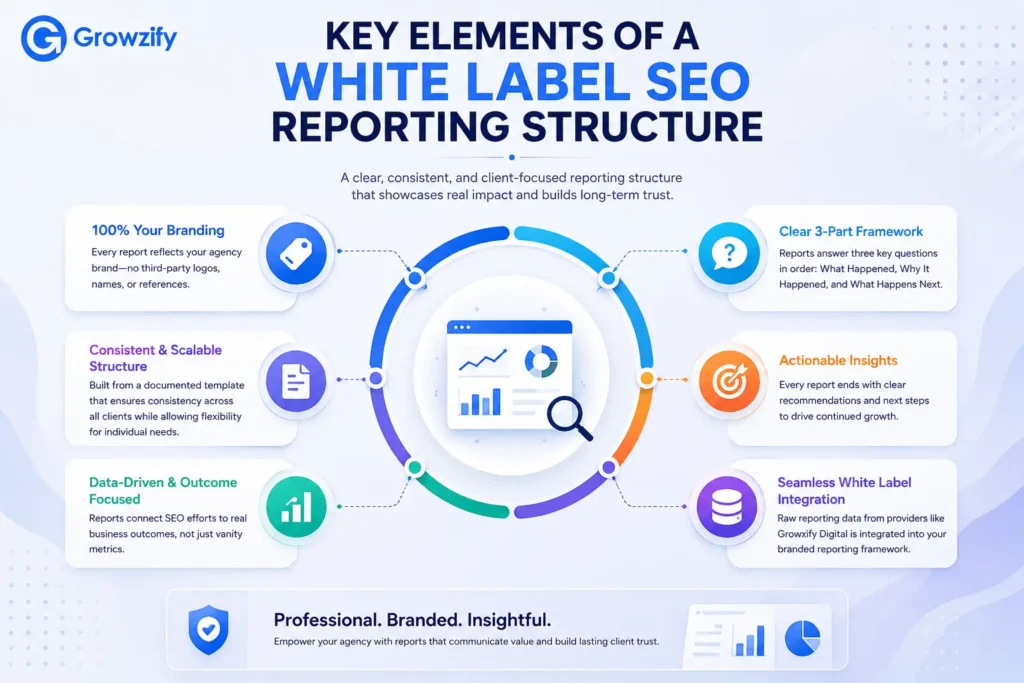
- Every deliverable carries the agency’s branding; no white-label provider name, logo, or reference appears anywhere in client-facing documents
- The structure is consistent across all clients; adapted per client context, but built from the same documented template
- Reports answer three questions in order: what happened, why it happened, and what happens next
- Data is connected to business outcomes, not just SEO metrics in isolation
- Agencies using white-label SEO services through providers like Growzify Digital receive raw reporting data that slots into the agency’s branded reporting framework
A white-label SEO reporting structure is a standardized, branded framework. An agency uses this to translate SEO performance data into client-facing reports that demonstrate value and drive retention. Let’s understand how agency can create the reports and handle client queries more efficiently.
Core Principles of White Label SEO Reporting
White label SEO reporting is not just about presenting data it’s about building a consistent, client-focused communication system. For agency owners, account managers, and SEO directors, the goal is to reduce reporting time while turning reports into a retention and trust-building tool. Before structuring reports, it’s essential to define the principles that guide them.
Branding is absolute.
Every report must reflect the agency’s identity—from logo and colors to fonts and layout. No third-party branding or tool references should appear, ensuring a seamless white-label experience.
Context always accompanies data.
Metrics without explanation create confusion. Every performance change must be supported with clear reasoning, helping clients understand what’s happening and why.
Use business language, not SEO jargon.
Reports should translate technical metrics into business impact. Clients care about growth, visibility, and revenue—not algorithm updates or technical terms.
Forward-looking insights are essential.
A report should not only reflect past performance but also outline what comes next. This keeps clients aligned and confident in the ongoing strategy.
Consistency builds trust.
Delivering reports in the same format, at the same time, creates reliability and professionalism. Inconsistency signals instability.
Keep it concise and relevant.
More data does not mean more value. Focus on what matters most to the client’s goals.
When these principles are applied, reporting becomes more than an update. It becomes a strategic tool that strengthens relationships and drives long-term growth.
Key Elements of a White Label SEO Reporting Structure
A strongwhite label SEO reporting structureis built on clarity, consistency, and purpose. It defines how performance is communicated, ensuring every report delivers meaningful insights, aligns with business goals, and presents SEO efforts in a way clients can easily understand.
Standardized Data Framework
Every report follows the same format, ensuring consistency across all clients and campaigns without reinventing the structure each time.
Branded Presentation
Reports are delivered under your agency’s identity, maintaining a professional look and reinforcing your brand authority.
Clear Performance Metrics
Focuses on essential KPIs like traffic, rankings, and conversions—presented in a way that is easy to interpret.
Context-Driven Insights
Goes beyond raw data by explaining what changed, why it changed, and what it means for the business.
Consistency Across Clients
Ensures every client receives the same level of clarity and quality, regardless of scale or complexity.
Integration with Execution Teams
Whether work is done in-house or via a white label partner, the reporting aligns with the execution process seamlessly.
Client-Friendly Communication
Avoids technical jargon and focuses on delivering insights in a way that clients can easily understand and act upon.
Think of a white-label SEO reporting structure as the front-facing layer of your entire SEO operation. Clients don’t see your workflows or internal processes they see your reports. And that report becomes your identity. A strong structure ensures that identity reflects clarity, professionalism, and expertise every single time.
How to Deploy a White Label SEO Reporting System
Deploying awhite label SEO reporting systemis less about adding complexity and more about building consistency into your workflow. When reporting is structured properly, it removes confusion, aligns teams, and ensures every client receives a clear and professional experience. Instead of treating reports as one-off tasks, agencies should approach them as a repeatable system that supports both delivery and growth.
Create a Standardized Template
Build a fixed reporting format that includes all key sections like summary, performance, work done, and next steps. This ensures consistency across all clients while allowing minor customization within the same structure.
Automate Data Collection
Use tools like Google Analytics and Search Console integrations to pull real-time data automatically. This reduces manual errors and saves time, allowing teams to focus more on insights rather than data gathering.
Add Human Insights
Automation provides data, but interpretation creates value. Always include clear explanations of what changed, why it happened, and how it impacts the client’s business.
Define a Clear Workflow
Assign responsibilities for report creation, review, and delivery. This ensures accountability and prevents last-minute delays or inconsistencies in reporting.
Integrate White Label Partners
Align yourwhite label SEO providerwith your reporting system. Let them handle execution while your agency maintains control over reporting, branding, and client communication.
When deployed correctly, a white label SEO reporting system becomes a foundation for scalability. It simplifies operations, improves client communication, and ensures every report reflects your agency’s professionalism. Over time, this structured approach transforms reporting into a powerful tool for growth, trust, and long-term retention.
Reporting Is the Experience Clients Remember
At the end of the day, clients don’t see your SEO work they experience your reporting. That’s what shapes their perception of your agency.
A well-structured report does more than show results it builds trust, reduces confusion, and creates a sense of direction. It turns SEO from something abstract into something tangible.
If your agency is struggling with retention, inconsistency, or scaling challenges, the issue may not be your SEO work; it’s how that work is communicated. With Growzify, we provide structured white label reporting designed to keep things clear, client-friendly, and completely stress-free.
Fix the reporting structure, and everything else starts to align. When clients truly understand what’s happening, they don’t just stay, they grow with you.
FAQs
What should a white-label SEO report include?
An executive summary, key metrics snapshot, keyword rankings with movement, organic traffic data, backlinks acquired, technical SEO status, content published, and performance. It can also include local SEO metrics if applicable, a specific list of work completed, and a plan for the following month. Every section should carry the agency’s branding with no third-party provider references.
How often should agencies send SEO reports to clients?
Monthly reports are standard for most retainer clients. Quarterly business reviews supplement monthly reports with strategic analysis. Annual reviews mark campaign milestones and strategic pivots.
What metrics matter most in an SEO report?
Organic sessions, keyword rankings (especially top 3 and top 10 positions), goal completions or organic revenue, domain authority trend, and backlinks acquired.
How do agencies brand white-label SEO reports?
By using reporting platforms that allow full white-labeling, custom logos, brand colors, agency domain, and removal of all third-party tool branding. Tools like AgencyAnalytics, Google Looker Studio, and DashThis support complete agency branding. All PDFs, slide decks, and dashboard URLs carry only the agency’s identity.
What is the best format for delivering SEO reports to clients?
A branded PDF for the primary delivery is stable, professional, and archivable. A live dashboard link (Looker Studio or AgencyAnalytics) as supplemental access for clients who want real-time data between reports. The monthly call walkthrough contextualizes both. Avoid raw data exports or tool-branded reports as primary deliverables.
How do agencies explain SEO results in non-technical language?
By translating metrics into business implications. “Domain rating increased from 34 to 37” becomes “Your site’s authority score continues to rise, which directly supports your ability to compete for higher-value keywords.
What should agencies do when SEO results are negative in a given month?Acknowledge the decline directly in the executive summary, provide specific context (algorithm update, seasonal trend, technical issue). Explain what the data shows about the cause, and outline the specific actions being taken in response.

Chitranshu SharmaA growth strategist, digital marketing consultant, and the founder of Growzify, a performance-driven agency helping brands dominate search, shape perception, and build sustainable online visibility. With 8+ years of hands-on experience in Enterprise SEO, Online Reputation Management (ORM), and AI-led traffic generation, Chitranshu has helped startups, public figures, SaaS companies, and cannabis brands outrank competitors — ethically and at scale.
Explore More Articles
How to Find and Compare Local SEO Outsourcing Providers
How to Find and Compare Local SEO Outsourcing Providers Finding a local SEO outsourcing provider...
October 13, 2026Outsourcing

Inside a White Label SEO Campaign: How the Work Gets Done
Inside a White Label SEO Campaign: How the Work Gets Done Clients see a single...
October 13, 2026White Label

How to Vet an SEO Outsourcing Provider Before You Sign a Contract
How to Vet an SEO Outsourcing Provider Before You Sign a Contract A polished proposal...
October 9, 2026Outsourcing

Multilingual SEO Best Practices: Optimize Your Multi-Language Website
Multilingual SEO Best Practices: Optimize Your Multi-Language Website Translating a page and localizing it for...
October 7, 2026SEO
What Makes In-House Enterprise SEO Work Different Day-to-Day?
What Makes In-House Enterprise SEO Work Different Day-to-Day? On a small site, deciding to fix...
October 7, 2026Enterprise
How Core Algorithm Updates Impact Large Sites Differently Than Small Ones
How Core Algorithm Updates Impact Large Sites Differently Than Small Ones A large enterprise site...
October 7, 2026Enterprise
When Should You Outsource SEO? 11 Signs It Makes Sense
When Should You Outsource SEO? 11 Signs It Makes Sense Outsourcing SEO does not necessarily...
September 26, 2026Outsourcing