


Why White Label SEO Is the Future of Digital Agencies: The Complete Analysis (2026)
White label SEO is becoming a key growth model for digital agencies in 2026.
It helps agencies scale services, reduce operational costs, and deliver expert SEO without expanding internal teams. This analysis explains why more agencies are adopting white label partnerships for long-term growth and efficiency.

Written byChitranshu Sharma
May 14, 2026
Quick Nav
White label SEO is the future of digital agencies because the economics, technology, and competitive dynamics of the agency market have permanently shifted in its favor. Fixed-cost staffing models are becoming structurally unsustainable for growth-stage agencies.
“White label SEO is no longer just a fulfillment shortcut for agencies. In 2026, it became a scalable growth model that allows digital agencies to expand services and compete with larger firms without building massive in-house SEO teams.”
AI has made specialist fulfillment faster and more accessible. Clients are consolidating their vendor relationships, expecting agencies to cover more disciplines without proportionally larger teams.
The agencies generating the highest margins and longest client relationships in 2026 are not the ones with the largest headcounts. They are the ones with the most efficient fulfillment systems.
Key points:
- The agency market is rewarding specialization in client management and outsourcing execution, not rewarding agencies that try to build every capability in-house
- White label SEO transforms the agency’s cost structure from fixed to variable, enabling growth without the capital risk of premature hiring.
- AI has accelerated white-label SEO fulfillment quality and speed, widening the gap between white-label and in-house economics at every scale below enterprise.e
- Client expectations for integrated, multi-disciplinary marketing are growing, but clients are not willing to pay proportionally more for larger agency teams
- Agencies using white-label SEO services through providers like Growzify Digital are positioned for the next decade of agency growth, not the last decade’s model.
White label SEO is the future of digital agencies because it aligns the agency’s cost structure, service scope, and competitive positioning with where the market is going, not where it has been.
Who it is for:Agency owners, founders, investors, and senior leaders who want a rigorous, forward-looking analysis of why white-label SEO is not a transitional model but the dominant operating structure for the next generation of profitable digital agencies.
The Agency Model That Is Becoming Obsolete
To understand why white-label SEO is the future, it is necessary to be honest about what is failing.
The traditional full-service digital agency model hires specialists in every discipline, builds capacity ahead of revenue, and works effectively in an era defined by three conditions:
Condition 1: Digital marketing was a narrow discipline
In 2010, a digital agency needed to cover paid search, social media, and basic website management. The specialist skill set required was manageable for a team of 10–15 people. A mid-size agency could genuinely be full-service.
Condition 2: Talent was relatively affordable and stable
Digital marketing salaries were modest compared to technology roles. Turnover was lower. The cost of building an in-house team was a meaningful but manageable percentage of revenue.
Condition 3: Clients had patience for specialization
Clients accepted working with multiple agencies, one for SEO, one for paid media, and one for creative. The expectation of a single integrated agency managing all disciplines was not yet universal.
None of these three conditions exists in 2026.
What has replaced them:
Digital marketing now includes SEO, paid ads, social media marketing, influencer campaigns, email marketing, automation, analytics, CRO, and rapidly evolving AI-driven services.
Even SEO alone now covers technical SEO, content strategy, local SEO, international SEO, and AI optimization. No agency can realistically build deep in-house expertise across every specialization at the same time.
Specialist digital marketing talent commands compensation that rivals software engineering in many markets. Turnover is high. The true cost of a full-service team has become prohibitive for agencies below enterprise scale.
Clients, particularly post-COVID and post-AI-disruption clients, want fewer vendor relationships, not more. They want one agency managing their digital marketing with the breadth of a large firm and the responsiveness of a boutique.
The traditional full-service model cannot satisfy these expectations at the cost structure it requires. Something has to give. White-label SEO is what gives the right direction.
The Economic Shift: Why Variable Cost Beats Fixed Cost in Agency Growth
The fundamental economic argument for white-label SEO’s future dominance is not complicated. It is a cost structure argument.
The fixed-cost agency model:
An agency that builds in-house SEO capability carries fixed costs, salaries, benefits, tools, and management overhead, regardless of client volume. When the agency has 20 SEO clients, the fixed cost is the same as when it has 10.
When a client churns and volume drops to 15, the fixed cost still does not decrease. This model rewards scale, when enough clients fill the team’s capacity, unit economics improve.
The variable-cost white-label model:
An agency using white-label SEO pays for execution only when a client is paying. Zero clients, zero fulfillment cost. One client, one campaign cost. Twenty clients, twenty campaign costs, each generating a margin.
This model is more profitable at every revenue level below the break-even point of a full in-house team, which is approximately $800,000–$1,000,000 in annual SEO revenue.
The macroeconomic context that amplifies this advantage:
In a period of higher interest rates, tighter marketing budgets, and economic uncertainty, agencies that carry low fixed costs are structurally more resilient than agencies that carry high ones.
Awhite label SEO agencycan survive a 30% client loss with margin compression. The same event at a fixed-cost agency triggers a cash flow crisis and layoff decisions.
The post-2022 economic environment, and the uncertainty that has persisted since, has exposed the fragility of the high-fixed-cost agency model.
The agencies that maintained profitability through revenue volatility were, disproportionately, those with variable cost structures.
The compounding advantage at scale:
As white-label SEO volume increases, per-campaign wholesale costs decrease through volume pricing. The agency’s retail price holds. The margin expands.
The model produces compounding margin improvement without requiring proportional investment, a dynamic that fixed-cost models cannot replicate.
The Competitive Landscape Is Rewarding Specialization
The agency market is bifurcating. At one end: large, well-capitalized networks with genuine multi-disciplinary in-house capability at scale. At the other: highly specialized boutique agencies with deep expertise in a single discipline or vertical.
The middle, mid-size generalist agencies trying to build broad in-house capability are the most competitively exposed segment of the market.
These agencies are too small to match large networks on resource depth and too unfocused to match boutiques on expertise.
White label SEO resolves this competitive positioning problem.
The agency that uses white-label SEO can:
- Offer SEO with the depth and consistency of a specialist boutique, because a specialist boutique is executing it
- Maintain the breadth of a full-service agency, because the white-label model allows coverage of multiple disciplines without proportional headcount.
- Price competitively against specialist boutiques, because wholesale costs are lower than maintaining equivalent in-house capacity
- Scale client relationships beyond the capacity of their internal team, because execution scales with the provider, not the agency
This is the competitive position that the market is rewarding. Not the largest team. Not the most narrow specialization.
The agency that can promise breadth and deliver depth, through a systematized white-label fulfillment model, wins the client relationship conversations that matter most.
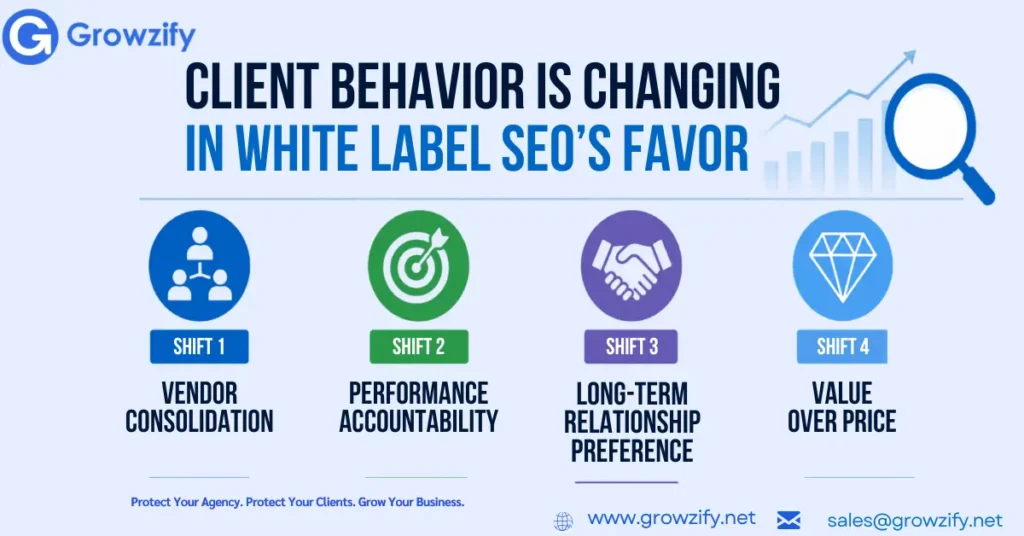
Client Behavior Is Changing in White Label SEO’s Favor
The way clients buy and manage digital marketing services is shifting, and every major shift is directionally favorable to the white-label SEO model.
Shift 1: Vendor consolidation
Clients are reducing the number of agencies they work with. The administrative overhead, communication complexity, and strategic fragmentation have driven a consolidation toward single-agency relationships that cover more disciplines.
This is a direct opportunity for agencies using white-label SEO. A web design agency that added white-label SEO retained clients who would otherwise have taken their organic search budget to a separate provider.
A paid media agency that added white-label SEO consolidated the client’s entire digital marketing spend under one relationship. Every vendor consolidation trend is a white-label SEO opportunity for an agency that is positioned to cover the discipline credibly.
Shift 2: Performance accountability
Clients in 2026 are more sophisticated about digital marketing ROI than at any previous point. They track metrics. They compare performance against benchmarks. They ask harder questions about attribution and business impact.
This sophistication favors quality white-label SEO over cheap, generic alternatives. The sophisticated clients notice the difference in the quality of work.
The performance accountability trend eliminates low-quality white-label providers from the market and rewards the agencies that partner with providers delivering genuine results.
Shift 3: Long-term relationship preference
Research consistently shows that once clients move past the early investment phase of an agency relationship, they prefer to stay with providers they already trust.
Over time, agencies develop strategic alignment, workflow familiarity, and institutional knowledge that clients do not want to rebuild from scratch with a new partner.
This strengthens the long-term value of the white-label SEO model. When an agency delivers strong results and manages the client relationship effectively, it creates lasting partnerships that lead to referrals.
Shift 4: Value over price
The clients with the largest marketing budgets and the longest retention potential are not buying on price. They are buying on demonstrated competence, strategic alignment, and communication quality. These are functions the agency controls, not the white-label provider.
An agency that charges $3,000/month for white-label SEO will retain clients that a competitor charges $1,500/month to serve.
The Technology Tailwind: AI Makes White Label More Competitive
Every major AI development in digital marketing has widened the competitive advantage of white-label SEO over in-house teams at growth-stage agencies.
AI has lowered the cost of specialist execution
The labor cost reduction AI has enabled in SEO fulfillment is a 70–85% reduction in time spent on research, brief creation, content drafting, and reporting. It means that quality white-label execution is now available at a lower wholesale price than before AI.
AI has raised the quality floor of white-label execution
AI tools used by quality white-label providers produce more comprehensive keyword research, more complete technical audits, and faster content production than equivalent manual work.
The baseline quality of AI-augmented white-label SEO has improved, making the model more competitive against in-house teams.
AI has created new disciplines that favor specialist execution
AI Overview optimization, AEO, GEO, and AI-first search strategies are emerging disciplines that require specific expertise. Most agencies do not have this expertise in-house.
White-label providers who have invested in these disciplines offer agencies access to cutting-edge capability without the training investment required to develop it internally.
AI has made reporting and communication more efficient
The agency-side functions that white-label SEO requires, brief preparation, QC review, report narrative, and client communication, have all been made more efficient by AI tools available to agencies directly.
The time investment required to manage a white-label SEO relationship per client has decreased, improving the per-client economics of the model.
Every AI development trend reinforces the same conclusion: the economics of white-label SEO execution improve with AI adoption, and the economics of equivalent in-house staffing do not improve at the same rate.
The Talent Market Is Making In-House Teams Harder to Build
The talent dynamics of the digital marketing industry have shifted against in-house agency teams in structural ways, not cyclical.
Compensation Inflation
Digital marketing specialist salaries have increased substantially over the last five years, driven by technology sector competition, remote work normalization, and the growing commercial importance of digital marketing to every type of business. An experienced technical SEO who commanded $55,000 in 2019 commands $75,000–$95,000 in 2026.
Retention Difficulty
Digital marketing professionals have more options than at any previous point; remote roles, freelance platforms, consulting opportunities, and in-house corporate roles all compete with agency employment.
Agencies offering less flexible work environments or slower salary growth lose experienced staff consistently.
Generational Shift
The next generation of digital marketing talent increasingly prefers independent work arrangements, freelancing, consulting, and remote specialist roles over traditional agency employment.
Building stable in-house teams from this talent pool requires competitive compensation and benefits that many growth-stage agencies cannot sustain.
White label SEO’s structural advantage in this talent environment
The white label provider aggregates specialist talent that no single growth-stage agency could afford or retain individually. The technical SEO specialist, the content expert, the link building strategist, and the local SEO manager are all accessible through the white-label relationship.
As the talent market becomes more competitive, this aggregation advantage grows, not shrinks.
The Agency Profitability Data Points in One Direction
Agency profitability benchmarks, from M&A advisors, agency industry analysts, and ownership survey data, consistently show that the agencies commanding the highest valuations and generating the strongest margins share a set of operational characteristics.
The characteristics of high-margin, high-value agencies:
- Revenue per employee above $150,000:Agencies with high revenue per employee have efficient fulfillment models; they are not staffing proportionally with client growth
- Gross margins above 55%:Achievable in white label SEO at growth stage; difficult with equivalent in-house teams
- Client retention above 85%:Driven by relationship management quality, not dependent on execution being in-house
- Recurring revenue above 70% of total:SEO retainers are inherently recurring, building a high percentage of recurring revenue is a direct argument for white-label SEO as a primary service line
- Low-key person dependency:Agencies valued at a premium are not dependent on one person’s relationships or knowledge. The white-label model distributes this risk by making the execution provider-agnostic
The valuation multiple implication:
Digital marketing agencies are typically valued at 4–8x EBITDA. An agency with $500,000 in annual EBITDA is valued at $2,000,000–$4,000,000.
The same agency with a white-label SEO model, which typically produces higher EBITDA margins than equivalent in-house delivery, commands a higher EBITDA figure and therefore a higher absolute valuation.
The shift from fixed-cost in-house delivery to variable-cost white-label fulfillment is not just a margin decision. It is a valuation decision.
The Agencies That Will Not Survive the Next Decade
Being clear about the future requires being honest about what fails. Several agency types are structurally exposed to the forces driving white-label SEO adoption.
The generalist mid-size agency with undifferentiated capability
An agency offering mediocre versions of seven disciplines, none of which is best-in-class, will be squeezed between large networks and specialist boutiques.
Without a fulfillment model that gives them specialist-quality execution across disciplines, they cannot compete on quality or price.
The agency that builds in-house before volume justifies it
Agencies that hire ahead of revenue, committing fixed costs to uncertain client pipelines, are financially fragile at every growth stage. A single bad quarter triggers existential decisions. These agencies either find a more efficient model or contract.
The agency that treats AI as a cost-cutting tool rather than a quality amplifier
Agencies (and white-label providers) using AI to reduce content quality in pursuit of margin are building on sand. Google’s quality systems, client sophistication, and the performance accountability trend will expose this approach within 12–24 months of any client relationship beginning.
The agency whose value proposition is execution
If an agency’s primary value to clients is that “we do the SEO work,” that value proposition is commoditizing. Execution is becoming faster, cheaper, and more accessible.
The agencies whose value proposition is strategic direction, relationship quality, and business partnership, with execution handled by a best-in-class fulfillment partner, have a durable competitive position.
The Agency Model That Wins the Next Decade
The agency that wins the next decade is not the largest. It is not the most fully staffed. It is the agency that has built the most efficient system for delivering specialist-quality marketing across multiple disciplines while maintaining the client relationship quality.
The architecture of the winning agency model:
Client relationship layer (in-house):Exceptional account management. Strategic direction. Proactive communication. QBRs that demonstrate business partnership. New client acquisition through referral and reputation.
Execution layer (white label):SEO delivered through Growzify Digital or an equivalent specialist provider. Paid media through a paid media white-label partner, if not in-house. Creative through a design partner. Content through the SEO white label provider’s content team.
Systems layer (documented and owned):Brief templates, QC checklists, report templates, onboarding documents, scope packages, and communication protocols that make every client addition operationally smooth.
Technology layer (AI-augmented):AI tools integrated into brief preparation, QC review, report narrative, and client communication, reducing the time cost of client management per client.
This agency has low fixed costs. High gross margins. Strong client retention. Growing referral revenue. A scalable fulfillment model. And a valuation that reflects all of these advantages.
It is the agency that white-label SEO makes possible, not theoretically, but practically, today.
Why Growzify Digital Is Built for the Future of Agencies
The future of digital agencies requires white-label partners who understand their role in the architecture described above.
Growzify Digital is built as the execution layer for agencies that want to win the next decade.
What this means operationally:
- Growzify Digital executes. The agency manages. The client sees only the agency, at every touchpoint, in every deliverable, across every communication.
- Campaigns are fulfilled to quality standards that hold up under sophisticated client scrutiny, because the agencies Growzify Digital serves retain clients who ask hard questions.
- AI-augmented fulfillment produces faster delivery and more comprehensive campaign coverage, without trading the human oversight that quality content and link building require.
- Volume pricing rewards agencies that grow, improving margin as client volume increases, rather than extracting more as the agency scales
- Flexible engagement terms allow agencies to start, scale, and adapt without long-term commitments that constrain strategic options.
Agencies moving toward the model described in this guide usewhite-label SEO services from Growzify Digitalas a long-term execution infrastructure.
The SEO service scope at Growzify Digital covers the full spectrum of modern SEO, including technical SEO, content strategy, AI Overview optimization, and AEO. The fulfillment system is built specifically for the search environment of 2026 and beyond.
For modern agencies, white-label SEO is no longer a stopgap model. It is becoming the operational foundation for scalable growth in an increasingly specialized digital marketing landscape.
Why Smart Agencies Are Moving Beyond Fixed-Cost Models
White label SEO is not a trend. It is not a workaround for agencies that cannot afford in-house teams. It is the structural evolution of the agency model, driven by economics, technology, talent dynamics, and client behavior, moving in the same direction.
The agencies of the next decade are not defined by the size of their teams. They are defined by the quality of their client relationships, the efficiency of their fulfillment systems, and the consistency of their margins.
White label SEO enables all four, simultaneously, at any revenue level above the first client. Agencies that recognize this shift early and build accordingly are positioning themselves for long-term growth.
With theright white-label SEO partner, strong operational systems, and disciplined client management, they are creating more scalable and valuable agency businesses for the next decade.
In contrast, agencies that continue relying heavily on fixed-cost in-house expansion during growth stages often face rising operational pressure. The same risk applies to agencies choosing low-cost, low-quality white-label providers purely to save money.
In both cases, the result is usually weaker margins, inconsistent delivery quality, and a business model that is becoming less competitive in the modern agency market.
Growzify Digital becomes the execution infrastructure for the agencies building toward the future, with white-label SEO services that hold up under the quality standards of 2026.
FAQs
Why is white-label SEO the future of digital agencies?
The economics, technology, and competitive dynamics of the agency market have permanently shifted in its favor. Fixed-cost in-house teams are becoming structurally unsustainable below enterprise scale. AI has made specialist white-label fulfillment faster and better.
Is the traditional full-service agency model dying?
The mid-market generalist version of the traditional model is under significant structural pressure. Agencies too small to match large networks on resource depth and too unfocused to match boutiques on expertise are being squeezed on both sides.
How does white-label SEO improve agency valuation?
Through higher EBITDA margins, the primary driver of agency valuation multiples is. White label SEO’s variable cost structure produces higher gross margins than equivalent in-house staffing at growth-stage revenue levels. Higher margins produce higher EBITDA.
What type of agency is best positioned for the next decade?
Agencies with exceptional client relationship management as their core competency. They rely on specialist-quality execution delivered through white-label fulfillment partners. They use documented systems that make every new client addition operationally efficient.
Will AI make white-label SEO providers obsolete?
No, AI has made quality white-label providers more competitive, not less. AI has lowered fulfillment costs, improved execution speed, and expanded campaign scope at equivalent cost. Simultaneously, AI has created new SEO disciplines, AI Overview optimization, AEO, and GEO, that require specialist expertise agencies do not have in-house.

Chitranshu SharmaA growth strategist, digital marketing consultant, and the founder of Growzify, a performance-driven agency helping brands dominate search, shape perception, and build sustainable online visibility. With 8+ years of hands-on experience in Enterprise SEO, Online Reputation Management (ORM), and AI-led traffic generation, Chitranshu has helped startups, public figures, SaaS companies, and cannabis brands outrank competitors — ethically and at scale.
Explore More Articles
How to Find and Compare Local SEO Outsourcing Providers
How to Find and Compare Local SEO Outsourcing Providers Finding a local SEO outsourcing provider...
October 13, 2026Outsourcing
Inside a White Label SEO Campaign: How the Work Gets Done
Inside a White Label SEO Campaign: How the Work Gets Done Clients see a single...
October 13, 2026White Label

How to Vet an SEO Outsourcing Provider Before You Sign a Contract
How to Vet an SEO Outsourcing Provider Before You Sign a Contract A polished proposal...
October 9, 2026Outsourcing

Multilingual SEO Best Practices: Optimize Your Multi-Language Website
Multilingual SEO Best Practices: Optimize Your Multi-Language Website Translating a page and localizing it for...
October 7, 2026SEO
What Makes In-House Enterprise SEO Work Different Day-to-Day?
What Makes In-House Enterprise SEO Work Different Day-to-Day? On a small site, deciding to fix...
October 7, 2026Enterprise
How Core Algorithm Updates Impact Large Sites Differently Than Small Ones
How Core Algorithm Updates Impact Large Sites Differently Than Small Ones A large enterprise site...
October 7, 2026Enterprise
When Should You Outsource SEO? 11 Signs It Makes Sense
When Should You Outsource SEO? 11 Signs It Makes Sense Outsourcing SEO does not necessarily...
September 26, 2026Outsourcing