


8 Signs Your Business Needs an Enterprise SEO Strategy
An enterprise SEO strategy helps businesses manage large websites, improve search visibility, and scale organic growth efficiently. Learn the eight key signs that indicate your business is ready for enterprise SEO and how it supports long-term digital success.

Written byChitranshu Sharma
August 6, 2026
Quick Nav
A business may need an enterprise SEO operating model when website or organisational complexity makes isolated page optimisation unreliable. Common indicators include repeated template-level issues, multi-market conflicts, overlapping content across teams, an unresolved technical backlog, migration risk and reporting that cannot connect search performance to business outcomes.
No fixed company size, page count or number of warning signs determines the need. The issue becomes enterprise-level when it repeatedly affects multiple pages, systems, teams or markets and requires shared governance, prioritization and implementation.
What Is Enterprise SEO?
Many people assume enterprise SEO is simply SEO for large businesses. In reality, it’s a scalable approach designed for organisations managing complex websites, multiple stakeholders, and growing digital ecosystems.
Instead of focusing on individual page improvements, enterprise SEO creates systems that make optimisation repeatable across pages. It combines technical governance, content strategy, automation, reporting, and cross-functional collaboration to improve organic performance at scale.
The goal is building an SEO framework that continues to support business growth as your website, teams, and markets expand.
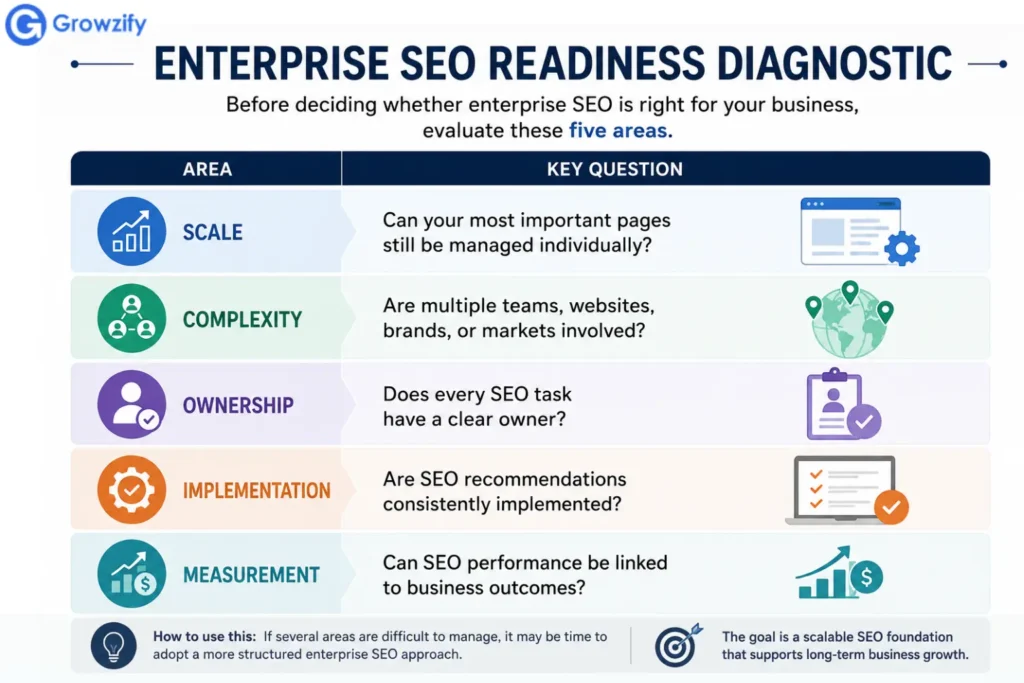
Enterprise SEO Readiness Diagnostic
| Sign | Evidence that supports an enterprise constraint | False positive to rule out | Likely first action |
| Manual management is failing | Repeated template-level issues and inconsistent implementation | Temporary workload increase | Template and workflow audit |
| Multiple markets are creating conflict | Regional pages, profiles or owners overlap systematically | One isolated regional error | International/local governance review |
| Organic growth has plateaued | Multiple page groups show technical, architectural or intent problems | Lower demand, seasonality or tracking error | Diagnostic audit before more publishing |
| Teams publish without governance | Overlapping briefs, page roles and inconsistent standards | Legitimately different audience intent | Content inventory and ownership model |
| Technical backlog persists | Same high-impact issues remain across release cycles | Low-priority recommendations correctly deferred | Prioritisation and implementation governance |
| Major site change occurred | Redirect, canonical, internal-link or indexation patterns changed | Normal post-launch volatility | Migration audit and monitoring |
| Buyer research is unsupported | Recurring sales questions and missing decision content across the journey | Weak demand or offer rather than content gap | Buyer-journey content audit |
| Reporting lacks business context | SEO cannot be connected to qualified demand or outcomes | Business performance is genuinely flat | Analytics and attribution review |
8 Signs Your Business Needs an Enterprise SEO Strategy
As businesses grow, their websites become more complex to manage. New products, expanding markets, multiple teams, and evolving customer expectations all increase the demands on your SEO strategy.
Enterprise SEO is about managing growing complexity. As your business expands, SEO challenges often shift from individual page optimisation to coordinating content, technical improvements, multiple teams, and business priorities. Here are eight practical signs that indicate your website may be ready for an enterprise SEO strategy.
1. Your Website Has Outgrown Manual SEO Management
A growing website naturally creates more opportunities for organic growth, but it also becomes harder to manage using manual SEO processes. Updating metadata, internal links, structured data, and on-page content one page at a time quickly becomes inefficient as new products, categories, services, or resources are added.
The challenge isn’t simply having more pages—it’s managing them consistently. Important URLs may receive little internal link support, duplicate content can appear across templates, and optimisation becomes increasingly difficult to coordinate.
How to validate this sign
- Manual SEO updates take longer than before.
- Repetitive optimisation tasks consume significant time.
- Similar SEO issues appear across multiple page types.
- Maintaining consistency has become difficult.
Example:An ecommerce business growing from hundreds to thousands of product pages found than manually updating individual pages.
2. Your Business Operates Across Multiple Locations, Regions, or Markets
Expanding into new cities, countries, or regions creates new SEO opportunities, but it also increases complexity. Each market may require dedicated landing pages, local business information, regional content, and technical configurations. Without shared standards, inconsistencies can quickly affect search visibility.
Different regional teams may unknowingly target the same search intent, business listings may become inconsistent, or location pages may compete against one another in search results. Coordinating these activities manually becomes increasingly difficult as the business grows.
How to validate this sign
- You manage multiple locations or regional websites.
- Local teams publish content independently.
- Maintaining consistent business information is challenging.
- Regional pages compete for similar keywords.
Example:A retail brand expanding into multiple regions introduced central SEO governance to standardize local pages while allowing each market to create content tailored to its audience.
3. Organic Traffic Has Plateaued Despite Consistent Publishing
Publishing more content should create more opportunities for organic growth. Publishing content can create additional organic opportunities when each page serves a distinct user need and contributes useful, differentiated information. Increasing output without validating demand, intent, and overlap can expand the library without improving performance.
An enterprise SEO audit helps identify these underlying issues by evaluating your website’s technical health, content structure, crawlability, and overall search performance. Instead of simply publishing more content, it helps uncover the root causes preventing existing pages from reaching their full potential.
How to validate this sign
- Organic traffic has remained flat for several months.
- A small percentage of pages drive most organic traffic.
- Your website hasn’t had a comprehensive enterprise SEO audit.
Organic visibility is concentrated in a small page set while strategically important sections remain underrepresented or decline despite validated demand.
Example: A SaaS company doubled its content output but saw little improvement in organic growth. An enterprise SEO audit uncovered weak internal linking, crawl inefficiencies, and site architecture issues. After addressing these structural challenges, existing content gained greater visibility and future content delivered stronger organic results.
4. Multiple Teams Are Publishing Without SEO Governance
As businesses grow, marketing, product, regional, and content teams often publish independently. While this increases output, it can also create duplicate content, inconsistent optimisation, and keyword cannibalisation if everyone follows different processes. Inconsistencies make it harder for search engines to understand which pages should rank.
Overlapping page purpose, inconsistent internal links, and conflicting metadata can make it harder to maintain clear URL ownership for the same search intent and conversion role.
How to validate this sign
- Different teams manage content without shared SEO standards.
- Similar pages target the same search intent.
- Metadata, internal links, and page structures vary across the website.
Example:A software company found multiple departments creating overlapping resource pages. Introducing shared guidelines could reduce duplicate briefs and create clearer page ownership. Any effect on rankings, traffic, or conversions should then be measured rather than assumed.
5. You Have a Technical SEO Backlog That Never Gets Resolved
Growing websites commonly accumulate technical issues as templates, integrations, redirects, and publishing workflows change. But the real concern is when those issues remain unresolved for months because no one owns them. Problems such as broken redirects, template errors, duplicate content, structured data issues, or slow page performance often stay on the backlog while new work continues. As the website grows, these issues can affect more pages and become increasingly difficult to fix.
How to validate this sign
- As the website grows, these issues can affect more pages.
- Recommendations are repeatedly delayed.
- No team clearly owns technical SEO implementation.
Example:An ecommerce brand repeatedly identified template-level SEO issues but lacked clear ownership. Once responsibilities and priorities were established, fixes were rolled out across thousands of pages, improving both crawl efficiency and overall site performance.
6. Your Business Has Recently Gone Through Major Website Changes
Website migrations, platform upgrades, domain changes, mergers, or acquisitions often introduce SEO challenges that aren’t immediately visible. Redirect issues, broken internal links, duplicate content, crawl inefficiencies, and indexing problems can gradually impact organic performance if they aren’t identified and resolved early. A migration SEO audit can identify redirect, canonical, internal-link, sitemap, and indexation risks before and after launch. It reduces avoidable migration errors but cannot guarantee uninterrupted rankings while search engines recrawl and reprocess the changes.
How to validate this sign
- Your website has recently migrated or changed platforms.
- Organic traffic or rankings have become inconsistent.
- Redirect, crawl, or indexing issues are appearing in Google Search Console.
- A post-migration SEO audit hasn’t been completed.
Example:In an illustrative scenario, a post-migration audit could identify redirect gaps, broken internal links, and indexation problems. Correcting those issues would remove identifiable technical barriers, while subsequent visibility changes would still need to be measured against recrawling, demand and other migration activity
7. Your Buyers Need More Information Before They Choose You
As your business grows, so do your customers’ expectations. This is especially true for B2B, SaaS, and high-value purchases, where buyers often spend weeks or months researching solutions before contacting a sales team. They compare products, evaluate competitors, explore technical documentation, and look for proof that your solution meets their needs.
As the buying journey becomes more complex, publishing occasional blog posts is no longer enough. A well-structuredenterprise SEO content strategyhelps businesses create and manage content that supports every stage of the decision-making process. Comparison pages, implementation guides, case studies, FAQs, product documentation, and educational resources work together to answer buyer questions, build trust, and improve discoverability across search.
How to validate this sign
- Buyers frequently ask questions your website doesn’t answer.
- Sales teams repeatedly share the same resources with prospects.
- Competitors provide more comprehensive educational content.
- Your content strategy doesn’t support the full buyer journey.
Example:A SaaS company expanded into enterprise markets but realised its website focused mainly on product features. By introducing an enterprise SEO content strategy with comparison pages, implementation guides, case studies, and technical resources, it attracted more qualified visitors, shortened the research phase, and generated higher-quality organic leads.
8. Leadership Needs Better SEO Reporting and Business Insights
As businesses grow, leadership expects SEO reporting to go beyond rankings and traffic. Decision-makers want to understand how organic search contributes to qualified leads, revenue, customer acquisition, and business growth. If reporting requires combining data from multiple tools without a clear business narrative, your current approach may no longer be sufficient.
Enterprise SEO connects technical performance, content effectiveness, user behaviour, and business KPIs into a single reporting framework, helping leaders make informed strategic decisions.
How to validate this sign
- Reporting takes hours to prepare every month.
- SEO metrics aren’t connected to business outcomes.
- Leadership struggles to measure SEO’s ROI.
Example:A growing B2B company replaced fragmented reports with a unified SEO dashboard that linked search performance to pipeline and revenue, making it easier to prioritise initiatives and demonstrate business impact.
Identifying the constraint before it propagates across more pages, teams, or markets can reduce future remediation and coordination costs. An enterprise SEO operating model can establish clearer ownership, repeatable controls and prioritisation. Whether performance improves depends on the quality of the diagnosis, implementation, and underlying search opportunity.
Enterprise SEO Doesn't Automatically Solve Every Challenge
Enterprise SEOis designed to manage complexity, improve scalability, and strengthen long-term organic performance. Enterprise SEO cannot create search demand, fix weak product-market fit or compensate indefinitely for a poor customer experience. It can improve technical access, content systems, governance and measurement, but the underlying offer and user value still determine whether increased visibility produces business results.
Before investing in enterprise SEO, it’s important to identify the root cause of the problem. If the issue spans multiple teams, templates, systems, or markets, a structured enterprise SEO strategy is likely the right next step. If it’s isolated to a specific campaign or technical issue, a targeted audit or implementation plan may be all that’s needed.
Which Type of Enterprise SEO Support Do You Need?
Not every business experiencing these signs needs a long-term enterprise SEO engagement. The right solution depends on the complexity of your challenges and how they’re affecting your business.
| Situation | Recommended Next Step |
| Recent migration or replatform | Migration SEO audit |
| Large technical backlog | Technical SEO implementation and governance |
| Multiple locations or international expansion | Enterprise SEO strategy |
| Multiple publishing teams | SEO governance and content framework |
| Fragmented reporting | SEO analytics and reporting framework |
| Unsure of the root cause | Comprehensive enterprise SEO audit |
The goal is to identify whether your business needs a one-time technical improvement, better internal processes, or a long-term enterprise SEO strategy.
Illustrative Example: When a Business Needs an Enterprise SEO Strategy
Understanding the signs is easier when you see them in action. The following example illustrates how a growing business can gradually outgrow its existing SEO approach. While the company continues to invest in content and marketing, increasing website complexity creates challenges that require a more structured and scalable enterprise SEO strategy.
Note:These are illustrative scenarios based on common enterprise SEO challenges.
Organic Growth Plateau
A B2B software company consistently published new content, but organic traffic remained unchanged. In an illustrative scenario, an audit could identify weak internal linking, page overlap, or technical barriers affecting important content. The company would then test whether correcting those constraints improves discovery, visibility and qualified traffic rather than assuming that more publishing is the solution.
A plateau does not automatically indicate a technical or enterprise SEO problem. Compare impressions, click-through rates, demand trends, indexation, conversion quality, and SERP changes before identifying the constraint.
Multi-Location Expansion
A retail brand expanded across multiple regions, with each location managing its own landing pages and local listings. Central governance could improve data consistency and reduce conflicting location-page practices. Local visibility would still need to be evaluated against Business Profile quality, proximity, competition, reviews, and website relevance.
Executive SEO Reporting
A growing business relied on multiple reporting tools, making it difficult for leadership to understand SEO’s business impact. A unified reporting model could make prioritisation more defensible by connecting search performance to qualified leads, pipeline, and documented attribution assumptions.
This example shows how business growth naturally brings new SEO challenges. As more teams, pages, products, and markets come together, a structured enterprise SEO strategy creates clarity, improves collaboration, strengthens technical performance, and builds a scalable foundation that supports consistent organic growth and long-term business success.
Build a Smarter Enterprise SEO Strategy
Enterprise SEO isn’t about having the biggest website—it’s about having the right systems to support a growing business. As websites become more complex, success depends less on individual page optimisation and more on coordinated processes, technical governance, and cross-functional collaboration.
If several of these signs sound familiar, your current SEO operating model may no longer match your business’s complexity. Recognising those signals early allows you to build a stronger foundation before small challenges become large operational constraints.
AtGrowzify, we help businesses simplify complexity with tailored enterprise SEO strategies that improve technical performance, strengthen organic visibility, and support sustainable business growth. Whether you’re expanding into new markets, managing multiple websites, or looking for greater SEO accountability, the right strategy today can help your business scale with confidence.
Frequently Asked Questions
Do I need all eight signs before considering enterprise SEO?
No. Enterprise SEO isn’t determined by the number of signs you experience. One significant issue, such as a complex migration or an unmanaged technical backlog, may justify specialist support, while several smaller issues may simply require a structured assessment.
Is enterprise SEO only for large companies?
No. Enterprise SEO is driven by complexity rather than company size. A growing business with multiple locations, brands, or technical systems may benefit from enterprise SEO well before it considers itself an enterprise.
What’s the first step before investing in enterprise SEO?
Start with a comprehensive SEO assessment. Understanding whether the challenge is technical, organisational, or content-related helps determine the most effective solution before investing in long-term initiatives.
Can enterprise SEO be managed in-house?
Yes. Many organisations successfully manage enterprise SEO internally. Others choose specialist consultants or agency partners. The most important factor isn’t who performs the work—it’s having clear ownership, governance, and consistent implementation.

Chitranshu SharmaA growth strategist, digital marketing consultant, and the founder of Growzify, a performance-driven agency helping brands dominate search, shape perception, and build sustainable online visibility. With 8+ years of hands-on experience in Enterprise SEO, Online Reputation Management (ORM), and AI-led traffic generation, Chitranshu has helped startups, public figures, SaaS companies, and cannabis brands outrank competitors — ethically and at scale.
Explore More Articles
How to Find and Compare Local SEO Outsourcing Providers
How to Find and Compare Local SEO Outsourcing Providers Finding a local SEO outsourcing provider...
October 13, 2026Outsourcing
Inside a White Label SEO Campaign: How the Work Gets Done
Inside a White Label SEO Campaign: How the Work Gets Done Clients see a single...
October 13, 2026White Label

How to Vet an SEO Outsourcing Provider Before You Sign a Contract
How to Vet an SEO Outsourcing Provider Before You Sign a Contract A polished proposal...
October 9, 2026Outsourcing

Multilingual SEO Best Practices: Optimize Your Multi-Language Website
Multilingual SEO Best Practices: Optimize Your Multi-Language Website Translating a page and localizing it for...
October 7, 2026SEO

What Makes In-House Enterprise SEO Work Different Day-to-Day?
What Makes In-House Enterprise SEO Work Different Day-to-Day? On a small site, deciding to fix...
October 7, 2026Enterprise

How Core Algorithm Updates Impact Large Sites Differently Than Small Ones
How Core Algorithm Updates Impact Large Sites Differently Than Small Ones A large enterprise site...
October 7, 2026Enterprise
When Should You Outsource SEO? 11 Signs It Makes Sense
When Should You Outsource SEO? 11 Signs It Makes Sense Outsourcing SEO does not necessarily...
September 26, 2026Outsourcing