How to Manage SEO Outsourcing Across Multiple Teams
How to Manage SEO Outsourcing Across Multiple Teams A single-owner...
Read More →
A single-owner outsourcing model works fine until the SEO provider’s work actually has to touch development, content, brand, and a regional team at the same time. That’s when coordination, not execution speed, becomes the real bottleneck. You can externalize execution, but a recommendation is not an implemented change, and an implemented change is not complete until someone validates it.

Managing SEO outsourcing across multiple teams means coordinating how an external provider’s recommendations and deliverables move through every internal team that has to act on them, development for technical changes, content or brand for copy approval, and any regional or business-unit teams with their own priorities, so work doesn’t stall in the handoff between departments. This differs from a simpler outsourcing setup with a single internal owner, because in larger or more distributed organizations, approval authority is often spread across technical, content, brand, legal, and regional stakeholders rather than concentrated in one person.
Methodology:This guide draws on Google Search Central’s own documentation on Search Console user permissions and on evaluating an SEO provider, plus recurring coordination patterns Growzify observes when SEO outsourcing spans more than one internal department. Statements attributed to Growzify are practitioner observations, not universal guarantees, and the example later in this article is an illustrative composite, not a specific client case.
A small business with one internal SEO owner can approve most decisions directly. Once SEO outsourcing touches development, content, brand, and a regional or business-unit team at the same time, that single-owner model tends to strain, since approval authority is often distributed across those functions rather than held by one person.
As more internal teams become involved, approval and implementation dependencies can become a significant source of delay, even when the provider has already completed its part of the work. In an illustrative case, a technical fix could be written and ready within a day and still take several weeks to actually ship if it’s waiting on a development team with its own unrelated priorities.
Common risks to plan for include unclear technical ownership, overlapping content approvals, regional conflicts, fragmented status tracking, and competing priorities. These are practitioner-observed risk patterns, not universal behaviors, but they’re worth screening for directly.
Unclear technical ownership.A provider’s crawl or Core Web Vitals recommendation often needs a developer to implement it, and that developer may report to someone with no direct stake in SEO outcomes, which can leave the fix without a clear internal champion.
Overlapping content approval.If both a content team and a brand team can weigh in on the same page, and neither one is designated as final approver, drafts can circulate without ever actually clearing.
Regional or business-unit conflict.A centralized SEO recommendation doesn’t always fit a specific region’s product mix or local market, and without a channel for that feedback, a regional team may end up sidelining guidance rather than raising the conflict directly. Centralize standards and shared visibility; localize the actual decision where a genuine market, language, or product difference justifies it, and document that exception, the reason, the affected market, and the final call, rather than letting it quietly diverge with no record.
Fragmented status tracking.When status lives in one team’s email thread, a second team’s chat channel, and a third team’s spreadsheet, nobody, including the provider, can see the full picture of what’s actually pending.
Competing priorities set independently by each team.Marketing may treat a content refresh as urgent while development is mid-sprint on an unrelated feature, and without a shared prioritization view, each team can end up optimizing for its own workload rather than the engagement as a whole.

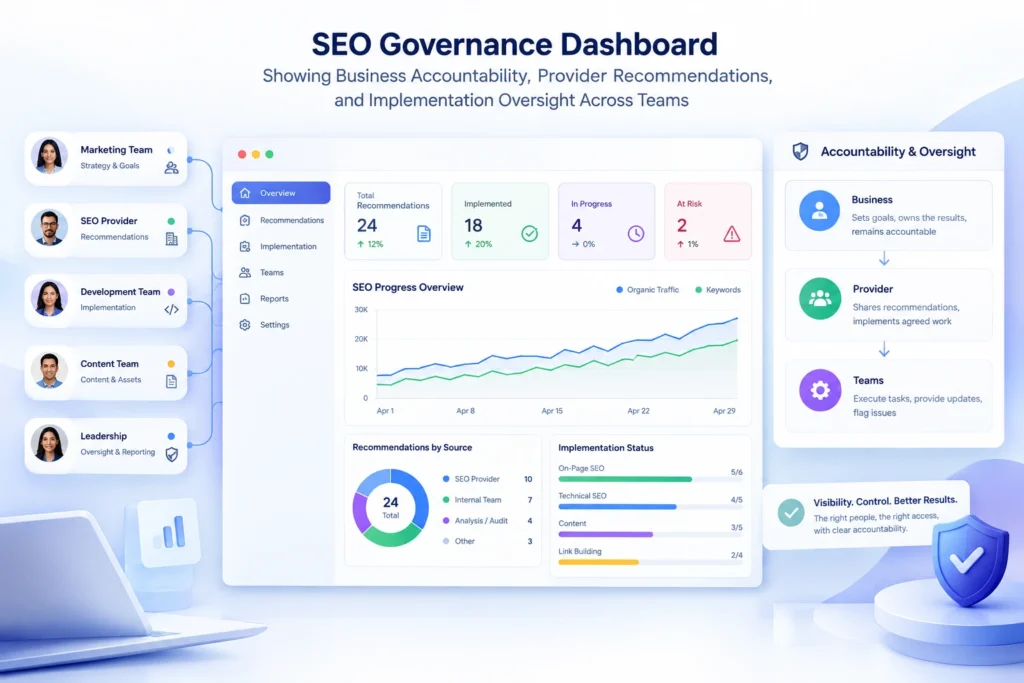
The fix isn’t finding a single person with enough authority to approve everything personally; that role doesn’t scale past a certain organization size. The fix is a coordination layer: one accountable point of contact whose job is routing and tracking work, not personally approving every team’s output.
That person holdsprocess authority, making sure every item has an owner, a priority, a current status, a named dependency, an approval path, and an escalation route, rather thanapproval authorityover the content of the work itself, which stays with the relevant functional team.
That person needs to know which team owns which type of decision, keep a visible record of what’s pending with whom, and escalate when something stalls past an agreed turnaround. They don’t need deep technical or content expertise themselves, just enough context to route work correctly and enough authority to ask a stalled team why.
This role tends to matter more as the number of involved teams grows, not the size of the SEO budget. A small engagement touching only marketing and development needs far less formal coordination than a larger one spanning multiple regional teams, each with its own local priorities and approval habits.
A recommendation shouldn’t move directly from “the provider delivered it” to “it’s done.” In a multi-team organization, there are several distinct states in between, and collapsing them into one “complete” status is exactly what lets work quietly stall.
A workable cycle looks like this:
These responsibilities do not need to sit within the same team. For example, a provider might diagnose and implement a technical change, while the business approves it and both sides participate in validation.
The important distinction is thatrecommended, approved, implemented, and validated are separate states. A provider recommendation should not be marked complete simply because it was delivered.
Priority itself should reflect the consequence of not acting, business impact, search impact, effort, dependency, and reversibility, not simply how strongly the provider frames a recommendation as urgent. Critical issues, an accidental noindex, a broken canonical deployment, a severe migration problem, a widespread server error, or a compromised account, should bypass routine prioritization entirely and follow a defined incident-escalation path rather than waiting in the normal queue.
Mapping ownership explicitly prevents the most common failure: two teams assuming the other one is handling something. The roles and timelines below are illustrative examples only, not formal SLAs unless an organization actually operates under one; each organization should set its own internal turnaround targets around its release cycles, risk level, team structure, and escalation requirements.
| Work type | Example owner/approver | Example internal turnaround target | Escalates to |
| Technical/development changes | Engineering lead | 5-10 business days, matched to sprint cycles | Head of engineering or CTO |
| Content and on-page copy | Content or brand lead | 3-5 business days | Marketing director |
| Regional or local pages | Regional business-unit lead | 5-7 business days | Regional GM |
| Link acquisition or outreach | Brand or legal, if sensitivities exist | 3-5 business days | Marketing director |
| Reporting interpretation and strategy shifts | The SEO coordination owner | Reviewed monthly | Whoever holds the SEO budget |
Escalation should trigger on defined conditions, the target window being exceeded, a high-risk release, an unresolved disagreement, a production regression, rather than depending on whoever happens to notice a ticket has been sitting too long.
A shared source of truth should show, at minimum, the issue, the workstream, the owner, the approver, current status, priority, a named dependency where one exists, a review or due target, a link to the actual implementation ticket, and validation evidence once shipped.
That doesn’t mean every team abandons its own tools; a development ticket can live in the engineering system while the provider tracks its own backlog elsewhere. It means one authoritative record reconciles those systems rather than requiring everyone to use the same software.
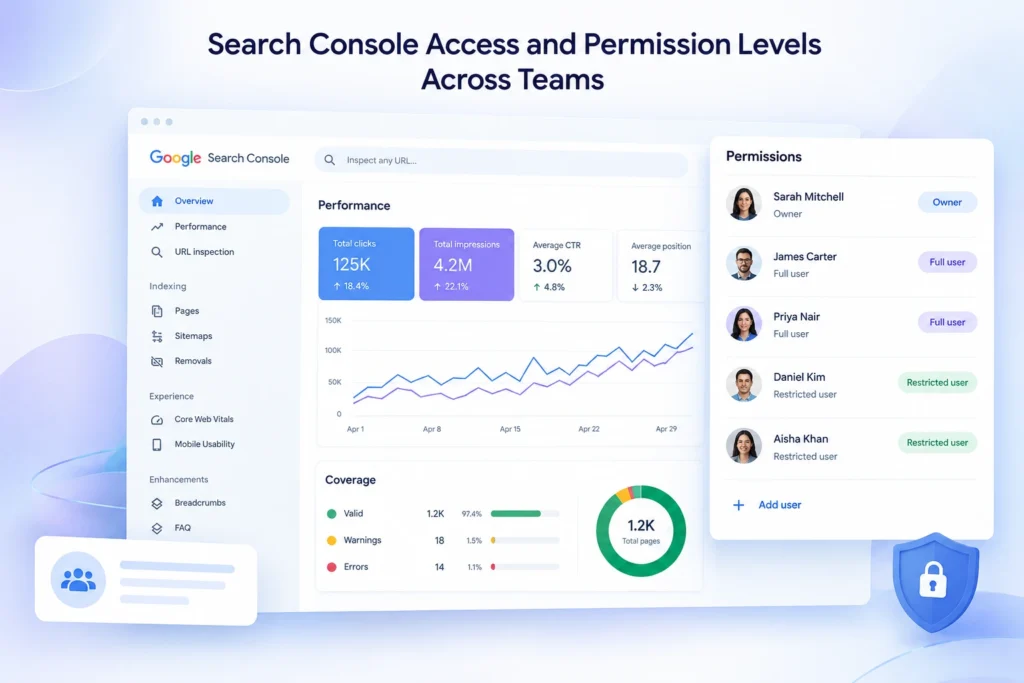
Multi-team engagements often default to granting everyone broad access “to make things easier,” which creates its own coordination problem later, since nobody can tell who changed what.
Google’s own documentation on Search Console permissionsdefines three actual user permission levels, Owner, Full user, and Restricted user, each with different capabilities. Associates are a separate mechanism entirely: an associated Google service or account can perform certain actions tied to the site, but an associate isn’t simply another Search Console user tier alongside the other three.
Grant access according to the specific task at hand, and use the lowest level that supports the required work, rather than handing out Owner access by default as more teams join the engagement. Core properties and accounts, Search Console, analytics, and the CMS should stay owned by the organization itself rather than depending on one provider’s or one department’s account for continued access.
Development teams juggle feature work, bug fixes, and SEO recommendations from a provider who doesn’t report to them, and SEO tickets often lose that competition by default.
A few habits help. Translate the provider’s technical recommendation into whatever ticket format the development team already uses, rather than sending a separate SEO-specific list they have to interpret, and describe the expected post-change state directly rather than a vague “fix SEO issue,” so acceptance criteria are clear before work starts.
Agree on a recurring triage cadence that matches the team’s existing release process, for example, reviewing SEO dependencies during an existing sprint-planning or backlog-triage meeting rather than adding a separate standalone one.
Technical SEO work is genuinely done only once the intended change has been implemented and validated in the environment that matters, live HTML, status codes, canonical tags, or indexing behavior, depending on the change, not merely when a ticket gets closed.
Tracking two separate latencies, how long a recommendation sits before a decision, and how long an approved item sits before it ships, tends to surface exactly where work is structurally getting stuck, and a pattern of long delays in either one is itself useful information for the next budget or headcount conversation.
Google’s guidance on evaluating an SEO providerstates that site owners are ultimately responsible for the actions of the companies they hire. From a site-governance perspective, that’s exactly why internal oversight still matters with multiple teams involved: Google evaluates what actually happened to the site, and won’t distinguish between a flawed provider recommendation and a regional team’s implementation mistake when assessing the result.
Contractual responsibility between the business and its provider, by contrast, is a separate question governed by whatever agreement is actually in place between them.
This is part of why treating the provider as a fully autonomous black box rarely works once multiple teams are involved. Someone internally still needs enough visibility into what’s being recommended and implemented to catch a problem before it reaches production or goes live regionally.
The coordination layer only works if information actually reaches every team that needs it, not just the person managing the relationship.
Maintain one shared status source, then distribute role-relevant updates to the teams or stakeholders who actually need to act on them, rather than broadcasting every detail to everyone.
A clearly defined escalation path, who to contact and how urgently, prevents a stalled approval from sitting quietly for weeks before anyone raises it. It also helps to keep a lightweight decision log for anything materially changed, rejected, or regionally overridden: the recommendation, the reason, and the final call, so the same debate doesn’t quietly restart every reporting cycle.
This same communication discipline is what keeps outsourced SEO relationships healthy at the client level too, not just internally. Growzify’sguide to maintaining client retention with outsourced SEOcovers the same underlying principle: transparent, proactive communication, applied to the agency-client relationship rather than internal team coordination.
Agencies managing SEO across multiple client-facing account teams face a version of this same coordination problem, just one layer removed. If each account team sources its own freelancer or vendor independently, quality, reporting format, and communication style can vary widely from one client to the next.
A single partner can make processes, reporting formats, documentation, and escalation paths easier to standardize across account teams, rather than each team managing a different vendor relationship on its own.
Multiple specialist providers may make more sense when different accounts require materially different capabilities; the right model depends on coordination cost, specialist needs, capacity, and vendor-concentration risk rather than a single answer for every agency.
The more delivery is centralized with one external provider, the more it’s worth having continuity documentation and access portability in place, so a change in that relationship doesn’t leave every account team starting from scratch.
Growzify’sguide to how agencies and freelancers use white label SEO to expand their servicescovers how that consolidation typically works in practice, including what stays consistent across client teams and what still needs to be customized per account.
For a business managing SEO outsourcing across its own internal departments rather than client accounts, the equivalent question is whether to consolidate around one outsourcing relationship with a clear internal governance structure, rather than letting different departments independently manage separate vendor relationships.
The following is an illustrative, hypothetical scenario built to show how cross-team coordination plays out, not a specific named client.
Consider a mid-sized ecommerce company outsourcing SEO for the first time, with the work touching its marketing team, its small internal development team, and a regional sales team managing three international storefronts.
In the first month, the provider’s technical recommendations sat in a shared inbox nobody checked regularly, content revisions bounced between marketing and brand with no final approver, and the regional team quietly ignored a centralized keyword strategy that didn’t reflect local search behavior in one of its markets.
The company’s operations manager was assigned as the coordination owner in month two, not to approve everything personally, but to route each recommendation to the right team and track status in one shared document.
Technical items went into the development team’s existing ticket system with an illustrative two-week review slot matched to that team’s own sprint cycle. Marketing was named final approver on content, with brand consulted rather than co-approving. The regional team got a standing channel to flag when a recommendation didn’t fit local conditions, with the exception and its reasoning logged rather than silently applied.
In this illustrative scenario, the primary change was operational rather than strategic: clearer routing, ownership, and tracking helped more recommendations actually reach implementation and get validated, rather than stalling somewhere between delivery and production.
How is managing SEO outsourcing across multiple teams different from a standard outsourcing engagement?
A standard engagement often works with a single internal owner who can approve most decisions directly. In multi-team organizations, decision rights are often distributed across several functions instead, which makes structured routing and ownership more important than relying on one person to approve every type of work.
Who should be the internal coordination owner?
Someone with enough organizational visibility to know which team owns which decision and enough standing to ask a stalled team for a status update. They need process authority, the standing to track and escalate, not necessarily SEO technical authority, since their role is routing and tracking work rather than evaluating its technical quality themselves.
Who decides SEO priority across multiple teams?
No single function should decide every priority in isolation. Material SEO work is generally better evaluated against business impact, search impact, implementation risk, effort, and dependencies, with critical indexing, security, or production issues following a faster escalation path rather than waiting behind routine prioritization.
What if the SEO provider says work is complete, but engineering hasn’t shipped it yet?
Treat provider delivery and production implementation as separate statuses rather than one. A recommendation can be complete from the provider’s side while the actual SEO change remains unimplemented, or implemented but not yet validated, from the business’s side, and a shared status system should show those states separately rather than collapsing them into one.
How do we stop SEO technical fixes from getting buried in the development backlog?
Put SEO tickets into the same system and format the development team already uses, with a clear description of the expected post-change state, rather than a vague item they have to translate themselves. Agree a recurring triage cadence tied to the team’s existing release process so SEO items get actively triaged instead of defaulting to “later.”
Should every team have the same level of access to SEO tools and reports?
No.Search Console provides Owner, Full user, and Restricted user access, each with different capabilities; associations with other Google services are handled through a separate mechanism, not as a fourth user tier. Access should be assigned according to the work each person actually needs to perform, rather than granted broadly by default, and core accounts should stay under the organization’s own ownership.
What happens if a regional team disagrees with a centralized SEO recommendation?
That disagreement should have a clear channel to reach the coordination owner rather than being silently ignored. A recommendation that doesn’t fit local market conditions is useful feedback for the provider, and a documented exception, with its reasoning, is a better outcome than one team quietly opting out of the broader strategy without a record of why.
Is the outsourced provider responsible if an internal team implements something incorrectly?
Google’s own guidance holds the site owner ultimately responsible for what happens to the site in search, regardless of which party made the underlying mistake, which is a statement about search governance, not about contractual fault between the business and its provider. That contractual question is a separate matter governed by whatever agreement is in place. Either way, internal visibility into what’s being recommended and implemented still matters, even with a trusted provider.
Does an agency face the same coordination problem with its own client-facing teams?
Yes, in a similar form. If separate account teams each source their own SEO vendor independently, quality and reporting can vary significantly between clients. Centralization can make standards, reporting formats, QA expectations, and escalation procedures easier to standardize, but actual consistency still depends on the provider’s execution and the agency’s own oversight.
How often should the coordination owner report status to leadership?
There’s no universal correct cadence. Leadership updates should match the pace and risk of the work, a major migration or release may call for more frequent visibility, while stable ongoing delivery may only need periodic summaries, and internal task tracking can stay more frequent than executive reporting regardless of that cadence.
Even a sound SEO strategy can stall when recommendations move through several teams without clear ownership, approval paths, or shared status tracking. A recommendation is not an implemented SEO change, and an implemented change isn’t complete until someone has actually validated it.
Multi-team outsourcing needs an operating model for routing, decision-making, implementation, and escalation alongside the SEO strategy itself, built around a clear coordination owner, an explicit map of who recommends, approves, implements, and validates each type of work, and a shared, current view of what’s actually pending.
If you’re a business coordinating outsourced SEO across your own internal departments, Growzify’sSEO outsourcing servicesteam can help set up that coordination structure directly with your teams.
If you’re an agency coordinating SEO delivery across multiple client-facing teams instead, Growzify’swhite label SEO servicesteam can walk through how a single fulfillment partner would plug into that structure.

At Growzify, we are dedicated to helping your business achieve its goals. Are you Ready to take the next step?


How to Find and Compare Local SEO Outsourcing Providers Finding a local SEO outsourcing provider...

Inside a White Label SEO Campaign: How the Work Gets Done Clients see a single...

How to Vet an SEO Outsourcing Provider Before You Sign a Contract A polished proposal...

Multilingual SEO Best Practices: Optimize Your Multi-Language Website Translating a page and localizing it for...

What Makes In-House Enterprise SEO Work Different Day-to-Day? On a small site, deciding to fix...

How Core Algorithm Updates Impact Large Sites Differently Than Small Ones A large enterprise site...
When Should You Outsource SEO? 11 Signs It Makes Sense Outsourcing SEO does not necessarily...

SEO Outsourcing Checklist: What to Prepare Before You Hand Off Your SEO SEO handoffs can...
Call Now






Growzify digital team is very effective, and easy to work with. Very strong communication and always up for suggestions. Saw 300% growth in web traffic 170% growth in revenue through Facebook ad’s & Amazon. I recommended them to my fellows and they turned their online business into a money making machine.