



How to Control Index Bloat Across Millions of URLs
A site with two million indexed URLs isn’t necessarily winning. If most of those URLs are filtered duplicates, repetitive or low-utility generated pages, or leftover artifacts from an old migration, the index is bloated rather than comprehensive, creating unnecessary complexity around crawling, canonicalization, reporting, and management of the URLs that actually matter.

Written byChitranshu Sharma
August 25, 2026
Quick Nav
Index bloat occurs when Google indexes more URLs than a site actually wants competing in Search, often due to duplicates, parameters, obsolete pages, or low-value generated URLs. Fixing it means identifying the unwanted URL groups and applying the right control, such as canonicalization, noindex, redirects, removal, or preventing unnecessary URL generation.
Methodology:This guide is grounded in Google Search Central’s documentation on indexing controls, duplicate content, canonicalization, and faceted navigation, alongside recurring patterns observed in Growzify enterprise SEO reviews. Statements attributed to Growzify are practitioner observations, not confirmed Google ranking mechanisms, and the composite example later in this article is illustrative rather than a client case study.
What Index Bloat Actually Is
Index bloat isn’t about how many pages a site has indexed; it’s about how many of those indexed pages actually serve a search intent the site genuinely wants to compete for. A site where most of its indexed URLs are filtered variants of the same twenty thousand products isn’t more visible than a smaller, cleaner index would be; it’s carrying unnecessary indexed inventory that can complicate canonicalization, crawling, reporting, and management of the URLs that actually matter.
Index bloat is a distinct problem from crawl budget, even though the two frequently show up together on the same large sites.Crawl budget concerns how much of a site Google is willing and able to crawl. Index bloat concerns which of the URLs Google discovers and processes ultimately remain represented in its index, whether or not they carry independent value. A site can have a perfectly healthy crawl budget and still be significantly bloated in its index, and fixing one doesn’t automatically fix the other.
Growzify’s guides on auditing a website with millions of URLs andenterprise crawl budget managementcover the broader diagnostic process and the crawling side of this picture; this guide focuses specifically on the indexing side and the controls that actually fix it.
Known URLs Are Not the Same as Indexed URLs
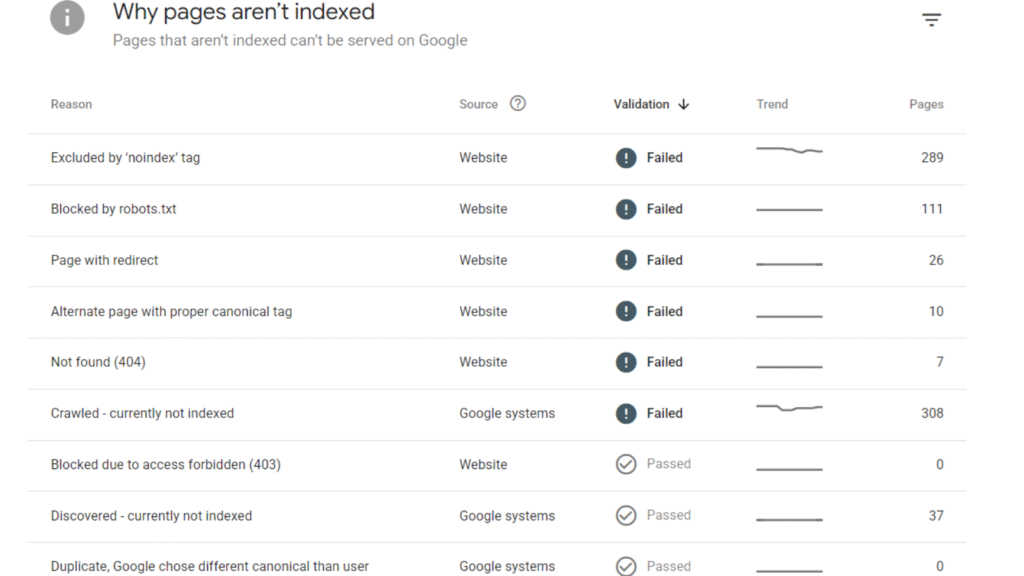
Search Console’s Page Indexing report can show large numbers of duplicate, alternate, redirected, or otherwise non-indexed URLs, because Google knows about a URL without necessarily keeping it as an indexed Search result. A large known-URL count on its own doesn’t prove index bloat; some duplicate content on a site is normal, and Google’s own documentation is explicit that it isn’t treated as a violation of Google’s spam policies.
The cohort actually worth diagnosing as bloat is the URLs that remain indexed when they shouldn’t be, not the full set of URLs Google has simply discovered, crawled, or logged as a known duplicate. A related but separate problem, an excessive volume of discovered or crawled URLs that never needed to exist in the first place, is better treated as a crawl-efficiency issue than as index bloat itself, even though the two commonly trace back to the same broken URL-generation source.
Why Index Bloat Matters at Enterprise Scale
At a few hundred pages, a handful of low-value indexed URLs is a minor annoyance. At millions of URLs, the same pattern multiplied across an entire site becomes a structural problem. Large duplicate URL spaces aren’t inherently harmful on their own, but inconsistent canonical signals, or a large number of materially similar pages competing to represent the same content, can make canonicalization, crawling, and reporting meaningfully harder to manage.
What turns ordinary duplication into bloat at enterprise scale is usually structural: faceted navigation, parameterized URLs, or programmatic page generation are exactly the kind of architecture that produces duplication in volumes large enough to matter.
It also makes internal measurement harder. When a large share of a site’s indexed inventory is low-value filtered variants, standard reporting- indexed page counts, crawl stats, sitemap coverage, becomes less representative of how the URLs the business actually intends to compete with are performing, because the signal is buried under noise the team never intended to generate.
The Growzify Index Inventory Reconciliation
Diagnosing index bloat accurately means keeping four distinct inventories separate rather than treating “URLs Google knows about” as a single number. This is a practitioner framework Growzify uses to structure the diagnosis, not a Google-documented metric.
| Inventory | What it represents |
| Intended inventory | The URLs the business and CMS actually want eligible for independent Search visibility |
| Known inventory | Every URL Google has discovered, including duplicates, alternates, and redirected URLs it has no intention of indexing independently |
| Indexed inventory | The URLs Google currently keeps indexed, whether or not the site intended them to be |
| Search-performing inventory | The subset of indexed URLs that actually receive impressions or clicks |
The true index-bloat cohort is the gap between the indexed inventory and the intended inventory, not the gap between the known inventory and the intended inventory. Conceptually: index bloat cohort equals the URLs currently indexed minus the URLs intentionally eligible for independent Search visibility.
This is a reconciliation for diagnosis, not a Google-reported metric, and the two inventories need to be normalized for canonical equivalents, temporary indexing states, and Search Console’s own reporting limitations before the comparison means anything.
How to Measure Index Bloat at Enterprise Scale
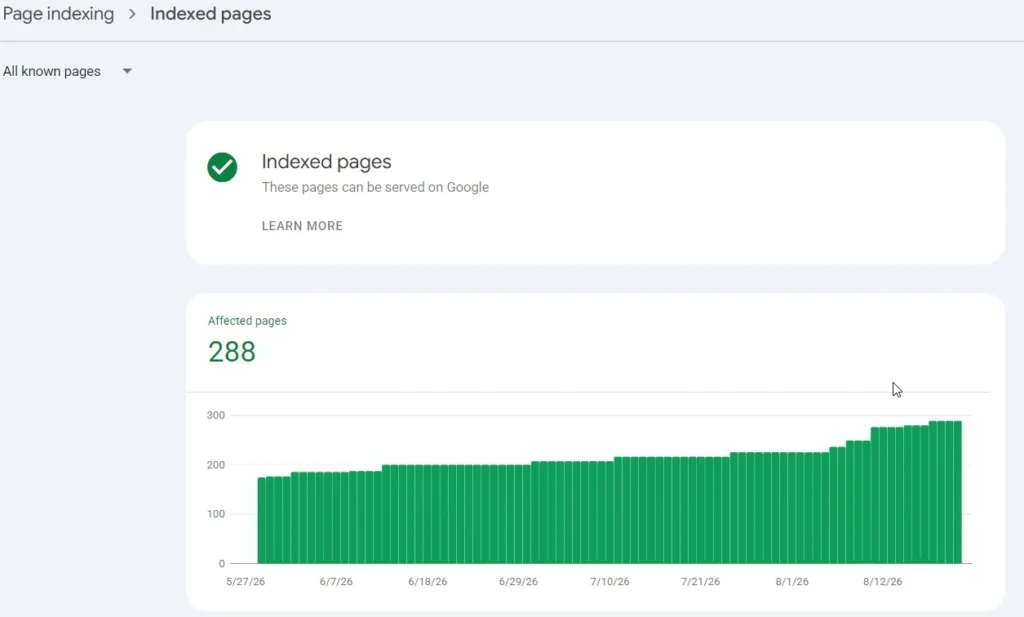
Measuring index bloat on a site with millions of URLs takes more than a single report, since Search Console’s own detail views cap example URL lists at 1,000 per status and explicitly aren’t guaranteed to show every URL in that status even when fewer than 1,000 exist.
The core comparison is the site’s intended indexable inventory, drawn from the CMS or database, or from dedicated XML sitemaps built around a template or URL pattern, against what Google reports as indexed and not indexed, including the reason assigned to each non-indexed cohort: duplicate without a user-selected canonical, alternate page with a proper canonical tag, blocked by noindex, and so on.
Search Console’s Page Indexing report provides those totals and reasons at the property level, and it can be filtered by a specific submitted sitemap, but not by an arbitrary URL pattern. For very large sites, building sitemap segmentation around URL classes that map to actual business and technical templates, products, categories, locations turns Search Console from a property-level aggregate into a genuinely useful cohort-monitoring system; Growzify’s enterprise technical SEO checklist covers where this kind of segmentation fits alongside other core technical reviews.
Combining that segmented Search Console data with CMS, database, crawl, or log-based URL cohorts is what actually identifies which templates and URL patterns are responsible for a gap between intended and indexed inventory.
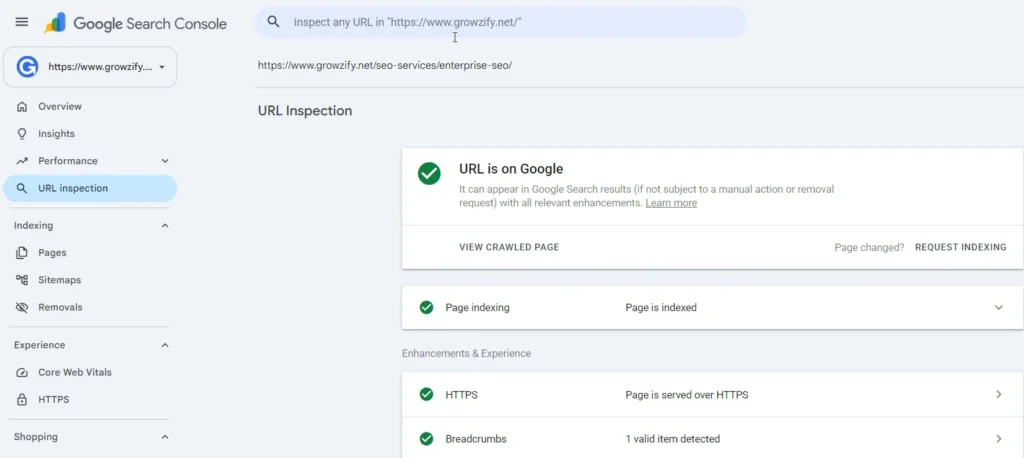
Targeted URL sampling, pulling a representative set of URLs from a suspected bloat source and checking their indexing status directly, fills in what the aggregate reports can’t show at full URL-level detail. Sampling works best stratified by URL cohort rather than purely random, a batch each from faceted URLs, taxonomy pages, legacy URLs, and programmatic pages, for example, rather than one large undifferentiated sample that happens to be dominated by whichever cohort is largest.
Thesite:search operatoris a rough, secondary sanity check only, not a measurement tool. Google’s own documentation on search operators doesn’t guarantee the count this operator returns reflects the actual index accurately, so it’s useful for spotting an obvious anomaly, a sudden, dramatic jump in results, rather than for tracking a number precisely over time.
None of these sources alone tells you why bloat is happening. That diagnosis requires matching segmented indexing data against the specific sources covered next.
Establish a Baseline Before Changing Anything
Before touching a URL cohort at enterprise scale, capture a baseline: indexed totals by cohort, non-indexed reason totals, sitemap-segmented counts, a sample of the canonical URLs Google has actually selected, organic traffic and conversions for the affected templates, recent crawl activity, and the internal link sources pointing into the cohort. Without this baseline, there’s no reliable way to confirm afterward whether a change actually worked or whether an unrelated factor moved the numbers instead.
Five Index Bloat Sources Growzify Commonly Investigates
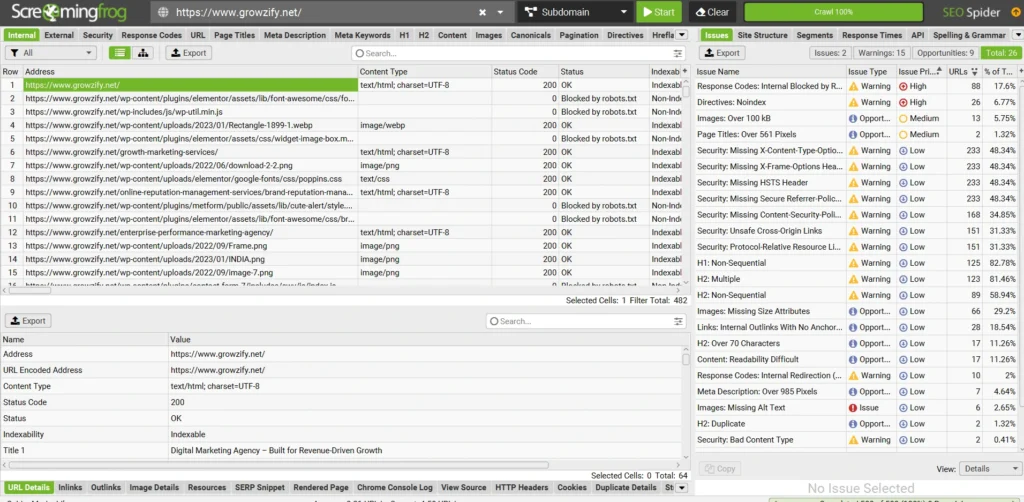
Faceted navigation and parameter URLs.Filter combinations on category and listing pages can multiply a modest catalog into hundreds of thousands of technically unique URLs, most carrying no independent search value beyond the base category page they filter.
Repetitive or low-utility generated pages.Internal search results pages, zero-result category states, sort-order variations, and placeholder pages with little distinguishing content can become crawlable and indexable when CMS or application defaults expose them, without anyone deciding they should compete in search. A temporarily out-of-stock product is a different situation and generally shouldn’t be treated this way; Google’s own e-commerce guidance recommends keeping those pages accessible and marking the product unavailable rather than removing them from Search. A permanently discontinued product with a genuine successor is better handled with a redirect to that replacement; one with no replacement at all is a case-by-case call based on whether the page still holds independent search or reference value before defaulting to a 404 or 410.
CMS-default taxonomy pages.WordPress tag pages and similar auto-generated archive pages are a frequent source of bloat, but not a uniform one: some taxonomy pages genuinely aggregate useful content and rank on their own merit, while others exist purely as a CMS default with no independent value. Treating the whole cohort the same way, indexed or noindexed, without distinguishing which pages actually serve a purpose, wastes the more useful ones or leaves genuinely low-value ones indexed.
Legacy and migration artifacts.Old URL patterns, deprecated parameter structures, and pages left over from a platform change can remain discovered, crawled, or indexed long after the migration when replacement and removal signals were incomplete at the time.
Programmatic SEO without safeguards.Automatically generated landing pages can produce real value at scale; the risk isn’t programmatic generation as a production method, it’s generating pages without sufficient independent value or primarily to create more indexable surface area rather than to serve a genuine, distinct search intent.
Growzify’s guide on optimizing websites with millions of pages covers the broader operational playbook for managing URL inventory at this scale, including how to standardize technical templates so new bloat doesn’t get introduced as fast as old bloat gets cleaned up.
The Growzify Index Control Decision Matrix
Picking the right control starts with one question: what should this URL’s final state actually be? That question comes before asking whether the URL happens to be indexed already; current indexing status affects how a control gets applied, not which control is correct in the first place. This is a practitioner framework Growzify uses to route each URL to its correct fix, not a Google-documented process.
| Intended final state | Primary control |
| URL deserves independent Search visibility | Keep it indexable; let it self-canonicalize |
| Duplicate should consolidate into a representative URL | rel=canonical, or a redirect where the duplicate has no reason to exist separately at all |
| URL must remain available to users but shouldn’t compete in Search | Noindex |
| URL no longer needs to exist in any form | 404 or 410, or a permanent redirect if a genuine replacement exists |
| URL space shouldn’t exist or be crawled at scale | Prevent generation or internal discovery of the URLs; restrict crawling with robots.txt where that’s the appropriate long-term control |
| Temporary, urgent suppression | Search Console’s removal tool, alongside the permanent underlying fix, since the tool only suppresses a URL temporarily |
For a URL that’s already indexed, apply the permanent signal that matches that intended final state, canonicalization for a genuine duplicate, a permanent redirect (301 or 308) for content with a real replacement, noindex for a page that must stay accessible but not searchable, or 404/410 when the resource is genuinely gone, and avoid blocking crawling before Google has had a chance to process that newly introduced signal, since a crawl block would prevent Google from ever seeing it.
Crawl-generation controls and robots.txt belong in the picture when the long-term crawl policy for that URL space actually warrants them, not automatically as a second step once deindexing happens to be complete; a page kept alive with noindex specifically may need to stay crawlable indefinitely so Google can keep confirming that directive.
Faceted or filtered URLs that shouldn’t appear in Search at allare the clearest case for prevention over correction: Google’s own faceted-navigation guidance notes that canonical and nofollow signals are generally less effective long-term than preventing crawling outright for URL spaces that don’t need Search visibility, since the URL space can otherwise grow effectively without bound. For a cohort already indexed, apply noindex or removal first so Google can process the deindexing signal, then prevent the combinations from being generated or internally discoverable going forward.
Faceted or filtered URLs that are genuine duplicates or near-duplicates of a base page, but that still need to remain crawlable for users, are the case canonicalization actually fits: consolidate them to the representative URL and keep that signal applied consistently as new filter combinations get generated. If a filtered state doesn’t need to exist as a crawlable URL at all, preventing its generation is the more durable answer than relying on canonical alone.
Session IDs and tracking parametersshould have any already-indexed duplicate variants canonicalized toward the clean URL, while crawlable session or tracking URLs are prevented from being generated in the first place and internal links are standardized to the clean version. Canonicalization here consolidates existing duplicates; it isn’t permission to keep generating unlimited new parameter variants.
Internal search-result, sort-order, and similar UX-state URLs(?q=, ?sort=, ?order=) usually carry no independent search value unless a specific query or sort state has been deliberately curated into its own landing page. Noindex or crawl-generation controls apply depending on whether the state needs to stay user-accessible; the underlying principle is that a UX state isn’t automatically a Search landing page just because it happens to be crawlable.
Paginationdeserves separate treatment from arbitrary faceted duplication. Paginated pages can expose genuinely distinct items and shouldn’t automatically be canonicalized to page one purely to reduce an indexed-page count; doing so can suppress the discovery of content that only appears on later pages.
Across all of these, canonical, redirect, and sitemap signals should stay consistent with each other rather than conflicting, since Google’s own guidance on consolidating duplicate URLs recommends combining canonicalization methods and treats consistency as what makes consolidation reliable; conflicting signals make it harder to diagnose why a given URL isn’t consolidating the way it’s supposed to.
Choosing the Right Control Mechanism
Getting the mechanism wrong is where most enterprise index bloat projects lose time, because a control applied incorrectly can look like it’s working while doing nothing at all.
Robots.txtprevents crawling, not indexing. Google’s own introduction to robots.txt states directly that it “is not a mechanism for keeping a web page out of Google,” and that a robots.txt-disallowed page can still be indexed if it’s linked to from other sites, since Google can index a URL based on external signals even without crawling its content. Robots.txt is the right tool when a URL genuinely shouldn’t be crawled at all, not as a general-purpose way to keep something out of the index.
The noindex directiveis an indexing control rather than a crawl control; Google still has to crawl the page to discover and periodically refresh the directive. Google’s documentation states directly thatnoindex specified in robots.txtisn’t supported, and that for a noindex meta tag or HTTP header to work, the page must not be blocked by robots.txt, since a blocked page never gets crawled to see the tag in the first place.
Combining a robots.txt disallow with a newly applied noindex directive on the same URL is a common and costly mistake for exactly this reason: robots.txt prevents Google from crawling the URL at all, so it never sees the noindex directive, making the intended deindexing control ineffective.
Canonical tagsconsolidate duplicate signals toward a preferred URL but don’t stop Googlebot from crawling the alternate versions, just less frequently than the canonical, and they’re a signal Google can choose not to follow if it disagrees with the specified canonical. Google’s own documentation on canonicalization confirms the canonical page is crawled most regularly while duplicates are crawled less often, and it’s explicit that indicating a canonical preference is a hint, not a rule.
Canonicalization is a consolidation mechanism for genuinely duplicate or near-duplicate URLs, not a general-purpose way to keep a page out of the index; if the pages in question aren’t actually close duplicates, Google may disregard the canonical entirely or select a result the site didn’t intend.
Redirects and removalare the right tools for URLs that no longer need to exist in any form. A permanent redirect, 301 or 308, signals that the replacement URL should become the destination when a genuine equivalent exists; a 404 or 410 status is the honest signal for content that’s genuinely gone. Search Console’s URL removal tool only suppresses a URL temporarily, useful when speed matters, alongside the permanent underlying fix, not as a replacement for one.
Safe Cohort Rollout at Million-URL Scale
A control that’s correct in principle can still do real damage applied all at once across millions of URLs, since a pattern that looks disposable can quietly contain revenue-generating or genuinely search-visible exceptions. A safer sequence: identify the specific URL pattern, sample it manually rather than assuming uniformity, confirm business and search value with the team that owns that content, apply the change to a limited cohort first, verify the directive or status actually renders correctly on those URLs, monitor Search Console, server logs, and rankings for that cohort specifically, then expand the rollout in stages, with a clear rollback path kept available throughout.
A Composite Example: Diagnosing Bloat on a Marketplace Site
The following is an illustrative, composite scenario built from patterns Growzify sees across enterprise reviews, not a specific named client or a real audit result.
An online marketplace with tens of thousands of genuine product listings discovered its indexed URL count in Search Console was several times larger than its intended catalog. The initial assumption was that this reflected strong coverage.
Reviewing Page Indexing cohorts, combined with template-specific sitemap segmentation and the marketplace’s own URL inventory, told a different story: a large share of the excess was duplicate pages without a user-selected canonical, traced back to a faceted navigation system generating a filtered URL for every combination of category, size, and color.
The filter combinations that needed to stay crawlable for users, because customers genuinely used them to reach specific product sets, were canonicalized to their base category page. The combinations that carried no independent value and didn’t need to remain crawlable at all were instead restricted from being generated as URLs in the first place, consistent with Google’s own guidance that preventing crawling holds up better long-term than canonical alone for faceted URLs that don’t need Search visibility.
A separate cohort turned out to be legacy URLs from an earlier platform migration, still indexed and still occasionally receiving crawl requests, addressed with permanent redirects to their current equivalents. From there, the plan was to monitor Page Indexing cohorts, the canonical URLs Google actually selected, and server logs across subsequent recrawls, to confirm the unwanted variants were genuinely leaving the index and the preferred URLs were consolidating correctly, rather than assuming the fix worked from the initial changes alone.
Common Mistakes When Controlling Index Bloat
Combining a robots.txt disallow with a newly applied noindex directive on the same URLs.Blocking crawling prevents Google from ever crawling the page to discover the noindex directive, which makes the intended deindexing control ineffective rather than reinforcing it.
Applying a template-level control before validating the actual URL cohort.A pattern that looks safely disposable can contain revenue-generating or currently search-visible exceptions; sampling and confirming business ownership before applying noindex, robots.txt, or redirect rules across millions of URLs at once catches those exceptions before they’re accidentally deindexed.
Canonicalizing pages that aren’t genuinely duplicates.Canonicalization is for duplicate or very similar pages, not a general-purpose way to suppress a page from the index; if the pages are materially different, Google may ignore the canonical, or consolidation may produce a result the site didn’t intend.
Using noindex as a default fix for everything.Noindex is the right tool for pages that should stay accessible to users but shouldn’t compete in search, not for duplicate URLs better served by canonicalization, or for URLs that shouldn’t be crawled at all.
Treating thesite:operator count as a precise metric.Google doesn’t guarantee this count reflects the actual index accurately, so tracking it closely over time produces noisy, unreliable trend data compared to Search Console’s own reporting.
Fixing the symptom without closing the source.Deindexing a batch of bloated URLs without fixing the faceted navigation, CMS default, or programmatic system that generated them means the same unwanted URL patterns can reappear over time.
How to Know the Cleanup Worked
A falling indexed-page count on its own doesn’t confirm success; it can just as easily mean a mistake removed pages that should have stayed. A genuinely successful cleanup shows the unwanted cohort declining from the index specifically, the intended canonical being selected for consolidated groups, the pages meant to stay indexed remaining indexed and stable in organic traffic, crawl activity on the restricted URL space actually falling where prevention was applied, no new instances of the same unwanted pattern appearing, and the Page Indexing report’s reason distribution for that cohort stabilizing rather than continuing to shift. Confirming this against the baseline captured before the change started is what separates a verified fix from an assumption that it worked.
Frequently Asked Questions
Does index bloat directly hurt search rankings?
Google doesn’t document index bloat as a direct ranking factor. Its practical effects can include unnecessary crawl activity, canonicalization ambiguity among duplicate URLs, unwanted URLs appearing in Search, and difficulty measuring the performance of the site’s actual, intended indexable inventory.
What’s the difference between index bloat and crawl budget waste?
They’re related but distinct. Crawl budget waste describes crawling resources spent on low-value URLs. Index bloat describes what happens when those URLs remain indexed despite not belonging in the site’s intended Search inventory. A site can have one problem without the other, though large sites frequently have both.
Should I use noindex or canonical tags for faceted navigation URLs?
It depends on the filtered URL’s intended final state, not just whether it’s currently indexed. If the URL must remain crawlable and is a genuine duplicate or near-duplicate of a base page, canonicalization is usually appropriate. If the filtered combination has no independent search value and doesn’t need to remain crawlable at all, preventing its generation is the more durable fix, since Google’s own faceted-navigation guidance notes that canonical and noindex are both less effective long-term than preventing crawling for URL spaces that don’t need Search visibility in the first place.
How often should index bloat be reassessed on a large site?
Ongoing monitoring is more reliable than a fixed schedule: automated cohort checks for sites with frequent template or catalog changes, a review immediately after any CMS, template, or migration change, and a broader structural review on a quarterly cadence as a baseline, since a single scheduled review can miss bloat reintroduced well before the next one is due.
Can index bloat happen even on a site with strong content?
Yes. Index bloat is a structural and technical issue, not a content-quality problem in the traditional sense. A site with genuinely strong core content can still accumulate significant bloat through faceted navigation, CMS defaults, or an unmanaged programmatic system layered on top of that good content.
When Index Bloat Control Needs Specialist Support
If the issue is confined to a small, clearly understood cohort and the internal team can safely change the responsible template on its own, a focused internal cleanup is often sufficient. Specialist support becomes more clearly worth it once a site’s indexed count diverges significantly from its genuine URL inventory, once faceted navigation or a programmatic system is generating new bloat faster than it can be manually reviewed, or once the cleanup spans multiple templates and business units with conflicting canonical signals, active traffic-generating exceptions, or migration history, where a blanket directive risks removing legitimate pages along with the unwanted ones.
Where This Fits Into a Broader Enterprise SEO Program
Index bloat control is one part of the broader technical discipline of managing a large site’s URL inventory responsibly, alongside crawl efficiency, content quality, and site architecture.
If your organization’s indexed page count doesn’t match what your team believes should actually be competing in search, Growzify’senterprise SEO servicesteam can diagnose the specific sources responsible and apply the right control mechanism to each one.

Chitranshu SharmaA growth strategist, digital marketing consultant, and the founder of Growzify, a performance-driven agency helping brands dominate search, shape perception, and build sustainable online visibility. With 8+ years of hands-on experience in Enterprise SEO, Online Reputation Management (ORM), and AI-led traffic generation, Chitranshu has helped startups, public figures, SaaS companies, and cannabis brands outrank competitors — ethically and at scale.
Explore More Articles

How to Find and Compare Local SEO Outsourcing Providers
How to Find and Compare Local SEO Outsourcing Providers Finding a local SEO outsourcing provider...
October 13, 2026Outsourcing

Inside a White Label SEO Campaign: How the Work Gets Done
Inside a White Label SEO Campaign: How the Work Gets Done Clients see a single...
October 13, 2026White Label

How to Vet an SEO Outsourcing Provider Before You Sign a Contract
How to Vet an SEO Outsourcing Provider Before You Sign a Contract A polished proposal...
October 9, 2026Outsourcing

Multilingual SEO Best Practices: Optimize Your Multi-Language Website
Multilingual SEO Best Practices: Optimize Your Multi-Language Website Translating a page and localizing it for...
October 7, 2026SEO

What Makes In-House Enterprise SEO Work Different Day-to-Day?
What Makes In-House Enterprise SEO Work Different Day-to-Day? On a small site, deciding to fix...
October 7, 2026Enterprise

How Core Algorithm Updates Impact Large Sites Differently Than Small Ones
How Core Algorithm Updates Impact Large Sites Differently Than Small Ones A large enterprise site...
October 7, 2026Enterprise

When Should You Outsource SEO? 11 Signs It Makes Sense
When Should You Outsource SEO? 11 Signs It Makes Sense Outsourcing SEO does not necessarily...
September 26, 2026Outsourcing