


Enterprise SEO: A Complete Guide for Large Organizations
Enterprise SEO help large businesses improve search visibility through technical SEO, scalable content strategies, automation, and ongoing optimization, enabling sustainable organic growth, stronger rankings, and increased qualified traffic.

Written byChitranshu Sharma
July 13, 2026
Quick Nav
Enterprise SEO is an operating model for managing organic search across large or organisationally complex websites. It applies standard SEO principles through scalable technical controls, content systems, governance, automation, measurement and cross-functional workflows. The defining factor is not a fixed number of pages or employees; it is whether SEO performance depends on coordinating multiple templates, systems, teams, markets or business priorities consistently.
Methodology:This guide combines Google Search documentation with recurring patterns observed in Growzify enterprise SEO reviews. Statements attributed to Growzify reflect practitioner experience and should not be interpreted as confirmed Google ranking mechanisms.
Enterprise SEO is about managing complexity at scale. As organisations grow, websites expand into thousands of URLs spread across multiple brands, markets, languages, content management systems, and cross-functional teams. What begins as a straightforward SEO strategy quickly evolves into a coordinated effort involving technical architecture, content governance, engineering, product, and marketing.
A single template issue can affect thousands of pages, a website migration can reshape an entire site’s search visibility, and disconnected teams can unknowingly compete for the same search intent. Enterprise SEO provides the structure, governance, and scalable processes needed to manage these challenges while aligning SEO with broader business goals.
This complete guide explores every stage of enterprise SEO from strategy and technical foundations to content governance, international SEO, reporting, and scalable implementation, helping large organisations build sustainable organic growth.
Building an SEO Strategy That Scales With Your Business
An enterprise SEO strategy works best when organic search supports clear business objectives, such as generating qualified leads and increasing product discovery. Makes it easier for enterprises to enter new markets and grow revenue in existing ones.
Begin Enterprise SEO Strategy by identifying:
- Which products or services are most valuable?
- Which markets have the greatest growth potential?
- Which customer groups are most important?
- Where is organic search already generating results?
- Where are competitors gaining visibility?
- Which website areas are preventing growth?
Enterprise SEO Priority Model
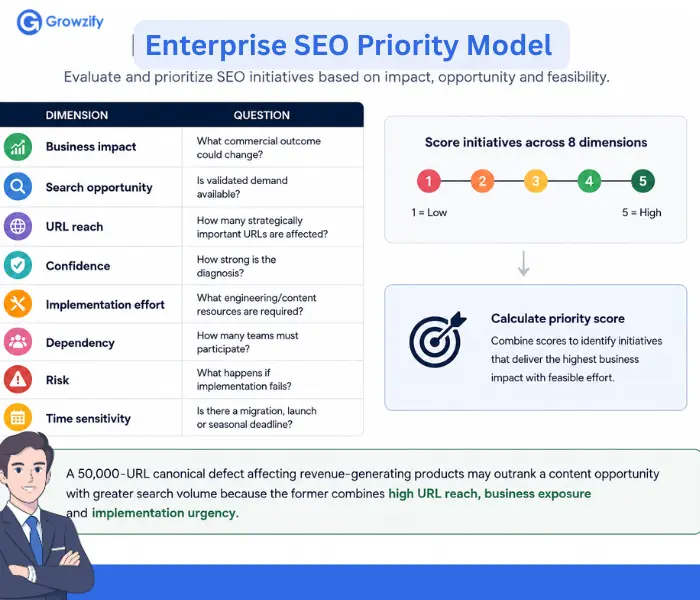
A simplified framework for prioritizing enterprise SEO initiatives by evaluating business impact. These evaluation parameters include search opportunity, URL reach, implementation effort, dependencies, risk, and time sensitivity to focus resources on the highest-value opportunities.
For enterprise SEO, a useful approach is to prioritize opportunities based on business impact, search potential, implementation effort, and the strength of the existing website. A technically complex project may still be a high priority if it affects a major revenue-generating section, while a high-volume keyword may not be worth pursuing if it has little relevance to the business or its customers.
Start With the Technical Foundation
Once priorities are established, the next step is making sure search engines can discover and understand the website. Once business priorities are established, technical SEO determines whether important URLs can be discovered, crawled, rendered, consolidated, indexed and served reliably. At enterprise scale, the objective is not to maximise indexation; it is to make the correct URLs accessible.
Large websites often accumulate technical complexity through redesigns, migrations, new products, CMS changes, international expansion, and years of content publishing.
An enterprise technical SEO review should examine these parameters for their website.
- Crawling and indexation:Ensure search engines can efficiently discover, crawl, and index important pages.
- URL structures:Keep URLs clear, logical, consistent, and easy for users and search engines to understand.
- XML sitemaps:Help search engines discover important URLs across large and complex websites.
- Robots.txt:Control which areas of the website search engine crawlers can access.
- Canonicalization:Signal the preferred version of similar or duplicate pages.
- Redirects:Properly guide users and search engines from outdated URLs to relevant new ones.
- Duplicate pages:Identify and manage repeated or substantially similar content that can create indexing issues.
- Thin or low-value pages:Improve, consolidate, or remove pages that provide little useful information.
- Orphan pages:Find important pages that lack internal links and improve their discoverability.
- JavaScript rendering:Ensure important content and links remain accessible to search engines when JavaScript is used.
- Faceted navigation:Manage filter-generated URLs to prevent unnecessary crawling and duplicate pages.
- Mobile usability:Make sure pages provide a smooth, accessible experience across mobile devices.
- Site performance and Core Web Vitals:Improve loading speed, responsiveness, and visual stability for better user experience.
Google explains that Search relies on crawling, indexing, and serving processes, making crawlability and indexability important foundations for search visibility. However, technical SEO should not become an endless list of fixes. Prioritize issues according to their potential effect on important pages, users, and business objectives.
Crawl budget is not a universal enterprise SEO problem. It becomes materially relevant when a site has a very large or rapidly changing URL inventory, substantial numbers of discovered-but-not-indexed URLs, or inefficient crawling caused by faceted navigation, duplicate URLs, soft errors, unnecessary resources or server limitations.
The objective is not simply to “increase crawl budget.” Enterprise teams should reduce unnecessary crawling, maintain accurate sitemaps, improve server and rendering efficiency, and make strategically important URLs easier to discover and prioritise.
For example, a broken canonical pattern affecting 50,000 product URLs deserves considerably more attention than a minor issue affecting a handful of low-value pages. Building a technical SEO dashboard that separates critical issues, high-impact improvements, routine maintenance, and low-priority recommendations.
Build a Scalable Content Strategy
After the technical foundation is under control, the focus shifts to what the business should actually be found for. Large businesses can easily fall into the trap of producing content simply because there are more keywords to target. That approach can create thousands of pages without creating meaningful value. A stronger strategy starts with customer needs and search intent.
Build an Enterprise Content Strategy Designed to Scale Business Growth
- Core topics associated with the business
- Commercial search opportunities
- Informational questions
- Product and service searches
- Comparison searches
- Existing content gaps
- Pages competing for the same search intent
Then map those opportunities to the appropriate page. This prevents multiple teams from unknowingly creating pages that target the same topic.
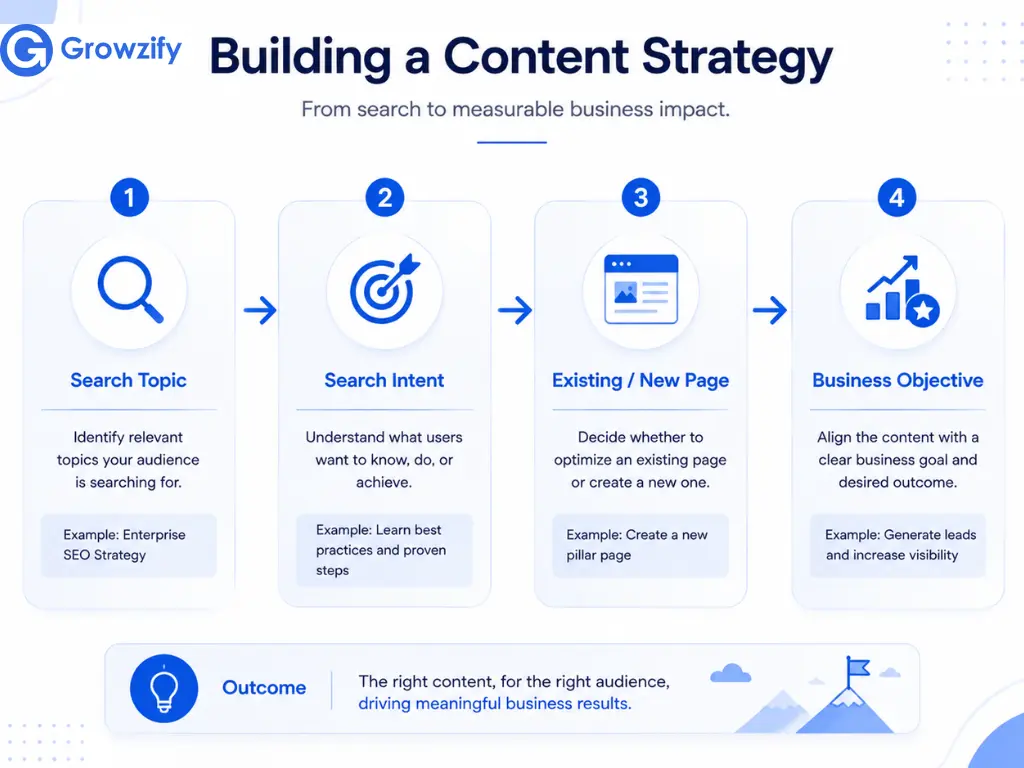
Content should also be managed throughout its lifecycle. Some pages should be created, some improved, some consolidated, and some removed when they no longer serve a useful purpose.
The objective is not maximum publishing volume. It isuseful, differentiated coverage around the topics that matter to customers and the business.
Google’s core ranking systems look to reward content that provides a good page experience. Google guidancefocuses on purpose and value: automation can support research, structure and production, but generating large volumes of pages without meaningful user value may violate scaled-content policies. Enterprise teams should therefore govern AI output through source validation, SME review, originality requirements and page-level quality controls.
Create a Strong Site Architecture and Internal Linking System
As content grows, organization becomes increasingly important. A visitor should be able to move naturally from a broad category to a more specific product, service, or supporting resource. Search engines should also be able to discover important pages through clear links. A scalable architecture can include:
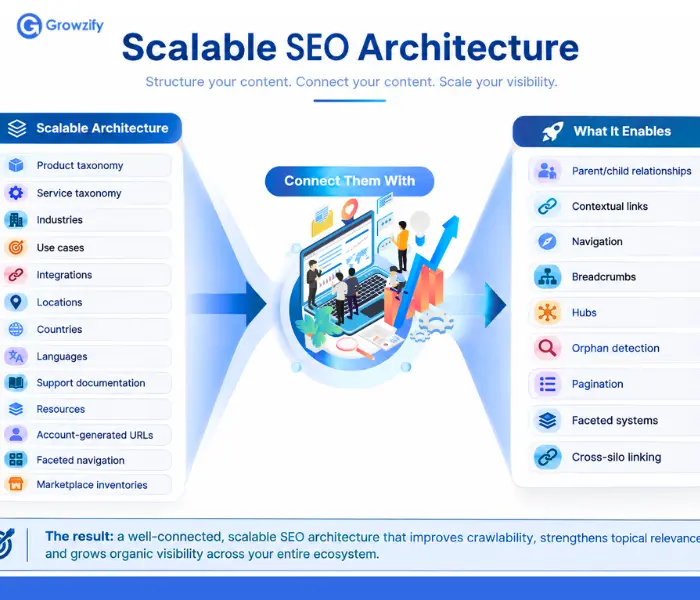
Google confirms that crawlable links help it discover pages and provide relevance context through linked content and anchor text
Site architecture should follow user and business relationships—not an arbitrary rule that every URL must sit within a fixed number of clicks.Internal links should be intentional rather than added simply to increase the number of links on a page.
Consider:
- Which pages are most important?
- Which pages naturally support each other?
- Where can additional context help the reader?
- Which important pages are difficult to reach?
- Which pages have become orphaned?
Google notes that crawlable links help search engines discover pages and understand the relevance of linked content. For enterprise websites, internal linking can therefore become an ongoing process rather than a one-time optimization project.
Manage SEO Across Multiple Markets and Locations
Growth often means entering new countries, languages, and locations. That introduces another layer of SEO complexity. As enterprises expand into new countries, regions, and cities, their SEO strategy needs to grow with them. Each market has its own search behavior, language, and customer expectations, so a one-size-fits-all approach rarely works. The goal is to keep the overall strategy consistent while making each market locally relevant.
A global business needs to determine:
- Which pages should be translated?
- Which content needs local adaptation?
- How should country and language versions be structured?
- Which information should remain globally consistent?
- How should local search intent influence content?
- Self-referencing annotations where appropriate
- Reciprocal links
- Correct language/region codes
- canonical alignment
- x-default where useful
- URL-level implementation
- HTML/header/sitemap implementation options
- testing
- common errors
Google specifically identifies missing return links and incorrect language/region codes as common hreflang implementation errors.
For multilingual and multi-regional websites, Google recommends clearly indicating localized versions andgoogle guides hreflang implementations.
The challenge is avoiding two extremes.
- One is complete duplication, where every market receives essentially the same content despite different customer needs.
- The other is complete decentralization, where every regional team creates its own SEO approach without shared standards.
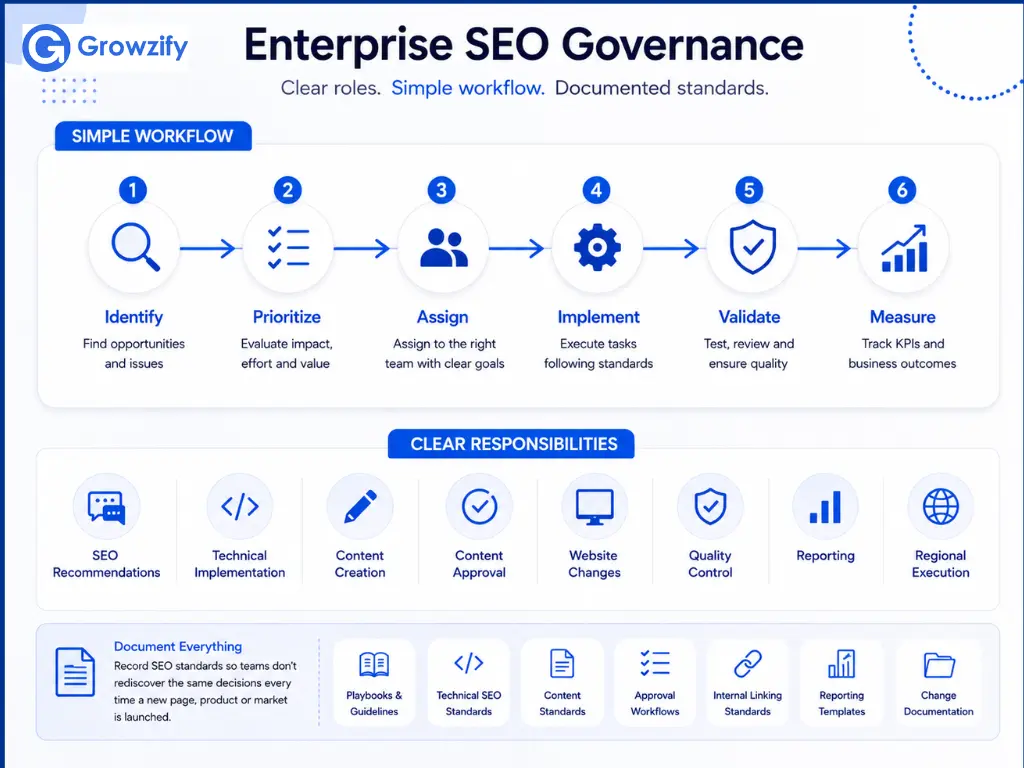
A scalable enterprise model usually combines central governance with enough flexibility for local teams to address regional search behavior.
Establish Enterprise SEO Governance and Workflows
At this point, the challenge moves from strategy to execution. A large organization may have SEO specialists, writers, developers, designers, product managers, marketers, regional teams, and legal stakeholders. If everyone works independently, even a strong SEO strategy can struggle to get implemented.
Here’s a simpler, enterprise-focused version that’s easier for readers to understand while retaining the depth of the original.
Enterprise SEO Release Checklist
Before launching a major website update, verify:
- Assess the SEO impact of the release.
- Crawl the staging site to identify potential issues.
- Validate page templates and metadata.
- Check canonical tags are correct.
- Confirm robots.txt and meta robots settings.
- Test all redirects before deployment.
- Verify internal links across key pages.
- Validate structured data and schema markup.
- Perform analytics and tracking quality assurance.
After the release, monitor closely:
- Compare pre- and post-launch crawls.
- Monitor page indexation in search engines.
- Track organic traffic and keyword performance.
- Review server logs for crawl activity.
- Check Google Search Console for errors and warnings.
- Follow a rollback or escalation plan if critical SEO issues appear.
Why this matters:
Enterprise websites involve thousands of pages and multiple teams. A structured release process helps identify SEO issues early, protects existing rankings, and ensures technical changes support long-term organic growth instead of creating unexpected performance problems.
Measure Enterprise SEO Through Business Outcomes
Enterprise SEO measurement should go beyond asking,“Did our rankings improve?”A strong measurement framework connects organic search performance with engagement, technical health, and business results. By tracking the right SEO KPIs, large businesses can understand what is working, where opportunities exist, and how organic search contributes to overall growth.
Visibility: Understand How Your Enterprise Appears in Search
Visibility metrics show whether your website is becoming more discoverable for relevant searches. For enterprise websites, it is useful to look beyond overall rankings and understand performance across important products, services, locations, and markets.
- Impressions:Measure how often your pages appear in search results.
- Keyword rankings:Track positions for priority commercial and informational terms.
- Search visibility:Monitor your overall presence across relevant search results.
- Non-brand performance:Measure how effectively you attract people who are not already searching for your brand.
Example:An enterprise software company may see strong branded rankings but limited visibility for non-brand searches such as “project management software.” Improving visibility for these relevant searches can create opportunities to reach new customers.
Engagement: See What Users Do After Finding You
Visibility alone does not show whether searchers find your content useful. Engagement metrics help enterprise SEO teams understand whether visitors are clicking through and interacting with important landing pages.
- Organic clicks:Measure visits generated from search results.
- Click-through rate (CTR):Understand how often impressions turn into website visits.
- Landing-page engagement:Evaluate how visitors interact with key pages after arriving through search.
- Returning visitors:Identify whether organic search is bringing users back to the website.
Example:An ecommerce business may rank well for a product category but receive a low CTR. Improving the page title and description could help attract more qualified clicks without changing its ranking position.
Business Impact: Connect Enterprise SEO to Revenue and Growth
For large businesses, SEO performance ultimately needs to connect with measurable business outcomes. Tracking conversions helps demonstrate whether organic search is contributing to revenue, lead generation, customer acquisition, or pipeline growth.
- Leads:Track qualified inquiries generated through organic search.
- Sales:Measure purchases or completed transactions from organic traffic.
- Revenue:Connect organic search visits with actual revenue where attribution allows.
- Conversion rate:Compare how effectively organic visitors complete desired actions.
- Pipeline contribution:For B2B enterprises, measure how organic search contributes to opportunities and potential revenue.
Example:A B2B enterprise may discover that one service page generates less traffic than its informational articles but produces significantly more qualified leads. That insight can help the SEO team prioritize improvements to similar commercial pages.
Technical Health: Make Sure SEO Performance Has a Strong Foundation
Technical SEO metrics help enterprise teams identify problems that could limit search visibility or create poor user experiences. These metrics are especially important for websites with thousands or millions of URLs.
- Enterprise indexation strategy is about index quality, not index size
- Crawl issues:Identify technical problems that prevent search engines from efficiently accessing important content.
- Core Web Vitals:Monitor loading performance, responsiveness, and visual stability.
- Technical errors:Track issues such as broken links, incorrect redirects, server errors, and indexing problems.
Example:If a website migration causes thousands of important product pages to become inaccessible or incorrectly redirected, traffic and conversions may decline. Monitoring technical health can help identify the issue before it affects a larger portion of the business.
Build a Practical 90-Day Enterprise SEO Roadmap
A strong enterprise SEO strategy becomes much easier to implement when it is broken into clear, manageable steps. Instead of trying to fix everything at once, a 90-day roadmap helps teams focus on the highest-impact opportunities first. It also creates a clear process for moving from auditing and planning to implementation, measurement, and ongoing improvement.
Days 1–30: Audit & Prioritize
- Review technical SEO and website performance.
- Identify content and search opportunities.
- Set priorities based on business impact.
- Define KPIs and assign responsibilities.
- Stakeholder interviews
- architecture mapping
- log analysis where necessary
- Search Console segmentation
- analytics validation
- URL inventory
- template inventory
- market inventory
- content ownership
- backlog review
- business KPI alignment
Days 31–60: Implement & Improve
- Fix high-priority technical issues.
- Improve important pages and internal linking.
- Address key content gaps.
- Establish SEO workflows across teams.
- high-impact template fixes
- governance creation
- content inventory decisions
- internal-link pilots
- reporting baseline
- engineering workflow
- international issues
- migration risk controls
Days 61–90: Measure & Scale
- Review performance against your KPIs.
- Identify what is working and where improvements are needed.
- Scale successful initiatives across relevant pages and markets.
- Automate repetitive processes where appropriate.
- validate deployment
- compare affected cohorts
- scale proven changes
- establish SLAs
- automate monitoring
- quarterly roadmap
- executive reporting
By the end of 90 days, the goal is not to “finish” enterprise SEO. It is to establish a repeatable system that teams can continue improving and scaling. The results from the first 90 days should then guide the next phase of your enterprise SEO strategy.
Creating a Scalable SEO System for Long-Term Growth
Enterprise SEO is about more than optimizing a large website. It requires a scalable system that connects business goals, technical SEO, content, site structure, governance, and measurement. As search evolves, strong fundamentals and useful content remain essential.
For large businesses, the goal is to build a repeatable process that can grow across teams, pages, and markets.Growzifyhelps enterprises strengthen this process through scalable SEO strategies, structured execution, and ongoing optimization focused on sustainable business growth.
- Add FAQs.
- Add primary sources.
- Label Growzify frameworks as proprietary/practitioner models.
- Add internal links.
- Rewrite CTA.
- Full grammar/proofreading pass.
- Remove Canva production notes from final body.
Frequently Asked Questions
Is Enterprise SEO Worth It for My Business?
Enterprise SEO is worth the investment if your business manages a large or complex website and relies on organic search to attract customers. It helps improve technical performance, strengthen content, and create scalable processes that support long-term growth. Instead of focusing on short-term rankings, enterprise SEO builds a sustainable framework that continues delivering value as your business expands.
How Do I Know If My Business Needs Enterprise SEO?
Your business may benefit from enterprise SEO if you’re managing thousands of pages, expanding into new markets, publishing content through multiple teams, or experiencing recurring technical SEO issues. Other signs include slowing organic growth, complex website migrations, fragmented reporting, and increasing difficulty maintaining SEO consistency across your website.
What Types of Businesses Benefit Most from Enterprise SEO?
Enterprise SEO is ideal for businesses that manage large or growing digital ecosystems. This includes ecommerce brands, SaaS companies, enterprise B2B organizations, marketplaces, publishers, franchises, healthcare providers, financial institutions, universities, and businesses operating across multiple locations, countries, or languages.
How Long Does It Take to See Results from Enterprise SEO?
Enterprise SEO is a long-term growth strategy rather than a quick fix. While technical improvements can sometimes produce positive results within a few weeks, meaningful increases in organic visibility, traffic, and business outcomes typically develop overthree to six months. Larger websites and highly competitive industries may requiresix to twelve monthsto realize the full impact of a structured enterprise SEO strategy.
Can I Manage Enterprise SEO In-House or Should I Hire an Agency?
Both approaches can be successful. Organizations with experienced SEO, content, development, and analytics teams often manage enterprise SEO internally. However, many businesses partner with an enterprise SEO agency to gain specialized expertise, additional resources, and strategic guidance—particularly during website migrations, international expansion, or large-scale technical projects.
What Should I Look for in an Enterprise SEO Agency?
Choose an agency with proven experience managing large websites, complex technical SEO projects, and scalable content strategies. Look for expertise in website migrations, international SEO, technical audits, reporting, and cross-functional collaboration. A strong enterprise SEO partner should prioritize measurable business outcomes and provide clear recommendations that align with your long-term growth objectives.
How Is Enterprise SEO Different from Traditional SEO?
Traditional SEO typically focuses on optimizing individual pages or smaller websites. Enterprise SEO is designed for scale, helping businesses manage thousands of pages, multiple websites, markets, languages, and stakeholders through structured processes, technical governance, automation, and scalable content strategies. The emphasis shifts from page-level optimization to organization-wide SEO management.
Does Enterprise SEO Include Technical SEO, Content, and Website Architecture?
Yes. Enterprise SEO combines several disciplines into one unified strategy. It includes technical SEO, website architecture, content strategy, internal linking, structured data, international SEO, content governance, reporting, and implementation workflows. Bringing these elements together helps large organizations improve search visibility while maintaining consistency across complex websites.
How Do You Measure the Success of an Enterprise SEO Strategy?
Enterprise SEO success is measured by its contribution to business growth rather than rankings alone. Common metrics include organic traffic, qualified leads, conversions, revenue, keyword visibility, indexed pages, crawl health, user engagement, and share of voice. Many organizations also measure implementation efficiency, technical issue resolution, and the overall return on SEO investment to understand long-term impact.

Chitranshu SharmaA growth strategist, digital marketing consultant, and the founder of Growzify, a performance-driven agency helping brands dominate search, shape perception, and build sustainable online visibility. With 8+ years of hands-on experience in Enterprise SEO, Online Reputation Management (ORM), and AI-led traffic generation, Chitranshu has helped startups, public figures, SaaS companies, and cannabis brands outrank competitors — ethically and at scale.
Explore More Articles
How to Find and Compare Local SEO Outsourcing Providers
How to Find and Compare Local SEO Outsourcing Providers Finding a local SEO outsourcing provider...
October 13, 2026Outsourcing

Inside a White Label SEO Campaign: How the Work Gets Done
Inside a White Label SEO Campaign: How the Work Gets Done Clients see a single...
October 13, 2026White Label

How to Vet an SEO Outsourcing Provider Before You Sign a Contract
How to Vet an SEO Outsourcing Provider Before You Sign a Contract A polished proposal...
October 9, 2026Outsourcing

Multilingual SEO Best Practices: Optimize Your Multi-Language Website
Multilingual SEO Best Practices: Optimize Your Multi-Language Website Translating a page and localizing it for...
October 7, 2026SEO

What Makes In-House Enterprise SEO Work Different Day-to-Day?
What Makes In-House Enterprise SEO Work Different Day-to-Day? On a small site, deciding to fix...
October 7, 2026Enterprise

How Core Algorithm Updates Impact Large Sites Differently Than Small Ones
How Core Algorithm Updates Impact Large Sites Differently Than Small Ones A large enterprise site...
October 7, 2026Enterprise
When Should You Outsource SEO? 11 Signs It Makes Sense
When Should You Outsource SEO? 11 Signs It Makes Sense Outsourcing SEO does not necessarily...
September 26, 2026Outsourcing