



Why Your Law Firm Isn't Getting Recommended in AI Overviews
If your law firm isn’t appearing in Google AI Overviews, it’s likely missing key trust and authority signals that AI search engines rely on. This guide explains why AI may not recommend your firm and shares practical strategies to improve visibility across Google AI Overviews, ChatGPT, Gemini, Perplexity, and other AI-powered search platforms.

Written byChitranshu Sharma
June 26, 2026
Quick Nav
For years, stronglaw firm SEOwas measured by where your website ranked on Google’s first page. Today, that is only part of the picture. Before users even reach the traditional search results, Google often displays an AI Overview that recommends law firms, answers legal questions, and summarizes services directly in the search results.
This shift is changing how potential clients discover legal services. Some firms are consistently featured in these AI-generated answers, while others are overlooked, even if they have years of experience and an established reputation.
If your firm is missing from AI Overviews, it does not necessarily mean your competitors offer better legal services. It may simply mean their SEO strategy is better aligned with how AI understands and recommends businesses.
Modern SEO for lawyersnow requires more than traditional rankings. It requires content that answers real client questions, demonstrates expertise, and makes it easy for AI-powered search engines to understand your firm.
Let’s explore why some law firms are recommended in AI Overviews while others are not.
What Are Google AI Overviews?
Google AI Overviews are AI-generated summaries that appear at the top of search results, answering a user’s question directly before any traditional organic listing even loads.
Instead of sending users straight to ten blue links, Google now often answers the question itself, pulling information and recommendations from sources it considers trustworthy and relevant.
For law firms, this matters enormously. When someone searches “best personal injury attorney near me” or “do I need a lawyer for a DUI,” Google’s AI might generate a summary recommending specific firms, summarizing legal concepts, or answering the question outright. If your firm isn’t part of that summary, you’ve lost visibility before the user even scrolls.
This is why ranking number one in traditional search results is no longer the finish line. A firm could technically hold a strong position on page one and still be invisible inside the AI Overview that sits above it. Law firm SEO now has to account for both layers of visibility at once.
Why Some Law Firms Get Recommended While Others Don’t
AI Overviews don’t pull information randomly. They evaluate specific signals to decide which sources deserve to be summarized and recommended.
Authoritymatters heavily. Google’s AI looks at whether a website demonstrates real subject matter expertise, not generic content written to target a keyword.
Trustsignals come from consistency. Accurate contact information, verified reviews, legitimate attorney credentials, and a website that behaves the way users expect all contribute to whether AI systems treat a firm as a credible source.
Expertiseis demonstrated through depth, not volume. A firm with three genuinely thorough practice area pages often outperforms a firm with twenty thin ones, because depth signals real knowledge rather than keyword targeting.
Website qualityincludes technical performance, clear navigation, and a structure that search engines can actually parse and understand without guesswork.
Structured informationthrough schema markup helps AI systems understand exactly what a page is about, who wrote it, and what entity it represents. Without this, AI tools are left interpreting unstructured text and may simply move on to a competitor’s page instead.
Local relevanceplays a much bigger role for law firms than people expect. AI Overviews factor in location signals heavily when the query implies local intent, which most legal searches do.
Topical depthacross a firm’s content tells AI systems whether the firm is a serious authority on a practice area or just dabbling in it for traffic. Firms that publish comprehensive content clusters around their core practice areas consistently outperform firms publishing scattered, unrelated blog posts.
User experiencerounds out the picture. Slow load times, confusing navigation, and intrusive pop-ups all signal to both users and AI crawlers that a site may not deserve to be recommended.
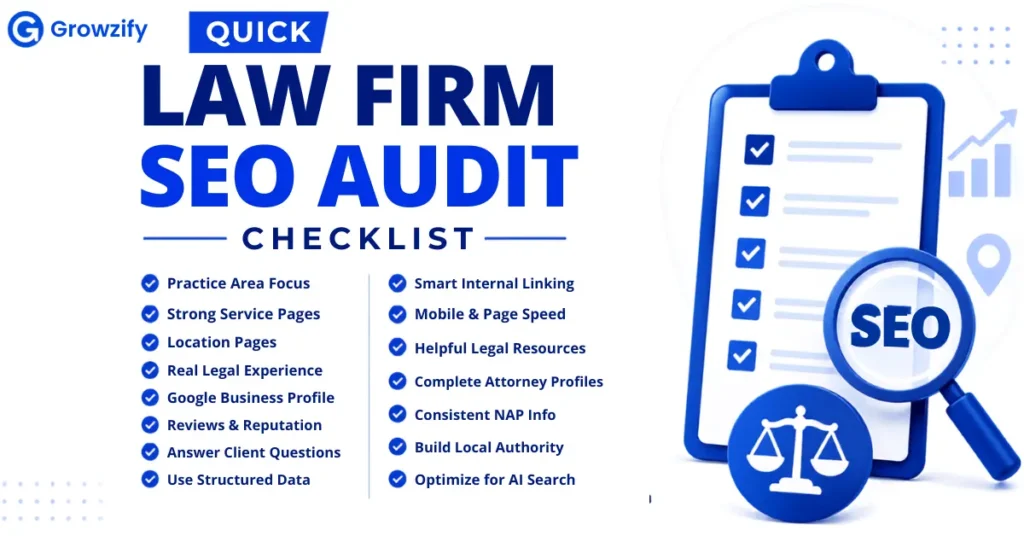
Quick Law Firm SEO Audit Checklist
Here’s where you can start evaluating your own site right now. Walk through each of these and be honest about where your firm stands.
Is Your Website Built Around Practice Areas?
Your site structure should mirror how clients actually search, organized by specific practice area rather than generic service descriptions.
AI systems use this structure to understand what your firm actually does and how deep that expertise runs.
A site with one vague “Practice Areas” page covering everything from divorce to DUI defense gives AI very little to work with.
Are Your Service Pages Too Thin?
A 200-word page that says you “handle car accident cases” tells Google almost nothing useful.
AI Overviews favor pages that thoroughly answer the questions someone would actually have, including process explanations, common scenarios, and realistic expectations.
If your service pages read like a brochure rather than a resource, this is likely costing you visibility.
Does Every Location Have Its Own Optimized Page?
If your firm serves multiple cities or counties, each location needs its own dedicated page, not a single page with a city name swapped in a template.
AI systems and local search algorithms both reward genuine local relevance, including location-specific information about courts, local legal nuances, and community presence.
Are You Demonstrating Real Legal Experience?
Generic legal content that could have been written by anyone gets ignored. AI systems increasingly favor content that shows direct experience or specific insights that only someone practicing in that area would know. This is the experience layer of EEAT that most law firm sites skip entirely.
Is Your Google Business Profile Fully Optimized?
Your Google Business Profile feeds directly into local AI recommendations. Incomplete profiles, outdated hours, missing categories, or sparse descriptions all weaken your standing.
A fully optimized profile with accurate practice area categories, regular updates, and complete information gives AI systems a much clearer signal about who you are and where you operate.
Are Reviews Supporting Your Authority?
Review volume matters, but so does review content. Reviews that mention specific outcomes, specific attorneys, or specific practice areas give AI systems more context than a string of five-star ratings with no detail.
Actively encouraging detailed reviews and responding to them professionally strengthens your trust signals significantly.
Is Your Content Answering Real Client Questions?
AI Overviews are fundamentally built to answer questions. If your content doesn’t directly answer the questions potential clients are actually asking, you’re leaving an enormous opportunity on the table. Structure content around real questions, and answer them clearly near the top of the page.
Do You Use Structured Data?
Schema markup tells search engines and AI systems exactly what they’re looking at: an attorney, a law firm, a legal service, a review, an FAQ.
Without this markup, AI tools have to guess at context, and guessing often means skipping your site in favor of one that made the information explicit.
Are Internal Links Helping Search Engines?
Internal linking shows search engines how your content connects and reinforces topical authority.
A blog post about car accident claims should link to your personal injury practice area page, which should link to relevant FAQ content.
Weak or random internal linking makes it harder for AI crawlers to understand your site’s full expertise.
Is Your Website Fast on Mobile?
Most legal searches happen on mobile devices, often from someone in a stressful situation looking for help quickly.
A slow-loading site frustrates users and signals lower quality to search algorithms. Page speed isn’t a minor technical detail anymore. It’s a direct ranking and visibility factor.
Are You Publishing Helpful Legal Resources?
Beyond service pages, firms that publish genuinely useful resources, like explainer guides, FAQ hubs, or process walkthroughs, build the topical depth that AI systems reward.
This content marketing layer is often what separates firms that show up in AI Overviews from firms that only have transactional service pages.
Are Your Attorney Profiles Complete?
Attorney bio pages are an EEAT goldmine that many firms underuse. Complete profiles with bar admissions, education, case experience, and even published articles or speaking engagements give AI systems clear signals of genuine expertise behind your content.
Is Your Contact Information Consistent Everywhere?
Inconsistent name, address, and phone number information across your website, directories, and Google Business Profile creates confusion for both users and algorithms.
This consistency, often called NAP consistency, is foundational to local SEO and directly affects whether AI systems trust your business information.
Are You Building Local Authority?
Beyond your own website, local authority comes from citations, local press mentions, sponsorships, and community involvement that get referenced online.
These external signals tell AI systems your firm is a recognized presence in your area, not just a website claiming to be.
Are You Optimizing for AI Search, Not Just Google Rankings?
This is the mindset shift most firms haven’t made yet. Optimizing purely for traditional rankings ignores the fact that AI Overviews evaluate content differently, favoring direct answers, clear structure, and demonstrated expertise over keyword density.
Firms that treat AI search visibility as its own discipline are pulling ahead of firms still optimizing exclusively for 2015-era SEO tactics.
Traditional Law Firm SEO vs AI Search Optimization
| Factor | Traditional SEO | AEO | GEO | AI Overviews |
| Primary goal | Rank in search results | Get featured as a direct answer | Get cited or referenced by generative AI | Get summarized and recommended |
| Content focus | Keyword targeting | Clear, concise answers | Comprehensive, structured topical depth | Authority and trust signals |
| Key technical factor | Backlinks, on-page SEO | Structured data, FAQ formatting | Entity clarity, semantic structure | Schema, EEAT, consistency |
| Measurement | Rankings, organic traffic | Featured snippet placement | AI citation frequency | AI Overview appearance |
| Best for | Long-term organic visibility | Quick, specific question searches | Broad topic authority | High-intent local searches |
Common Law Firm SEO Mistakes That Prevent AI Visibility
Several recurring issues keep otherwise solid law firms out of AI Overviews.
Duplicate contentacross location pages, where only the city name changes, signals low effort and confuses search engines about which page should rank for what.
Generic practice pagesthat read identically to thousands of other firm websites give AI systems no reason to choose your page over a competitor’s.
Outdated legal informationis a serious trust issue. If your page references outdated statutes or processes, both users and AI systems will deprioritize it in favor of current, accurate sources.
Weak internal linkingprevents search engines from understanding the full scope of your expertise, even if the individual pages are strong.
Poor EEAT signalsshow up as missing author information, no attorney bios linked to content, and a general lack of demonstrated experience behind the writing.
Missing schemaleaves AI systems to interpret your content without the structured signals that make recommendations easier and more confident.
Ignoring local SEOis especially costly for law firms, since mostlegal searches carry strong local intent that AI Overviews weigh heavily.
Publishing only for keywords instead of usersproduces content that technically targets a search term but fails to actually help the person reading it, which both users and AI systems eventually recognize.
How SEO, AEO, and GEO Work Together for Law Firms
These three disciplines function as layers rather than separate paths.
Traditional SEObuilds the foundation: a technically sound website, solid on-page optimization, and consistent local signals.
Answer Engine Optimizationbuilds on that foundation by structuring content to directly answer specific questions, increasing your chances of appearing in featured snippets and voice search results.
Generative Engine Optimizationextends this further by ensuring your content is structured, entity-rich, and comprehensive enough that generative AI tools can confidently cite or reference your firm when generating an answer.
When all three layers are working together, the result is AI recommendations. Search engines and AI tools start treating your firm as a trustworthy, relevant source.
That leads to higher visibility across both traditional rankings and AI-generated summaries.
Higher visibility, in turn, produces more qualified leads, because the people finding you through AI Overviews already have strong intent and trust in the recommendation they just received.
How Growzify Helps Law Firms Get Found Across Search and AI Platforms
Growzify works with law firms specifically on closing the gap between traditional SEO and the AI search landscape that now sits on top of it.
This starts with a full audit of a firm’s existing website, practice area structure, and local SEO presence. This helps in identifying exactly where the gaps are between what AI Overviews look for and what the current site provides.
From there,Growzify builds out technical SEO improvements, structured data implementation, and content strategy designed around the comprehensive practice area depth that AI systems reward.
Local SEO work includes Google Business Profile optimization, citation consistency, and location page development for firms serving multiple markets.
Content strategy focuses on building genuine topical authority through content clusters rather than isolated blog posts chasing individual keywords.
On the AI search side, Growzify applies AEO and GEO principles directly into how content gets structured, ensuring pages are formatted to answer real client questions clearly.
The goal throughout is straightforward: make sure a law firm’s website gives search engines and AI systems every reason to recommend it, not just rank it.
Turn Your Law Firm SEO Into an AI Advantage
AI Overviews didn’t appear to make law firm marketing harder. They appeared because users wanted faster, clearer answers, and Google built a system to deliver that.
The firms showing up inside those answers have simply given Google’s AI clear, structured, trustworthy information to work with. If your competitor is getting recommended and you’re not, it’s rarely about who has better attorneys.
It’s about who built a website and content strategy that AI systems can actually understand and trust. Run through the checklist above honestly, and you’ll likely find specific, fixable gaps.
The firms that close this gap now will have a meaningful head start as AI search continues to grow. If you’d rather have an expert walk through this audit with you,Growzify works with law firmsevery day on exactly this kind of visibility gap.
Frequently Asked Questions
How long does Law Firm SEO take?
Most law firms start seeing meaningful movement in rankings and visibility within three to six months, with stronger results building over six to twelve months as content authority and backlinks accumulate. AI search visibility can sometimes improve faster once structured data and clear answer formatting are in place, though sustained authority still takes consistent effort over time.
Can small law firms appear in AI Overviews?
Yes. AI Overviews don’t favor large firms simply because of size or marketing budget. They favor clear, well-structured, trustworthy content and strong local relevance. A small firm with genuinely thorough practice area pages, complete attorney profiles, and solid local SEO can absolutely outperform a larger firm with a thinner, less optimized website.
Is SEO for lawyers different from general SEO?
Yes, significantly. SEO for lawyers requires strict attention to EEAT due to the sensitive, high-stakes nature of legal topics, a heavier emphasis on local SEO since most legal searches are location-based, and careful compliance with advertising rules specific to the legal profession.
Does AI search replace Google rankings?
No, it works alongside them. AI Overviews appear above traditional search results, but don’t eliminate the value of ranking well organically. In fact, strong traditional SEO often supports better AI visibility, since the signals AI systems evaluate, like authority, structure, and trust, overlap heavily with what drives traditional rankings.
Why should I choose Growzify for Law Firm SEO?
Growzify specializes specifically in the intersection of traditional SEO, AEO, and GEO for law firms, rather than applying generic SEO tactics borrowed from unrelated industries. This means audits, content strategy, and technical improvements are built around how AI systems actually evaluate legal websites today, helping firms close visibility gaps that generic SEO approaches often miss entirely.

Chitranshu SharmaA growth strategist, digital marketing consultant, and the founder of Growzify, a performance-driven agency helping brands dominate search, shape perception, and build sustainable online visibility. With 8+ years of hands-on experience in Enterprise SEO, Online Reputation Management (ORM), and AI-led traffic generation, Chitranshu has helped startups, public figures, SaaS companies, and cannabis brands outrank competitors — ethically and at scale.
Explore More Articles
How to Find and Compare Local SEO Outsourcing Providers
How to Find and Compare Local SEO Outsourcing Providers Finding a local SEO outsourcing provider...
October 13, 2026Outsourcing

Inside a White Label SEO Campaign: How the Work Gets Done
Inside a White Label SEO Campaign: How the Work Gets Done Clients see a single...
October 13, 2026White Label

How to Vet an SEO Outsourcing Provider Before You Sign a Contract
How to Vet an SEO Outsourcing Provider Before You Sign a Contract A polished proposal...
October 9, 2026Outsourcing

Multilingual SEO Best Practices: Optimize Your Multi-Language Website
Multilingual SEO Best Practices: Optimize Your Multi-Language Website Translating a page and localizing it for...
October 7, 2026SEO
What Makes In-House Enterprise SEO Work Different Day-to-Day?
What Makes In-House Enterprise SEO Work Different Day-to-Day? On a small site, deciding to fix...
October 7, 2026Enterprise

How Core Algorithm Updates Impact Large Sites Differently Than Small Ones
How Core Algorithm Updates Impact Large Sites Differently Than Small Ones A large enterprise site...
October 7, 2026Enterprise
When Should You Outsource SEO? 11 Signs It Makes Sense
When Should You Outsource SEO? 11 Signs It Makes Sense Outsourcing SEO does not necessarily...
September 26, 2026Outsourcing