


How to Get Your Law Firm Recommended in ChatGPT
ChatGPT and other AI platforms evaluate multiple signals when identifying and recommending law firms. This guide explains how factors such as topical authority, EEAT, content quality, online reputation, brand mentions, structured data, and website credibility influence AI-driven recommendations. Learn what law firms can do to improve visibility and increase their chances of being surfaced in AI-generated responses.

Written byChitranshu Sharma
June 4, 2026
Quick Nav
Most law firms think of SEO as a Google problem. Get the rankings right, get the clicks, get the calls. That model still works. But it no longer tells the whole story. A growing number of prospective legal clients are starting their search differently.
They open ChatGPT and type a question. “What should I look for in a personal injury attorney?” “Which types of lawyers handle wrongful termination cases?” “How do I find a good immigration lawyer near me?”
ChatGPT answers those questions. And the law firms whose content, authority signals, and digital presence meet certain thresholds are the ones that get named, referenced, and recommended.
Law Firm SEO is no longer just about where you rank on Google. It is about whether AI systems can find you, trust you, and confidently reference you when a prospective client is asking for exactly what you offer.
What ChatGPT Actually Looks At When Evaluating Law Firms
ChatGPT does not run a live Google search every time someone asks about a law firm. It generates responses based on patterns learned from a massive training dataset that includes websites, publications, directories, forums, and online content of all kinds.
When a user asks a legal question, the model draws on everything it has absorbed about law firms, legal topics, and online authority.
For law firms, this means visibility inside ChatGPT is built before anyone ever asks the question. It is the result of a consistent, well-structured, and authoritative digital presence accumulated over time.
Here is what that presence looks like in practice.
Online Authority Signals
ChatGPT assigns more confidence to law firms that appear frequently across credible, authoritative sources. A firm mentioned in a local news article, cited on a bar association website, and referenced in relevant online communities carries more weight in AI training data.
These external mentions teach AI systems who the firm is, what it does, and whether other trusted sources consider it legitimate.
The more consistently and widely a firm appears across high-quality sources, the more likely it is to be recognized and referenced by ChatGPT.
This is why Law Firm SEO built around digital authority, not just keyword rankings, is the right investment for AI visibility.
A firm with 10 meaningful external references outperforms a firm with 100 low-quality directory listings every time.
Content Quality and Legal Relevance
ChatGPT was trained on text. The quality of a firm’s content directly shapes whether AI systems treat that firm as a credible source of legal knowledge.
Thin content does not make the cut. A practice area page with 300 words and a phone number contributes almost nothing to AI recognition.
A well-structured page that explains the legal process, defines key terms, answers real questions, and provides jurisdiction-specific context signals genuine expertise.
Content that directly answers the questions prospective clients are asking is especially valuable. ChatGPT responds to user queries by synthesizing answers.
Firms whose content is structured around those same question patterns give AI systems material to work with.
The practical implication is clear. Law firms that publish deep, accurate, attorney-reviewed content on topics their clients are actively searching for build AI visibility as a natural byproduct of doing content right.
Local SEO Strength
ChatGPT increasingly incorporates location-aware responses, particularly when users ask about finding an attorney in a specific city or region.
Local SEO signals feed into this process. A law firm with a fully optimized Google Business Profile, consistent name-address-phone information across the web, and strong local citation coverage is more clearly identifiable.
AI systems learn location associations through data. A firm that appears repeatedly in connection with its city, its local court system, and its regional legal community becomes associated with that geography.
Neglecting local SEO means remaining invisible in location-specific AI recommendations, even if the firm has strong content.
Reviews and Reputation Signals
Reviews are not just a conversion tool. They are data signals that AI systems absorb and interpret. A law firm with a consistent pattern of detailed, positive reviews appears in training data as a firm that clients trust and recommend. Those patterns become part of how ChatGPT understands the firm’s reputation.
Review content also matters beyond the star rating. Reviews that mention specific practice areas, attorney names, and positive outcomes create rich, corroborating data that reinforces the firm’s expertise signals across AI training sources.
A firm with 200 generic one-line reviews contributes less than a firm with 50 detailed, specific reviews that describe the legal experience in meaningful terms.
Website Structure and Content Clarity
ChatGPT learns from content it can parse clearly. A law firm website with logical structure, clean navigation, and clearly labeled attorney profiles gives AI systems a clear map of who the firm is and what it does.
Cluttered websites with vague service descriptions, no author information, and poor internal organization are harder for AI to interpret accurately. The result is a less confident representation in AI responses.
From a Law Firm SEO perspective, website clarity is not just a user experience consideration. It is a data quality consideration for every AI system that processes that content.
Schema markup reinforces this clarity at the technical level. LegalService schema, Attorney schema, and FAQPage schema translate content into machine-readable formats that AI systems can parse with greater precision.
Firms with clean schema implementation remove the ambiguity that causes AI systems to under-represent or misclassify them.
Entity Recognition and Topical Authority
In AI systems, an entity is a clearly defined, recognizable subject. A law firm that exists as a well-documented entity across the web is more reliably recognized and referenced than one that exists as an anonymous website.
Entity recognition is built through consistent branding, attorney profiles linked to verifiable credentials, and appearances in authoritative external content.
Topical authority is the depth of recognized expertise a firm has built around its practice areas. A firm that has published a comprehensive work holds topical authority on that subject.
ChatGPT draws from topical authorities when answering legal questions. A firm with surface-level content across many topics holds far less AI visibility than a firm with deep, expert-level content across a focused set of relevant practice areas.
A Quick Comparison: Firms ChatGPT References vs. Firms It Ignores
Signal | High AI Visibility | Low AI Visibility |
Content depth | Comprehensive practice area hubs | Thin, generic landing pages |
External mentions | Legal publications, news, bar sites | Only self-published content |
Reviews | Detailed, specific, consistent | Few, generic, or inconsistent |
Local presence | Fully optimized GBP and citations | Incomplete or inconsistent profiles |
Schema markup | LegalService, Attorney, FAQPage | None or partial implementation |
Entity recognition | Verified across multiple platforms | Exists only on the firm’s website |
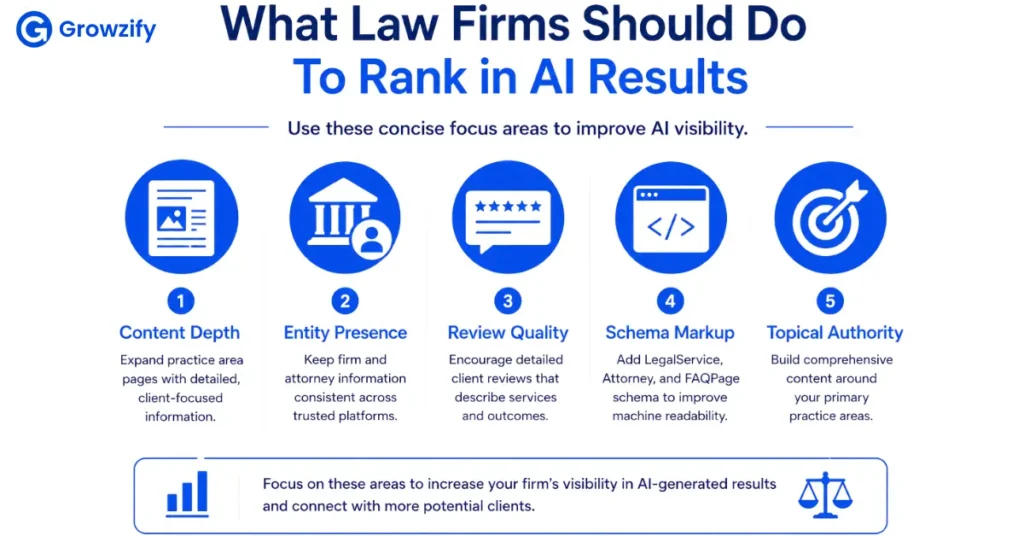
What Law Firms Should Do To Rank in AI Results
Understanding how ChatGPT evaluates law firms is useful. Acting on it is what builds real visibility.
Start with content depth.Audit your practice area pages and identify where your content is thin, generic, or lacks the legal specificity required for AI recognition.
Build out content hubs that answer the full range of questions a prospective client would ask before hiring your firm.
Strengthen your entity presence.Ensure your firm and your attorneys appear consistently across bar association listings, legal directories, Google Business Profile, and relevant legal publications.
Inconsistency across these sources introduces ambiguity that reduces AI recognition.
Prioritize review quality.Encourage clients to leave detailed, specific reviews that describe their legal experience.
A higher volume of meaningful reviews builds a stronger AI reputation signal than a large number of brief, vague ones.
Implement schema markup.Work with a legal SEO specialist to add Legal Service, Attorney, and FAQ Page schema to your website. This step alone significantly improves AI parsability.
Build topical authority intentionally.Focus content investment on your primary practice areas rather than spreading thin content across every possible legal topic. Depth signals expertise. Breadth without depth signals nothing.
How Growzify Helps Law Firms Earn Visibility in ChatGPT and AI Search
The way prospective clients discover legal services is changing. Traditional search engines remain important, but AI platforms are increasingly influencing how people research legal issues and evaluate attorneys.
Law firms that want to stay competitive need a digital strategy that supports both search engine rankings and AI-driven recommendations.
Growzify helps law firmsbuild the authority, content depth, and entity recognition signals that AI systems rely on when generating responses.
Instead of focusing solely on keyword rankings, the approach combines Law Firm SEO, local optimization, structured data implementation, content strategy, and reputation management to create a stronger digital footprint across the web.
The process begins with a detailed audit of your firm’s online presence. This includes evaluating practice area content, local SEO performance, attorney profiles, schema markup, citation consistency, review signals, and external authority sources.
Based on the findings, Growzify develops a tailored strategy designed to strengthen the trust and relevance signals that influence both search engines and AI platforms.
By creating comprehensive legal content, strengthening technical SEO foundations, enhancing local visibility, and building topical authority in key practice areas, Growzify helps law firms position themselves as credible, recognizable sources of legal information.
The result is stronger visibility in traditional search results and greater potential to be referenced in AI-generated answers when prospective clients search for legal guidance.
As AI search continues to evolve, law firms that invest in authority, expertise, and digital trust signals today will be better positioned to attract clients tomorrow.
Frequently Asked Questions
Does ChatGPT use live search results to recommend law firms?
ChatGPT’s base model generates responses from its training data, not from live search results. It draws on content, mentions, reviews, and authority signals that were present in its training sources. Some ChatGPT versions with browsing capabilities do access live content, but the core AI recommendations for law firms are shaped primarily by the historical data the model was trained on.
How is being recommended by ChatGPT different from ranking on Google?
Google rankings are based on real-time algorithmic evaluation of current content, backlinks, and technical signals. ChatGPT recommendations are drawn from patterns in training data, including how frequently and confidently a firm appears across credible sources. A firm can rank well on Google without appearing in ChatGPT responses if its content lacks the depth and entity recognition required for AI extraction.
Does the size of a law firm affect its visibility in ChatGPT recommendations?
Firm size alone does not determine AI visibility. What matters is the depth and credibility of the firm’s digital presence. A solo practitioner with comprehensive, well-structured content, strong local SEO, and consistent external mentions can appear in ChatGPT recommendations more readily than a large firm with a poorly optimized website and thin content. AI systems evaluate authority signals, not headcount.
What role do legal directories like Avvo and Martindale-Hubbell play in ChatGPT recommendations?
Legal directories are important sources of structured, credible information about law firms and attorneys. They contribute to entity recognition by providing consistent, verifiable data about a firm’s name, location, practice areas, and credentials. Directory listings are not sufficient on their own, but they are a meaningful component of the overall AI visibility picture.
How does Growzify help law firms improve their visibility in ChatGPT and other AI search systems?
Growzify builds Law Firm SEO strategies specifically designed for AI search visibility, not just traditional Google rankings. The approach covers content depth, entity recognition, technical schema implementation, local SEO, and reputation signal development across all the channels that AI systems draw from. The result is a law firm that appears not only in Google search results but in the AI-generated answers.

Chitranshu SharmaA growth strategist, digital marketing consultant, and the founder of Growzify, a performance-driven agency helping brands dominate search, shape perception, and build sustainable online visibility. With 8+ years of hands-on experience in Enterprise SEO, Online Reputation Management (ORM), and AI-led traffic generation, Chitranshu has helped startups, public figures, SaaS companies, and cannabis brands outrank competitors — ethically and at scale.
Explore More Articles
How to Build a Technical SEO Monitoring Stack for Large Websites
How to Build a Technical SEO Monitoring Stack for Large Websites A technical SEO regression...
September 2, 2026Enterprise

Identifying and Fixing Thin Content Pages on Large Websites
Identifying and Fixing Thin Content Pages on Large Websites A page can be 2,000 words...
September 2, 2026Enterprise
How to Deploy and Maintain Structured Data and Rich Snippets Across a Website with Thousands of Pages
How to Deploy and Maintain Structured Data and Rich Snippets Across a Website with Thousands...
September 1, 2026Enterprise
Pre-Deployment Technical SEO Checklist for Large Enterprise Websites
Pre-Deployment Technical SEO Checklist for Large Enterprise Websites A single enterprise deployment can introduce a...
September 1, 2026Enterprise
How to Fix Core Web Vitals and Page Speed for an Enterprise Website
How to Fix Core Web Vitals and Page Speed for an Enterprise Website Enterprise Core...
August 31, 2026Enterprise
Robots.txt Best Practices for Complex, Large Enterprise Websites
Robots.txt Best Practices for Complex, Large Enterprise Websites A single overly broad robots.txt rule can...
August 27, 2026Enterprise

How to Structure XML Sitemaps for Large Websites
How to Structure XML Sitemaps for Large Websites A single sitemap file listing two million...
August 27, 2026Enterprise