



SEO for Lawyers in 2026: Fundamentals to Get More Clients Online
This guide explains the fundamentals of SEO for lawyers and how law firms can attract more clients online through local SEO, content strategy, and search visibility improvements.

Written byChitranshu Sharma
May 21, 2026
Quick Nav
The way people find lawyers has changed permanently, and the change is accelerating.
In 2026, a potential client experiencing a workplace injury doesn’t open the Yellow Pages or ask a colleague for a referral as a first step. They pull out their phone, type “workers’ compensation attorney near me,” and decide within the first few seconds based on what they see.
If your firm appears prominently, credibly, with clear social proof, you have a realistic chance at that consultation. If your firm doesn’t appear, that client belongs to whoever does.
What makes this moment more complex than it was three years ago is AI. Google’s AI Overviews now summarize legal options before a single organic result loads.
Perplexity, ChatGPT Search, and Gemini route legal queries directly to synthesized answers drawn from the most authoritative, well-structured legal content available.
People now search across many different platforms, and law firms that depended on just one source of visibility are seeing fewer potential clients come through that channel.
Law firm SEO helps firms build visibility across all the places people search today. A strong SEO strategy helps your firm rank in Google search results, appear in AI-generated answers, and attract people actively looking for legal help.
Growzify Digital specializes in law firm SEOand legal digital marketing. The focus is on building search visibility systems that drive qualified consultation requests, not just website traffic.
What Is Law Firm SEO?
Law firm SEO is the strategic processof optimizing a law firm’s digital presence so it ranks prominently in search results when potential clients search for legal services.
It operates across four interconnected systems:
- Technical SEO, ensuring your website is fast, crawlable, and properly indexed
- Local SEO, ranking in Google’s map pack for location-specific legal searches
- Content strategy, publishing authoritative legal content that ranks and converts
- Authority building, earning trust signals from credible legal and local sources
Unlike traditional legal advertising, law firm SEO targets people at the exact moment they’re searching for legal help.
A television ad reaches people who may never need your services. An SEO-optimized practice-area page reaches someone typing “divorce lawyer in [your city]” right now.
Why legal SEO requires authority and trust:
Google classifies legal content under its YMYL (Your Money or Your Life) framework, which subjects it to higher quality evaluation than most categories.
This means content must demonstrate genuine attorney expertise, be accurately attributed, and be supported by credible sources. Generic legal content doesn’t rank; authoritative, expert-level content does.
Why SEO Matters More for Lawyers in 2026
The legal search environment has shifted in ways that compound SEO’s importance and increase the cost of ignoring it.
AI Search Is Reshaping Legal Discovery
Google’s AI Overviews appear in a growing percentage of legal queries, synthesizing answers from the most authoritative legal sources and presenting them above organic results.
Perplexity, ChatGPT Search, and Gemini do the same. Law firms that don’t appear in these AI-generated summaries are invisible to an expanding share of legal searches.
Appearing in AI summaries requires content structured for machine extraction. Direct-answer paragraphs, FAQ schema, clear topical hierarchy, and demonstrated expertise signals. This is not optional infrastructure in 2026; it is a baseline competitive requirement.
Local Search Dominance Is Winner-Take-All
Google’s local map pack, the three map results appearing above organic listings for city-specific legal queries, captures a disproportionate share of consultation calls.
For high-urgency practice areas, the majority of call volume flows through those top three map positions. Firms outside the local pack are fighting for a fraction of available intake volume.
Paid Advertising Costs Are Unsustainable for Most Firms
A single click for “car accident attorney Los Angeles” costs $150–$300+ in 2026. Criminal defense and mass tort keywords exceed $300 per click in competitive markets.
The cost-per-lead from paid advertising makes it financially impractical as a primary channel for most solo and mid-size firms.
Organic SEO, once established, generates consultation requests at a fraction of the cost-per-case that paid channels require.
Semantic and Entity-Based Search Has Changed What Ranks
Google’s algorithm no longer matches keywords mechanically; it evaluates topical authority, entity relationships, and the depth of expertise a website demonstrates across a subject area.
A law firm that comprehensively covers all aspects of personal injury law, liability, insurance claims, and comparative fault signals deeper authority than one with a single thin practice-area page.
The Core Fundamentals of Law Firm SEO
Technical SEO
Technical SEO ensures that search engines can efficiently crawl, index, and evaluate your website, and that users have a fast, functional experience when they arrive.
Critical technical factors for law firms:
Core Web Vitals
Google’s performance metrics (LCP under 2.5 seconds, CLS under 0.1, INP under 200ms) are ranking signals. Most law firm websites fail these benchmarks due to heavy homepage designs and unoptimized images.
Mobile-First Indexing
Google indexes your mobile site first. Over 65% of legal searches happen on mobile. A site that performs poorly on smartphones loses rankings and consultations simultaneously.
Schema Markup
LegalService, Attorney, LocalBusiness, and FAQ schema help Google and AI systems understand your pages and surface them in rich results and AI-generated answers. Most law firm websites have zero schema implementation.
Crawl Efficiency
Practice-area pages, location pages, and attorney bios must be discoverable and properly indexed. Redirect chains, orphaned pages, and broken internal links waste crawl budget.
Local SEO for Lawyers
Local SEO determines whether your firm appears in the map pack, the highest-conversion position in legal search.
Google Business Profile optimization
- Select precise primary categories (“Personal Injury Attorney” outperforms “Lawyer” for PI queries)
- Define service areas for every city and county you serve
- Post weekly to signal an active practice
- Seed Q&A with the questions clients actually ask
- Maintain consistent review acquisition with compliant request processes
Local Citation Infrastructure
Consistent NAP (Name, Address, Phone) across Avvo, Justia, FindLaw, Martindale-Hubbell, Super Lawyers, your state bar directory, and 40+ additional platforms is a local ranking foundation.
Geo-Targeted Landing Pages
Each city you serve needs a dedicated page with locally specific legal content, not duplicate text with the city name substituted.
Local courts, local filing procedures, locally relevant FAQs, and location-specific schema all contribute to city-level local rankings.
Legal Content Strategy
Content is the mechanism through which law firm SEO authority compounds over time. Google’s Helpful Content system rewards depth, accuracy, and demonstrated expertise, and penalizes thin, undifferentiated content regardless of how it was produced.
A mature law firm’s content architecture includes:
- Practice-area hub pages: Comprehensive 1,500–3,000-word pages covering each practice area: process, client rights, timelines, common questions, and local context. Schema-marked, internally linked, attorney-attributed.
- Geo-targeted landing pages: City + practice area combinations (“motorcycle accident lawyer in Austin”), capturing high-intent local searches.
- FAQ content optimized for AI extraction: Structured Q&A designed to appear in Google featured snippets and get cited by AI Overviews and LLM-based answer engines.
- Attorney bio pages: Credential-rich, locally optimized pages that strengthen E-E-A-T signals and support local search rankings.
- Topical blog content: Informational articles that build subject authority and capture research-phase queries from potential clients.
Every content page must be attributed to a named, credentialed attorney. Author bios must include bar admissions, years of practice, and verifiable credentials.
Content must be accurate, regularly updated, and supported by authoritative legal sources.
Authority and Trust Building
Link authority in legal SEO comes from sources that signal genuine credibility:
- Legal directory profiles (Avvo, Justia, FindLaw, Martindale, Super Lawyers)
- State and local bar association listings
- Local news citations and press coverage
- Legal aid organizations and civic associations
- Guest contributions to legal publications and law reviews
What to avoid:Purchased link packages, private blog networks, and reciprocal link schemes. Google’s quality evaluation is most stringent in the legal vertical.
A manual penalty from manipulative link practices can take 12–18 months to fully recover from.
Conversion Optimization
Traffic without conversion is overhead, not revenue. Law firm websites frequently lose potential clients due to poor conversion architecture:
- No visible click-to-call button above the fold on mobile
- Form-heavy intake processes without call alternatives
- Trust signals (awards, reviews, bar memberships) buried in footers
- No after-hours conversion capture for urgent legal situations
Consultation-focused optimization includes:
- Phone number prominently accessible and tappable on every mobile page
- Multiple intake pathways: phone, contact form, live chat, callback request
- Trust signal placement proximate to conversion points
- Clear, specific calls-to-action on every practice-area page
How Law Firm SEO Generates More Clients
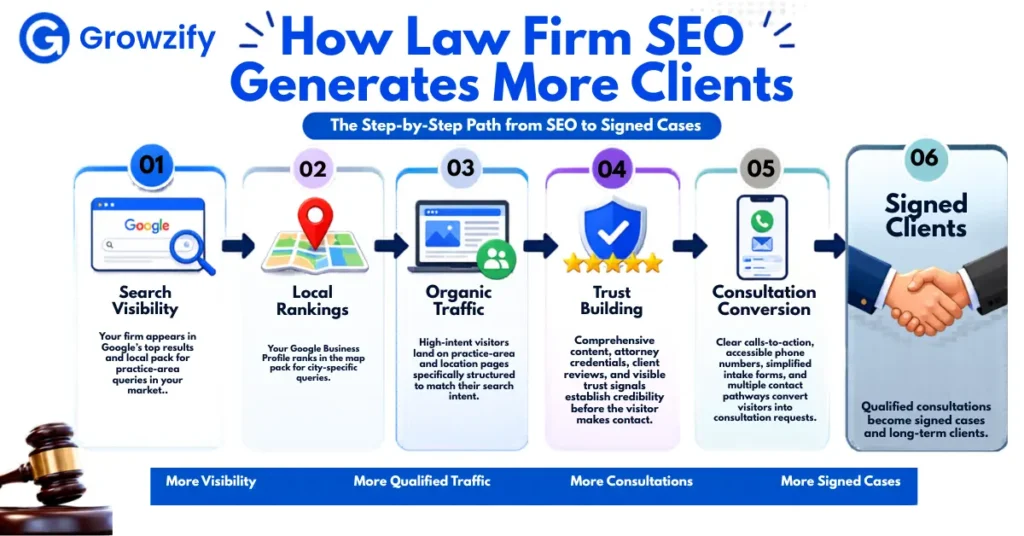
Here is the step-by-step mechanism connecting SEO investment to signed cases:
Step 1, Search Visibility:Your firm appears in Google’s top results and local pack for practice-area queries in your market. AI Overviews and featured snippets surface your content as authoritative source material.
Step 2, Local Rankings:Your Google Business Profile ranks in the map pack for city-specific queries. Calls and direction requests from GBP listings generate a direct intake contact.
Step 3, Organic Traffic:High-intent visitors land on practice-area and location pages specifically structured to match their search intent.
Step 4, Trust Building:Comprehensive content, attorney credentials, client reviews, and visible trust signals establish credibility before the visitor makes contact.
Step 5, Consultation Conversion:Clear calls-to-action, accessible phone numbers, simplified intake forms, and multiple contact pathways convert visitors into consultation requests.
Step 6, Signed Clients:Qualified consultations, from people who searched for your specific practice area in your market, convert at higher rates than cold leads from paid channels because intent was established before first contact.
This compounding mechanism is what makes law firm SEO services more valuable than paid advertising over a 12–24 month horizon.
Each content piece, each link earned, and each technical improvement compounds on the last.
Common Areas Limiting Law Firm SEO Growth
These patterns appear consistently in law firm SEO audits, and each represents a specific, correctable opportunity:
Thin practice-area content.A 400-word page cannot compete with a competitor’s 2,500-word, schema-marked, attorney-reviewed hub page. Google’s Helpful Content system rewards depth explicitly.
Weak local optimization.Incomplete Google Business Profile, inconsistent citations, and no geo-targeted landing pages suppress map pack rankings regardless of organic performance.
Limited E-E-A-T signals.Content published without attorney attribution, author credentials, or verifiable expertise fails Google’s YMYL evaluation for legal topics.
Poor technical foundations.Core Web Vitals failures, mobile rendering issues, and missing schema markup create ranking ceilings that content investment cannot break through.
Generic content with no topical depth.A law firm that covers every aspect of its practice areas, from initial consultation through appeal, signals significantly more expertise than one with surface-level pages. Semantic coverage is a ranking factor.
No AI-search optimization.Content not structured for AI extraction, lacking FAQ schema, direct-answer paragraphs, and entity-rich language, is invisible to the AI-generated summaries capturing a growing share of legal search intent.
Missing conversion pathways.High traffic to poorly converting pages produces analytics data, not cases. Intake optimization is the final step between SEO investment and revenue.
AI Search and the Future of Law Firm SEO
This is the most consequential shift in legal search since the introduction of mobile-first indexing, and most law firms are not yet positioned for it.
AI-generated search summaries, Google AI Overviews, Perplexity, ChatGPT Search, Gemini, Bing Copilot, and synthesize answers from the most authoritative legal content available.
These systems don’t rank pages; they extract information from pages and attribute it to sources. Firms cited in AI summaries receive referral authority that drives both direct traffic and trust signals.
Firms excluded from AI summaries lose visibility in a channel that is expanding as a percentage of total search behavior.
How to Optimize for AI Search (GEO and AEO)
Answer Engine Optimization (AEO)structures content for extraction by AI search systems:
- Direct-answer paragraph construction (question + immediate, complete answer + supporting context)
- FAQ schema implementation for structured Q&A extraction
- Clear hierarchical heading structure (H2 → H3 → specific subsections)
- Concise, information-dense paragraphs that stand alone as extractable answers
Generative Engine Optimization (GEO)focuses on entity and semantic signals that AI systems use to evaluate source authority:
- Entity optimization, ensuring Google’s Knowledge Graph recognizes your firm, attorneys, practice areas, and geographic markets as distinct, authoritative entities
- Topical completeness, covering every subtopic that AI systems associate with your practice areas
- E-E-A-T signals that AI systems evaluate when selecting sources to cite
- Structured data markup that machine-readable systems can parse and attribute
AI systems evaluate source authority by assessing how comprehensively a website covers its subject matter.
A law firm site that thoroughly covers every aspect of personal injury law, liability theories, and the litigation process is more likely to be cited as authoritative than one with a single broad page.
Law firms that optimize for AI search now are building visibility in a channel that will generate an increasing share of legal consultation intent over the next 24–36 months.
How Growzify Digital Helps Law Firms Grow Online
Growzify Digital is a specialist legal SEO agencybuilt specifically to help law firms generate more clients through a structured, data-driven organic search strategy.
Here’s what makes our approach operationally different from general marketing agencies:
Legal-First SEO Strategy
Every campaign begins with a keyword architecture built around your practice areas, geographic markets, and competitive landscape, not an industry-agnostic template.
We understand the difference between personal injury SEO, criminal defense SEO, and immigration SEO because they require fundamentally different approaches.
AI-Search-Ready Content Architecture
We build every content asset with dual optimization: traditional search ranking and an AI-generated answer engine citation. FAQ schema, direct-answer paragraph construction, entity optimization, and topical completeness are built into every piece we produce.
Local SEO Precision
Our local SEO strategy focuses on improving your visibility where potential clients search the most. This includes Google Business Profile audits and optimization, consistent citations across 40+ legal and local directories, review-generation systems that comply with state bar guidelines, and geo-targeted content for city- and practice-area searches.
For most law firms, ranking in Google’s local pack is one of the highest-value SEO opportunities. Achieving those rankings requires a focused legal SEO strategy and local search expertise.
Technical Foundation
We remediate Core Web Vitals failures, implement complete legal schema markup, rebuild internal linking architecture, and ensure every page is properly crawlable and indexed before content investment begins.
Conversion-Integrated SEO
Traffic is context, consultations are the goal. We optimize intake pathways, CTA placement, trust signal positioning, and mobile conversion architecture as part of every campaign. Rankings that don’t generate calls are incomplete work.
Outcome-Tied Reporting
Monthly reports connect SEO activity to consultation volume, keyword ranking movement, call tracking from organic search, and form submission attribution. You always know your exact ROI in cases, not clicks.
Book a consultation with Growzify Digitalto get a customized law firm SEO audit and see exactly what’s limiting your firm’s organic search visibility.
Law Firm SEO as a Long-Term Client Acquisition System
Law firm SEO is no longer just a marketing tactic. It has become a core client acquisition system for firms that want consistent consultation requests from organic search.
The firms seeing steady growth have built SEO systems that strengthen over time. This includes strong technical SEO foundations, local SEO for map pack visibility, high-quality content that ranks and converts, and AI search optimization that improves visibility across newer search platforms.
SEO results also build gradually. The first 1-3 months are usually focused on fixing technical issues and building the foundation. Months 4-6 often bring early ranking improvements and increased visibility.
By months 9-12, many firms begin seeing measurable growth in consultations and qualified leads. Firms that stay committed to SEO for 18-24 months often see long-term returns that outperform many paid marketing channels.
AI search is already shaping how people find legal services online. Law firms that optimize content for AI-generated search results today are positioning themselves for stronger long-term visibility across both traditional search and AI-powered platforms.
The core principles of SEO remain the same: build authority, publish useful legal content, strengthen local visibility, and convert search traffic into consultations.
What has changed is the complexity of the search landscape and the level of strategy needed to compete effectively.
Growzify Digital creates customized law firm SEO strategies tailored to your practice areas, target market, and client acquisition goals.
Why Choose Growzify Digital for Law Firm SEO?
Growzify Digital specializes in attorney SEOmarketing with a methodology covering technical SEO, AI-search-ready content strategy, local SEO precision, and conversion-integrated reporting.
Every campaign is built around consultation growth, not traffic metrics. Monthly reporting connects every SEO deliverable to qualified intake volume, ensuring law firm clients always know the exact return on their SEO investment.
Contact Growzify Digital for a complimentarylaw firm SEO auditand strategy consultation.
Frequently Asked Questions
How does SEO help lawyers get more clients?
SEO places your firm in front of potential clients at the exact moment they’re searching for legal help, the highest-intent moment in the client acquisition process. When your firm ranks for relevant practice areas and local queries, you receive consistent organic traffic from people who need legal services.
How long does legal SEO take to show results?
Initial keyword movement typically occurs in months 3–4. Meaningful local pack improvement appears in months 5–6. Consultation-level impact from organic search is generally visible by months 6–9. Full compounding ROI develops over 12–24 months.
Why is local SEO important for attorneys?
Over 70% of legal searches include local intent. Google’s local map pack, which appears above organic results for most practice-area queries, drives a disproportionate share of consultation calls, particularly for high-urgency practices like criminal defense and personal injury.
What makes SEO for lawyers different from general SEO?
Legal SEO operates under Google’s YMYL (Your Money or Your Life) classification, which requires higher E-E-A-T standards than most industries. Content must demonstrate attorney-level expertise, be accurately attributed to credentialed authors, and be supported by authoritative legal sources.
How do lawyers rank on Google Maps?
Google Maps (local pack) rankings are determined by Google Business Profile completeness and category accuracy, proximity to the searcher’s location, review quantity and recency, local citation consistency across legal directories, and geo-targeted website content that matches search intent.
How does AI search affect law firm SEO?
AI search engines synthesize legal answers from the most authoritative, well-structured sources available and present them above traditional organic results. Law firms whose content is structured for AI extraction get cited in these summaries, gaining visibility in a channel with a rapidly growing share of legal search intent.
Can SEO for attorneys increase consultation volume?
Yes, when executed with conversion optimization integrated into the SEO strategy. Organic traffic from high-intent legal searches converts into consultation requests when landing pages are structured with clear calls-to-action, accessible contact pathways, and mobile-optimized intake processes.

Chitranshu SharmaA growth strategist, digital marketing consultant, and the founder of Growzify, a performance-driven agency helping brands dominate search, shape perception, and build sustainable online visibility. With 8+ years of hands-on experience in Enterprise SEO, Online Reputation Management (ORM), and AI-led traffic generation, Chitranshu has helped startups, public figures, SaaS companies, and cannabis brands outrank competitors — ethically and at scale.
Explore More Articles
How to Find and Compare Local SEO Outsourcing Providers
How to Find and Compare Local SEO Outsourcing Providers Finding a local SEO outsourcing provider...
October 13, 2026Outsourcing

Inside a White Label SEO Campaign: How the Work Gets Done
Inside a White Label SEO Campaign: How the Work Gets Done Clients see a single...
October 13, 2026White Label

How to Vet an SEO Outsourcing Provider Before You Sign a Contract
How to Vet an SEO Outsourcing Provider Before You Sign a Contract A polished proposal...
October 9, 2026Outsourcing

Multilingual SEO Best Practices: Optimize Your Multi-Language Website
Multilingual SEO Best Practices: Optimize Your Multi-Language Website Translating a page and localizing it for...
October 7, 2026SEO
What Makes In-House Enterprise SEO Work Different Day-to-Day?
What Makes In-House Enterprise SEO Work Different Day-to-Day? On a small site, deciding to fix...
October 7, 2026Enterprise

How Core Algorithm Updates Impact Large Sites Differently Than Small Ones
How Core Algorithm Updates Impact Large Sites Differently Than Small Ones A large enterprise site...
October 7, 2026Enterprise
When Should You Outsource SEO? 11 Signs It Makes Sense
When Should You Outsource SEO? 11 Signs It Makes Sense Outsourcing SEO does not necessarily...
September 26, 2026Outsourcing