



Law Firm SEO Competitor Analysis: Outrank Local Competitors in 2026
Competitive SEO analysis helps law firms identify opportunities to outrank local competitors in search results. This guide explains how keyword research, content strategy, backlinks, and local SEO impact legal search visibility. Learn the SEO tactics successful law firms use to improve rankings and attract more qualified leads.

Written byChitranshu Sharma
May 22, 2026
Quick Nav
Legal search in 2026 is intensely competitive. When someone searches for a “personal injury lawyer in [city],” they usually contact one of the firms appearing at the top of the results.
Firms that fail to secure those positions often miss the opportunity entirely. In today’s AI-driven search landscape, visibility is no longer just an advantage for law firms. It directly impacts client inquiries, consultations, and case acquisition.
“Competitive SEO analysis for law firms helps identify why competing firms rank higher in local search results and what strategies are driving their visibility. By analyzing competitor keywords, content, backlinks, local SEO signals, and technical performance, law firms can uncover ranking gaps, improve search presence, and position themselves ahead of local competitors in Google’s increasingly competitive legal search landscape.”
The intensity of that competition has increased significantly. More firms are investing in law firm SEO. AI-generated search summaries are reshaping which firms get cited as authoritative sources.
Google’s local map pack concentrates the majority of consultation call volume into three visible positions. And paid search CPCs for legal keywords have climbed to the point where organic visibility is no longer a growth strategy for most firms, but a financial necessity.
The firms consistently occupying top positions in competitive legal markets share a common characteristic: they don’t guess at SEO strategy. They analyze competitors systematically, identify specific ranking gaps, and execute against those gaps with precision.
Competitive SEO analysis is the mechanism that separates strategic growth from expensive experimentation.
Growzify Digital builds competitive SEO systems for law firms, starting with a structured analysis of who is ranking, why they are ranking, and exactly what it takes to displace them.
What Is Competitive SEO Analysis for Law Firms?
Competitive SEO analysis for law firms is the systematic process of evaluating:
- Which firms rank above yours for your target keywords
- What they are doing technically and editorially to achieve those rankings
- Where specific gaps exist that your firm can exploit to outrank them.
It answers four fundamental questions:
- Who is ranking for the keywords that drive consultation requests in your market?
- What content, technical infrastructure, and authority signals support their rankings?
- Where are the gaps between your current position and theirs?
- What specific actions, executed in what order, will close those gaps most efficiently?
How competitor insights drive SEO decisions:Without competitive analysis, law firm SEO investment is directional but imprecise. You know you need content and links, but not which content performs better than competitors, which link sources they rely on, or which technical advantages they hold. Competitive analysis converts general SEO knowledge into a market-specific strategy.
How it connects to client acquisition:Every ranking gap identified in competitive analysis represents a search query currently sending potential clients to a competitor. Closing those gaps systematically redirects that consultation volume to your firm.
Why Competitive SEO is Essential in Law Firm SEO
Legal search markets are geographically concentrated, keyword-specific, and winner-take-most in structure. Understanding who is winning and why is a prerequisite for displacing them.
Here is why competitive analysis has become more consequential in 2026:
Legal keyword CPCs have made organic a necessity
Keywords like “car accident attorney Chicago” or “DUI lawyer Miami” now cost $150 to $300+ per click in paid search.
For firms generating 50 consultations per month from paid ads, the monthly ad spend can exceed $50,000 before factoring in management fees.
Organic rankings that generate the same volume cost a fraction of that over a 24-month horizon.
AI search has created a new competitive surface
Google AI Overviews, Perplexity, and ChatGPT Search now synthesize legal answers from the most authoritative sources available and present them before traditional organic results.
Firms cited in these AI summaries receive attribution and referral visibility that compounds their organic authority. Firms not cited are invisible in a channel with a rapidly growing market share.
Google’s local map pack concentrates intake volume
The top three map positions for practice-area queries in any market receive the significant majority of consultation calls. Position four receives almost nothing.
Understanding how competitors are holding those map positions and what their Google Business Profile strategy looks like is the starting point for displacing them locally.
Organic visibility compounds
A page-one ranking built through sound competitive strategy generates consultation requests for years. A paid ad stops the moment the budget runs out. The long-term ROI case for competitive law firm SEO is structural, not circumstantial.
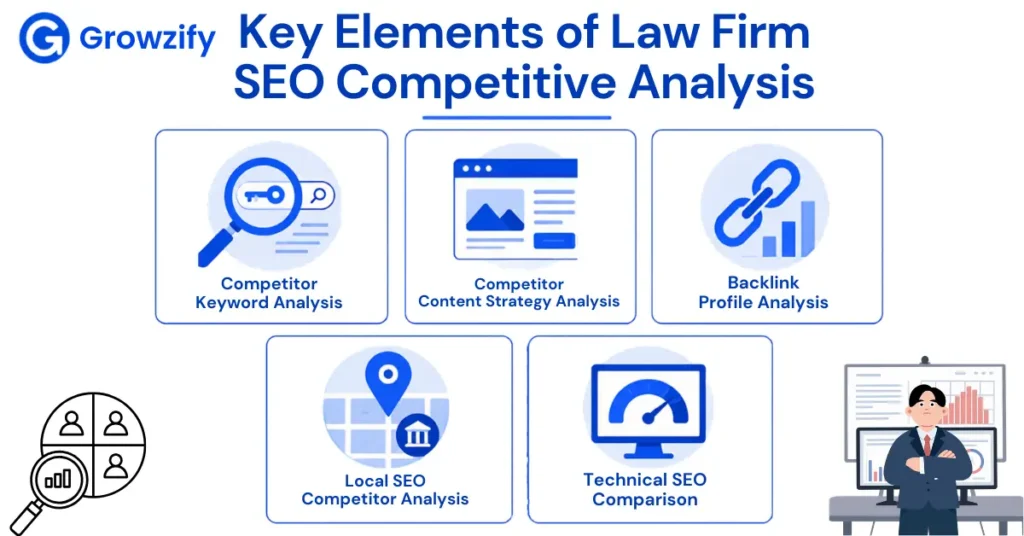
Key Elements of Law Firm SEO Competitive Analysis
Competitor Keyword Analysis
Keyword analysis identifies exactly which search queries are currently sending potential clients to competing firms, and which of those queries your firm does not currently rank for.
What to analyze:
- Practice area keyword mapping:Which competitors rank for your core practice area terms (“personal injury lawyer [city],” “criminal defense attorney [city]”), and at what positions?
- Long-tail opportunity identification:Competitors strong on head terms often leave long-tail queries underserved. “How long does a personal injury lawsuit take in [state]?” may receive less competition than the head term while attracting clients in the research phase.
- Local intent keyword discovery:City-specific and county-specific variations that competitors may not have geo-targeted landing pages for represent direct ranking opportunities.
- Gap analysis:Keywords where competitors rank on pages one or two but your firm does not appear in the top five pages represent high-priority content opportunities.
Practical tool application:Google Search Console reveals which queries your pages currently receive impressions for. Third-party tools reveal what competitors rank for that you don’t. The gap between those two datasets is your keyword opportunity map.
Competitor Content Strategy Analysis
Content depth and quality are primary ranking differentiators in competitive legal markets. Analyzing competitor content reveals what Google is rewarding, and what you need to match or exceed.
Key analysis dimensions:
- Practice area page structure:How comprehensive are competitor practice-area pages? Word count, heading structure, FAQ sections, internal linking, and schema implementation all influence rankings.
- Blog content depth:Are competitors publishing topically comprehensive blog content that builds subject authority, or thin posts targeting isolated keywords?
- FAQ content coverage:Which questions are competitors answering that your site does not address? FAQ gaps often correspond directly to featured snippet opportunities.
- E-E-A-T signal comparison:Are competitor pages attributed to named, credentialed attorneys? Do they include author bios, bar admissions, and practice-specific credentials? Google evaluates these signals explicitly for legal content.
- Content freshness:Pages with recent update dates and time-sensitive information (statute of limitations, recent case law changes) signal active content management that Google rewards.
Backlink Profile Analysis
Authority inlaw firm SEOis partially determined by the quality and relevance of external sites linking to your domain. Competitor backlink analysis reveals which sources are contributing to their rankings and which sources your firm lacks.
What to evaluate:
- Legal directory coverage:Are competitors listed on Avvo, Justia, FindLaw, Martindale-Hubbell, and Super Lawyers? Are their profiles complete and actively maintained?
- Authority domains:Links from bar associations, law schools, legal publications, and local news outlets carry significant weight. Identify which of these sources link to competitors but not to your firm.
- Local citation sources:Local chamber of commerce, civic organizations, and regional media links contribute to local authority signals. Gaps in your local citation profile relative to competitors represent specific acquisition targets.
- Link quality versus quantity:A competitor with 200 high-quality, topically relevant links will outrank one with 2,000 low-quality, purchased links in Google’s current evaluation framework. Quality analysis matters more than counting.
Local SEO Competitor Analysis
Local map pack rankings are determined by a different set of signals than organic rankings, and they require separate competitive analysis.
Google Business Profile comparison:
- How complete is each competitor’s profile? Primary category selection, secondary categories, service area definition, and description keyword usage all influence local rankings.
- Review quantity, recency, and response rate are local ranking factors. How does your review velocity compare to the firms currently holding top three map positions?
- Post frequency signals an active practice. Competitors posting weekly versus monthly show measurably different local engagement signals.
Citation consistency audit:Identify whether competitors maintain consistent NAP (Name, Address, Phone) data across legal directories, local platforms, and general business directories. Inconsistencies in your own citation profile that competitors don’t share represent suppressors of your local rankings.
Technical SEO Comparison
Technical performance differences between your site and competitor sites create ranking advantages that content investment alone cannot overcome.
Key technical benchmarks to compare:
- Site speed and Core Web Vitals:LCP (Largest Contentful Paint) under 2.5 seconds is Google’s performance threshold. Firms whose sites load faster on mobile have a measurable ranking advantage in competitive markets.
- Mobile optimization:Over 65% of legal searches occur on mobile. A site with poor mobile rendering, small tap targets, or horizontal scrolling loses both rankings and conversions.
- Schema markup implementation:Competitors using LegalService, Attorney, FAQ, and LocalBusiness schema provide Google and AI systems with structured information that influences rich results and AI Overview eligibility.
- Indexing efficiency:Are competitor pages indexed promptly and completely? A crawl architecture that allows efficient discovery of all practice-area and location pages supports ranking across a broader keyword portfolio.
How Law Firms Can Outrank Local Competitors
Translating competitive analysis into ranking improvement requires a prioritized, sequenced execution plan.
Step 1: Identify and prioritize keyword gaps
Rank keyword opportunities by search volume, commercial intent, and ranking difficulty. High-volume, high-intent keywords with competitors ranking on page two or three represent the fastest path to visible movement.
Step 2: Build content depth that exceeds current ranking pages
For each priority keyword, analyze the top three ranking pages for that query. Build content that covers the topic more comprehensively, with better structure, stronger E-E-A-T signals, and more complete FAQ coverage.
Step 3: Strengthen local authority
Complete every element of your Google Business Profile, resolve citation inconsistencies, and implement a compliant review acquisition process. Local map pack improvement often delivers faster consultation volume impact than organic ranking movement.
Step 4: Acquire links from sources competitors use
Legal directories, bar associations, and local publications that link to competitors represent high-priority outreach targets. Being absent from sources that support competitor rankings is a direct authority disadvantage.
Step 5: Optimize for conversion at every landing page
Traffic from competitive rankings generates zero cases if landing pages don’t convert. Every practice-area page needs visible click-to-call functionality, proximity-placed trust signals, and a clear path to consultation request.
Step 6: Implement AI search optimization
Structure all content with direct-answer paragraphs, FAQ schema, and topical completeness that AI systems evaluate when selecting sources for generated summaries. Competitors not yet optimizing for AI search are leaving AI Overview citation opportunities unclaimed.
Common Competitive SEO Mistakes Law Firms Make
Understanding what fails in competitive law firm SEO is as valuable as knowing what works.
Copying competitor content without strategic improvement
Reproducing a competitor’s page structure and content without adding depth, expertise, or local specificity produces duplicate content that Google has no reason to rank above the original.
Ignoring local SEO while focusing on organic
For most practice areas, the local map pack delivers more consultation calls than organic positions three through ten combined.
Firms that optimize only for organic rankings while neglecting their Google Business Profile misallocate their SEO investment.
Weak backlink strategies focused on volume over quality
Purchased links, private blog network placements, and low-quality directory submissions have diminishing returns in Google’s current algorithm. Quality link acquisition from legal-relevant, authoritative sources outperforms volume-based approaches.
No conversion strategy for organic traffic
Achieving rankings that competitors hold without matching their on-page conversion elements produces traffic but not consultations. Conversion architecture must be competitive, not just present.
Lack of AI search readiness
Firms whose content is not structured for AI extraction miss citation opportunities in Google AI Overviews and LLM-based answer engines. Competitors who are already cited in AI summaries hold a compounding authority advantage.
AI Search and Competitive Law Firm SEO in 2026
AI-generated search is not a future consideration. It is a current competitive reality that is reshaping which law firms get discovered for legal queries.
How AI search engines evaluate authority
Generative search systems select sources based on topical authority, E-E-A-T signals, content structure, and entity recognition.
A law firm that Google’s Knowledge Graph recognizes as an authoritative entity for “personal injury law in [city]” is significantly more likely to be cited in AI Overviews.
Entity-based ranking systems
AI search evaluates the relationships between your firm, your attorneys, your practice areas, and your geographic markets as a network of entities. Structured data markup, consistent NAP data, directory listings, and authoritative citations all contribute to how clearly those entity relationships are understood by AI systems.
GEO optimization for legal content
Generative Engine Optimization (GEO) ensures your content is structured in a way that AI systems can extract, attribute, and present in generated answers.
This means direct-answer paragraph construction, complete topical coverage, and entity-rich language that AI systems use to evaluate relevance.
AEO optimization for answer engines
Answer Engine Optimization (AEO) focuses on FAQ schema implementation, question-based heading structure, and concise, self-contained answer blocks that AI systems can extract and cite in response to user queries.
How Growzify Digital Helps Law Firms Outrank Competitors
Growzify Digital is a specialist legal SEO agencythat bases every law firm engagement on competitive analysis. We don’t build generic SEO campaigns. We build market-specific strategies designed to displace specific competitors for specific keywords in specific geographic markets.
Competitive SEO Audits
Every engagement begins with a structured audit of your law firm’s current search visibility. We analyze your top local competitors and identify gaps in keyword coverage, content quality, local authority, technical SEO, and AI search optimization.
This helps define what is limiting your rankings and where the biggest growth opportunities exist.
Keyword Gap Analysis
We compare your keyword rankings against competing law firms across your target practice areas and locations. This process uncovers high-value keyword opportunities where competitor rankings are weaker and your firm has strong potential to gain visibility quickly.
Content Architecture Planning
Using competitive content analysis, we create a strategic content plan for your firm. The goal is to match or exceed competitor content depth while covering topics they have overlooked. Every page is optimized for both traditional Google rankings and AI-driven search results.
Local SEO Systems
Our local SEO strategy includes Google Business Profile optimization, citation consistency across major legal directories, compliant review acquisition systems, and geo-targeted landing pages. These elements help improve visibility in local searches where competitors currently dominate.
Authority Building Strategies
We identify the legal directories, local publications, bar association links, and industry citations supporting competitor rankings. From there, we implement a structured outreach strategy to build the same authority signals for your firm.
AI Search Optimization
We apply advanced AEO and GEO optimization across your website content. This includes FAQ schema, entity optimization, direct-answer formatting, and comprehensive topical coverage designed to improve visibility in AI Overviews and LLM-based search platforms.
Request a competitive law firm SEO audit from Growzify Digital to see exactly where your local competitors hold ranking advantages. Also, understand what a structured strategy to close those gaps would look like for your firm.
Building a Long-Term Competitive Advantage in Law Firm SEO
Competitive SEO analysis is not a one-time research exercise. It is an ongoing intelligence system that keeps your law firm’s SEO strategy aligned with a market that is constantly shifting. Competitors publish new content.
Google continues to evolve its ranking systems, while AI-driven search platforms are handling a growing share of legal queries.
Law firms that maintain strong search visibility are the ones that treat competitive SEO analysis as an ongoing strategy, not a one-time setup process.
Astructured approachis essential. Successful firms continuously identify competitive gaps, prioritize high-value opportunities, execute improvements systematically, and measure success through consultation growth rather than rankings alone.
Rankings create visibility, but signed cases are the real outcome. AI search competition in 2026 introduces another critical factor. Many law firms are still focused only on traditional organic rankings.
Firms that optimize content for AI extraction, direct-answer visibility, and AI Overviews are building a long-term authority advantage.
Contact Growzify Digitalfor a competitive law firm SEO audit and strategy consultation. We will show you exactly which local competitors are outranking your firm, why they are ranking above you, and what a precise strategy to overtake them looks like for your specific market and practice areas.
Why choose Growzify Digital for law firm SEO?
Growzify Digital approaches every law firm SEO engagement with competitive analysis as the foundation rather than generic strategy templates.
Our methodology covers competitor keyword gap analysis, content architecture planning, local SEO systems, authority building, technical optimization, and AI search readiness.
Every client receives a structured competitive audit at engagement start and ongoing reporting that connects SEO execution to qualified intake growth.
Frequently Asked Questions
What is competitive SEO analysis for law firms?
Competitive SEO analysis for law firms is the process of systematically evaluating which competitor firms rank above yours for target keywords, what technical, content, and authority factors support their rankings.
How do law firms outrank competitors online?
Law firms outrank competitors by identifying specific keyword, content, and authority gaps through structured competitor analysis, then systematically closing those gaps through deeper content production, stronger local SEO optimization, higher-quality link acquisition, better technical performance, and AI search optimization.
Why is local SEO important for lawyers?
Local SEO determines whether your firm appears in Google’s local map pack, which displays above organic results for most practice-area queries and captures a disproportionate share of consultation calls.
How does AI search impact law firm SEO competition?
AI search systems, including Google AI Overviews, Perplexity, ChatGPT Search, and Gemini, synthesize legal answers from the most authoritative, well-structured sources and present them before traditional organic results. Firms cited in AI summaries receive compounding authority and visibility advantages.
How long does it take for competitive SEO to show results for law firms?
Initial ranking movement from a competitive SEO strategy typically appears in months three to four. Meaningful local pack improvement is usually visible by months five to six. Consultation-level impact from organic rankings develops over months six to nine.

Chitranshu SharmaA growth strategist, digital marketing consultant, and the founder of Growzify, a performance-driven agency helping brands dominate search, shape perception, and build sustainable online visibility. With 8+ years of hands-on experience in Enterprise SEO, Online Reputation Management (ORM), and AI-led traffic generation, Chitranshu has helped startups, public figures, SaaS companies, and cannabis brands outrank competitors — ethically and at scale.
Explore More Articles
How to Find and Compare Local SEO Outsourcing Providers
How to Find and Compare Local SEO Outsourcing Providers Finding a local SEO outsourcing provider...
October 13, 2026Outsourcing
Inside a White Label SEO Campaign: How the Work Gets Done
Inside a White Label SEO Campaign: How the Work Gets Done Clients see a single...
October 13, 2026White Label

How to Vet an SEO Outsourcing Provider Before You Sign a Contract
How to Vet an SEO Outsourcing Provider Before You Sign a Contract A polished proposal...
October 9, 2026Outsourcing

Multilingual SEO Best Practices: Optimize Your Multi-Language Website
Multilingual SEO Best Practices: Optimize Your Multi-Language Website Translating a page and localizing it for...
October 7, 2026SEO
What Makes In-House Enterprise SEO Work Different Day-to-Day?
What Makes In-House Enterprise SEO Work Different Day-to-Day? On a small site, deciding to fix...
October 7, 2026Enterprise

How Core Algorithm Updates Impact Large Sites Differently Than Small Ones
How Core Algorithm Updates Impact Large Sites Differently Than Small Ones A large enterprise site...
October 7, 2026Enterprise
When Should You Outsource SEO? 11 Signs It Makes Sense
When Should You Outsource SEO? 11 Signs It Makes Sense Outsourcing SEO does not necessarily...
September 26, 2026Outsourcing