


SEO for Lawyers: The Complete Law Firm SEO Guide for 2026
This complete law firm SEO guide explains how lawyers can improve online visibility and attract qualified leads in 2026. It covers local SEO, content strategy, rankings, website optimization, and Google Business Profile performance. Learn the key SEO strategies law firms use to generate long-term organic growth and client inquiries.

Written byChitranshu Sharma
May 20, 2026
Quick Nav
Legal search is more competitive in 2026 than it has ever been, and it’s getting harder to win using the strategies that worked three years ago. Google’s AI Overviews now answer legal questions before a single organic result loads. Perplexity, ChatGPT Search, and Gemini are routing legal queries directly to synthesized answers, drawing from the most authoritative, well-structured legal content available.“Law firm SEO in 2026 is no longer just about ranking on Google. Modern legal SEO focuses on building authority, optimizing for AI-driven search results, improving local visibility, and creating content that answers real client questions clearly.”Firms that built their SEO around keyword stuffing, thin practice-area pages, and low-quality link schemes are disappearing from search results entirely. The firms gaining ground are doing something different. They’re investing in SEO for lawyers that operate across all four layers of modern legal search: technical excellence, deep legal content, local authority, and AI-search optimization.Growzify Digital works exclusively with law firmsand legal practices to build SEO systems that rank, convert, and compound over time.
What Is SEO for Lawyers?
SEO for lawyers is the strategic process of improving a law firm’s visibility in search engine results, Google, Bing, and increasingly AI-powered answer engines.
At its core, legal SEO ensures that when someone types “DUI lawyer near me” or “how to file for divorce in Texas,” your firm appears prominently, credibly, and with a clear path to contact.
How Legal SEO Differs from Standard SEO
Legal SEO operates under stricter standards than most industries because it falls under Google’s YMYL (Your Money or Your Life) classification. Legal queries carry real-world consequences; a person acting on incorrect legal information can lose a case, miss a filing deadline, or waive important rights.
This classification means:
- E-E-A-T requirements are higher:Google evaluates Experience, Expertise, Authoritativeness, and Trustworthiness at a much more granular level for legal content than for, say, a recipe blog.
- Thin content doesn’t rank:A 300-word personal injury page cannot compete with a 2,000-word, schema-marked, attorney-reviewed hub page.
- Trust signals are ranking factors:Bar association memberships, attorney credentials, client reviews, and authoritative legal citations all influence how Google evaluates your site’s authority.
- Local intent dominates:Over 70% of legal searches include explicit or implicit local intent; people want a lawyer in their city, not a national directory.
Why Legal Authority Matters in Search
Google’s algorithm doesn’t just evaluate content; it evaluates the source of that content. A law firm with documented attorney expertise, verified credentials, consistent legal publishing, and citations from bar associations and legal publications signals genuine authority. That’s what ranks in 2026.
Why SEO Matters for Law Firms in 2026
Law firm SEO is the highest ROI marketing channel available to most legal practices when executed with precision.
Here’s what’s changed in 2026 that makes SEO more important than ever, and more demanding to execute correctly.
AI Search Is Reshaping Legal Discovery
Google’s AI Overviews now appear in over 60% of legal queries. Perplexity and ChatGPT Search synthesize answers from authoritative sources and surface law firm recommendations directly.
Firms with deep, well-structured, entity-optimized content get cited in these AI summaries. Firms with thin pages get excluded entirely.
To appear in AI-generated legal search results, your content must:
- Answer specific legal questions directly and completely
- Be structured with a clear H2/H3 hierarchy and FAQ markup
- Demonstrate E-E-A-T through verifiable attorney expertise
- Use schema markup that AI systems can parse and cite
Local Search Is the Primary Intake Channel for Most Firms
Google’s local map pack appears above organic results for nearly every city-specific legal query. The top three positions in that map pack receive the majority of consultation calls, particularly for high-urgency practice areas like criminal defense, personal injury, and family law.
Local search factors that determine map pack placement:
- Google Business Profile completeness and category accuracy
- Review quantity, recency, and response rate
- Local citation consistency across legal directories
- Proximity to the searcher’s location
- Geo-targeted website content that matches search intent
Paid Ads Are Becoming Unsustainable for Solo and Mid-Size Firms
A single click for “car accident lawyer Los Angeles” now costs $150–$250+. For criminal defense and mass tort keywords, CPCs regularly exceed $300. Law firms that rely primarily on paid advertising are facing an escalating cost structure that makes client acquisition mathematically difficult.
The difference with SEO is that strong rankings continue generating consultations long after the page is published. A page-one ranking built today generates leads for years without ongoing per-click cost.
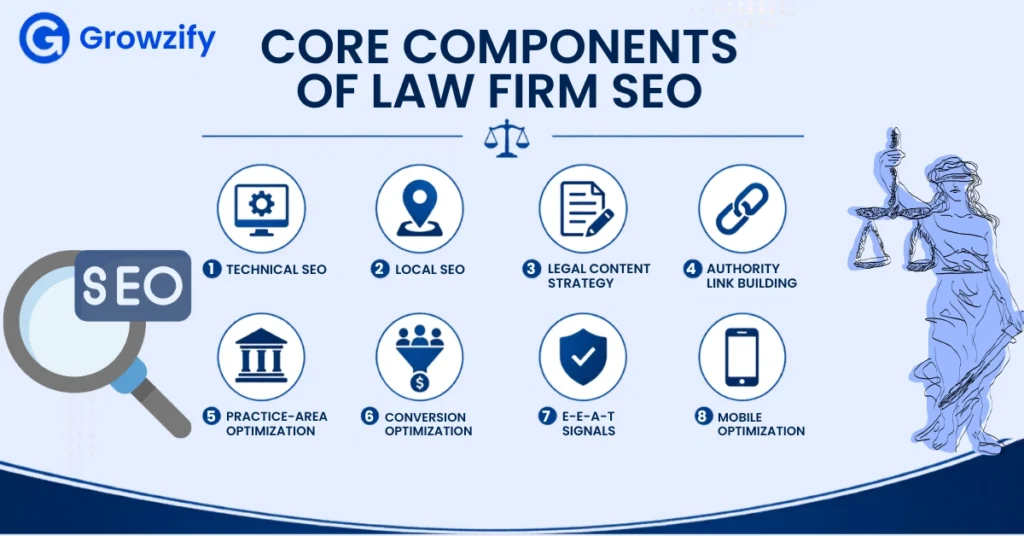
Core Components of Law Firm SEO
Modern law firm SEO services operate across eight integrated components. Missing any one of them creates a weak link that limits the performance of the others.
Technical SEO
Technical SEO ensures that search engines can crawl, index, and understand your website without friction.
For law firms, the most critical technical factors are:
- Core Web Vitals, LCP (page load speed), CLS (layout stability), and INP (interaction responsiveness). Google uses these as ranking signals, and legal websites frequently fail them due to overloaded homepage designs and unoptimized images.
- Mobile-first indexing, Over 65% of legal searches happen on mobile. A site that renders poorly on mobile loses rankings and conversions simultaneously.
- Schema markup, LegalService, Attorney, LocalBusiness, FAQ, and BreadcrumbList schema help both Google and AI systems understand your pages and surface them in rich results and AI answers.
- Crawl efficiency, Large law firm sites with redirect chains, orphaned pages, and duplicate content waste crawl budget and dilute ranking signals.
At Growzify Digital, our approach is guided byreal law firm case study experience across competitive practice areas.
Local SEO for Law Firms
Local SEO is the highest-leverage component ofSEO for law firmsfor most practice types. It determines whether you appear in the map pack, the single most visible position in legal search results.
Legal Content Strategy
Content is the foundation of legal SEO authority. Google’s Helpful Content system explicitly rewards depth, accuracy, and demonstrated expertise.
A mature law firm’s content architecture includes:
- Practice-area hub pages, comprehensive, schema-marked, 1,500–3,000 words covering every aspect of a practice area from process to outcomes
- Geo-targeted landing pages, city + practice area pages (“motorcycle accident lawyer in Denver”), capturing high-intent local searches
- Attorney bio pages, credential-rich, locally optimized, and structured for E-E-A-T evaluation
- FAQ content, structured to appear in Google’s featured snippets and AI answer engines
- Topical blog content, informational articles that build authority and capture long-tail queries from clients in the research phase
Authority Link Building
Links from authoritative, topically relevant sources signal trust to search engines. For law firms, this means:
- Legal directory listings (Avvo, Justia, FindLaw, Martindale-Hubbell, Super Lawyers)
- State and local bar association profiles
- Local news citations and press coverage
- Legal aid organizations and civic associations
- Guest contributions to legal publications
What to avoid:Purchased link packages, private blog networks (PBNs), and link exchanges. Google’s manual review teams actively monitor the legal vertical for manipulative link practices.
Practice-Area Optimization
Each practice area requires its own keyword architecture, content depth, and conversion pathway. Personal injury SEO differs fundamentally from criminal defense SEO; the search behavior, keyword intent, and decision timeline are completely different.
A qualified legal SEO agency maps keyword clusters by practice area, geographic market, and funnel stage before writing a single word of content.
Conversion Optimization
Traffic without conversions is overhead, not revenue. Law firm websites frequently lose potential clients due to:
- No visible phone number above the fold on mobile
- Form-heavy intake processes with no call-to-action alternatives
- Missing trust signals (awards, reviews, bar memberships) near conversion points
- No live chat or callback option for after-hours visitors
SEO and conversion optimization must be developed together; ranking a page that converts at 1% is half the value of ranking a page that converts at 3%.
E-E-A-T Signals
E-E-A-T is not a single ranking factor, it’s a framework Google uses across dozens of signals to evaluate the trustworthiness of legal content.
Practical E-E-A-T implementation for law firms:
- Every content page is attributed to a named, credentialed attorney
- Author bio pages with bar admission, years of practice, and notable cases
- Consistent NAP (Name, Address, Phone) across all platforms
- Active review profiles on Google, Avvo, and legal-specific directories
- Citations from authoritative legal and local sources
Mobile Optimization
More than two-thirds of legal searches happen on smartphones, often in urgent moments. Someone arrested at 11 pm or involved in an accident on the highway is searching on their phone.
A law firm website with a 5-second mobile load time, small tap targets, and a non-responsive layout loses those clients before they make contact.
Local SEO for Lawyers
Local SEO for lawyersis the discipline of ranking prominently in location-specific legal searches, particularly in Google’s local map pack.
For most law firms, local SEO drives more consultation volume than organic rankings alone. The map pack appears above the first organic result for nearly every “[practice area] lawyer in [city]” query.
Google Business Profile Optimization
Your Google Business Profile (GBP) is the single most important local SEO asset for most law firms. Ranking in the local pack requires:
- Primary category accuracy“Personal Injury Attorney” outperforms “Lawyer” for personal injury queries. Category selection directly influences which searches trigger your listing.
- Complete service areas, define every city and county you serve, not just your office location.
- Weekly postsand GBP posts signal an active, engaged business and provide keyword-rich content that influences local ranking.
- Q&A management, Seed your GBP Q&A with the questions potential clients actually ask. This content can appear in local search results directly.
- Review velocity and response rate. Consistent review acquisition and timely responses are both local ranking factors.
Location-Specific Landing Pages
If your firm serves multiple cities or counties, each location needs a dedicated landing page, not duplicate content with the city name swapped.
A properly built location page includes:
- City-specific legal information (local courts, judges, local statutes where relevant)
- Locally relevant FAQs
- Embedded Google Map with your GBP location
- Local schema markup (LocalBusiness with geo-coordinates)
- Location-specific testimonials were available
Local Citation Consistency
Your firm’s NAP data must be identical across every platform where it appears. Inconsistent citations, different phone numbers, suite number variations, or address formats create conflicting signals that suppress local pack rankings.
Key legal citation sources:Avvo, Justia, FindLaw, Martindale-Hubbell, Super Lawyers, Yelp, Bing Places, Apple Maps, and your state bar’s attorney directory.
Growzify Digital audits and remediate local citation inconsistencies as part of every law firm SEO onboarding. Citation errors are among the most common reasons firms can’t break into the local pack despite doing everything else correctly.
Common Law Firm SEO Mistakes
Understanding what doesn’t work is as important as knowing what does. These are the most costly mistakes we see in law firm SEO audits.
Thin practice-area pages.A 400-word page about “personal injury law” cannot rank in competitive markets. Google rewards depth, and competitors with comprehensive hub pages will consistently outrank you.
Generic AI-generated content.Low-quality AI content flooding the legal internet has accelerated Google’s crackdown on undifferentiated, formulaic pages. Content that reads like every other law firm page, regardless of how it was produced, is being systematically deranked.
Keyword stuffing in titles and headers.“Best Personal Injury Lawyer Personal Injury Attorney Personal Injury Law Firm” as a page title signals manipulation, not relevance. Modern SEO rewards natural language that matches how people actually search.
Ignoring Core Web Vitals.A beautiful law firm website that loads in 6 seconds on mobile fails both users and Google’s technical ranking requirements.
No conversion pathway on landing pages.Ranking on page one for a high-intent legal keyword and then sending visitors to a generic homepage is a direct loss of case opportunities.
Mismanaged Google Business Profile.Incomplete categories, no service area settings, zero post activity, and unanswered reviews suppress local pack visibility for firms that have otherwise done strong SEO work.
No schema markup.Law firms that don’t implement LegalService, Attorney, and FAQ schema are missing structured data signals that help both Google and AI systems understand and surface their content.
Weak E-E-A-T signals.Publishing legal content without named attorney authorship, credentials, and verifiable expertise fails Google’s quality evaluation framework for YMYL content.
How to Choose the Right SEO Company for Your Law Firm
Choosing anSEO company for law firmsis a high-stakes decision. The wrong agency wastes your budget and potentially harms your rankings. Here’s how to evaluate providers with precision.
Questions to Ask Every Agency
- “Which law firms have you ranked, in which practice areas, and in which markets?”Demand specific examples, not category experience.
- “Walk me through your content strategy for a personal injury firm targeting five cities.”Listen for geo-targeted pages, internal linking strategy, and schema implementation.
- “How do you build links for law firms specifically?”Valid answers: legal directories, PR outreach, bar associations. Red flag: “link packages” or volume-based link building.
- “What does your monthly report include?”Rankings, organic traffic, call tracking data, and consultation attribution should all be present.
- “How do you optimize content for AI search engines and featured snippets?”If they don’t have a clear answer, they’re behind the current standard oflegal SEO services.
Red Flags
- Guaranteed page-one rankings (impossible to promise, ethically dishonest)
- No law firm case studies or client references
- Reporting limited to rankings without consultation data
- Content produced without legal review or attorney attribution
- Lock-in contracts with no performance milestones
Metrics That Matter
Metric | Why It Matters |
Local pack ranking position | Drives the majority of consultation calls |
Organic traffic by practice area page | Shows keyword-level growth |
Consultation attribution | Ties SEO to actual revenue |
Call volume from organic search | Measures intake impact |
Keyword ranking velocity | Indicates whether the strategy is working |
Growzify Digitalprovides every law firm client with monthly reporting across all five metrics, so you always know exactly what your SEO investment is returning in consultation volume, not just ranking positions.
How Long Does SEO Take for Lawyers?
Meaningful ranking movement typically begins in months 3–5. Consultation-level impact is usually visible by month 6–9. Full compounding returns develop over 12–24 months.
Here’s a realistic breakdown:
Months 1–2: Foundation Phase
Technical audit and remediation, keyword architecture, Google Business Profile optimization, local citation cleanup, and initial content calendar. You won’t see ranking movement yet; this phase builds the infrastructure that rankings depend on.
Months 3–4: Content and Visibility Phase
Practice-area pages published, geo-targeted landing pages live, initial link outreach completed. You’ll begin to see movement on lower-competition, long-tail keywords. Local pack rankings may begin improving.
Months 5–6: Ranking Growth Phase
Competitive practice-area keywords begin ranking on pages 2–3. Local pack visibility improves noticeably. Organic consultation requests begin appearing in attribution data.
Months 9–12: Compounding Phase
Head keywords rank on page one. Local pack presence across multiple cities. Organic leads generate consistent intake volume. The cost-per-case from SEO now compares favorably against any paid channel.
Months 12–24: Authority Phase
Your firm ranks for a broad keyword portfolio across multiple practice areas and locations. SEO becomes your primary client acquisition channel. Each additional piece of content and link compounds on an already-strong foundation.
Firms that cancel before month 6 exit before the compounding phase begins, and that’s where the real return on investment lives.
Why Growzify Digital Is a Strong Partner for Law Firm SEO
Growzify Digital is a specialist digital marketing agencyfocused on law firm SEO and attorney SEO for legal practices across practice areas, including personal injury, criminal defense, family law, immigration, and corporate law.
Here’s what makes our approach operationally different from general SEO agencies.
Legal-First SEO Architecture
Every campaign starts with a keyword architecture built around your specific practice areas, geographic markets, and competitive landscape, not a template applied from another industry.
E-E-A-T Content That Passes Google’s Standards
Our legal content team produces attorney-reviewed, credential-attributed content that meets Google’s YMYL standards for legal topics. Every piece includes appropriate schema markup, internal linking, and conversion elements optimized for the legal intake funnel.
Local Pack Specialization
We’ve developed a structured local SEO methodology for law firms: Google Business Profile audit and rebuild, citation consistency across 40+ legal and local directories, review acquisition systems compliant with state bar rules, and geo-targeted content that ranks for city + practice area queries.
AI-Search Optimization
We structure legal content to rank not just in Google organic results, but in AI Overviews, Perplexity summaries, and ChatGPT Search responses. This includes entity optimization, FAQ schema, direct-answer paragraph structure, and topical coverage that AI systems cite as authoritative sources.
Outcome-Tied Reporting
Every monthly report connects SEO activity to consultation volume. Rankings are context; consultations are the goal. You’ll always know what your law firm’s digital marketing investment is generating in actual business outcomes.
Get a free law firm SEO audit from Growzify Digital. We’ll analyze your current rankings, local visibility, content gaps, and technical health, then give you a prioritized action plan specific to your market and practice areas.
Why Law Firms Need SEO More Than Ever in 2026
SEO for lawyers in 2026 is a more sophisticated discipline than it was even two years ago. The gap between firms that execute it correctly and firms that don’t is widening.
AI-powered search engines are reshaping how potential clients find legal help. Local map pack competition is intensifying in every major market.
Google’s quality standards for legal content are higher than they’ve ever been. And paid advertising costs are pushing more firms to compete for organic visibility.
The law firms winning in this environment share one characteristic: they invested in comprehensive, strategy-driven law firm SEO before they needed it.
They built content authority, local pack presence, and technical foundations that compound over time. Now those investments generate consistent intake volume at a fraction of the cost of paid advertising.
The firms still struggling are either doing nothing, doing it wrong, or working with agencies that don’t understand the legal vertical.
The right time to build a durable SEO foundation for your law firm was two years ago. The second-best time is now.
Contact Growzify Digital for a law firm SEO strategy consultation, and get a clear roadmap for turning your website into your most productive business development asset.
Frequently Asked Questions
How much does law firm SEO cost?
Effective law firm SEO services typically range from $2,500 to $10,000+ per month, depending on market competitiveness, practice area, and campaign scope. In high-competition markets like personal injury in major cities, campaigns at the higher end of this range are often necessary to compete.
How long does attorney SEO take to show results?
Initial ranking movement typically occurs in months 3–4. Meaningful local pack improvement appears by months 5–6. Consultation-level impact is usually visible by month 6–9. Full compounding ROI develops over 12–24 months.
Is local SEO important for lawyers?
Local SEO is critical for most law firms. Over 70% of legal searches include local intent, and Google’s local map pack, which appears above organic results, captures the majority of consultation calls for practice areas like personal injury, criminal defense, and family law.
Should law firms invest in content marketing?
Content marketing is not optional for competitive legal SEO; it’s the mechanism through which authority is built. Law firms that publish comprehensive practice-area pages, geo-targeted landing pages, FAQ content, and topical blog articles consistently outrank firms that treat their website as a static brochure.
How does AI search affect law firm SEO in 2026?
AI-powered search, Google AI Overviews, Perplexity, ChatGPT Search, Gemini, increasingly answer legal queries directly in the search interface, drawing from the most authoritative and well-structured legal content available.
Why choose Growzify Digital for law firm SEO?
Growzify Digital specializes in SEO for law firmswith a structured methodology covering technical SEO, E-E-A-T legal content, local pack optimization, and AI-search readiness. Every campaign is built around consultation growth, not vanity metrics.

Chitranshu SharmaA growth strategist, digital marketing consultant, and the founder of Growzify, a performance-driven agency helping brands dominate search, shape perception, and build sustainable online visibility. With 8+ years of hands-on experience in Enterprise SEO, Online Reputation Management (ORM), and AI-led traffic generation, Chitranshu has helped startups, public figures, SaaS companies, and cannabis brands outrank competitors — ethically and at scale.
Explore More Articles
How to Find and Compare Local SEO Outsourcing Providers
How to Find and Compare Local SEO Outsourcing Providers Finding a local SEO outsourcing provider...
October 13, 2026Outsourcing
Inside a White Label SEO Campaign: How the Work Gets Done
Inside a White Label SEO Campaign: How the Work Gets Done Clients see a single...
October 13, 2026White Label

How to Vet an SEO Outsourcing Provider Before You Sign a Contract
How to Vet an SEO Outsourcing Provider Before You Sign a Contract A polished proposal...
October 9, 2026Outsourcing

Multilingual SEO Best Practices: Optimize Your Multi-Language Website
Multilingual SEO Best Practices: Optimize Your Multi-Language Website Translating a page and localizing it for...
October 7, 2026SEO
What Makes In-House Enterprise SEO Work Different Day-to-Day?
What Makes In-House Enterprise SEO Work Different Day-to-Day? On a small site, deciding to fix...
October 7, 2026Enterprise

How Core Algorithm Updates Impact Large Sites Differently Than Small Ones
How Core Algorithm Updates Impact Large Sites Differently Than Small Ones A large enterprise site...
October 7, 2026Enterprise
When Should You Outsource SEO? 11 Signs It Makes Sense
When Should You Outsource SEO? 11 Signs It Makes Sense Outsourcing SEO does not necessarily...
September 26, 2026Outsourcing