



What a Good White Label SEO Contract Should Include
A well-structured white label SEO contract defines deliverables, pricing, timelines, and reporting expectations clearly. It helps agencies avoid isunderstandings while protecting both service providers and clients. Learn the essential terms and clauses every SEO partnership agreement should include.

Written byChitranshu Sharma
May 12, 2026
Quick Nav
In the digital marketing landscape today, ranking and traffic are one component. But what matters the most is the systems, partnerships, and how reliably you can deliver results at scale. As agencies grow, many turn to white-label SEO providers to expand capacity without increasing internal overhead. But growth through outsourcing only works when the foundation is stronger. That foundation is the contract.
A good white-label SEO contract is a strategic document that defines how work gets done, who owns it, and what standards it must meet. It clearly outlines deliverables, pricing, timelines, confidentiality, intellectual property ownership, performance benchmarks, and exit terms.
At its core, the purpose of the contract is simple: eliminate ambiguity before it becomes a problem. It protects the agency and the provider while setting clear expectations. Ensuring smooth delivery and strong partnerships, let’s understand how to build better white-label SEO contracts, the essential elements that truly matter.
White Label SEO Contract Essentials for Agencies
A strong contract also prevents the most expensive issues inwhite label SEO partnerships, including scope disputes, confidentiality breaches, quality disagreements, payment conflicts, and unclear termination rights.
- A white-label SEO contract must define exact deliverables, not package names, but specific monthly outputs with measurable standards
- Confidentiality and non-disclosure provisions protect the agency’s client relationships from provider contact or disclosure
- Intellectual property clauses must confirm that the agency owns all work product, content, reports, and strategy documents produced under the contract
- Performance standards and revision rights define what happens when deliverables do not meet agreed quality levels
- Exit and termination terms must allow the agency to leave without losing client data, work product, or relationship continuity
- Agencies using white-label SEO services through providers like Growzify Digital work under contracts that address all these areas, protecting the agency’s business and its clients’ interests
A good white-label SEO contract is a specific and enforceable agreement between an agency and its white-label provider. It clearly defines what will be delivered, the expected quality standards, project timelines, pricing terms, and confidentiality protections.
It should also explain intellectual property ownership, reporting responsibilities, and the conditions under which either party can terminate the agreement. A strong contract leaves no major operational question unanswered.
It is designed for agencies that want to protect client relationships, intellectual property, profit margins, and operational continuity before entering a long-term fulfillment partnership.
Core Elements of a Good white-label SEO Contract
A well-structured white-label SEO contract is the foundation of a reliable and scalable agency partnership. It clearly defines expectations, responsibilities, and quality standards. Ensuring thewhite label SEO agencyand provider operate with alignment, transparency, and long-term business protection from the very beginning of the collaboration.
Element 1: Parties and Relationship Definition
The contract must clearly identify:
- The agency (legal entity name, jurisdiction)
- The white-label SEO provider (legal entity name, jurisdiction)
- The nature of the relationship is independent contractor, not employee
The independent contractor clause:This protects the agency from employment liability. The white-label provider is not an employee; they are an independent contractor responsible for their own taxes, benefits, and employment obligations. The contract should state this explicitly and include standard independent contractor language.
The white-label relationship acknowledgment:The contract should clearly state that all services are provided on a white-label basis. The provider must not present itself as the service provider to the agency’s clients or contact those clients directly.
It should also prohibit the provider from using client names, business information, or campaign data for any purpose outside the agreed services.
Element 2: Scope of Services, The Most Critical Section
Vague scope language is the single most common source of white-label SEO contract disputes. The scope section must be specific enough to be enforced.
Scope schedule as an exhibit:For agencies with multiple client tiers, the scope section should reference a Schedule of Services as an exhibit, allowing the same contract to govern different campaign levels without separate agreements for each tier.
Scope change protocol:The contract must define how scope changes are handled. Verbal requests are not binding scope changes. A written change order, email confirmation is typically sufficient, documents what was agreed, at what additional cost, and when it is effective.
Element 3: Deliverable Standards and Quality Requirements
Defining deliverables by name is insufficient. The contract must define the standards that those deliverables must meet.
Content standards:
- Minimum word count per piece by content type
- Keyword integration requirements, primary keyword in title, H1, first paragraph
- Plagiarism threshold, typically less than 5% similarity on Copyscape or equivalent
- E-E-A-T compliance requirements for YMYL verticals
- Brand voice adherence matches the client brief provided by the agency
- Revision entitlement, minimum one revision cycle per piece within [X] business days of delivery
Link building standards:
- Minimum domain rating (DR) or domain authority (DA) threshold per link
- Domain traffic requirement, minimum verified organic traffic per linking domain
- Prohibition on link types, PBNs, link farms, automated directories, and paid link schemes that violate Google’s guidelines
- Anchor text compliance must match the brief specifications
- Placement requirement, body content only, not footer, sidebar, or author bio unless approved
Technical SEO standards:
- Implementation requirement: fixes must be applied to the live site, not just recommended
- Verification requirement, post-implementation crawl or screenshot confirmation for each fix
- Response time for critical technical issues, the timeframe within which critical errors (site down, mass deindexation) must be addressed
Reporting standards:
- Delivery deadline, specific date each month
- Branding requirement: agency branding only, no provider branding
- Data accuracy requirement: data must match Google Analytics and Search Console for the reporting period
- Required sections: executive summary, rankings, traffic, links, work completed, forward plan
Element 4: Revision Rights and Rejection Protocol
Even with strong quality standards, deliverables will occasionally miss the mark. The contract must define what happens.
Revision entitlement:The agency should be entitled to at least one full revision cycle per deliverable, at no additional cost, within a defined window, typically 5–7 business days after delivery.
Rejection rights:If a deliverable fails the quality standards defined in the contract and the revision does not resolve the deficiencies, the agency should have the right to reject the deliverable entirely, with either a replacement at no charge or a credit against the following month’s invoice.
What is not a valid rejection:The contract should define that subjective preference, “we just don’t like the style,” without reference to specific brief or quality standard violations, does not constitute grounds for rejection.
Element 5: Confidentiality and Non-Disclosure
This is the most business-critical protection in a white-label contract. The agency’s client relationships are its primary asset. A provider with access to client names, domains, performance data, and business information must be contractually prohibited from using or disclosing that information.
What the confidentiality clause must cover:
- Client identity protection:Provider may not disclose the names, domains, or business details of agency clients to any third party, including the provider’s own staff, beyond those directly working on the campaign
- Performance data protection:Client SEO performance data, analytics access, and campaign results are confidential, not to be referenced in the provider’s marketing materials, case studies, or public communications
- Agency methodology protection:Brief templates, strategy frameworks, reporting formats, and client management processes shared with the provider are the agency’s confidential property
- Survival clause:Confidentiality obligations survive contract termination, typically for three to five years post-termination
The non-disparagement clause:The provider should be contractually prohibited from making negative statements about the agency, its methods, or its clients, to anyone, including current or prospective providers in the agency’s market.
Element 6: Non-Solicitation and Non-Contact
Confidentiality protects information. Non-solicitation and non-contact clauses directly protect the agency’s client relationships.
Non-solicitation clause:The provider may not solicit the agency’s clients, directly or indirectly, for SEO or related services during the contract term and for a defined period post-termination. Twelve to twenty-four months post-termination is standard.
Non-contact clause:The provider may not contact the agency’s clients for any business purpose during or after the contract term. This is distinct from non-solicitation, which prohibits even introductory contact that could lead to a direct relationship.
Non-circumvention clause:The provider may not enter into a direct business relationship with the agency’s clients, even if the client initiates contact. If a client reaches out to the provider directly, the provider must immediately notify the agency and decline to engage.
These clauses are the contractual foundation of the white-label model. Without them, the agency’s most valuable assets, its client relationships, are unprotected.
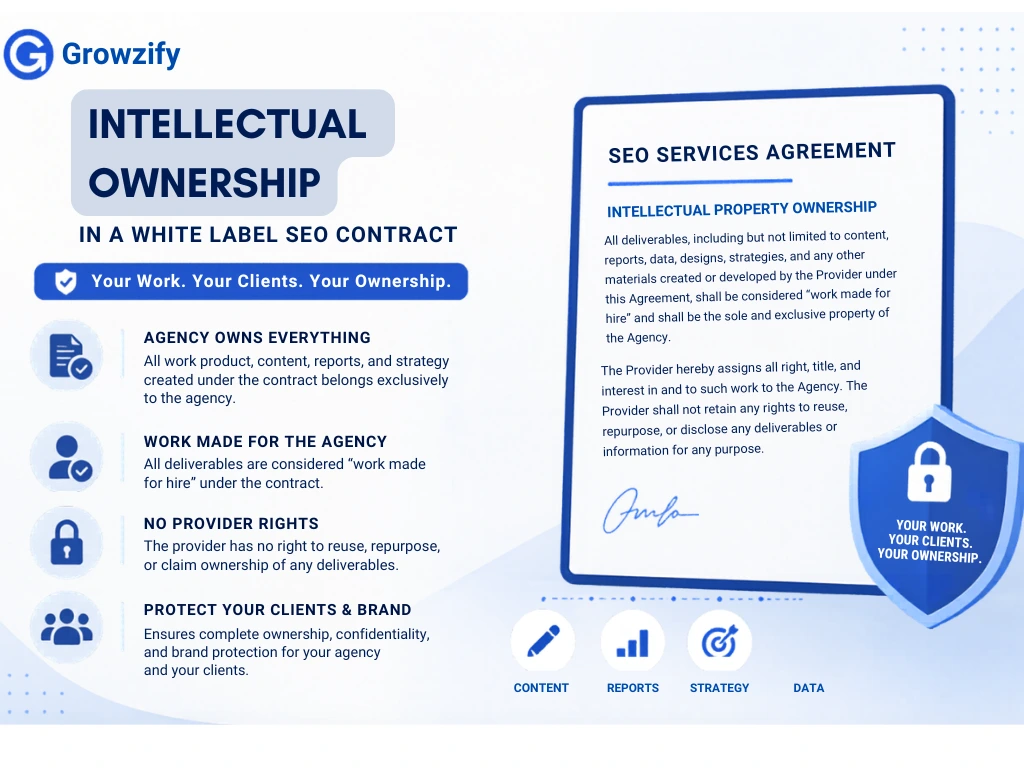
Element 7: Intellectual Ownership white label SEO Contract
All work product produced under the contract, content, reports, strategy documents, link placements, and any other deliverables must be explicitly assigned to the agency.
Work-for-hire language:The contract should state that all deliverables are produced as “work made for hire” under applicable copyright law, and that to the extent any deliverable does not qualify as work made for hire, the provider assigns all intellectual property rights to the agency upon full payment.
Content ownership:Blog articles, landing pages, product descriptions, and any other written content produced under the contract are the agency’s property, and by extension, the client’s property. The provider retains no license to republish, reuse, or reference this content.
Report and strategy document ownership:Monthly reports, strategy documents, audit findings, and keyword research outputs are the agency’s property. The provider may not use these materials for case studies, training materials, or any other purpose without explicit written consent.
Tool and platform access:The contract should confirm that any accounts created on behalf of the agency or its clients, GBP profiles, GSC access, citation management accounts, remain under agency control and are transferred in full upon contract termination.
Element 8: Pricing, Payment Terms, and Price Escalation
The financial terms of the contract must protect the agency’s margin predictability and cash flow management.
Pricing documentation:The contract should reference a pricing schedule as an exhibit, listing the wholesale cost per campaign tier and per service component. This prevents informal price changes that are not documented.
Payment timing:Most white-label providers invoice monthly in advance. The agency should ensure payment terms align with its own client billing cycle, ideally invoicing clients before paying the provider, to avoid cash flow gaps.
Price escalation terms:The contract must specify:
- Whether prices can be increased, and if so, by what maximum percentage annually
- What notice period is required before a price increase takes effect? 60–90 days is reasonable
- Whether the agency can terminate without penalty if a price increase exceeds a defined threshold
Disputed invoice protocol:The contract should define what happens when the agency disputes a charge, a specific process for raising disputes, a response time for the provider, and a hold on payment for the disputed amount pending resolution.
Late payment terms:Define the grace period before late fees apply and the late fee rate. Standard: 30-day grace period, 1.5% per month on outstanding balances.
Element 9: Term, Renewal, and Termination
Termination rights are where agencies most frequently discover that the contract they signed does not protect them.
Initial term:A reasonable initial term for a white-label SEO contract is month-to-month or three months. Longer initial terms, six to twelve months, should only be accepted in exchange for meaningful price concessions.
Agencies should never accept a 12-month initial commitment without the ability to cancel on reasonable notice if deliverable quality standards are not met.
Automatic renewal:The contract should not auto-renew for extended terms without explicit written consent. Month-to-month continuation after an initial term is acceptable. Automatic renewal of a 12-month term without action is not.
Termination for convenience:The agency should be able to terminate the contract for any reason with reasonable notice, typically 30 days. Some providers require a 60-day notice, which is acceptable. Notice periods exceeding 90 days should be negotiated down.
Termination for cause:The agency should be able to terminate immediately, without notice period, for material breach. Material breach triggers should include:
- Persistent failure to meet deliverable quality standards after documented revision requests
- Confidentiality breach, the provider discloses client information
- Non-solicitation violation, provider contacts agency clients
- Fraudulent reporting, provider claims deliverables not actually completed
- Provider insolvency or cessation of business
Post-termination obligations:Upon termination, the provider must:
- Deliver all completed work product to the agency within a defined window (typically 5–10 business days)
- Transfer all access credentials, analytics accounts, GBP profiles, and platform logins
- Return or certify the destruction of all confidential client information
- Provide transition support, a final reporting period, and a handover document for a defined period (typically 30 days)
Element 10: Data Protection and Security
Agencies share sensitive client information with white-label providers, analytics access, website credentials, and business performance data. The contract must address how this data is protected.
Data handling requirements:
- Provider may use client data only for the purpose of fulfilling the contracted services
- Client data may not be stored on unsecured platforms or shared with unauthorized third parties
- Access credentials must be stored in a password manager with enterprise-level security, not email or plain text documents
Data breach notification:The provider must notify the agency within a defined timeframe, typically 48–72 hours, if a data breach occurs that may have exposed client information.
GDPR / CCPA compliance:For agencies with clients subject to data protection regulations, the contract should confirm the provider’s compliance with applicable regulations and their data processing obligations.
Element 11: Liability Limitations and Indemnification
Both parties need protection from disproportionate liability exposure.
Provider liability cap:Standard: Provider’s total liability for any claim is capped at the total fees paid in the prior three months. This is a reasonable limitation; it ensures the provider carries meaningful accountability without facing existential liability for errors in a single campaign.
Agency indemnification of provider:The agency indemnifies the provider against claims arising from the agency’s instructions. If the agency provides a brief that directs the provider to create content making claims the agency knows to be false, the agency is responsible for that direction.
Provider indemnification of agency:The provider indemnifies the agency against claims arising from the provider’s own errors, content that infringes third-party copyright, and links built using methods that violate Google’s guidelines. This results in a client penalty or confidentiality breaches caused by the provider’s own security failures.
SEO results disclaimer:A standard and reasonable clause: the provider does not guarantee specific ranking positions or traffic volumes. SEO results depend on factors outside the provider’s control, such as search engine algorithm changes, client site changes, and competitive activity.
Element 12: Dispute Resolution
Define how disputes are resolved before they arise, not during them.
Notice and cure period:Before either party can initiate formal dispute resolution, they must provide written notice of the dispute and a defined cure period, typically 15–30 days, for the other party to address the issue.
Dispute resolution mechanism:Options, from least to most formal:
- Direct negotiation between senior representatives
- Mediation, neutral third-party facilitator
- Binding arbitration is faster and less expensive than litigation
- Litigation in a specified jurisdiction
Most white-label SEO contracts specify arbitration as the dispute resolution mechanism for unresolved disputes. This is generally preferable to litigation for both parties.
Governing law and jurisdiction:The contract must specify which jurisdiction’s law governs the agreement and where disputes will be resolved. For international white-label relationships, jurisdiction selection is particularly important.
Element 13: Subcontracting and Assignment
white-label providers frequently use subcontractors, particularly for content production and link building. The contract must address this.
Subcontracting disclosure:The provider should disclose whether subcontractors are used and for what functions. The agency may reasonably require notification of subcontractor use.
Subcontractor confidentiality:The provider must ensure all subcontractors are bound by equivalent confidentiality, non-solicitation, and data protection obligations. The provider is responsible for subcontractor compliance.
Assignment restrictions:Neither party should be able to assign the contract, including in a business acquisition, without the other party’s written consent. This prevents the agency from unknowingly contracting with a new entity following a provider acquisition.
When these core elements are clearly defined, a white-label SEO contract becomes a safeguard for consistency, quality, and trust. It ensures smooth collaboration, protects client relationships. This enables agencies to scale confidently without risking delivery standards or operational control.
Contract Red Flags: What to Reject or Negotiate
Agencies reviewing a provider-drafted contract should treat the following terms as unacceptable without negotiation.
Red Flag | Why It Is Problematic | What to Request Instead |
12-month initial term, no early exit | Lock the agency in before quality is proven | Month-to-month or 3-month initial term with 30-day notice |
Auto-renewal for extended terms | Creates commitment without affirmative consent | Month-to-month continuation only |
No IP assignment clause | Provider may retain ownership of content | Explicit work-for-hire and IP assignment language |
No non-solicitation clause | The provider can approach agency clients | 24-month non-solicitation post-termination |
No confidentiality survival clause | Protections end when the contract ends | Confidentiality survives termination for 3–5 years |
Unlimited liability cap | Agency exposed to disproportionate claims | Mutual liability cap at 3 months’ fees |
No revision rights | The agency has no remedy for poor quality | Minimum one revision per deliverable at no charge |
Vague deliverable definitions | Nothing to enforce against | Specific counts, standards, and deadlines per deliverable |
Price increase at any time without notice | The agency cannot plan margins | 60-day notice minimum, annual cap on increases |
No data returned on termination | The agency cannot recover the client’s work product | Explicit post-termination data return within 10 business days |
Why Agencies Choose Growzify Digital as a White-Label SEO Partner
A contract is only as strong as the partner behind it.Growzify Digitalworks with agencies through structured white-label SEO agreements designed to protect client relationships, confidentiality, and operational continuity.
The partnership model is built around clear deliverables, transparent communication, and defined responsibilities. Thus reducing the risk of scope confusion or delivery misalignment.
Agencies useGrowzify Digital’s white label SEO servicesbecause the relationship is supported by documented processes, specialist execution, and operational standards that prioritize long-term trust, not short-term transactions. For agencies evaluating campaign scope, deliverables, and pricing structure, the SEO services page provides a detailed breakdown of what should be clearly defined in any well-structured white-label agreement.
FAQs
What should a white-label SEO contract include?
A complete white-label SEO contract should mainly include: specific deliverable definitions with quality standards, confidentiality and non-disclosure provisions, non-solicitation, and intellectual property assignment.
Who owns the content produced by a white-label SEO provider?
Under a properly drafted contract, the agency owns all content produced by the white-label provider through work-for-hire language and IP assignment clauses. Without these provisions, the provider may retain copyright in content they produced, which can create disputes when the agency switches providers or the relationship ends.
How long should a white-label SEO contract term be?
For new provider relationships, a month-to-month or a three-month initial term is appropriate, as it allows the relationship to prove itself before a longer commitment.
Can a white-label SEO provider contact my clients directly?
Without a non-contact and non-solicitation clause in the contract, there is no legal prohibition. A properly drafted contract explicitly prohibits the provider from contacting the agency’s clients for any business purpose, during and for a defined period after the contract term.
What happens to client data when a white-label SEO contract ends?
A well-drafted contract requires the provider to return all client data, analytics access, work product, strategy documents, and platform credentials, within a defined window of contract termination.

Chitranshu SharmaA growth strategist, digital marketing consultant, and the founder of Growzify, a performance-driven agency helping brands dominate search, shape perception, and build sustainable online visibility. With 8+ years of hands-on experience in Enterprise SEO, Online Reputation Management (ORM), and AI-led traffic generation, Chitranshu has helped startups, public figures, SaaS companies, and cannabis brands outrank competitors — ethically and at scale.
Explore More Articles

Content Gap Analysis For Large Enterprise Business Websites
Content Gap Analysis For Large Enterprise Business Websites Content gap analysis for large enterprise business...
October 22, 2026Enterprise

Content Mapping for Conversions: A Guide for Large Enterprise Websites
Content Mapping for Conversions: A Guide for Large Enterprise Websites Most enterprise sites don’t have...
October 22, 2026Enterprise

Top 10 AI SEO Strategies to Get Ranked on AI Searches
Top 10 AI SEO Strategies to Get Ranked on AI Searches AI answers compress the...
October 21, 2026AI SEO

How to Manage SEO Outsourcing Across Multiple Teams
How to Manage SEO Outsourcing Across Multiple Teams A single-owner outsourcing model works fine until...
October 13, 2026Outsourcing

How to Find and Compare Local SEO Outsourcing Providers
How to Find and Compare Local SEO Outsourcing Providers Finding a local SEO outsourcing provider...
October 13, 2026Outsourcing

Inside a White Label SEO Campaign: How the Work Gets Done
Inside a White Label SEO Campaign: How the Work Gets Done Clients see a single...
October 13, 2026White Label

How to Vet an SEO Outsourcing Provider Before You Sign a Contract
How to Vet an SEO Outsourcing Provider Before You Sign a Contract A polished proposal...
October 9, 2026Outsourcing