


Backend SEO Systems Agencies Use to Scale: The Real Workflow (2026)
This guide breaks down the backend SEO systems agencies use to scale in 2026.
It covers real workflows, tools, and automation used for daily SEO operations.
Learn how to build efficient processes that support consistent growth and delivery.

Written byChitranshu Sharma
May 6, 2026
Quick Nav
What Are Backend SEO Systems for Agencies?
Backend SEO systems are the operational infrastructure — tools, processes, workflows, and fulfillment structures — that allow agencies to deliver SEO at scale without proportional increases in headcount, error rate, or client churn. They are the difference between an agency that handles 10 clients reactively and one that manages 100 clients systematically.
Key points:
- Backend SEO systems cover intake, auditing, execution, reporting, quality control, and client communication — end to end
- Well-built systems reduce dependency on individual team members and make delivery consistent regardless of who executes
- Agencies that scale SEO profitably use documented workflows, not improvised delivery
- White-label fulfillment partners like Growzify Digital plug directly into these systems as an execution layer
- The goal is repeatable, predictable output — not heroic individual effort on every campaign
One-line definition:Backend SEO systems are the documented processes, tools, and workflows that agencies use to deliver consistent SEO results across multiple clients simultaneously.
Who it is for:Agency owners, SEO directors, account managers, and operations leads at digital marketing agencies who want to scale from 10 to 100+ clients without rebuilding delivery from scratch every time.
1. Why Most Agencies Fail to Scale SEO
Most agencies do not have a growth problem. They have a system problem.
The agency closes new clients. Work increases. The team stretches. Quality slips on existing accounts while new ones get attention. A client churns. The team recovers. Another client comes in. The cycle repeats.
This pattern — sometimes called the agency growth trap — is not caused by bad SEO. It is caused by delivery that depends on individual effort rather than repeatable systems.
An agency without documented backend systems is scaling on heroics. Individual team members carry institutional knowledge in their heads. When they leave, that knowledge leaves with them. When volume spikes, there is no playbook to follow — just improvisation under pressure.
The symptoms of a system-less agency:
- Onboarding takes different amounts of time for every new client
- Reports are built manually each month and look different depending on who makes them
- Strategy decisions are made from memory rather than documented frameworks
- Deliverables vary in quality based on who executed them, not what the client paid for
- No clear answer to the question: “What exactly happens in month one for a new SEO client?”
The agencies that scale SEO profitably — past $500K, past $1M, past $5M in annual SEO revenue — are running documented systems, not talented individuals making individual judgment calls on every account.
2. The Architecture of a Scalable Agency SEO System
Acomplete backend SEO systemhas seven layers. Each layer has inputs, outputs, and documented processes connecting them.
Layer 1: Client Intake and Onboarding
Layer 2: Site Audit and Baseline Establishment
Layer3: Strategy Development
Layer4: Execution Management
Layer5: Quality Control
Layer6: Reporting and Communication
Layer 7: Retention and Upsell
Most agencies have partial versions of some layers. Few have all seven documented and connected. The gaps between layers are where clients fall through — where work gets missed, where communication breaks down, where results stagnate.
3. Layer 1: Client Intake and Onboarding System
The onboarding experience sets the tone for the entire client relationship. A disorganized onboarding signals a disorganized agency — and creates the anxiety that precedes churn.
What a documented intake system includes:
Kickoff form / intake questionnaireA structured form the client completes before the first meeting. Covers business goals, target audience, primary competitors, current marketing channels, past SEO activity, access credentials, and content approval process.
This is not optional. Without structured intake, the team asks different questions in different orders across every new account. Standardize the inputs.
Access collection checklistA documented list of every access the team needs: Google Analytics 4, Google Search Console, Google Business Profile (if local), CMS access, hosting panel (if technical changes are needed), social profiles. Collected systematically at kickoff — not piecemeal over the first three weeks.
Kickoff meeting agenda templateEvery kickoff meeting covers the same ground: goals review, timeline expectations, communication preferences, reporting schedule, and what success looks like at 90 days. The template ensures nothing is missed regardless of who runs the meeting.
Project management setupThe new client gets a project board — Asana, ClickUp, Monday.com, or equivalent — with the first 90 days of tasks pre-populated from a template. Every task has an owner and a due date. Nothing lives in someone’s inbox.
Internal handoff documentationThe sales-to-delivery handoff is documented: what was promised, at what price, with what specific deliverables. This prevents the gap between what was sold and what is delivered — one of the most common sources of early client dissatisfaction.
4. Layer 2: Site Audit and Baseline System
The audit is where agencies earn trust or lose it in the first 30 days. A thorough, well-presented audit demonstrates competence. A shallow or generic audit raises doubts.
What a scalable audit system includes:
Audit template by client typeDifferent client types — ecommerce stores, local service businesses, national SaaS companies, multi-location franchises — require different audit structures. A scalable agency has audit templates for each client type, not a one-size-fits-all checklist.
Technical SEO audit components:
- Crawlability and indexation status
- Site speed and Core Web Vitals
- Mobile usability
- Duplicate content and canonicalization
- Redirect chains and broken links
- Structured data implementation and errors
- XML sitemap and robots.txt configuration
- HTTPS implementation
On-page audit components:
- Title tags and meta descriptions across key pages
- Header hierarchy (H1–H3) consistency
- Content quality and depth assessment
- Keyword targeting accuracy per page
- Internal linking structure
Off-page audit components:
- Backlink profile — volume, quality, anchor text distribution
- Toxic or spammy link identification
- Competitor backlink gap analysis
Baseline metrics documentationBefore any work begins, current performance is documented — organic traffic by month (trailing 12 months), keyword ranking positions for primary targets, GBP performance if local, and domain authority metrics. This baseline makes progress measurement possible and protects the agency from claims that results did not improve.
Audit delivery formatThe audit is delivered in a format the client can read — not a raw data export from Screaming Frog. A branded presentation or structured report with prioritized recommendations by impact level. Quick wins first. Foundational issues second. Long-term opportunities third.
5. Layer 3: Strategy Development System
Strategy is where many agencies are inconsistent. They produce strategy documents that look different for every client — because there is no underlying framework.
What a documented strategy system includes:
Keyword research frameworkA repeatable process for mapping keywords to business goals and page types. The framework distinguishes between informational, navigational, and transactional intent. It maps primary and secondary keywords to existing pages or identifies content gaps requiring new pages.
Content gap analysis templateA documented comparison between the client’s current content and the search demand for their category — surfacing topics they should rank for but currently do not.
12-month SEO roadmap templateA standardized roadmap structure that sequences:
- Month 1–2: Technical foundation
- Month 3–4: On-page optimization and initial content
- Month 5–6: Link building begins, content expands
- Month 7–12: Authority building, content scaling, conversion optimization
This roadmap is adapted per client — but starts from a template, not a blank page.
Competitor analysis frameworkA structured comparison of the client’s domain against three to five competitors across: keyword overlap, content volume, backlink profile, technical health, and local presence. The output is a clear picture of where gaps exist and what effort is required to close them.
Strategy documentation and sign-offStrategy is documented and shared with the client for review. This creates alignment before execution begins and gives the agency a reference point if scope or direction questions arise later.
6. Layer 4: Execution Management System
Execution is where most agencies lose efficiency. Work gets done — but inconsistently, at different quality levels, in different sequences, by different team members with different approaches.
What a scalable execution system includes:
Standard Operating Procedures (SOPs) for every deliverable
Every deliverable the agency produces needs a written SOP. This is not optional at scale. Examples:
- SOP: How to optimize a category page
- SOP: How to write a location landing page
- SOP: How to conduct outreach for link building
- SOP: How to submit and verify citations
- SOP: How to optimize a Google Business Profile
SOPs mean a new team member can produce the same quality output as a senior team member — because the process is documented, not improvised.
Task assignment and accountabilityEvery task has one owner. Not a team. One person. Shared ownership creates accountability gaps. Project management tooling enforces this with assignee fields that cannot be left blank.
Execution calendarDeliverables are scheduled across the month — not clustered at the end. A 30-day execution calendar shows when each deliverable is due, who owns it, and what its dependencies are. This prevents month-end crunches that produce rushed, low-quality work.
White-label fulfillment integrationFor agencies using awhite-label SEO providerlikeGrowzify Digital, the execution layer is where the integration happens. The white-label provider receives the strategy brief, the client’s access credentials, and the deliverable schedule. The agency monitors output quality without executing directly.
This integration must itself be documented: what gets briefed, in what format, by when, and what the review process is before deliverables reach the client.
Content production workflow
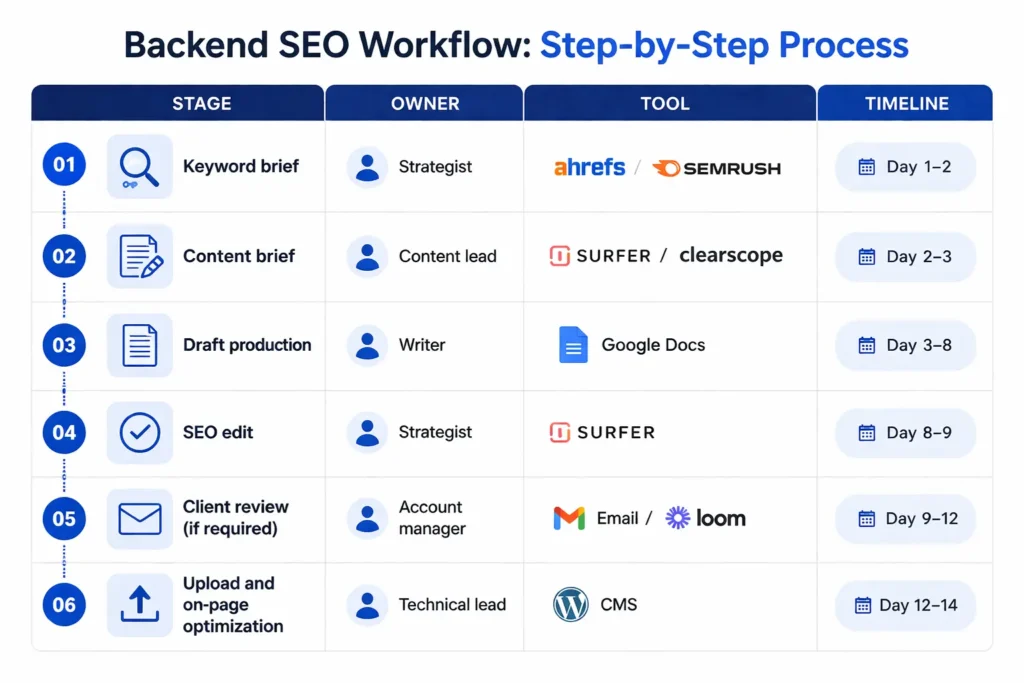
This workflow applies to every piece of content — not just when someone remembers to brief it.
Link building workflow
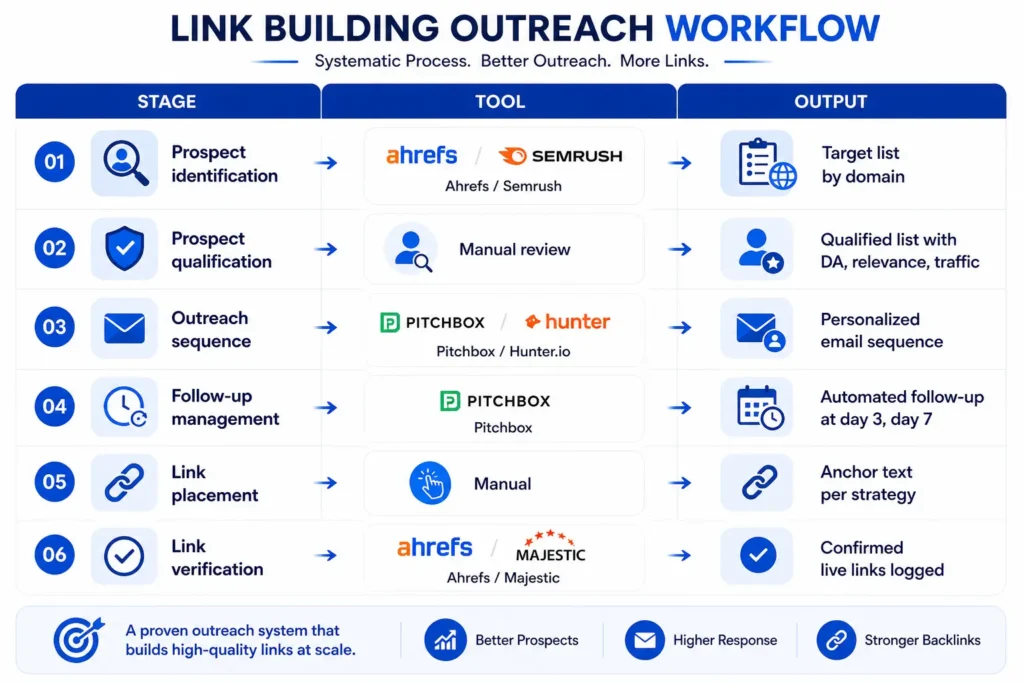
7. Layer 5: Quality Control System
Quality control is the layer most agencies skip when volume increases — and the first one they regret skipping.
What a QC system includes:
Deliverable review checklistBefore any deliverable reaches a client, it passes through a checklist. The checklist varies by deliverable type — content has a different QC checklist than a technical fix implementation or a link building report.
Content QC checklist example:
- Keyword target confirmed in title, H1, first 100 words
- Meta description written and within character limit
- Internal links added (minimum two per piece)
- Schema markup applied if applicable
- SurferSEO or equivalent content score meets threshold
- No factual errors or unsupported claims
- Uniqueness confirmed (no duplicate content issues)
Two-step review processDeliverables go through a peer review before an account manager or senior lead approves for client delivery. One person producing and reviewing their own work is not a QC process.
Error loggingWhen errors are caught — either internally or by the client — they are logged. Over time, the error log reveals patterns: which deliverable types have the most issues, which team members need additional training, which SOPs are unclear. Without logging, the same errors repeat indefinitely.
Client feedback integrationClient feedback is structured and documented — not received verbally and forgotten. Feedback informs SOP improvements, brief templates, and training priorities.
8. Layer 6: Reporting and Communication System
Reporting is the most visible layer of the backend system. It is what clients see every month. It either reinforces confidence or creates doubt.
What a scalable reporting system includes:
Branded report templatesReports are built from templates — not recreated from scratch monthly. Templates cover the standard reporting structure: executive summary, traffic overview, keyword rankings, backlink acquisition, work completed this month, work planned next month. The template is adapted per client, not rebuilt per client.
Automated data connectionsManual data entry in reports does not scale. Reporting systems connect directly to Google Analytics 4, Google Search Console, Google Business Profile, and rank tracking tools via API or platform integration (Google Looker Studio, AgencyAnalytics, DashThis). Data populates automatically — the team writes commentary, not tables.
Reporting cadence documentationEvery client has a documented reporting cadence: monthly report delivered by day X of the month, monthly call on day Y, quarterly strategy review in months 3, 6, 9, 12. This is set at kickoff and does not vary.
Monthly commentary frameworkThe narrative that accompanies report data follows a structure:
- What happened this month (results summary)
- Why it happened (context and attribution)
- What we are doing next month (forward-looking plan)
This framework prevents reports that dump data without explanation — which create client anxiety rather than confidence.
Proactive communication triggersThe system defines when the team communicates proactively — not just on the monthly reporting schedule. Triggers include: a ranking position drops significantly, a traffic anomaly appears, a technical issue is discovered, a Google algorithm update is confirmed. Clients who hear about issues proactively from their agency are far less likely to churn than clients who discover issues themselves.
9. Layer 7: Retention and Upsell System
Client acquisition is expensive. Retention is where agencies become profitable. Yet most agencies have no documented retention system — they rely on results to speak for themselves, and hope.
What a retention system includes:
90-day milestone reviewAt day 90, the agency presents a structured review: what was accomplished against the 90-day plan, what early performance signals indicate, and what the strategy for the next 90 days looks like. This resets the client’s frame of reference and demonstrates deliberate progress management.
Quarterly business reviews (QBRs)QBRs are structured meetings — not status calls — where the agency presents strategic analysis, competitive landscape updates, and the roadmap for the next quarter. QBRs position the agency as a strategic partner rather than a task executor.
Upsell identification frameworkThe system documents signals that indicate upsell opportunity:
- Client mentions paid search struggles → propose PPC integration
- Local rankings strong but national coverage weak → propose content authority campaign
- Strong organic traffic but low conversion → propose CRO or landing page optimization
- Multi-location client adding new locations → propose location expansion package
Upsells are not pitched randomly. They are identified by documented criteria and proposed with specific justification tied to client data.
Churn early warning signalsThe system tracks signals that precede churn: reduced engagement on reports, slow email responses, missed calls, questions about ROI without prompting. When signals appear, the account manager escalates to a senior relationship review — not waits to see what happens.
10. The Tool Stack for a Scalable Agency SEO System
Function | Tools Commonly Used |
Project management | ClickUp, Asana, Monday.com |
SEO research and auditing | Ahrefs, Semrush, Screaming Frog |
Content optimization | SurferSEO, Clearscope, MarketMuse |
Technical SEO validation | Screaming Frog, Google Search Console, PageSpeed Insights |
Rank tracking | AccuRanker, SERPWatcher, Semrush |
Citation management | BrightLocal, Yext, Whitespark |
Link building and outreach | Pitchbox, Hunter.io, Respona |
Reporting and dashboards | Google Looker Studio, AgencyAnalytics, DashThis |
Client communication | Slack, Loom, HubSpot CRM |
SOP documentation | Notion, Confluence, Google Workspace |
White-label fulfillment |
The key principle:The tool stack serves the system. Adding more tools without documented processes creates complexity, not efficiency. Many agencies are over-tooled and under-systematized.
11. How White-Label SEO Plugs Into Agency Backend Systems
White-label SEO is not a replacement for agency systems. It is an execution layer that integrates into an existing system — or exposes the absence of one.
Agencies that integrate a white-label provider like Growzify Digital effectively follow a documented handoff process:
What the agency provides to the white-label provider:
- Completed client intake brief
- Audit findings and strategy document
- Monthly deliverable scope — specific to that client’s package
- Brand guidelines for any content production
- Access credentials for the client’s platforms
- Reporting template with the agency’s branding
What the white-label provider returns:
- Executed deliverables — content, links, technical fixes, GBP updates
- Draft reports populated with the month’s performance data
- Work log documenting what was completed
- Flagged issues or opportunities identified during execution
What the agency does with the output:
- QC review against deliverable checklists
- Commentary and narrative added to report
- Report delivered to client under agency brand
- Client communication managed by agency account manager
This division of responsibility only works when both sides have documented processes. An agency without a strategy brief template cannot brief a white-label provider effectively. A white-label provider without documented execution SOPs cannot produce consistent output.
Growzify Digital is built to integrate into agency systems — not replace them.White label SEO servicesfrom Growzify Digital are designed to receive structured briefs and return branded, client-ready deliverables that slot directly into the agency’s reporting and communication workflow.
For agencies building or refining their backend systems, theSEO servicesoffering provides a reference for what full-scope execution looks like at each campaign level.
12. Real Workflow: What a Scaled Agency Month Looks Like
Week 1: Foundation
- New client onboards — intake form completed, accesses collected, project board set up
- Existing clients: technical tasks execute per monthly calendar
- Content briefs issued for the month’s content deliverables
- White-label provider briefed on month’s execution scope per client
Week 2: Execution
- Content drafts returned and in QC review
- Link outreach sequences running — follow-ups sent to week-one prospects
- On-page updates being implemented for existing clients
- GBP posts published for local clients on publishing schedule
Week 3: Quality and Production
- Content approved and uploaded to client CMS
- Links placed — confirmation and verification logged
- Technical implementations reviewed — changes confirmed live and functioning
- Rank tracking pulled — significant changes flagged for reporting context
Week 4: Reporting and Communication
- Monthly reports generated — automated data populated, commentary written
- Reports reviewed internally before client delivery
- Reports delivered to clients with email summary
- Monthly calls scheduled and completed
- Next month’s execution calendar confirmed with white-label provider
This rhythm — consistent, documented, repeatable — is what separates agencies that scale from agencies that stall.
AEO Question Cluster: Direct Answers
What backend tools do SEO agencies use to scale?Agencies at scale typically use Ahrefs or Semrush for research, Screaming Frog for technical audits, SurferSEO for content optimization, AccuRanker for rank tracking, Google Looker Studio or AgencyAnalytics for reporting, ClickUp or Asana for project management, and Pitchbox for link building outreach. The tools matter less than the documented processes that govern how they are used.
What is an SOP in an SEO agency?A Standard Operating Procedure is a written, step-by-step document that describes exactly how a specific task is completed — who does it, in what order, using which tools, producing what output. SOPs allow consistent delivery regardless of which team member executes the work. They are the foundation of a scalable agency.
How do agencies manage multiple SEO clients at once?Through documented workflows, project management tooling, templated deliverables, and — often — white-label SEO fulfillment partners who execute campaigns at scale. Agencies managing 50+ clients are not doing so through individual effort. They are running systemized processes where every client follows the same structured workflow.
What is a white-label SEO fulfillment partner?A white-label SEO fulfillment partner is a specialist provider that executes SEO campaigns on behalf of an agency — invisibly. The agency briefs the provider, the provider delivers the work, and the agency presents it to the client under its own brand. The most effective integrations happen when both the agency and the provider have documented, compatible processes.
How do agencies track SEO results across multiple clients?Using rank tracking platforms (AccuRanker, Semrush), Google Search Console data aggregated by client, and reporting dashboards (AgencyAnalytics, Looker Studio) that pull data automatically per client account. Agencies at scale do not pull data manually — they build or configure automated data pipelines that populate reports with minimal manual input.
What causes SEO agencies to plateau in growth?The most common cause is delivery that does not scale — execution that depends on specific individuals, processes that exist only in people’s heads, and reporting that requires significant manual effort per client. When adding a new client means proportionally increasing effort rather than plugging into an existing system, growth creates operational strain rather than leverage.
How long does it take to build a scalable SEO agency system?Building a full seven-layer system from scratch takes 3–6 months of dedicated operational work. Most agencies build iteratively — systematizing their highest-volume processes first, then expanding to cover the full delivery lifecycle. Using a white-label partner for execution while building internal systems is a common approach that maintains delivery quality during the transition.
What is the most important layer in an agency’s backend SEO system?Quality control is the most underinvested layer in most agencies — and the one that protects client retention most directly. Agencies that produce consistent quality retain clients. Agencies that produce inconsistent quality churn clients regardless of how strong their sales and reporting processes are.
How do agencies use Google Looker Studio for SEO reporting?Looker Studio connects via data connectors to Google Analytics 4, Google Search Console, Google Ads, and third-party SEO tools. Agencies build branded report templates in Looker Studio that auto-populate with client-specific data when the data source is updated. The same template is duplicated for each client — reducing monthly report production from hours to minutes per client.
What is the ideal client-to-account-manager ratio for a scaled SEO agency?Most agencies target 10–15 clients per account manager when white-label or specialist team fulfillment handles execution. If account managers are also executing SEO work, this drops to 5–8 clients per person. Systems, templates, and white-label fulfillment partners shift the ratio by removing execution burden from account-facing roles.
How do agencies handle Google algorithm updates at scale?Through proactive communication protocols — when a significant update is confirmed, account managers communicate to all affected clients before they ask. Agencies with rank tracking alerts and documented communication templates can notify clients within 24–48 hours of an update with context, impact assessment, and the agency’s response plan.
What makes a client-facing SEO report effective?An effective report answers three questions: What happened? Why did it happen? What are we doing next? Reports that dump data without narrative create anxiety. Reports with a clear executive summary, contextualized metrics, and a forward-looking action plan build confidence — and reduce the frequency of client anxiety calls.
Can small agencies build scalable backend SEO systems?Yes. Small agencies often have an advantage — fewer legacy processes to replace. A solo operator or two-person agency that documents processes from the beginning grows into scale more efficiently than a 20-person agency that has been improvising for years. The barrier is not size — it is the discipline to document before you feel the need to.
Summary
Backend SEO systems are not a luxury for large agencies. They are the infrastructure that determines whether growth is sustainable or self-defeating.
The agencies that manage 100 clients with a 10-person team are not smarter or more talented than the agencies that manage 20 clients and feel perpetually overwhelmed. They have documented systems. They have templates for every deliverable. They haveQC checkliststhat catch errors before clients see them. They have reporting processes that take minutes, not days. And they have execution partners — like Growzify Digital — that integrate into their workflow as a reliable, invisible fulfillment layer.
Building the system is the work. Running the system is the business.
For agencies ready to systematize their SEO delivery — whether by improving internal processes, integrating white-label fulfillment, or both — Growzify Digital’swhite label SEO programis built to function as a plug-in execution layer within an agency’s existing operational infrastructure.

Chitranshu SharmaA growth strategist, digital marketing consultant, and the founder of Growzify, a performance-driven agency helping brands dominate search, shape perception, and build sustainable online visibility. With 8+ years of hands-on experience in Enterprise SEO, Online Reputation Management (ORM), and AI-led traffic generation, Chitranshu has helped startups, public figures, SaaS companies, and cannabis brands outrank competitors — ethically and at scale.
Explore More Articles
How to Find and Compare Local SEO Outsourcing Providers
How to Find and Compare Local SEO Outsourcing Providers Finding a local SEO outsourcing provider...
October 13, 2026Outsourcing
Inside a White Label SEO Campaign: How the Work Gets Done
Inside a White Label SEO Campaign: How the Work Gets Done Clients see a single...
October 13, 2026White Label
How to Vet an SEO Outsourcing Provider Before You Sign a Contract
How to Vet an SEO Outsourcing Provider Before You Sign a Contract A polished proposal...
October 9, 2026Outsourcing

Multilingual SEO Best Practices: Optimize Your Multi-Language Website
Multilingual SEO Best Practices: Optimize Your Multi-Language Website Translating a page and localizing it for...
October 7, 2026SEO
What Makes In-House Enterprise SEO Work Different Day-to-Day?
What Makes In-House Enterprise SEO Work Different Day-to-Day? On a small site, deciding to fix...
October 7, 2026Enterprise
How Core Algorithm Updates Impact Large Sites Differently Than Small Ones
How Core Algorithm Updates Impact Large Sites Differently Than Small Ones A large enterprise site...
October 7, 2026Enterprise
When Should You Outsource SEO? 11 Signs It Makes Sense
When Should You Outsource SEO? 11 Signs It Makes Sense Outsourcing SEO does not necessarily...
September 26, 2026Outsourcing