

Enterprise SEO Tips That Drive Rankings Across Traditional and AI Search
Applying enterprise SEO best practices across technical optimization, content strategy, internal linking, and AI-focused optimization helps large websites improve rankings, increase visibility, and achieve sustainable organic growth across both traditional and AI search.

Written byChitranshu Sharma
July 9, 2025
- Home
- Blog
- SEO
- Enterprise
- Enterprise SEO Tips That Drive Rankings Across Traditional and AI Search
Quick Nav
Scaling SEO for a large website requires more than publishing content and building backlinks. As websites expand across thousands of pages, multiple regions, and different teams, technical SEO, crawl efficiency, site architecture, and AI search readiness become essential for sustainable growth.
The right enterprise SEO strategies help improve rankings across both traditional and AI-powered search. From optimizing crawl budget and preventing keyword cannibalization to strengthening content governance, these practical tips will help your website perform better in Google Search, Google AI Overviews, ChatGPT, Gemini, Perplexity, and other AI search platforms.
Why These Tips Are Essential for Enterprise Scale
Suppose your company operates a website with 50,000 product pages across 12 countries. You have three CMS platforms bolted together after two acquisitions, and a content team that ships 200 pages a month, yet organic traffic has been flat for two quarters. A few pages rank well. Most do not. Nobody can even agree on which pages are supposed to rank for what.
At a small scale, a handful of SEO tips around keywords and backlinks can move the needle. At enterprise scale, the same tips fail unless they account for crawl efficiency, governance across teams, and how content performs in AI-generated answers rather than just blue links.
Google’s own documentation onlarge site crawl budget managementconfirms that crawling and indexing efficiency becomes a measurable factor once a site crosses tens of thousands of URLs. Industry coverage from outlets likeSearch Engine Landhas also tracked how AI Overviews are steadily influencing a growing share of enterprise queries.
At Growzify, the tips below are the ones we come back to first with almost every enterprise client, because they fix the foundation before anything else matters.
Enterprise SEO tips only work if they are applied at a systems level. A tip that works on a 200-page site can quietly fail on a 50,000-page site if crawl budget and governance are not addressed first.
Tips That Strengthen Traditional Search Rankings
Tip 1: Fix crawl budget waste before adding new content.Large sites often have thousands of low-value, duplicate, or parameterized URLs quietly eating crawl budget. Run a log file analysis using a tool like Botify, OnCrawl, or Screaming Frog, then clean up with refined robots.txt rules, canonical tags, and noindex where needed.
In client engagements, this single fix has typically moved indexation rates by 20 to 30 percent within a single quarter, before any new content is published.
Tip 2: Establish SEO governance across every team that publishes.When multiple teams publish independently, keyword cannibalization and inconsistent metadata follow quickly. Set up a centralized keyword governance system and a shared content calendar so teams are not competing against each other for the same rankings.
Tip 3: Build scalable content templates instead of one-off pages.At enterprise scale, manually optimizing each page does not hold up. Build templates with SEO best practices built in by default, so every new page inherits proper structure, metadata patterns, and internal consistency automatically.
Tip 4: Prioritize fixes by revenue impact, not technical severity alone.Not every technical issue deserves the same urgency. Rank fixes by how much organic revenue they touch, so leadership sees the business case and dev teams get the right priority signal.
Tip 5: Get international SEO right with proper hreflang and localization.Similar content across country sites dilutes rankings if hreflang is missing or misconfigured. Localize content rather than simply translating it, and confirm hreflang tags point correctly in both directions.
Tip 6: Bundle SEO fixes into existing dev sprints.Dev teams often deprioritize SEO work against feature releases. Pre-approve SEO templates and fixes so they do not need case-by-case sign-off, and slot them into sprints that are already planned.
Tip 7: Monitor crawl stats in Google Search Console monthly, not just rankings.Rankings lag. Crawl stats and the gap between discovered and indexed pages tell you about problems weeks before they show up as a traffic drop.
Enterprise SEO vs. Traditional SEO: What Changes at Scale
Enterprise SEO and traditional SEO share the same goal of improving organic visibility, but they differ significantly in how they are planned and executed. Traditional SEO mainly works for smaller websites with simpler workflows, while enterprise SEO is built to manage large-scale websites, complex technical challenges, multiple teams, and growing AI search requirements.
Traditional SEO
- Typically applies to websites under 500 to 1,000 pages
- Content quality and backlinks are the main growth levers
- Usually managed by a single marketer or a small team
- Relies on standard tools like Ahrefs or Semrush
- Publishing stays centralized and has lower volume
- Technical complexity stays moderate
- Reporting centers on traffic and rankings
- Optimization happens mostly at the individual page level
Enterprise SEO
- Applies once a site reaches 10,000 pages or more, sometimes millions
- Crawl budget, site architecture, and governance become the main growth lever
- Requires coordination across SEO, dev, legal, and regional teams
- Needs enterprise platforms plus custom scripts, log file analysis, and APIs
- Publishing is distributed across teams and regions at high volume
- Technical complexity is high, covering JS rendering, hreflang, faceted navigation, and duplicate content at scale
- Reporting has to tie back to revenue and give leadership visibility
- Optimization has to work site-wide, including structured data and entity strategy for AI Overviews and LLM citation
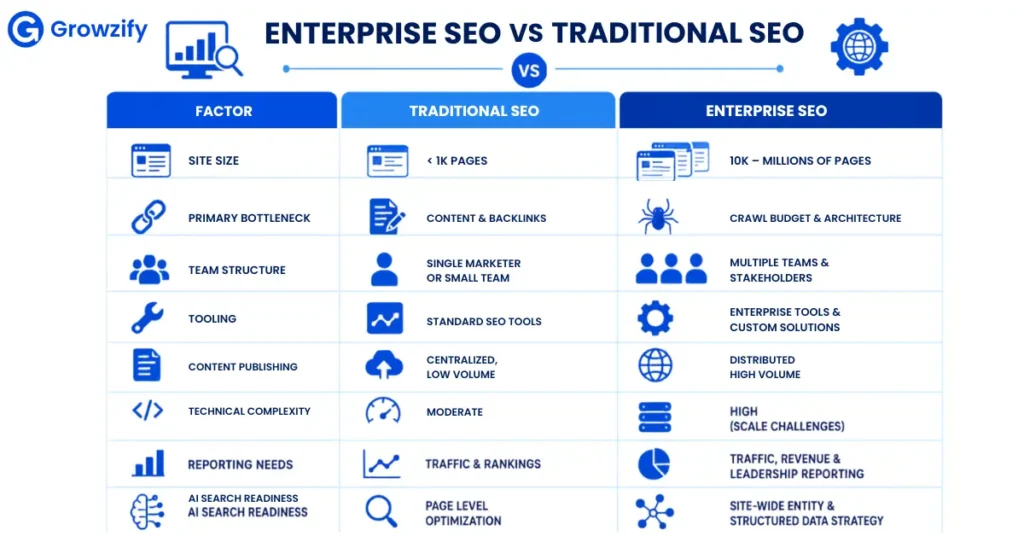
Traditional SEO tips optimize individual pages. Enterprise SEO tips optimize the system those pages live in, which is why the same tactic can produce very different results depending on site size.
Part 2: Tips That Win Visibility in AI Search (AEO and GEO)
Tip 1: Structure content around entities, not just keywords.AI systems like Google AI Overviews, ChatGPT, and Gemini match meaning and entities, not just exact phrases. Make sure your brand, products, and areas of expertise are clearly and consistently represented across your site so they read as recognizable entities.
Tip 2: Write standalone answers AI systems can lift directly.Every major section should answer a genuine question completely on its own, without requiring the reader to piece together context from other paragraphs. Short, direct definitions get cited more often than long, winding explanations.
Tip 3: Add schema markup at scale, not just on a few pages.FAQPage, HowTo, and Organization schema help both traditional search engines and AI systems understand page content accurately. At enterprise scale, this needs to be built into templates so it applies automatically across thousands of pages, not added manually one page at a time.
Tip 4: Use tables and comparisons for anything AI systems might extract.Structured formats like tables are easier for both search engines and LLMs to parse and cite accurately than dense paragraphs covering the same information.
Tip 5: Keep definitions crisp and citation-ready.When you introduce a concept, define it plainly in one or two sentences before expanding on it. This is exactly the kind of content AI Overviews tend to pull from directly.
Key takeaway:Winning traditional rankings and winning AI search visibility are not separate efforts anymore. The same well-structured, entity-rich content tends to perform well in both, as long as it is built for extraction, not just readability.
Common Challenges and How Enterprise SEO Solves Them
Challenge | Why It Happens | How Enterprise SEO Fixes It |
Crawl budget waste | Thousands of low-value, duplicate, or parameterized URLs eat crawl budget on large sites | Log file analysis, refined robots.txt rules, and strategic use of canonical tags and noindex |
Content cannibalization | Multiple teams unknowingly target the same keywords | A centralized keyword governance system and a shared content calendar across business units |
Slow implementation cycles | Dev teams deprioritize SEO fixes against feature work | Bundling SEO requirements into existing dev sprints and using pre-approved templates that skip case-by-case sign-off |
International duplicate content | Similar content across country sites dilutes rankings | Proper hreflang implementation and content that is localized, not just translated |
Difficulty measuring ROI | Stakeholders want revenue impact, not just rankings | Tying organic performance to pipeline and revenue data through proper analytics attribution |
What Does Enterprise SEO Cost?
Enterprise SEO services typically range from $10,000 to $50,000+ per month, depending on site size, number of markets, and scope of technical work required.
Pricing runs higher than traditional SEO retainers because engagements involve dedicated technical specialists, custom tooling, ongoing collaboration with dev and content teams, and strategy across multiple markets.
Some agencies offer project-based pricing for one-time technical audits or migrations, separate from ongoing retainer work.
In-House Team vs. Enterprise SEO Agency
Choosing between building an in-house SEO team and partnering with anenterprise SEO agencydepends on your business goals, available resources, and growth plans.
While an internal team offers deep organizational knowledge, an enterprise SEO agency provides specialized expertise, advanced tools, and the ability to scale quickly.
In-House Team
- Slower to get started due to hiring and onboarding.
- Strong understanding of the company’s goals and processes.
- Fixed salary and operational costs.
- Expertise depends on the skills of the internal team.
- Best suited for organizations with mature SEO programs and the budget to maintain a dedicated team.
Enterprise SEO Agency
- Faster implementation with experienced specialists and established workflows.
- Institutional knowledge grows over time through ongoing collaboration.
- Flexible and scalable retainer-based pricing.
- Access to technical SEO, international SEO, content strategy, and analytics experts.
- Ideal for businesses that need to scale quickly or fill specialized skill gaps without expanding their internal team.
Many enterprises adopt a hybrid approach, with an in-house SEO lead driving strategy and an enterprise SEO agency handling technical execution and specialized projects.
If your team is already focused on day-to-day SEO, managing enterprise-level technical challenges usually requires a partner who has done this specific kind of work before.
Mistakes to Avoid
- Applying traditional SEO tips at enterprise scale without addressing crawl budget and governance first
- Letting multiple teams publish without shared keyword governance
- Ignoring crawl budget until indexation problems show up as traffic drops
- Skipping SEO review during site migrations or replatforms
- Optimizing only for traditional rankings while ignoring AI Overview and LLM search visibilit
Turn Enterprise SEO Tips into Sustainable Organic Growth
Enterprise SEO is no longer just about improving rankings in traditional search engines. It requires a scalable strategy that combines technical excellence, high-quality content, strong governance, and AI search readiness.
By applying the right enterprise SEO tips, businesses can improve crawl efficiency, strengthen site architecture, eliminate content gaps, and increase visibility across Google Search, Google AI Overviews, ChatGPT, Gemini, Perplexity, and other AI-powered search platforms.
The most successful enterprise websites treat SEO as an ongoing business strategy rather than a one-time project. Regular technical audits, data-driven decisions, and continuous optimization ensure your website keeps pace with evolving search algorithms and user expectations.
When you are not sure where to begin, begin with a crawl budget. Every other tip here, traditional or AI-focused, depends on a site that search engines and AI systems can actually crawl and index properly. At Growzify, this is the first thing we check with every new enterprise client before any content work begins.
Frequently Asked Questions
What are the best enterprise SEO tips for large websites?
The highest-impact tips are fixing crawl budget waste first, setting up SEO governance across every team that publishes, and building templates that bake in SEO best practices automatically. Most large sites see faster results from fixing the technical foundation than from adding more content.
How do I get my content to show up in Google AI Overviews?
Structure content around clear entities, answer questions directly in one or two sentences before expanding, and use tables or lists for anything comparison-based. Google’s AI Overviews tend to pull from content that answers a question completely on its own, without extra context needed.
Do the same SEO tips work for ranking in ChatGPT, Gemini, and traditional Google search?
Largely yes. Well-structured, clearly defined, entity-rich content performs well across both traditional rankings and AI-generated answers, since both systems reward clarity and content that can be extracted without ambiguity.
How is SEO changing because of AI search?
SEO is expanding beyond ranking in ten blue links to include visibility inside AI-generated answers. This means content increasingly needs to be structured for citation, with direct definitions, clean formatting, and schema markup, alongside traditional ranking factors like backlinks and page quality.
How many pages does a website need before it counts as enterprise-level?
There is no fixed number, but most sites move into enterprise SEO territory once they cross a few thousand indexable pages, publish across multiple teams or regions, or start seeing a growing gap between discovered and indexed pages in Google Search Console.
What is the single most important enterprise SEO tip to start with?
Fixing crawl budget waste. A site that is not being crawled and indexed efficiently cannot benefit from any other SEO tip, whether it is aimed at traditional rankings or AI search visibility.
How do you fix crawl budget issues on a large website?
Run a log file analysis using a tool like Botify, OnCrawl, or Screaming Frog to see how crawlers are actually spending their time, then clean up low-value and duplicate URLs with refined robots.txt rules, canonical tags, and noindex where appropriate.
Why is my website not showing up in AI search results even though it ranks on Google?
This usually happens when content is written for readability but not for extraction. AI systems favour content with direct answers, clear entity references, and structured data like FAQ Page or How To schema, which many sites that rank well traditionally still have not implemented.

Chitranshu SharmaA growth strategist, digital marketing consultant, and the founder of Growzify, a performance-driven agency helping brands dominate search, shape perception, and build sustainable online visibility. With 8+ years of hands-on experience in Enterprise SEO, Online Reputation Management (ORM), and AI-led traffic generation, Chitranshu has helped startups, public figures, SaaS companies, and cannabis brands outrank competitors — ethically and at scale.
Explore More Articles
How to Find and Compare Local SEO Outsourcing Providers
How to Find and Compare Local SEO Outsourcing Providers Finding a local SEO outsourcing provider...
October 13, 2026Outsourcing
Inside a White Label SEO Campaign: How the Work Gets Done
Inside a White Label SEO Campaign: How the Work Gets Done Clients see a single...
October 13, 2026White Label
How to Vet an SEO Outsourcing Provider Before You Sign a Contract
How to Vet an SEO Outsourcing Provider Before You Sign a Contract A polished proposal...
October 9, 2026Outsourcing
Multilingual SEO Best Practices: Optimize Your Multi-Language Website
Multilingual SEO Best Practices: Optimize Your Multi-Language Website Translating a page and localizing it for...
October 7, 2026SEO
What Makes In-House Enterprise SEO Work Different Day-to-Day?
What Makes In-House Enterprise SEO Work Different Day-to-Day? On a small site, deciding to fix...
October 7, 2026Enterprise
How Core Algorithm Updates Impact Large Sites Differently Than Small Ones
How Core Algorithm Updates Impact Large Sites Differently Than Small Ones A large enterprise site...
October 7, 2026Enterprise
When Should You Outsource SEO? 11 Signs It Makes Sense
When Should You Outsource SEO? 11 Signs It Makes Sense Outsourcing SEO does not necessarily...
September 26, 2026Outsourcing