


Enterprise SEO Strategy: How to Scale Organic Growth
A well-planned enterprise SEO strategy combines technical excellence, scalable content, automation, and performance analysis to increase organic visibility, strengthen search authority, and support sustainable long-term business growth.

Written byChitranshu Sharma
July 10, 2025
- Home
- Blog
- SEO
- Enterprise
- Enterprise SEO Strategy: How to Scale Organic Growth
Quick Nav
An Enterprise SEO strategy is a long-term approach to helping businesses increase organic visibility, attract qualified traffic, and drive measurable business growth. It combines technical SEO, scalable content, strategic keyword research, site architecture, AI-ready optimization, and performance tracking into one structured framework. Enterprise SEO strategy aligns every optimization effort with business goals such as lead generation, revenue growth, brand authority, and expansion into new markets. A well-executed strategy creates sustainable organic growth while keeping your business competitive in both traditional search and AI-powered search experiences.
In today’s digital landscape, earning organic visibility for the enterprise has become far more challenging than simply ranking on Google’s first page. Many enterprise businesses are competing across search engines, AI Overviews, and AI-powered assistants. Along with managing thousands of web pages, multiple teams, and ever-changing customer expectations.
A single technical issue, fragmented content strategy, or poor website structure can impact thousands of pages and significantly reduce organic traffic. That’s why leading enterprises no longer view SEO as just another marketing tactic. Instead, they treat enterprise SEO as a long-term business strategy that drives scalable growth, strengthens brand authority, and creates lasting competitive advantages in an increasingly digital and AI-driven marketplace.
Let’s break down the proven frameworks, best practices, and actionable strategies. Progress towards a successfulenterprise SEO strategy helps drive productive business outcomes.
What Is an Enterprise SEO Strategy?
Anenterprise SEO strategyis a scalable framework that aligns technical SEO, content, website architecture, keyword research, and business goals to drive long-term organic growth. As enterprise websites expand, managing thousands of pages, multiple teams, and global markets becomes increasingly complex. Even a minor technical issue can impact search performance at scale.
That’s why enterprise SEO strategy focuses on building efficient systems, cross-team collaboration, and continuous optimization. Thus helping businesses increase qualified traffic, strengthen digital authority, and improve visibility across Google Search, AI Overviews, and AI-powered search experiences.
Whether you’re expanding into new markets, launching products, or strengthening your digital presence. Having a well-defined enterprise SEO strategy helps you scale organic growth, build topical authority, and stay competitive in the AI search landscape.
Enterprise SEO Strategy Is a Blueprint for Sustainable Growth
The search landscape is more competitive than ever. Customers no longer rely solely on Google’s traditional search results to discover brands or make purchasing decisions. Today, they explore Google AI Overviews, AI-powered search assistants, review platforms, industry publications, social communities, and compare multiple sources before making a decision.
As customer search journeys become more dynamic and non-linear, the path to conversion is longer and influenced by several digital touchpoints. For enterprise organizations, this shift presents opportunities and challenges.
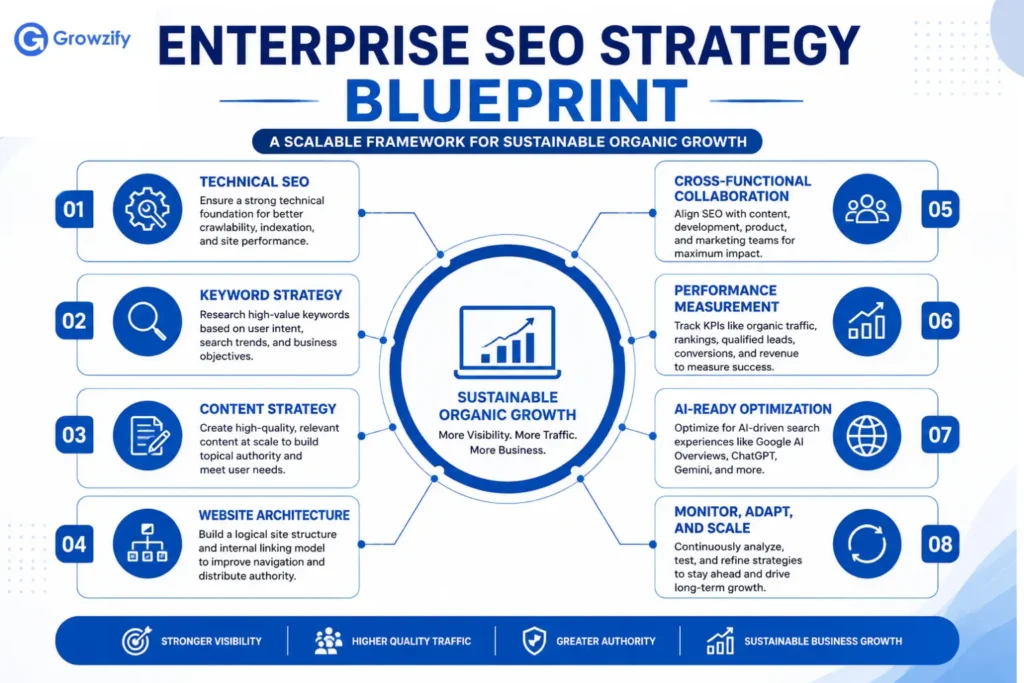
Businesses that adapt with a scalable enterprise SEO strategy can improve visibility, build trust, and engage customers wherever they search for information. That’s why enterprise SEO strategy has become a core business initiative rather than simply a marketing activity. A successful enterprise SEO strategy blueprint is built around
1. Build a Strong Technical SEO Foundation
Technical SEO ensures search engines can crawl, index, and understand thousands of pages efficiently. Improve site speed, Core Web Vitals, structured data, XML sitemaps, canonical tags, and fix crawl errors to maintain a healthy website.
Example:
An ecommerce brand with50,000+ product pagesfixes duplicate URLs, improves page speed from 4.5 seconds to 1.8 seconds, and submits optimized XML sitemaps, helping Google crawl new products much faster.
2. Conduct Intent-Driven Keyword Research
Instead of targeting only high-volume keywords, identify keywords that match different stages of the buyer’s journey, including informational, commercial, and transactional intent.
Example: Rather than creating a single page for “SaaS SEO,” develop supporting content such as SaaS Content Marketing, Technical SEO for SaaS, SaaS Link Building, Product-Led SEO, and SaaS SEO Metrics to capture multiple search intents.
3. Develop a Scalable Content Strategy
Create pillar pages supported by topic clusters that answer related questions and build topical authority across your niche.
Example: A pillar page on Enterprise SEO can internally link to Enterprise Technical SEO, Keyword Research, Link Building, AI SEO Strategy, SEO Reporting, and Case Studies, creating a connected content ecosystem that strengthens topical authority and helps search engines better understand your expertise..
4. Optimize Site Architecture and Internal Linking
Organize pages into logical categories and connect related content using internal links so both users and search engines can navigate easily.
Example:
A SaaS company organizes its website like: Solutions – Enterprise SEO – Technical SEO – Case Studies – Pricing – FAQs
Every supporting page links back to the main Enterprise SEO page, strengthening topical authority.
5. Align SEO Across Teams
Enterprise SEO isn’t only the SEO team’s responsibility. Developers, designers, content writers, product managers, and marketers all contribute to successful implementation.
Example:
The SEO team identifies missing schema markup, developers implement the changes, designers improve page experience, and content writers update the copy—all working toward improving organic visibility.
6. Measure Performance with Business KPIs
Track business outcomes instead of focusing only on rankings. Measure organic traffic, qualified leads, conversions, revenue, customer acquisition cost, and ROI.
Example:
Rather than celebrating a jump from Position 8 to Position 3, an enterprise tracks whether SEO generated 500 demo requests and $250,000 in pipeline revenue.
7. Optimize for AI Search and Answer Engines
Structure content so AI platforms can easily understand and reference it. Use semantic SEO, FAQs, schema markup, entity optimization, and concise answers.
Example:
A legal firm’s guide answers “What is Enterprise SEO?” in the first paragraph, includes FAQs, uses Article and FAQ schema, and explains related concepts, increasing its chances of appearing in Google AI Overviews and AI-generated search results.
8. Continuously Monitor, Improve, and Scale
Enterprise SEO is an ongoing process. Regularly audit technical issues, refresh outdated content, monitor competitors, and adapt to search algorithm changes.
Example:
Every quarter, a multinational company reviews its top-performing blogs, updates statistics, adds new AI SEO trends, improves internal linking, and expands content to maintain rankings and increase organic traffic year after year.
Together, these elements create a scalable SEO framework that drives sustainable organic growth and long-term business success. A successful strategy creates a scalable framework that connects technical excellence, authoritative content, automation, and business goals to drive long-term organic growth.
Why Enterprise SEO Strategy Matters
For enterprises managing large-scale websites and expanding digital operations, having a structuredEnterprise SEO strategyis about much more than improving search rankings. It provides a clear roadmap for increasing online visibility, strengthening brand authority, and driving sustainable organic growth in highly competitive markets.
A well-defined Enterprise SEO strategy aligns every optimization effort with broader business goals. Whether it’s generating qualified leads, reducing customer acquisition costs, expanding into new markets, or improving the overall customer experience. Rather than reacting to search algorithm updates or competitor activity, enterprise organizations take a proactive approach to building long-term search visibility and competitive advantage.
Here are the key reasons why enterprise businesses invest in an enterprise SEO strategy.
Managing Large-Scale Websites
Enterprise websites often contain thousands of pages spread across product catalogs and service pages. The documentation, knowledge bases, regional websites, resource centers, blogs, and landing pages. As the business grows, managing these assets manually becomes difficult.
Without a structured Enterprise SEO strategy, maintaining crawlability, internal linking, content consistency, and indexation becomes a major challenge. A standardized SEO framework ensures every section of the website contributes to organic growth. While remaining easy for users and search engines to navigate.
Aligning SEO With Business Goals
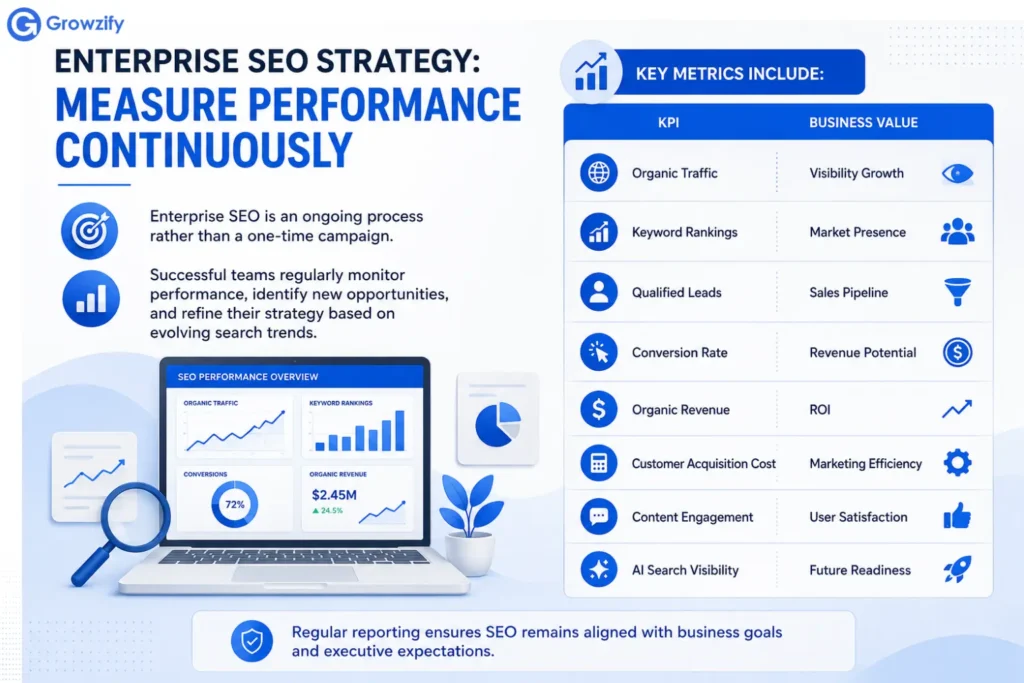
A successful Enterprise SEO strategy is measured by more than just keyword rankings. Its success can be evaluated through key business metrics such as organic traffic, qualified lead generation, customer acquisition, revenue growth, market expansion, brand visibility, and overall return on SEO investment. Tracking these KPIs ensures that every SEO initiative contributes directly to long-term business growth rather than simply improving search positions.
By aligning SEO with measurable KPIs, organizations can clearly demonstrate business impact rather than simply reporting traffic increases. This transforms SEO from a marketing activity into a long-term business growth strategy that contributes directly to company success.
Supporting Global Expansion
As enterprises expand into multiple countries and regions, they need a structured enterprise SEO strategy. This that supports different languages, customer segments, and regional search behavior. Simply translating content isn’t enough to achieve international visibility.
A structured Enterprise SEO strategy helps businesses build multilingual websites, optimize specific landing pages, implement international SEO best practices, and maintain consistent brand messaging across every market. This allows companies to grow globally while improving visibility in local search results.
Building Topical Authority
Search engines now reward websites that demonstrate deep expertise across an entire subject instead of publishing isolated articles around individual keywords. Building topical authority has become one of the strongest signals of trust and relevance.
Enterprise SEO focuses on creating pillar pages supported by interconnected topic clusters that answer customer questions throughout the buying journey. This improves internal linking, strengthens semantic relevance, and increases the likelihood of ranking for a broader range of competitive search queries.
Preparing for AI-Powered Search
Search is evolving rapidly with AI Overviews and other AI-powered search experiences changing how users discover information. Businesses now need content that is optimized for search engines and is also easy for AI systems to understand and reference.
A modern Enterprise SEO strategy combines traditional SEO with AI-ready optimization by creating well-structured, trustworthy, semantically rich content. Using clear headings, concise answers, FAQs, structured data, and topical authority helps improve visibility across both traditional search results and AI-generated responses.
An effective enterprise SEO strategy provides more than a roadmap for improving rankings. It creates a scalable framework that aligns technical SEO, content, and business objectives to drive sustainable organic growth. By investing in a long-term strategy, enterprises can strengthen their competitive position, adapt to changing search trends, and build lasting visibility across both traditional search engines and AI-powered discovery platforms.
How to Measure the Success of Your Enterprise SEO Strategy
Measuring the success of an Enterprise SEO strategy goes far beyond tracking keyword rankings. It involves monitoring a combination of performance metrics that align with your business goals. Whether your objective is increasing organic traffic, qualified leads, conversion rates, brand visibility, or revenue. So every SEO effort should support measurable business outcomes.
A well-structured Enterprise SEO strategy provides a framework for achieving sustainable growth while continuously improving performance. By tracking the right KPIs, businesses can evaluate ROI and opportunities. Optimize their SEO initiatives, and ensure they remain aligned with long-term business objectives. Let’s explore the key performance metrics that help measure the success of an Enterprise SEO strategy and its impact on business growth.
Monitor Organic Traffic Growth
Organic traffic is one of the clearest indicators of SEO success. A steady increase in visitors from search engines shows that your content is becoming more visible and attracting the right audience.
Track Keyword Visibility Across Your Core Topics
Instead of monitoring a handful of keywords, measure how your website performs across your entire topic cluster. Strong keyword visibility reflects growing authority within your industry.
Measure Qualified Leads Generated Through Organic Search
High traffic has little value if it doesn’t generate business. Track how many visitors become qualified leads by submitting forms, requesting demos, or contacting your sales team.
Evaluate Conversion Rates
Enterprise SEO should help visitors take meaningful actions. Monitor how effectively organic traffic converts into inquiries, sign-ups, purchases, or other business goals.
Measure Organic Revenue and ROI
One of the strongest indicators of SEO performance is the revenue generated through organic search. Comparing SEO investment with business returns helps demonstrate long-term value.
Monitor Customer Acquisition Cost (CAC)
As your organic visibility grows, your dependence on paid advertising often decreases. Measuring CAC helps determine how SEO contributes to more cost-effective customer acquisition.
Track AI Search Visibility
With Google AI Overviews, ChatGPT, Gemini, and other AI-powered search platforms becoming more influential, monitor how often your content is cited or surfaced in AI-generated answers.
Analyze User Engagement Signals
Metrics such as average engagement time, scroll depth, pages per session, and bounce rate reveal whether users find your content useful. Strong engagement signals often indicate high-quality content that satisfies search intent and supports long-term search performance.
Tracking these KPIs provides a complete picture of your Enterprise SEO performance. Instead of focusing only on rankings, measure how SEO impacts traffic, leads, revenue, customer acquisition, and AI search visibility. A data-driven approach ensures your SEO strategy continues delivering measurable business value while supporting sustainable long-term growth.
What to Look for in an Enterprise SEO Service?
Choosing the right Enterprise SEO servicesmeans selecting a platform or partner that can support long-term business growth and improve keyword rankings. As websites expand, SEO becomes more complex, requiring scalable processes, technical expertise, and data-driven decision-making. The ideal solution should simplify SEO management while delivering measurable business outcomes.
- Scalability:It should efficiently manage thousands of pages, multiple locations, and product categories. Have experience with international websites without affecting performance or workflow efficiency.
- Technical SEO Expertise:Look for features such as crawl analysis, index management, Core Web Vitals optimization, structured data implementation, site architecture improvements, and continuous technical monitoring to maintain strong search visibility.
- Business-Focused Reporting:Beyond rankings, the solution should provide insights into organic traffic, qualified leads, conversions, revenue. AI search visibility, and ROI through easy-to-understand dashboards.
- AI-Ready Optimization:Ensure it supports semantic SEO, Answer Engine Optimization (AEO), structured content, entity optimization, and Google AI Overviews to stay competitive as search evolves.
Areliable Enterprise SEO solutionshould scale with your business, adapt to changing search technologies, improve operational efficiency, and drive sustainable organic growth while supporting long-term digital success.
Scale Smarter with a Winning Enterprise SEO Strategy
Scaling an enterprise involves expanding products, services, or markets and opening ways to new business opportunities. It requires a well-defined Enterprise SEO strategy that supports long-term business growth.
At Growzify, we help enterprises build and execute customized SEO strategies that align with their business objectives. Our experienced team focuses on creating scalable solutions, strengthening online visibility, increasing qualified leads, and unlocking new growth opportunities in competitive markets. Choosing the right Enterprise SEO partner is a critical business decision, so it’s important toreview case studies, industry experience,and successful client outcomes before making your decision.
Businesses that achieve lasting success treat Enterprise SEO as a strategic business initiative. As search continues to evolve with AI-powered experiences, organizations that invest in a scalable enterprise SEO strategy today will be better positioned. Adapt to changing search behavior and drive sustainable organic growth for years to come. Ready to scale smarter? Give your business the competitive advantage it deserves with a results-driven Enterprise SEO strategy.
Frequently Asked Questions
Is Enterprise SEO suitable for every business?
Enterprise SEO is best suited for organizations managing large websites, multiple locations, international markets, or thousands of web pages. Smaller businesses often benefit more from traditional SEO strategies until their digital presence reaches enterprise scale.
What are the biggest challenges businesses face when implementing Enterprise SEO?
Common challenges include managing large volumes of content, coordinating multiple teams, maintaining technical consistency, prioritizing SEO across departments, and adapting quickly to search engine and AI updates. A structured roadmap and better management help overcome these challenges efficiently.
Should businesses build an in-house Enterprise SEO team or hire an agency?
The right choice depends on your resources and goals. In-house teams provide greater control and product knowledge, while experienced Enterprise SEO agencies offer specialized expertise, scalable resources, proven processes, and access to advanced SEO tools.
How often should an Enterprise SEO strategy be reviewed?
Enterprise SEO should be reviewed continuously, with technical audits, content performance analysis, and KPI reporting conducted monthly or quarterly. Regular reviews help businesses identify new opportunities, respond to algorithm updates, and maintain consistent organic growth.

Chitranshu SharmaA growth strategist, digital marketing consultant, and the founder of Growzify, a performance-driven agency helping brands dominate search, shape perception, and build sustainable online visibility. With 8+ years of hands-on experience in Enterprise SEO, Online Reputation Management (ORM), and AI-led traffic generation, Chitranshu has helped startups, public figures, SaaS companies, and cannabis brands outrank competitors — ethically and at scale.
Explore More Articles
Managing Redirect Chains and Canonical Tags at Enterprise Scale
Managing Redirect Chains and Canonical Tags at Enterprise Scale A single redirect rule written five...
September 4, 2026Enterprise
How to Build a Technical SEO Monitoring Stack for Large Websites
How to Build a Technical SEO Monitoring Stack for Large Websites A technical SEO regression...
September 2, 2026Enterprise

Identifying and Fixing Thin Content Pages on Large Websites
Identifying and Fixing Thin Content Pages on Large Websites A page can be 2,000 words...
September 2, 2026Enterprise
How to Deploy and Maintain Structured Data and Rich Snippets Across a Website with Thousands of Pages
How to Deploy and Maintain Structured Data and Rich Snippets Across a Website with Thousands...
September 1, 2026Enterprise
Pre-Deployment Technical SEO Checklist for Large Enterprise Websites
Pre-Deployment Technical SEO Checklist for Large Enterprise Websites A single enterprise deployment can introduce a...
September 1, 2026Enterprise
How to Fix Core Web Vitals and Page Speed for an Enterprise Website
How to Fix Core Web Vitals and Page Speed for an Enterprise Website Enterprise Core...
August 31, 2026Enterprise
Robots.txt Best Practices for Complex, Large Enterprise Websites
Robots.txt Best Practices for Complex, Large Enterprise Websites A single overly broad robots.txt rule can...
August 27, 2026Enterprise